Coinbase запускает первые фьючерсы на несколько активов, связанные с Mag7 и крипто-ETF.

cryptonews.ruPublished on 2025-09-03Last updated on 2025-09-03

Coinbase выпускает смелый новый фьючерсный продукт, объединяющий элиту технологий с ведущими крипто-ETF, прокладывая путь к следующему многоактивному торговому фронтиру Уолл-стрит.

Coinbase представляет Mag7 + Crypto Equity Index Futures

Криптовалютная биржа Coinbase (Nasdaq: COIN) объявила 2 сентября, что 22 сентября она представит Mag7 + Crypto Equity Index Futures, первые контракты, котирующиеся в США, которые объединяют акции с фондовыми биржами криптовалют (ETF). Компания описала это предложение как шаг к удовлетворению институционального спроса на более широкие рыночные инструменты. Coinbase заявила:

Представляем Mag7 + Crypto Equity Index Futures: первые, предлагающие комбинированное воздействие как на традиционные акции, так и на крипто-ETF.

Бенчмарк, разработанный Marketvector, будет состоять из 10 равноценных компонентов. Включены «Великолепная семерка» технологических активов — Apple, Microsoft, Alphabet, Amazon, Nvidia, Meta и Tesla — вместе с собственными акциями Coinbase и двумя криптовалютными ETF, Ishares Bitcoin Trust (IBIT) ETF и Ishares Ethereum Trust (ETHA) ETF.

Coinbase подчеркнула свою стратегическую смену фокуса еще одним комментарием: “Мы диверсифицируем нашу платформу деривативов в США, выходя за рамки одноактивных предложений впервые, запуская новый продукт индекс акций, который предоставляет тематическое воздействие на широкий спектр инновационных и растущих активов.” Методология пересматривает веса ежеквартально для обеспечения баланса по индексу.
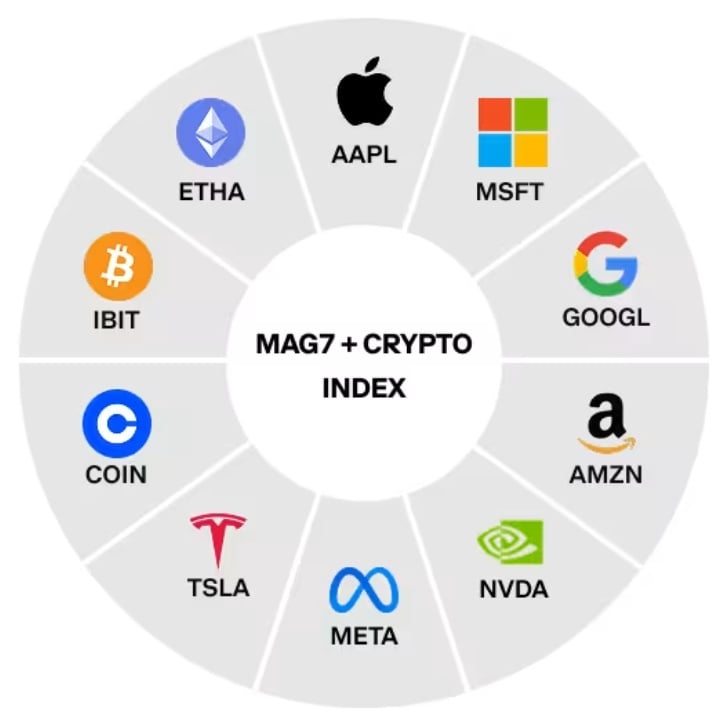
Mag7 + Crypto Equity Index Futures. Источник: Coinbase

Контракты будут ежемесячными и рассчитываются наличными, каждый из них оценивается в 1 доллар умноженный на уровень индекса, делая номинальный размер $3,000 при значении индекса $3,000. Компания позиционировала запуск как новую главу в разработке продукта:

Фьючерсы на индексы акций отмечают следующую эволюцию нашего продуктового набора и проложат путь к новой эре многоактивных деривативов, расширяя доступ, эффективность и возможности для инвесторов.

Хотя некоторые наблюдатели могут задаться вопросом о сложности объединения волатильных цифровых активов с технологическими акциями, сторонники подчеркивают этот шаг как доказательство того, что криптовалюты интегрируются в установленную финансовую экосистему.

Related Reads

Number of Active XRP Addresses Reaches Two-Month High Amid Worsening Market Sentiment

On August 14th, activity on the XRP Ledger surged to a two-month high, with 49,929 active addresses recorded in a 24-hour period. This spike occurred despite market sentiment towards XRP hitting a three-month low, as the token traded below $1, highlighting a sharp divergence between on-chain activity and retail investor mood. The data from Santiment shows that average daily active addresses had already risen to around 35,700 by August 12th, up from approximately 26,400 in July—a nearly 35% increase. However, the number of new addresses remained flat, suggesting the surge was driven by existing addresses becoming more active rather than an influx of new users. Analysts caution that while high address activity indicates increased network participation, it doesn't specify whether the activity stems from new investors, institutional moves, exchange transactions, or existing holders. Concurrently, the bearish sentiment, tracked from social platforms like X and Reddit, reflects crowd psychology rather than fundamental network health. The report notes that the XRP Ledger's validator-based consensus allows for such on-chain activity to grow independently of short-term price pessimism. Furthermore, broader ecosystem development, including Ripple's reported $550 million in investments since 2017 into grants and institutional infrastructure for tokenized assets, provides a long-term context separate from current price trends. The key question is whether the elevated address activity will be sustained beyond the single-day spike amidst ongoing negative sentiment, or if it represents only a temporary divergence.

cryptonews.ru3m ago

Number of Active XRP Addresses Reaches Two-Month High Amid Worsening Market Sentiment

cryptonews.ru3m ago

IPO Imminent, OpenAI Faces Major Personnel Upheaval

OpenAI, preparing for a potential IPO, is experiencing significant leadership turmoil. In mid-August 2026, longtime "GPU geek" Scott Gray quietly left, and within three days, Chief Operating Officer Brad Lightcap (8-year veteran) and Chief Revenue Officer Denise Dresser (8-month tenure) departed. This follows a broader exodus of at least 10 senior executives in 2026, including heads of product, safety, and ethics. Analysts view this as a strategic "surgery" to transform from a research lab into a sales-driven enterprise company before going public. Revenue now tilts toward enterprise clients, surpassing consumer income sooner than expected, with annualized revenue reaching $40 billion. The new CRO, Dali Rajic, is a veteran enterprise sales leader. Concurrently, OpenAI has disbanded independent safety teams like "Preparedness," which assessed catastrophic risks, integrating their functions into core research. Critics warn this removes dedicated "brakes" on AI development. The leadership vacuum raises questions about who is the clear second-in-command after former apps CEO Fidji Simo moved to an advisory role. Co-founder Greg Brockman appears to be consolidating power. As OpenAI races against rival Anthropic ($47B annualized revenue), it faces the dual challenge of commercial execution while managing the departure of foundational technical talent and ensuring responsible AI development remains a priority.

marsbit2h ago

IPO Imminent, OpenAI Faces Major Personnel Upheaval

marsbit2h ago

AI Can 'Have Moods Too'! New Research from USTC: Confusion and Anxiety Make AI Work Better

The article discusses research from the University of Science and Technology of China and Oxford, revealing that allowing AI to recognize and act upon simulated "internal emotions" can significantly improve its performance. The study demonstrates a coherent pairing between specific emotional states in AI agents and their subsequent skill choices. For instance, an agent feeling curious and desirous will search for products, while one feeling confused and tense will rephrase queries. This mirrors human decision-making influenced by emotions. Statistical validation showed a 76.5% semantic consistency in these pairings. Crucially, the research challenges the traditional view of AI errors as flaws to be eliminated. It found that "bad" emotions like confusion, tension, or frustration serve as useful metacognitive signals, indicating a mismatch between the current strategy and the environment. By responding to these signals, AI can proactively adjust before a failure occurs. This is particularly effective in complex tasks prone to failure. For example, in tasks like "heating an item" and "picking up two items," success rates surged from 9.6% to 56.9% and 4.4% to 31.3%, respectively, when using the emotion-driven skill selection method (EMOTION2SKILL). The AI's "nervous" state about a closed microwave, for instance, prompted it to check and open it first, preventing failure. The article also mentions related work from Tianjin University, which embeds emotional prediction into world models (Large Emotional World Model, LEWM), significantly improving prediction accuracy in human-centric environments. Removing emotional data was found to degrade performance even in unrelated logical reasoning tasks. These studies build on earlier findings, like those from Anthropic, that identifiable emotional representations exist within large language models (LLMs). The focus is shifting from philosophical debate about AI emotion to practically harnessing these internal states as functional signals to enhance AI robustness and capability.

marsbit2h ago

AI Can 'Have Moods Too'! New Research from USTC: Confusion and Anxiety Make AI Work Better

marsbit2h ago

Trading

Spot
活动图片