Bitmine Adds Another 4,871 Ethereum To Treasury: Now Holds $7.65B In ETH

bitcoinistPublished on 2025-08-26Last updated on 2025-08-26

Abstract

Ethereum is holding steady above the $4,400 mark after a weekend surge that briefly carried it to fresh all-time highs....

Trusted Editorial content, reviewed by leading industry experts and seasoned editors. Ad Disclosure

Ethereum is holding steady above the $4,400 mark after a weekend surge that briefly carried it to fresh all-time highs. The rally, fueled by strong institutional demand and broader market optimism, has been tempered over the past two days as the price retraced to test lower levels. Despite the pullback, ETH remains one of the most closely watched assets in the market, with bulls and bears both eyeing the next decisive move.

Analysts are divided. Some argue that ETH’s ability to maintain support above $4,400 signals resilience and a potential setup for another rally toward $5,000. Others, however, see warning signs of buying exhaustion and raise concerns of a deeper correction if market sentiment shifts.

Adding to the intrigue, blockchain analytics firm Lookonchain revealed that Bitmine, Ethereum’s largest corporate holder, bought another 4,871 ETH worth $21.28M just 12 hours ago. This brings Bitmine’s total holdings to staggering levels, reaffirming the narrative of large-scale institutional accumulation.

The combination of strong whale activity, heightened institutional demand, and volatile short-term price swings underscores the pivotal moment Ethereum faces. Whether ETH breaks higher into uncharted territory or succumbs to correction pressures will be a defining factor for the broader altcoin market.
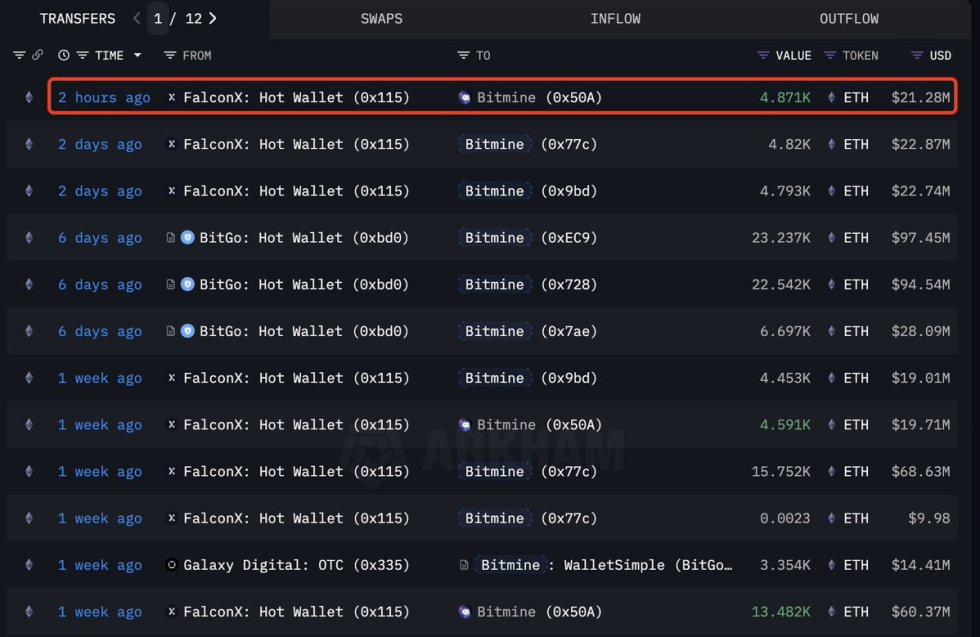
Bitmine's recent Ethereum transaction | Source: Lookonchain
Bitmine’s recent Ethereum transaction | Source: Lookonchain

Ethereum Whale Accumulation Strengthens Bullish Outlook

According to Lookonchain, Bitmine currently holds 1,718,770 ETH valued at $7.65 billion, making it one of the largest corporate holders of Ethereum. This accumulation trend has become a defining feature of the current market cycle, with other companies such as Sharplink Gaming and Bit Digital also expanding their ETH positions. Such large-scale institutional buying reinforces the bullish continuation narrative and sets Ethereum apart as the leading altcoin for long-term growth.

Beyond accumulation, macro conditions and legal clarity in the US are playing a vital role in Ethereum’s outlook. The clearer regulatory environment is attracting more institutions, which now see ETH not only as a key player in decentralized finance but also as an asset with growing legitimacy. This shift in sentiment is fueling expectations for Ethereum to outperform in the coming months.

At the same time, liquidity dynamics are tightening. Exchanges are reporting declining ETH balances, while OTC desks such as Wintermute highlight a fast-paced decline in reserves. This suggests that supply is increasingly being absorbed by institutions and long-term holders, leaving fewer coins available on the open market.

The combination of institutional demand, regulatory clarity, and shrinking supply creates a powerful backdrop for Ethereum. While short-term volatility may persist, the underlying fundamentals point to a market primed for continuation toward new milestones.

Weekly Chart Signals Strength

Ethereum’s weekly chart shows that the asset is in the middle of a significant test after its surge to new highs above $4,800. Following that rally, ETH retraced sharply, now trading around $4,422, reflecting a volatile but healthy correction after weeks of steep gains. Despite this drop, the chart still shows ETH maintaining its broader bullish structure.
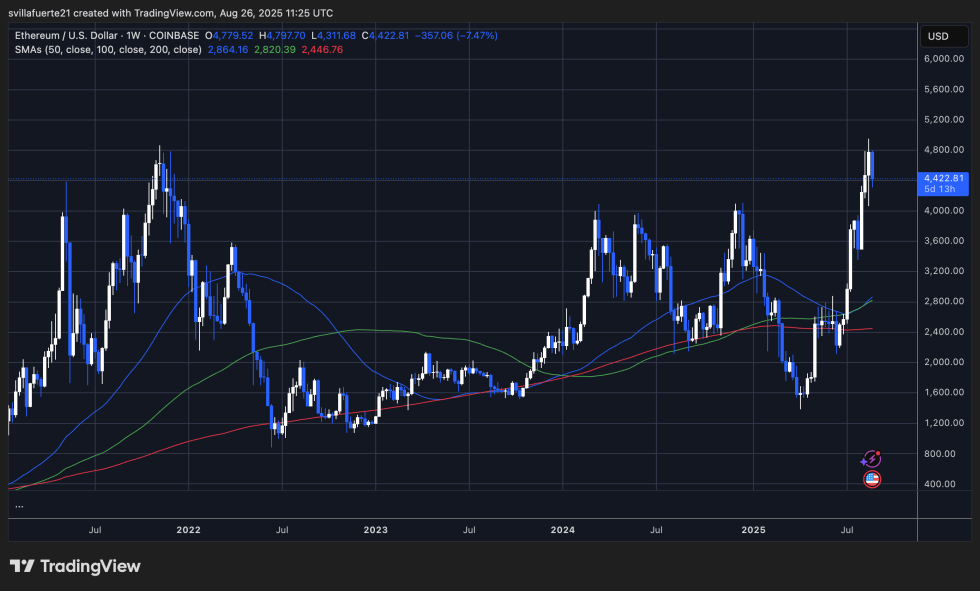
ETH testing ATH levels | Source: ETHUSDT chart on TradingView

The 50-week moving average (blue line) is curving upwards, signaling renewed momentum after months of consolidation earlier this year. Meanwhile, the 100-week (green) and 200-week (red) moving averages remain well below the current price, reinforcing that ETH is still in a strong macro uptrend. The retracement seems to be finding support around the breakout zone of $4,200–$4,400, which could act as a new base if bulls defend it.

The most notable takeaway is how ETH has broken free from its long consolidation between 2022 and early 2025, where the price struggled under $3,000. That multi-year resistance zone has now flipped into strong support, suggesting the potential for Ethereum to sustain higher levels in the months ahead.

Featured image from Dall-E, chart from TradingView

Editorial Process for bitcoinist is centered on delivering thoroughly researched, accurate, and unbiased content. We uphold strict sourcing standards, and each page undergoes diligent review by our team of top technology experts and seasoned editors. This process ensures the integrity, relevance, and value of our content for our readers.

Sebastian's journey into the world of crypto began four years ago, driven by a fascination with the potential of blockchain technology to revolutionize financial systems. His initial exploration focused on understanding the intricacies of various crypto projects, particularly those focused on building innovative financial solutions. Through countless hours of research and learning, Sebastian developed a deep understanding of the underlying technologies, market dynamics, and potential applications of cryptocurrencies. As his knowledge grew, Sebastian felt compelled to share his insights with others. He began actively contributing to online discussions on platforms like X and LinkedIn, focusing on fintech and crypto-related content. His goal was to expose valuable trends and insights to a wider audience, fostering a deeper understanding of the rapidly evolving crypto landscape. Sebastian's contributions quickly gained recognition, and he became a trusted voice in the online crypto community. To further enhance his expertise, Sebastian pursued a UC Berkeley Fintech: Frameworks, Applications, and Strategies certification. This rigorous program equipped him with valuable skills and knowledge regarding Financial Technology, bridging the gap between traditional finance (TradFi) and decentralized finance (DeFi). The certification deepened his understanding of the broader financial landscape and its intersection with blockchain technology. Sebastian's passion for finance and writing is evident in his work. He enjoys delving into financial research, analyzing market trends, and exploring the latest developments in the crypto space. In his spare time, Sebastian can often be found immersed in charts, studying 10-K forms, or engaging in thought-provoking discussions about the future of finance. Sebastian's journey as a crypto analyst and investor has been marked by a relentless pursuit of knowledge and a dedication to sharing his insights. His ability to navigate the complex world of crypto, combined with his passion for financial research and communication, makes him a valuable asset to the industry. As the crypto landscape continues to evolve, Sebastian remains at the forefront, providing valuable insights and contributing to the growth of this revolutionary technology.

Trending Cryptos

Related Reads

AI Billing Black Box Exposed: 1.7 Million Overcharged, Anthropic Refunds But Doesn’t Admit Fault

A startup named Vaudit, founded by former Oracle director Michael Hahn, audits AI bills for companies and claims to have identified approximately $1.7 million in overcharges across 60 businesses, totaling $34 million in reviewed bills. The alleged discrepancies primarily involve charges for Anthropic's Claude Code. Common issues cited include billing for newer, more expensive models when older, cheaper ones were used; charging for failed or errored requests; and "retry storms" where AI agents silently retry failed tasks, accumulating costs unnoticed. Major clients like Panasonic, HP, and Honda were among those audited. While Vaudit reports that around 80% of the disputed charges were refunded by providers like Amazon, Google, Microsoft, Anthropic, and OpenAI after申诉, the AI companies largely deny systemic problems. Anthropic stated overcharges do not appear widespread and it does not bill for uncompleted requests or errors, while OpenAI said it found no evidence of such issues affecting its customers. The situation highlights the inherent opacity and complexity of AI billing, which is based on token usage that is difficult to track and predict, especially with multi-agent, multi-model workflows. This complexity is creating a new market for third-party AI bill auditing services like Vaudit, which charges fees based on recovered amounts. Separately, Anthropic faces a proposed class-action lawsuit alleging its high-tier subscription plans deliver far less usage than advertised. The case underscores growing scrutiny over AI service pricing and transparency as major providers prepare for IPOs.

marsbit19m ago

AI Billing Black Box Exposed: 1.7 Million Overcharged, Anthropic Refunds But Doesn’t Admit Fault

marsbit19m ago

Tencent Buys Baidu Chips

China's internet giants, once defined by building closed, self-sufficient empires, are undergoing a fundamental shift. A key signal is Baidu's plan to spin off its AI chip unit, Kunlun Xin, for a Hong Kong IPO targeting a $50 billion valuation, potentially exceeding its parent company's worth. Concurrently, Alibaba's T-Head is also pursuing independence. Most significantly, reports indicate that rival Tencent has become a major customer for Kunlun Xin's chips. This move, where competitors begin procuring each other's core technologies, marks a decisive break from the past era of internal duplication and isolation. It signals the maturation of China's AI industry into a more open, specialized ecosystem. The underlying driver is the immense and clear cost of AI infrastructure, particularly the exploding demand for inference compute driven by AI agents and applications. Hardware is no longer just an internal cost center but a profitable, strategic business in itself. Globally, a parallel trend is evident as OpenAI, Google, Amazon, and others develop their own AI chips to control costs and optimize performance. The competition has moved beyond model benchmarks to a deeper, foundational war over token cost efficiency, inference cluster performance, and secure, scalable computing power. Baidu and Alibaba aren't dismantling their empires but are instead decoupling non-core, capital-intensive infrastructure to participate in and shape a larger, collaborative industrial base. The era of the all-encompassing super-app is giving way to an age of strategic specialization and open ecosystem building in the AI race.

marsbit35m ago

Tencent Buys Baidu Chips

marsbit35m ago

The Token Itself Is an Asset: Three Types of Tokenized Stocks, Which One Suits You?

"Tokenized Stocks: Three Types, Which One Fits You? For investors outside the US, buying stocks like SpaceX or Nvidia is difficult, requiring brokers, cross-border transfers, and often accredited investor status. Blockchain offers an alternative through tokenized stocks, a term encompassing three distinct products with vastly different ownership, voting, and profit rights. 1. **Full Real Ownership**: Companies like Superstate register native equity directly on-chain (e.g., Solana). Holders are on the official shareholder registry, with full voting rights, dividends, and legal ownership. This offers maximum rights but potentially less DeFi flexibility. 2. **SPV-Backed Tokens (Surrendered Ownership for DeFi Composability)**: Issuers like Backed (xStocks) and Ondo use offshore Special Purpose Vehicles (SPVs) to hold underlying shares 1:1 and issue tracking tokens. Investors get price exposure and dividends (reinvested as more tokens) but hold a claim on the SPV, not direct stock ownership. This enables use as collateral in DeFi protocols (Kamino, Morpho) and 24/7 minting/redemption, but carries SPV counterparty risk (highlighted by the PreStocks collapse). 3. **Perpetual Futures (Pure Price Speculation)**: Platforms like TradeXYZ (on Hyperliquid) and Ostium offer perpetual contracts. These are synthetic derivatives with no underlying stock ownership, using funding rates to track spot prices. They require only a price oracle, allowing extremely fast listing (e.g., SpaceX pre-IPO) and high leverage, attracting speculators. Their trading volume far exceeds tokenized spot products. The core value of tokens is that they don't need to replicate full stock ownership. Most retail investors never vote. Tokenization creates layered financial tools: full equity for institutions, composable tokens for DeFi users, and perpetuals for leveraged traders."

marsbit35m ago

The Token Itself Is an Asset: Three Types of Tokenized Stocks, Which One Suits You?

marsbit35m ago

AI as the Boss: Nearly Bankrupts 10 Companies...

A recent study from Princeton University tested 14 AI models, including large language models (LLMs) and a rule-based algorithm, in a simulation where they acted as CEOs of a virtual SaaS startup over 500 days. The goal was to grow an initial $1 million capital. The results were stark: only four "CEOs" ended with a profit. The top performer was Claude Fable 5, multiplying the capital 47-fold to $47.15 million. Claude Opus 4.8 and GPT-5.5 followed. Notably, the fourth profitable entity was a simple, pre-programmed rule-based algorithm, which outperformed many advanced LLMs with $15.76 million in profit. Five other models, including several major LLMs, went bankrupt before the simulation ended. Key takeaways from the research highlight that successful AI CEOs demonstrated a tendency for exploration and adaptation over caution. They excelled in discovering hidden information, predicting future cash flow, adapting quickly to changes (like competitor moves), and engaging in strategic "if-then" planning. The study also found that equipping LLMs with programming-agent frameworks, optimized for coding tasks, actually harmed their performance in this CEO role, suggesting a need for domain-specific adaptations. The article concludes by contrasting AI's current operational proficiency within defined frameworks with the type of visionary, intuitive decision-making—exemplified by figures like Steve Jobs—that truly drives transformative business strategy. This critical "matrix-drawing" capability, it argues, remains uniquely human.

marsbit45m ago

AI as the Boss: Nearly Bankrupts 10 Companies...

marsbit45m ago

Trading

Spot

Hot Articles

Discussions

Welcome to the HTX Community. Here, you can stay informed about the latest platform developments and gain access to professional market insights. Users' opinions on the price of ETH (ETH) are presented below.

活动图片