Solana’s Rally Gains Traction – Why Its Price Could Surge To New ATHs

bitcoinistPublished on 2025-08-25Last updated on 2025-08-25

Abstract

With the market turning increasingly bullish, Solana continues to demonstrate resilience and upside momentum, holding strongly above the $200 price...

Trusted Editorial content, reviewed by leading industry experts and seasoned editors. Ad Disclosure

With the market turning increasingly bullish, Solana continues to demonstrate resilience and upside momentum, holding strongly above the $200 price mark. As SOL’s price gains traction, key indicators are beginning to signal the potential for further upward movement in the short and long term.

An Impending Move For Solana To $275 And $300

Solana has reclaimed above the $200 price level once again following the recent market resurgence. Meanwhile, many crypto analysts believe that this could be the time for the leading altcoin to enter a parabolic phase and hit new all-time highs.

Related Reading: Solana Is Not Dead? This Upper Boundary Retest Could Set The Stage For $268

In an X (formerly Twitter) post, Darkfost, an author and on-chain expert at CryptoQuant, has outlined key indicators that point to a bigger move on the horizon. Given that indicators are turning strongly bullish, Solana’s current course puts it in an excellent position to regain market dominance in the upcoming months.

According to the on-chain expert, SOL continues to rise in silence as investors appear to be concentrating on Ethereum. Even though ETH has surged significantly to a new all-time high, Darkfost highlights that SOL might be gearing up for a similar upswing to a new all-time high in the near future.

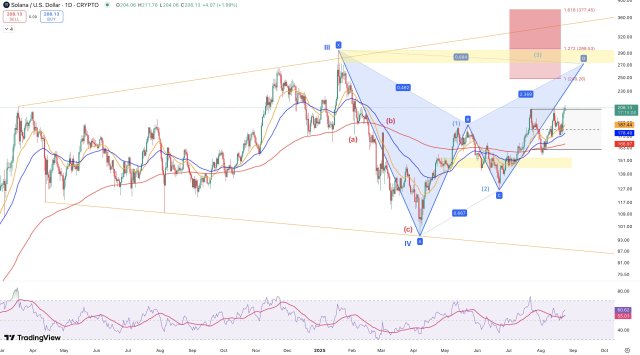
After examining Solana’s chart in the 1-day time frame, the expert revealed that the 21- and 50-day Exponential Moving Averages (EMAs) remain upward-sloping, acting as support above the 200 EMA, which is beginning to curve upward. This positioning indicates resilience and growing strength for an upsurge.
Solana
SOL upward strength building for major rally | Source: SOL chart from Darkfost on X

Darkfost also highlighted a positive development in the Relative Strength Index (RSI) indicator. Presently, the RSI indicator is holding strongly above the 50% level, suggesting a positive momentum.

The chart is showing that SOL has formed two key formations, such as the Broadening Megaphone structure and the Harmonic BAT pattern. While the upper limit of the megaphone structure sits around $300, the harmonic BAT pattern with a strong daily close above the neckline is targeting the $275 zone.

As the price quietly increases, a short-term range is being broken. Darkfost noted that a verified daily close above $210 should signal the start of the next bullish wave (3), with a minimum objective (1-1.27) between $250 and $300. This aligns with both the BAT target and a strong liquidity zone starting at $275.

Indicators Signaling Significant Upside Potential 

This newfound strength of SOL following the market resurgence goes beyond the 1-day time frame. In the larger outlook, particularly the 1-week time frame, Darkfost has also highlighted the growing momentum in the ongoing Solana trend. 

Related Reading: Ethereum Vs. Solana: Arthur Hayes Picks His Winner For This Cycle

Unlike the 1-day chart, the altcoin has reclaimed the 21 EMA and 50 EMA, both of which are rising after challenging the 200 EMA. The weekly RSI is experiencing a persistent upward move above the 50% level, with notable upward potential before moving into overheated territory. Furthermore, this week’s weekly close also confirms the emergence of the harmonic BAT pattern. 

Combining these indicators, SOL appears to still have a lot of room for growth in the near and distant future, while it is still lagging behind the second-largest crypto asset, Ethereum.

Solana
SOL trading at $200 on the 1D chart | Source: SOLUSDT on Tradingview.com
Featured image from iStock, chart from Tradingview.com
Editorial Process for bitcoinist is centered on delivering thoroughly researched, accurate, and unbiased content. We uphold strict sourcing standards, and each page undergoes diligent review by our team of top technology experts and seasoned editors. This process ensures the integrity, relevance, and value of our content for our readers.

Godspower Owie is my name, and I work for the news platforms NewsBTC and Bitcoinist. I sometimes like to think of myself as an explorer since I enjoy exploring new places, learning new things, especially valuable ones, and meeting new people who have an impact on my life, no matter how small. I value my family, friends, career, and time. Really, those are most likely the most significant aspects of every person's existence. Not illusions, but dreams are what I pursue.

Trending Cryptos

Related Reads

In Such a Crowded Cross-border Payment Track, Where Does the Next Stop Lie in the Future?

The crowded cross-border payments industry faces a paradox: intense competition above water with financing and narratives, while beneath, price wars and shrinking margins in basic PSP services are common. The path forward lies not in simple "cross-border" solutions but in deep **localization**. Success requires mastering the fragmented and tightening regulations of fiat currencies in each market—the "last mile" of compliance, banking, and settlement. Many Chinese PSPs have succeeded by following Chinese merchants overseas but have not deeply penetrated mainstream local merchant ecosystems abroad. Their strong product capabilities need to be applied to new, complex markets. The future belongs to companies that evolve from single-channel providers to **cross-border capital network operators**. This means moving beyond competing on transaction fees to creating internal networks that optimize capital efficiency through multi-directional matching, netting, and position reuse across countries and currencies. For Web3 and stablecoins, the key is integration, not replacement. Stablecoins offer efficiency gains but cannot bypass the foundational trust, compliance, and legal frameworks of traditional finance. The realistic path is the gradual adoption and "taming" of Web3 technologies by established financial institutions. The ultimate solution is a **dual clearing infrastructure** combining deep local fiat capabilities (local accounts, compliance, banking) with lightweight stablecoin-native capabilities (on-chain settlement, wallets). The biggest opportunity lies not in oversaturated mainstream corridors but in complex, underserved regional corridors (e.g., specific CIS, Middle East-Southeast Asia, or Latin American trade pairs). The winners will be those who build hard-to-replicate, deep capabilities in these areas—acting as the essential "clearing shovels" or infrastructure providers. The future keywords are **more local, more networked, and more stablecoin-native**. High-profit opportunities remain in the non-standardized, difficult-to-replicate deep waters of the industry, requiring genuine on-the-ground presence and long-term patience.

链捕手1h ago

In Such a Crowded Cross-border Payment Track, Where Does the Next Stop Lie in the Future?

链捕手1h ago

Lightning Fast Five-Whip Combo! Strategy's Self-Rescue Plan Officially Released

Strategy, amidst the STRC de-pegging crisis, has unveiled its "Digital Credit Capital Framework" self-rescue plan. The five-part framework includes: 1) **Cash Reserves**: Management of ~$2.55B in USD reserves, dedicated solely to covering ~17.4 months of preferred stock dividends and debt interest, with a 12-month minimum coverage floor. 2) **Dividend Policy**: STRC's dividend yield rises to 12% from July 1st, with monthly reviews. Strategy clarifies de-pegging does not automatically trigger further hikes. 3) **Preferred Stock Buyback**: A $1B authorization, prioritizing STRC repurchases to support its price, reduce future dividend obligations, and signal commitment, using funds separate from dividend reserves. 4) **Common Stock Buyback**: A separate $1B authorization for MSTR stock, aimed at creating shareholder value when the stock is deemed undervalued, establishing a two-way capital management mechanism. 5) **Bitcoin Monetization**: Formal authorization to sell BTC (up to $1.25B earmarked) to build USD reserves, cover dividends/interest, or fund buybacks, marking a strategic shift where BTC becomes a managed asset rather than a strictly "hold-only" reserve. Market reaction saw MSTR and STRC shares rise pre-market, while BTC remained stable. The plan aims to restore confidence in STRC, ensure dividend sustainability, and reopen Strategy's funding channels.

Odaily星球日报2h ago

Lightning Fast Five-Whip Combo! Strategy's Self-Rescue Plan Officially Released

Odaily星球日报2h ago

The Sword of Damocles Over the AI Bull Market: Not Just in South Korea, Leverage in U.S. Stocks Is Equally Staggering

Global equity markets are hitting new highs driven by the AI boom, but the fuel behind this rally is becoming increasingly dangerous. From the US to South Korea, margin debt and leveraged ETF assets have soared to historical extremes, with their pro-cyclical nature amplifying tail risks in market volatility. In the US, margin debt rose 54% year-over-year in May, reaching a record $1.4 trillion. Simultaneously, leveraged ETF assets nearly doubled in under 70 days to over $220 billion by early June, with intense focus on tech, semiconductor indices, and single stocks like NVIDIA and Tesla. A warning sign appeared in South Korea, where the KOSPI index experienced extreme volatility, plunging 10% to trigger a circuit breaker, then sharply rebounding before halting again, partly driven by concentrated, highly leveraged positions in chip stocks. Analysts are raising alarms. Barclays warns that leveraged funds have accumulated roughly $300 billion in equity-linked derivatives since late March, creating a major source of non-discretionary risk. Morgan Stanley notes an unprecedented reliance on leveraged financing by marginal buyers, with financing becoming more expensive and scarce. Charles Schwab has tightened margin requirements. The core risk lies in the mechanics: leveraged ETFs and derivatives can create a "tail wags the dog" effect, where fund flows force market makers to buy underlying stocks, amplifying gains. This process reverses in a downturn, triggering a self-reinforcing selling spiral as funds deleverage. Additionally, the cost of borrowing to buy stocks has spiked to multi-year highs. Morgan Stanley warns this sets up a nonlinear risk: high financing costs stall momentum, a price decline triggers forced deleveraging, and selling pressure is multiplied by leverage, potentially leading to outsized declines. The current market breadth is narrow, with gains heavily concentrated in tech, making the rally vulnerable to a pullback in leveraged positions. In summary, the AI-fueled bull market is increasingly propped up by record leverage. When this trend reverses, the deleveraging process could magnify losses, posing a significant threat to financial stability.

marsbit2h ago

The Sword of Damocles Over the AI Bull Market: Not Just in South Korea, Leverage in U.S. Stocks Is Equally Staggering

marsbit2h ago

Trading

Spot

Hot Articles

Discussions

Welcome to the HTX Community. Here, you can stay informed about the latest platform developments and gain access to professional market insights. Users' opinions on the price of SOL (SOL) are presented below.

活动图片