华尔街巨鲸撤退,散户大军能否接盘?ETH迎来终极流动性考验!

ambcryptoPublished on 2025-08-25Last updated on 2025-08-25

Abstract

ETF 流出量达到 2.41 亿美元,但链上数据显示散户交易者仍在坚守阵地。

以太坊 [ETH] 的反弹显示出华尔街和普通民众之间的势头出现分歧。

尽管数据显示草根活动日益活跃,但在美国上市的以太坊 ETF 刚刚录得 15 周以来的首次资金流出,流出金额达 2.41 亿美元。

以太坊上的交易失败数量(有时是 DEX 交易中零售驱动的爆发的副产品)已飙升至 20 万以上,这种模式此前标志着价格触底并引发复苏。

以下是概要。

机构资金流动稍事喘息

美国以太坊 ETF打破了连续 15 周的资金流入势头,投资者在 8 月 22 日当周流入资金 2.41 亿美元。
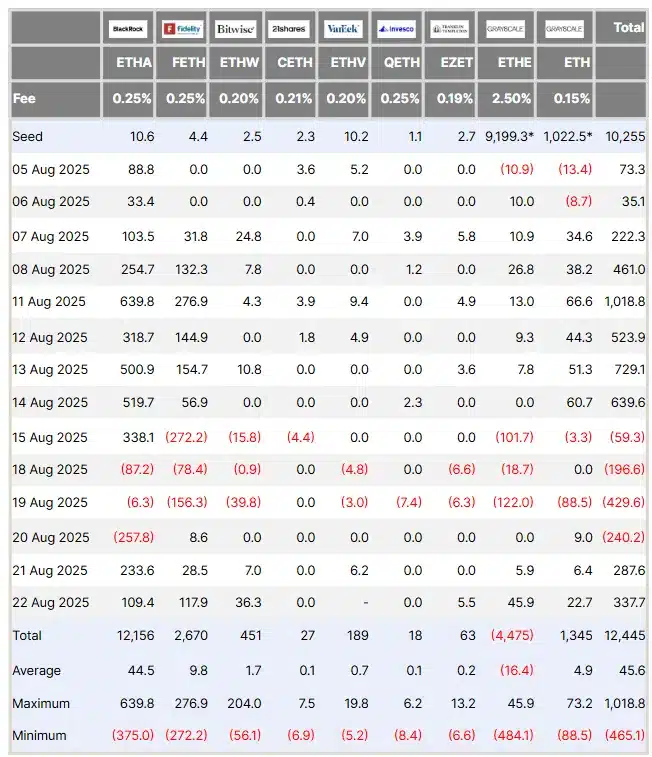
损失主要发生在本周初。对通胀数据高于预期的担忧引发了一波赎回潮,周二单日流出金额达4.29亿美元,为推出以来第二大赎回额。

美联储随后的鸽派立场缓解了市场紧张情绪,帮助 ETH 回升至新高,并引发了周末的资金流入。

然而,反弹不足以抵消早先的撤资,导致 ETF 出现罕见的周净回落。

尽管 ETF 回调,草根活动依然活跃

以太坊的失败交易(在最近的价格触底期间飙升至 200,000 笔以上)显示出链上压力,这通常与更高的零售参与度有关。
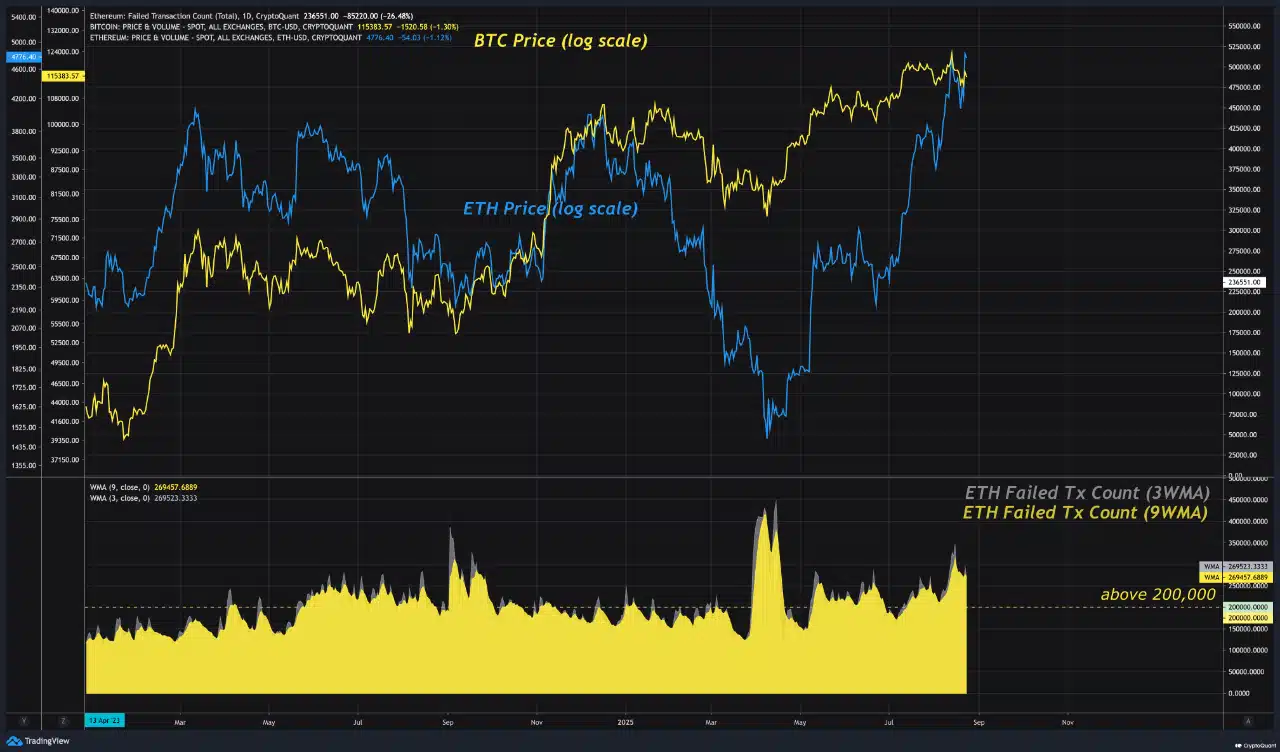
虽然这些峰值并不与 DEX 交易量的突然激增完全重叠,但整个夏季 DEX 的交易活动一直保持强劲。
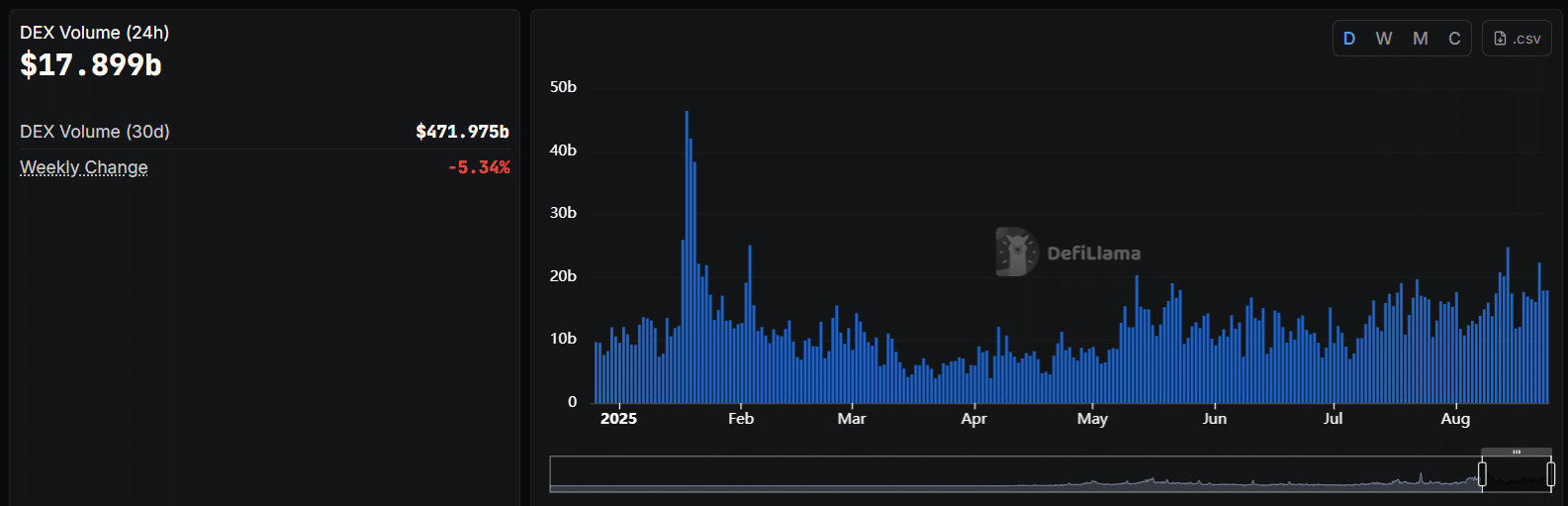
这意味着,即使机构从美国上市的以太坊 ETF 中撤出了 2.41 亿美元,小型交易者仍然活跃在链上。

市场情绪出现了分歧。一方面,传统市场谨慎退出;另一方面,坚韧的草根资金流继续支撑以太坊的复苏。

ETH保持稳定

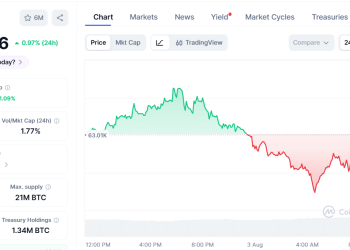
截至发稿时,以太坊交易价格为 4,724 美元,当日下跌 1.09%,此前曾短暂测试 4,816 美元附近的阻力位。

本周早些时候的反弹将 ETH 推高至其短期支撑位之上,9 天 SMA 为 4,465 美元,21 天 SMA 为 4,295 美元。
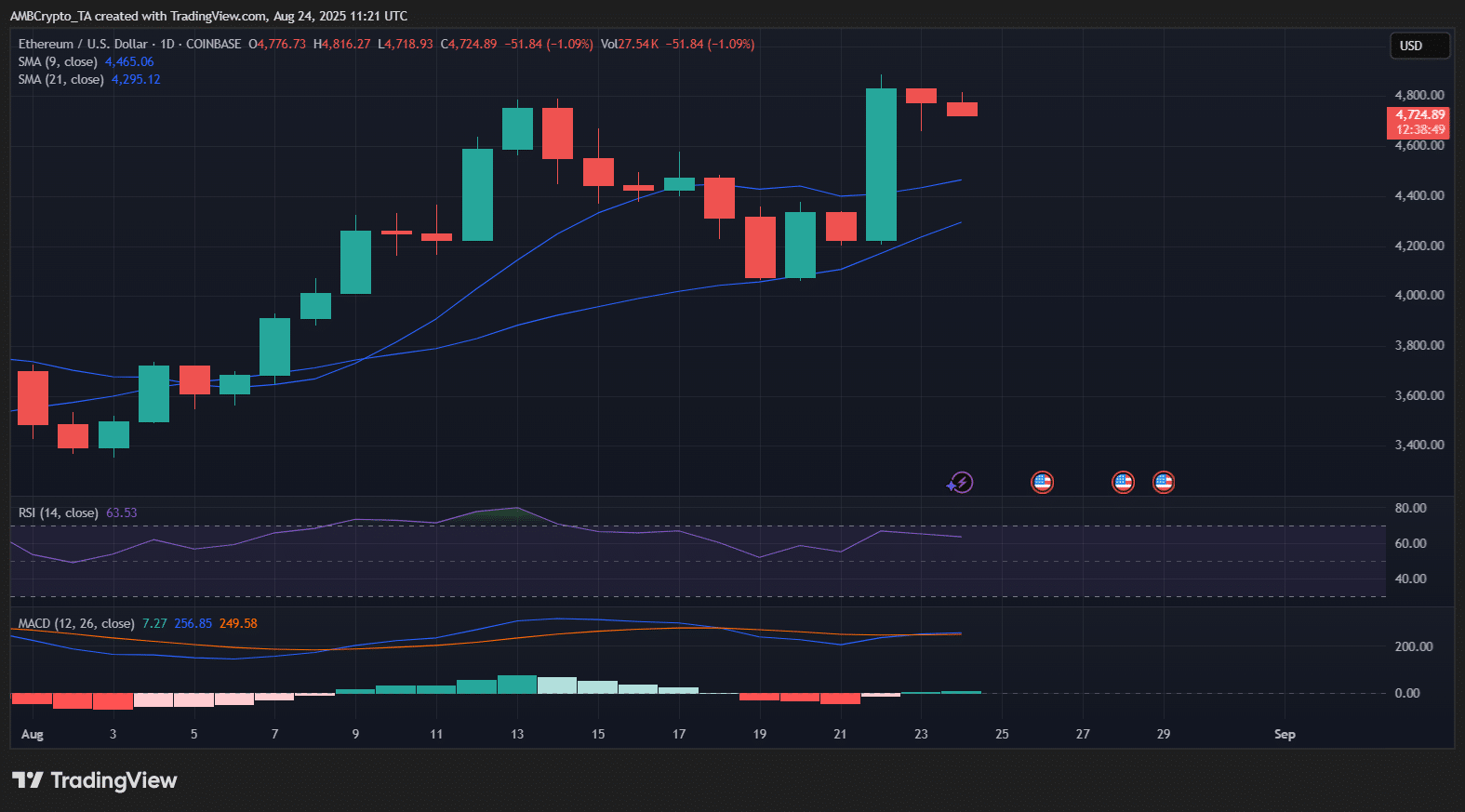
动量指标显示有所降温,但仍保持积极态势:RSI 徘徊在 63,表明 ETH 尚未超买,而 MACD 线保持在信号线上方,保持看涨情绪不变。

飙升后的盘整阶段表明了健康的停顿,以太坊保持了近期的大部分涨幅,并为进一步上涨保持了强劲的技术基础。

Related Reads

Six Complaints from an Ethereum Developer

A disgruntled early Ethereum developer and token holder presents six core criticisms of the project's trajectory, contrasting it with Solana's rise. 1. **Premature Complacency**: The Ethereum Foundation shifted from a "building" to an "infrastructure" mindset too soon, adopting a passive, "retired chairman" posture before securing market dominance, reflected in ETH's ~65% decline against BTC post-Merge. 2. **Misguided Messaging**: The Merge was marketed primarily on ESG (99.95% energy reduction) rather than user benefits like speed or yield, appealing to internal ideals instead of market demands. 3. **Delayed Execution**: Proof-of-Stake, on the roadmap since 2015, took seven years to launch, ceding critical narrative and development windows. Competitors like Solana built entire ecosystems in that time. 4. **Poor Native Staking UX**: Years after the Merge, there is still no first-party, user-friendly staking application, forcing reliance on centralized services like Lido and undermining ETH's "sound money" narrative. 5. **Managed Decline**: The rollup-centric roadmap deliberately weakens the base layer's fee capture, outsourcing value and profitability to L2s like Arbitrum and Base, which issue their own tokens and fragment capital. 6. **Ideology Over Product**: Ethereum culture prioritizes philosophical purity ("credible neutrality," "public goods") over competitive product delivery that meets user demands (e.g., financialization), while Solana's ecosystem focuses on coordinated execution. The diagnosis is accumulated execution debt, not a coordination failure. Ethereum possessed a structural advantage in 2021 but spent years in governance debates, while Solana efficiently executed. The current market cap reflects these specific strategic failures, not abstract theory.

marsbit1h ago

Six Complaints from an Ethereum Developer

marsbit1h ago

Six Complaints from an Ethereum Developer

Six Grievances from an Ethereum Developer The author, an early investor and developer still building on Ethereum, expresses deep frustration with its trajectory and declining ETH/BTC price since the merge. The core argument is that Ethereum's current market position stems from concrete failures in execution and strategy, not abstract coordination problems. The first grievance targets a shift in the Ethereum Foundation's mentality from builders to "infrastructure," adopting a premature posture of a retired victor. Second, marketing the Merge around ESG (99.95% energy reduction) is seen as talking to its own conscience rather than the market, which prioritizes user experience and yield. Third, the seven-year delay in delivering Proof-of-Stake (PoS) ceded critical narrative and development time to competitors like Solana. Fourth, three years post-merge, there is still no user-friendly first-party staking application, forcing reliance on centralized services like Lido and undermining ETH's monetary narrative. Fifth, the rollup-centric roadmap has strategically surrendered base-layer fee capture to L2s, fragmenting value within the ecosystem while Solana demonstrates an integrated L1's value accrual. Finally, the author criticizes an institutional culture that prioritizes philosophical ideals (credible neutrality, pluralism) over competitive product delivery focused on what users actually want. The diagnosis is "accumulated execution debt." Ethereum possessed a structural advantage in 2021 but spent years in governance debates, while Solana's ecosystem coordinated efficiently to deliver and capture the next wave of value. The conclusion is that Ethereum's market cap reflects its abandonment of the fight for asset appreciation.

链捕手1h ago

Six Complaints from an Ethereum Developer

链捕手1h ago

Token Budget Wars: Enterprise AI Enters the 'Accounting Era'

Token Budget Wars: Enterprise AI Enters the "Accounting Era" Enterprise AI is shifting from the question of "whether to adopt" to "how to account for it." As AI inference costs evolve from experimental budgets into ongoing operational expenses, CEOs and CFOs are demanding proof of value: what tangible results does each dollar spent on tokens deliver? The core of "Token Budget Wars" is not simply about reducing AI bills, but about intelligently allocating compute resources. It involves determining which business processes warrant more computational power, which tasks can use cheaper models, which can be outsourced or handled manually, and which are merely inefficient consumption. A key insight is that AI usage (token consumption) does not equal value. While SaaS usage indicated software adoption, AI token usage only indicates the "meter is running." The same workflow can cost vastly different amounts due to factors like prompt quality, context, model choice, and retries. The critical metric for scaling is "marginal token utility"—the business value created per additional dollar of inference cost. However, this is difficult to measure due to challenges like the long tail of retries, context inflation (where costs can scale quadratically with context length), and inefficient model routing (defaulting to the most powerful model for all tasks). The competition for token allocation is intensifying because, in the AI era, influence is tied to how much intelligence one can command, not just team size. AI spending is essentially competing with labor costs, whether for replacing external BPOs, internal staff, or generating new revenue. BPO contracts provide a clearer benchmark as they are priced per completed unit. The missing layer is attribution from tokens to business outcomes. Companies need a system that connects inference spending to completed work and results, capturing the agent's decision trajectory—what it saw, retrieved, tried, and why it succeeded or failed. This recorded rationale becomes a valuable asset. Ultimately, those who master token-to-outcome attribution will control the allocation of AI resources within enterprises, deciding which workflows get more compute, which are capped, or which revert to humans. The first phase of enterprise AI proved models could do the work. The next phase will determine how much of that work is worth paying for.

marsbit2h ago

Token Budget Wars: Enterprise AI Enters the 'Accounting Era'

marsbit2h ago

Trading

Spot
Futures

Hot Articles

Discussions

Welcome to the HTX Community. Here, you can stay informed about the latest platform developments and gain access to professional market insights. Users' opinions on the price of ETH (ETH) are presented below.

活动图片