Аналитик подтвердил, что Ethereum (ETH) демонстрирует мощный отскок от «сильного блока поддержки»

cryptonews.ruPublished on 2025-08-28Last updated on 2025-08-28

  • Ethereum успешно отскочил от ключевой зоны поддержки $4000–$4200, подтвердив прогнозы.
  • Цена восстановила уровень $4300 и вышла из ключевой модели «нисходящий клин».
  • Теперь аналитики наблюдают, сможет ли этот импульс вернуть цену к недавним максимумам.

Эфириум демонстрирует новый рост: его цена достигла $4315 после успешного и решительного отскока от ключевой зоны поддержки. Восстановление подтверждает недавние прогнозы ведущих трейдеров, которые считали падение цен высоковероятной возможностью для покупки.

««Высокая вероятность» отскока разыгрывается

Всего несколько дней назад рыночный стратег Михаэль ван де Поппе определил диапазон от 4000 до 4200 долларов как сильный уровень поддержки, отскок от которого весьма вероятен. Его анализ, оценивший вероятность разворота в 70%, похоже, оказался точным.

Падение в эту зону было встречено сильным давлением покупателей, что подтвердило её статус классической зоны накопления. Эта техническая сила потенциального ралли-реванша ETH подкреплена базовым спросом, о чём свидетельствует рекордный еженедельный приток ETP на Ethereum (ETH) в размере 2,9 млрд долларов. отчет.

This is the ideal area for dip buying on $ETH.

I wouldn't be surprised if we're getting a 10% bounce from here.

Volatility to go down on Ethereum and accumulation to start.

Always buy the dip. pic.twitter.com/v1GKcmqEC4

— Michaël van de Poppe (@CryptoMichNL) August 20, 2025

Решающий прорыв «клина»

Подкрепляя бычий импульс, Ethereum успешно восстановил структуру «падающего клина» на 4-часовом графике. По мнению аналитика TedPillows, отслеживавшего эту модель, отскок от уровня $4000 и последующий выход за пределы клина стали тем критическим шагом, который так ждали быки.

Учитывая, что цена уверенно превышает сопротивление 4300 долларов, открывается возможность для повторного тестирования области 4400 долларов. Длительное удержание этих новых уровней значительно усилит вероятность продолжения роста к недавним максимумам в районе 4600 долларов.

$ETH is trying to reclaim the wedge.

If Ethereum is able to reclaim this, we're probably seeing more upside.

Overall it look strong. pic.twitter.com/vObPYDEiWa

— Ted (@TedPillows) August 20, 2025

Индикаторы рынка и прогноз настроений

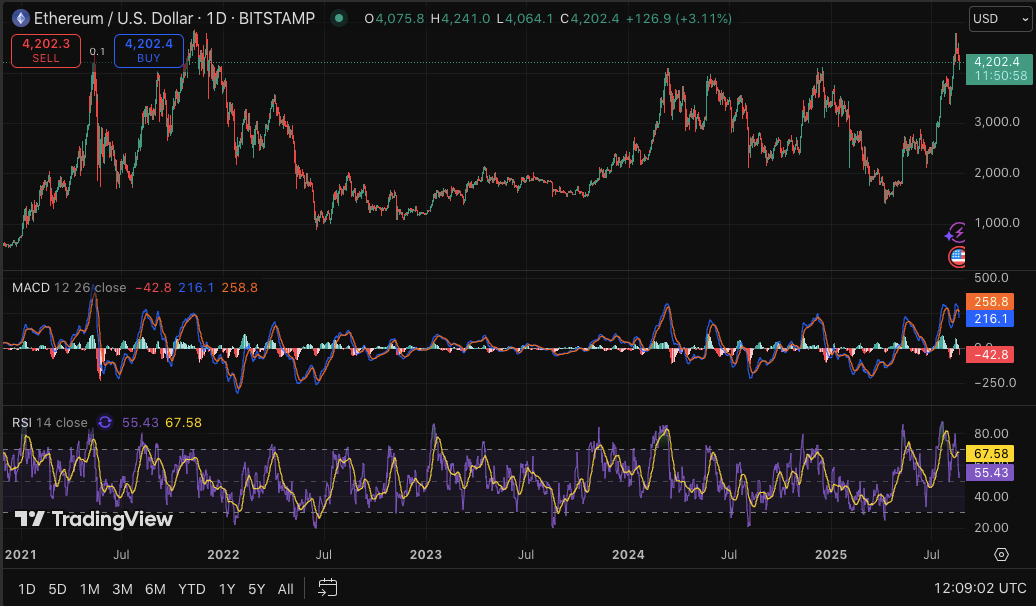
Дневной график цены ETH/USD, Источник: TradingView

Рыночные индикаторы отражают этот возобновившийся бычий тренд. MACD остаётся положительным, подтверждая, что базовая динамика по-прежнему благоприятствует покупателям.

Между тем, значение RSI составляет 67,5, что свидетельствует о приближении Ethereum к условиям перекупленности, что сигнализирует о возможной боковой консолидации или незначительном откате перед более сильным продолжением движения.


Trending Cryptos

Related Reads

Upbit is Anxious: A Hasty Counterattack Aimed at Regaining Stablecoin Market Share

Title: Upbit's Rushed Counterattack to Reclaim Stablecoin Market Share Facing a dramatic shift in South Korea's stablecoin market, leading exchange Upbit launched a promotional campaign from July 26 to August 9, waiving the 0.05% trading fee for stablecoins paired with the Korean Won (KRW) and rapidly listing new stablecoins like RLUSD and USDG. This move is a direct response to its plummeting market share in this sector. Historically a duopoly with Bithumb, the market has been reshaped since October 2025 when Coinone permanently removed fees for USDC trading. By June 2026, Coinone led with 34.8% of stablecoin volume, followed by Bithumb (31.1%) and Upbit (30.1%). This contrasts sharply with the overall crypto market, where Upbit commands 60%. The data shows stablecoin demand is highly sensitive to fees, as users primarily buy them to transfer capital overseas for derivatives trading or forex arbitrage. South Korean exchanges have seen a net outflow of stablecoins for 18 consecutive months, totaling approximately 14.9 trillion KRW, underscoring their role as a cross-border capital conduit. Upbit's limited-time promotion initially boosted its daily stablecoin volume by 162%, but the surge was almost entirely in USDT (98.1% of volume). The newly listed stablecoins saw negligible, fleeting interest. Furthermore, the promotional effect quickly waned in the second week, with volume dropping 33% on weekdays. A concurrent weakening of the KRW also contributed to the trading spike, independent of the fee waiver. The analysis suggests that once the promotion ends, Upbit is unlikely to retain its temporary gains unless it matches Coinone's permanent zero-fee policy, forcing a choice between market share and fee revenue. Upbit's strategic push may be less about immediate profit and more about preparing for future regulatory shifts. With South Korea's *Digital Asset Basic Act* on the horizon, which will regulate KRW-backed stablecoins, and following Dunamu's (Upbit's parent) integration into Naver Financial to build a payment ecosystem, securing a dominant position in the dollar stablecoin distribution channel holds long-term strategic value. However, potential regulatory conflicts could prevent Upbit from listing a future Naver-issued KRW stablecoin, making the current fight for dollar stablecoin flow even more critical.

marsbit2h ago

Upbit is Anxious: A Hasty Counterattack Aimed at Regaining Stablecoin Market Share

marsbit2h ago

Michael Saylor Compares Bitcoin and Gold!

Michael Saylor, founder of MicroStrategy, argues that Bitcoin fundamentally changes how wealth is stored and transferred by transforming digital scarcity into economic value. He describes Bitcoin as the first digital monetary network, combining computers, digital networks, and cryptography. It digitizes monetary assets, allowing their supply to be controlled by public protocols rather than institutions, thus converting economic value into information transmissible over global networks. Comparing Bitcoin to gold, Saylor states that while increasing Bitcoin's supply is harder, its integration with software and transfer is easier. He highlights Bitcoin's proof-of-work mechanism, which ties it to the physical world by consuming real energy to secure the ledger, making past transactions immutable. This creates a shared security system involving miners, energy companies, and investors. Saylor suggests "digital monetary energy" is a more accurate term than "digital gold." He emphasizes that the Bitcoin network is an adaptive ecosystem of miners, nodes, developers, and users. Its core design is intentionally simple, focused on maintaining a secure ledger for scarce digital assets, with complex functionalities built in higher-layer applications. This architecture allows Bitcoin to serve as a foundation for transmitting value and fostering innovation in payments and financial services. Saylor notes Bitcoin's deeper impact lies in creating digital sovereignty, where private keys give individuals permissionless control over their economic power, with ownership verified mathematically, not by institutions. He concludes that while gold's physical scarcity makes it money, Bitcoin's digital scarcity does the same, characterizing Bitcoin as the monetary energy of the digital age.

cryptonews.ru3h ago

Michael Saylor Compares Bitcoin and Gold!

cryptonews.ru3h ago

Trading

Spot

Hot Articles

Discussions

Welcome to the HTX Community. Here, you can stay informed about the latest platform developments and gain access to professional market insights. Users' opinions on the price of ETH (ETH) are presented below.

活动图片