Strategy Just Flipped Its Bitcoin Playbook—Here’s Why It Matters Now

bitcoinistPublished on 2025-08-19Last updated on 2025-08-19

Abstract

Strategy has redrawn the lines for when it will issue new MSTR shares, repurchase stock, or buy more Bitcoin—explicitly tying...

Trusted Editorial content, reviewed by leading industry experts and seasoned editors. Ad Disclosure

Strategy has redrawn the lines for when it will issue new MSTR shares, repurchase stock, or buy more Bitcoin—explicitly tying those decisions to its self-defined “mNAV” multiple and publishing price guardrails that anchor investor expectations. “Strategy today announced an update to its MSTR Equity ATM Guidance to provide greater flexibility in executing our capital markets strategy,” Michael Saylor wrote on X as he released a slide titled “MSTR Equity Guidance.”

The New Bitcoin Playbook By Saylor

The new framework segments actions by where the stock trades versus “mNAV,” which Strategy footnotes as the company’s enterprise value divided by its Bitcoin NAV. It also provides “implied MSTR price” signposts, stated as the share prices that would correspond to each mNAV band “all else being equal” as of August 17, 2025.

In the top band—“Above 4.0x mNAV”—Strategy says it “will actively issue MSTR to acquire Bitcoin,” with an implied MSTR level of roughly $1,000 for that threshold. In the middle band—“Between 2.5x and 4.0x mNAV”—it “will opportunistically issue MSTR to acquire Bitcoin,” pegging 2.5x mNAV to about $600 per share.

Below that—“Below 2.5x mNAV”—issuance turns “tactical,” directed first to “pay interest on debt obligations,” second to “fund preferred equity dividends,” and third “when otherwise deemed advantageous to the company.” At the bottom end—“Below 1.0x mNAV”—with an implied level near $210—Strategy says it “will consider issuing credit to repurchase MSTR.”
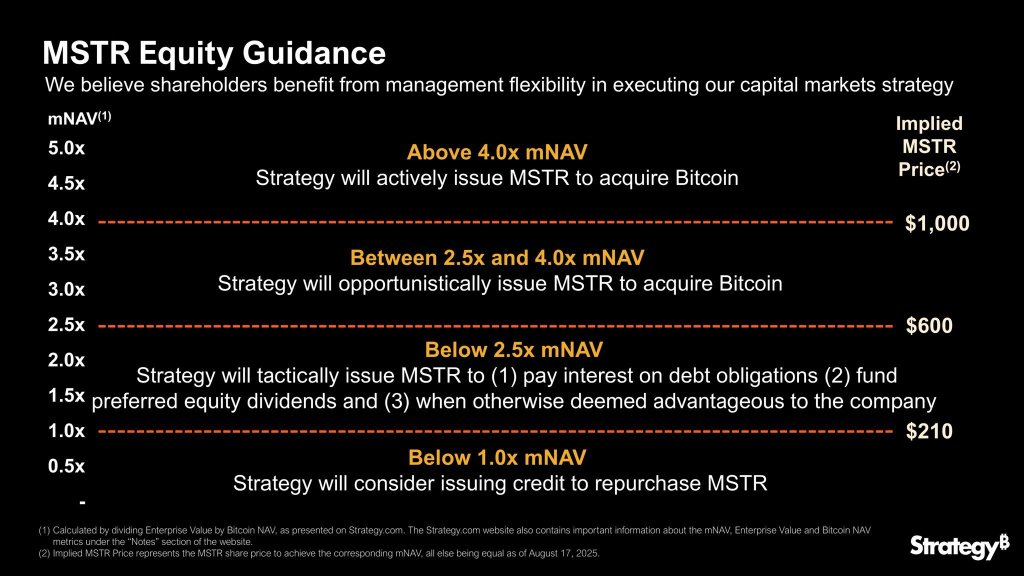
Strategy new Bitcoin playbook
Source: X @saylor

The language shift is subtle but consequential. Until now, Crypto Twitter widely believed Strategy would not sell new shares to buy more Bitcoin unless the stock traded at or above 2.5x mNAV. “CT is having a hard time figuring out what changed so I’ll make it easy for you,” wrote Udi Wertheimer.

“Up until yesterday: Strategy wasn’t going to sell more MSTR to buy more bitcoin until mNAV hit 2.5x. Starting today: Strategy can sell MSTR to buy more bitcoin.” That interpretation hinges on the added clause in the sub-2.5x bucket—“when otherwise deemed advantageous”—which gives management explicit discretion to issue equity even when the multiple is lower, after covering debt service and preferred dividends.

Reactions From X

Skeptics seized on the update to argue it lowers the bar for dilution. Founder of Kynikos Associates and MSTR short-seller James Chanos framed the change alongside a jab at recent purchasing cadence: “So not only did MSTR buy just $51M of Bitcoin, due to lack of demand for the preferred ATM’s, but it also looks like Saylor is lowering the 2.5x mNAV floor ‘when otherwise deemed advantageous’ to the Company.”

Supporters countered that the willingness to pivot is a hallmark of capable capital allocation. “One of the best signs of a confident and strong leadership team is seeing them pivot and update shareholders instantly when they see a better path for the business,” wrote Matt Cole, CEO of Strive.

The slide also clarifies how Strategy thinks about buybacks, stating that if MSTR trades below 1.0x mNAV it will “consider issuing credit to repurchase MSTR.” Read plainly, the policy draws a line between equity-funded Bitcoin accumulation when the stock commands a premium multiple, and leverage-funded buybacks when the market prices MSTR near or below its Bitcoin-derived baseline.

Speculation around the timing and purpose of the change rippled through trading circles, with one pseudonymous account, “Teddy Bitcoins,” asserting that Strategy intends to “hammer the ATM during the S&P inclusion,” claiming a goal to raise “$10–20 billion” to buy “100,000–200,000 bitcoin.”

When challenged—“During the inclusion?”—the account replied, “Correct,” and argued that waiting for inclusion to lift mNAV above 2.5x would have limited buying power once dilution pulled it back down. Others pushed back that an inclusion-driven rally might have put MSTR above the old 2.5x trigger in any case. None of those inclusion assertions are confirmed by the company yet.

The immediate takeaway is less about a single near-term trade and more about elasticity: Strategy has codified a wider decision bandwidth to raise equity for Bitcoin when it believes the terms are attractive, not just when a mechanical multiple threshold is met, while also sketching conditions under which it could swing to credit-funded repurchases.

At press time, Bitcoin traded at $115,141.
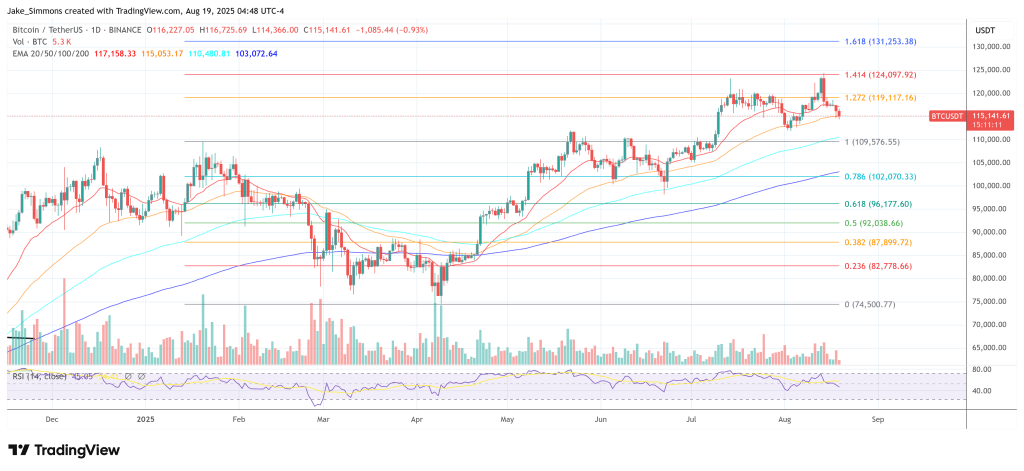
Bitcoin price
BTC holds above the EMA50, 1-day chart | Source: BTCUSDT on TradingView.com
Featured image created with DALL.E, chart from TradingView.com
Editorial Process for bitcoinist is centered on delivering thoroughly researched, accurate, and unbiased content. We uphold strict sourcing standards, and each page undergoes diligent review by our team of top technology experts and seasoned editors. This process ensures the integrity, relevance, and value of our content for our readers.

Jake Simmons has been a Bitcoin enthusiast since 2016. Ever since he heard about Bitcoin, he has been studying the topic every day and trying to share his knowledge with others. His goal is to contribute to Bitcoin's financial revolution, which will replace the fiat money system. Besides BTC and crypto, Jake studied Business Informatics at a university. After graduation in 2017, he has been working in the blockchain and crypto sector. You can follow Jake on Twitter at @realJakeSimmons.

Trending Cryptos

Related Reads

Opinion: AI Bubble Bursts, Bitcoin and Other Risky Assets Are the First to Be Impacted

BIS Warns AI Investment Boom Could Trigger Market Stress, Impacting Bitcoin First The Bank for International Settlements (BIS) warns that a potential bursting of the "AI bubble" could tighten liquidity and severely impact risk assets like Bitcoin in the near term. Major tech firms are projected to spend over $1 trillion on AI infrastructure in 2025-2026. The BIS cautions that if returns fail to meet expectations, a sudden withdrawal of financing could turn this investment boom into a prolonged bust, creating ripple effects across financial markets. While AI holds long-term economic promise, the current scale and speed of investment, coupled with intense competition and physical bottlenecks (e.g., semiconductors, power grids), mirror historical bubbles. The report highlights that the AI funding web—spanning corporate debt, private credit, and complex vendor agreements—makes systemic risks harder to see. A disappointment in AI adoption could transmit stress through this chain, widening credit spreads and pressuring weaker borrowers. For Bitcoin, the initial reaction to such a market shock would likely be defensive. As liquidity tightens, investors typically sell liquid assets first, and Bitcoin often trades in line with other risk assets during portfolio de-risking. Recent correlations, like Bitcoin's drop following a sharp decline in South Korea's stock market, support this view. However, the longer-term outcome for Bitcoin depends on the policy response. If an AI-driven credit crunch forces central banks to inject liquidity and ease policy eventually, it could reignite Bitcoin's narrative as a hedge against monetary debasement. Yet, traders betting on this outcome may first have to endure significant market volatility and potential price declines.

marsbit40m ago

Opinion: AI Bubble Bursts, Bitcoin and Other Risky Assets Are the First to Be Impacted

marsbit40m ago

South Korea Reaps Riches, America Turns Hostile

The US has filed a collective antitrust lawsuit in California against Samsung, SK Hynix, and US-based Micron, alleging they colluded to create a "RAMpocalypse" by slashing traditional DRAM production and raising prices 700% over four years amid the AI boom. This lawsuit targets the heart of the AI supply chain: High Bandwidth Memory (HBM), critical for Nvidia's GPUs. Currently, SK Hynix (57%), Samsung (22%), and Micron (21%) dominate global HBM production. The case highlights a deeper US concern: in the AI era, South Korea, through its HBM dominance, is capturing an estimated 35% of global AI profits, second only to the US (49%). SK Hynix's operating profit margin recently hit a record 72%. In response to the lawsuit, South Korea announced a massive $800 trillion won investment to build four new chip plants, doubling down on its strategic position. Analysts see the lawsuit not merely as a consumer price issue but as strategic pressure. It aims to support Micron's US manufacturing expansion (subsidized by the CHIPS Act) and secure America's share of AI profits by bringing more HBM production onshore. However, South Korea's rapid execution and massive cash flow from current HBM sales give it a significant speed advantage over US build-out timelines. The conflict underscores a fundamental shift: AI infrastructure like GPUs and HBM is becoming a new form of strategic national resource, akin to oil. While Nvidia and Korean memory giants are interdependent, the struggle over profit distribution and industrial sovereignty in this new landscape is just beginning. This lawsuit may be the first major skirmish in the AI resource wars.

marsbit53m ago

South Korea Reaps Riches, America Turns Hostile

marsbit53m ago

Trading

Spot

Hot Articles

What is $BITCOIN

DIGITAL GOLD ($BITCOIN): A Comprehensive Analysis Introduction to DIGITAL GOLD ($BITCOIN) DIGITAL GOLD ($BITCOIN) is a blockchain-based project operating on the Solana network, which aims to combine the characteristics of traditional precious metals with the innovation of decentralized technologies. While it shares a name with Bitcoin, often referred to as “digital gold” due to its perception as a store of value, DIGITAL GOLD is a separate token designed to create a unique ecosystem within the Web3 landscape. Its goal is to position itself as a viable alternative digital asset, although specifics regarding its applications and functionalities are still developing. What is DIGITAL GOLD ($BITCOIN)? DIGITAL GOLD ($BITCOIN) is a cryptocurrency token explicitly designed for use on the Solana blockchain. In contrast to Bitcoin, which provides a widely recognized value storage role, this token appears to focus on broader applications and characteristics. Notable aspects include: Blockchain Infrastructure: The token is built on the Solana blockchain, known for its capacity to handle high-speed and low-cost transactions. Supply Dynamics: DIGITAL GOLD has a maximum supply capped at 100 quadrillion tokens (100P $BITCOIN), although details regarding its circulating supply are currently undisclosed. Utility: While precise functionalities are not explicitly outlined, there are indications that the token could be utilized for various applications, potentially involving decentralized applications (dApps) or asset tokenization strategies. Who is the Creator of DIGITAL GOLD ($BITCOIN)? At present, the identity of the creators and development team behind DIGITAL GOLD ($BITCOIN) remains unknown. This situation is typical among many innovative projects within the blockchain space, particularly those aligning with decentralized finance and meme coin phenomena. While such anonymity may foster a community-driven culture, it intensifies concerns about governance and accountability. Who are the Investors of DIGITAL GOLD ($BITCOIN)? The available information indicates that DIGITAL GOLD ($BITCOIN) does not have any known institutional backers or prominent venture capital investments. The project seems to operate on a peer-to-peer model focused on community support and adoption rather than traditional funding routes. Its activity and liquidity are primarily situated on decentralized exchanges (DEXs), such as PumpSwap, rather than established centralized trading platforms, further highlighting its grassroots approach. How DIGITAL GOLD ($BITCOIN) Works The operational mechanics of DIGITAL GOLD ($BITCOIN) can be elaborated on based on its blockchain design and network attributes: Consensus Mechanism: By leveraging Solana’s unique proof-of-history (PoH) combined with a proof-of-stake (PoS) model, the project ensures efficient transaction validation contributing to the network's high performance. Tokenomics: While specific deflationary mechanisms have not been extensively detailed, the vast maximum token supply implies that it may cater to microtransactions or niche use cases that are still to be defined. Interoperability: There exists the potential for integration with Solana’s broader ecosystem, including various decentralized finance (DeFi) platforms. However, the details regarding specific integrations remain unspecified. Timeline of Key Events Here is a timeline that highlights significant milestones concerning DIGITAL GOLD ($BITCOIN): 2023: The initial deployment of the token occurs on the Solana blockchain, marked by its contract address. 2024: DIGITAL GOLD gains visibility as it becomes available for trading on decentralized exchanges like PumpSwap, allowing users to trade it against SOL. 2025: The project witnesses sporadic trading activity and potential interest in community-led engagements, although no noteworthy partnerships or technical advancements have been documented as of yet. Critical Analysis Strengths Scalability: The underlying Solana infrastructure supports high transaction volumes, which could enhance the utility of $BITCOIN in various transaction scenarios. Accessibility: The potential low trading price per token could attract retail investors, facilitating wider participation due to fractional ownership opportunities. Risks Lack of Transparency: The absence of publicly known backers, developers, or an audit process may yield skepticism regarding the project's sustainability and trustworthiness. Market Volatility: The trading activity is heavily reliant on speculative behavior, which can result in significant price volatility and uncertainty for investors. Conclusion DIGITAL GOLD ($BITCOIN) emerges as an intriguing yet ambiguous project within the rapidly evolving Solana ecosystem. While it attempts to leverage the “digital gold” narrative, its departure from Bitcoin's established role as a store of value underscores the need for a clearer differentiation of its intended utility and governance structure. Future acceptance and adoption will likely depend on addressing the current opacity and defining its operational and economic strategies more explicitly. Note: This report encompasses synthesised information available as of October 2023, and developments may have transpired beyond the research period.

521 Total ViewsPublished 2025.05.13Updated 2025.05.13

What is $BITCOIN

Discussions

Welcome to the HTX Community. Here, you can stay informed about the latest platform developments and gain access to professional market insights. Users' opinions on the price of BTC (BTC) are presented below.

活动图片