Was the Bitcoin price bottom $114.7K?: Data suggests it's time for a reversal

CointelegraphPublished on 2025-08-19Last updated on 2025-08-19

Abstract

Bitcoin derivatives, spot ETFs, top trader positions and stablecoin demand suggest BTC’s correction is near completion.

Key takeaways:

The Bitcoin options skew and stablecoin activity show fear remains contained, pointing to limited downside pressure.

Spot BTC ETF flows and top trader positioning confirm liquidity and resilience, signaling recovery potential above $120K.

Bitcoin fell to an 11-day low of $114,755 on Monday, igniting debate over whether Thursday’s record high signaled the end of the current bull run. Yet four distinct indicators suggest the correction is only temporary and that Bitcoin may soon reclaim the $120,000 mark.

The Bitcoin options skew metric climbed to its highest point in four months, highlighting sudden and excessive fear. In balanced conditions, the skew should move between -6% and +6%. When demand for protective put options increases, the indicator jumps above the neutral band, while periods of FOMO push it below.
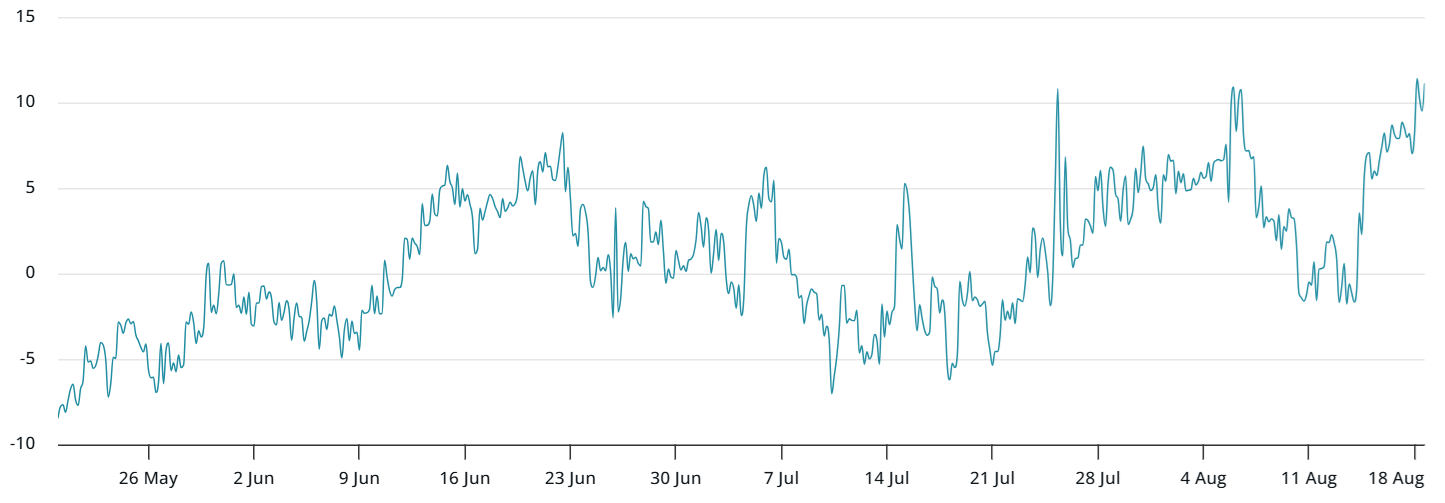
History shows such events often create strong buying opportunities. On Aug. 5, a similar skew jump was followed by a $9,657 rally within six days. Likewise, when Bitcoin plunged to $74,587 on April 9, the skew touched 13%, setting the stage for a double bottom and an $11,474 recovery in just four days.

Some investors are now afraid that outflows from spot Bitcoin exchange-traded funds (ETFs) could begin, especially after a seven-day inflow streak ended on Friday. Yet the panic seems misplaced. Between July 31 and Aug. 5, the ETFs registered $1.45 billion in net outflows, which translated into only a modest 6% correction to $112,000.
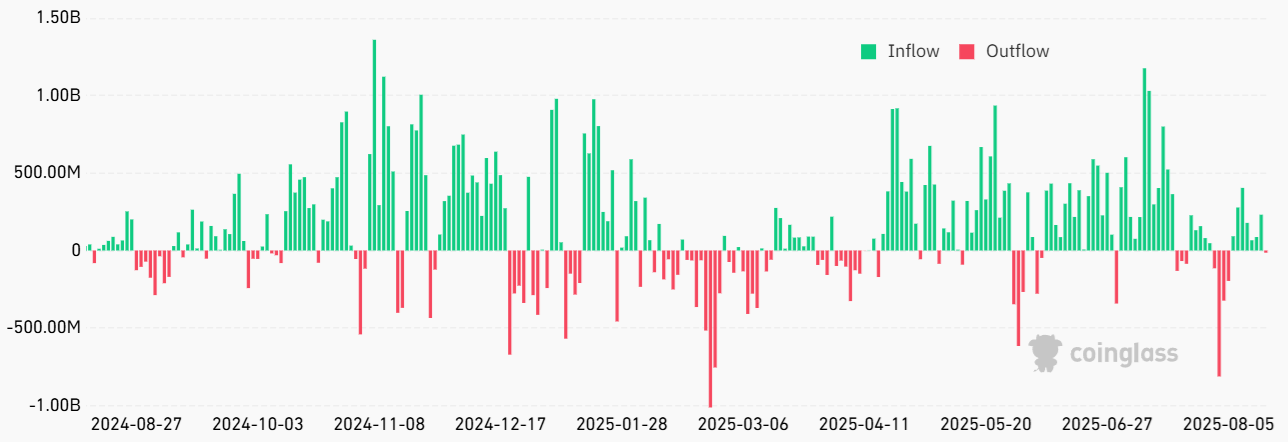
Spot Bitcoin ETFs represent a $152 billion market, meaning 1% inflows or outflows over a short span should be considered normal. Given the lower volatility in recent months, liquidity remains strong enough to absorb large ETF redemptions. Notably, the last time Bitcoin moved more than 12% within 72 hours was April 7.

Although top traders reduced longs between Thursday and Friday, the long-to-short ratio has since stabilized. While some may argue these traders hesitate to buy the dip at $115,000, it is equally possible they are waiting for a potential retest of $112,000 before deploying additional capital.

Stablecoin demand in China offers further perspective. Strong retail-driven activity usually pushes stablecoins to trade at a 2% premium against the official US dollar rate. By contrast, a discount above 0.5% often reflects fear, as traders exit crypto holdings.
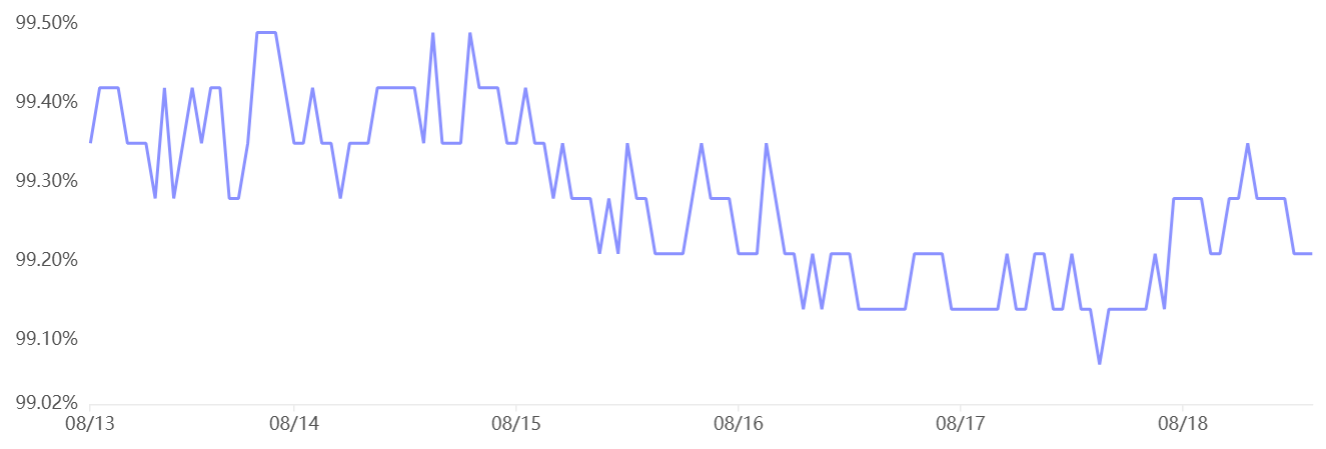
At present, Tether trades at a 0.8% discount in China, indicating mild pressure to leave crypto markets. Still, the figure has remained steady since Friday evening, suggesting no worsening sentiment.

Taken together, these four metrics — options skew, ETF flows, top trader positioning, and stablecoin demand — suggest Bitcoin’s pullback was a temporary setback and point to $114,755 being the likely bottom of this correction.


Trending Cryptos

Related Reads

Will History Repeat Itself? Fidelity Lists Five Catalysts to End the Crypto Winter

Fidelity's new report suggests that the current crypto winter for Bitcoin may be nearing its end, identifying five potential catalysts that could drive a market turnaround based on historical patterns. First, Bitcoin's approximately four-year cycle, driven by its halving mechanism, historically marks peaks and troughs. The last bottom was in November 2022, potentially pointing to the next around November 2026, though cycle length can vary. Second, clearer regulation has often preceded past bull markets. The focus is now on the CLARITY Act, which aims to clarify US digital asset oversight between the SEC and CFTC. Its passage could unlock domestic activity currently held back by legal uncertainty. Third, Federal Reserve monetary policy plays a role. A shift to lower interest rates tends to correlate with rising crypto prices by reducing borrowing costs and boosting risk appetite, though markets may price this in well ahead of any official change. Fourth, the emergence of breakthrough applications can fuel investor interest. Current trends like real-world asset tokenization, AI-related crypto infrastructure, and stablecoins are being watched, but history shows the biggest catalysts are often unexpected. Fifth, a new wave of institutional adoption could be a trigger. While ongoing adoption in 2026 hasn't sparked a new bull run, a major unexpected move—like a significant purchase by a tech giant or adoption as a hedge in a global crisis—could create a powerful new narrative. Fidelity concludes that while the market is in a downturn, historical turning points have often resulted from a combination of such factors, and the next phase for Bitcoin may depend on which of these catalysts materializes first.

Foresight News4m ago

Will History Repeat Itself? Fidelity Lists Five Catalysts to End the Crypto Winter

Foresight News4m ago

US CFTC Launches Broad Investigation into Polymarket, Is the Prediction Market Party Coming to an End?

The U.S. Commodity Futures Trading Commission (CFTC) is conducting a broad investigation into the prediction market platform Polymarket, focusing on its business practices including social media promotions. This follows a bipartisan letter from U.S. senators urging the CFTC to probe alleged fraudulent marketing tactics used to promote gambling-like products. The action coincides with a period of explosive growth for the prediction market sector, driven by events like the World Cup, with platforms like Kalshi and Robinhood reporting record trading volumes and revenue. The investigation signals a potential end to the sector's unregulated expansion and may lead to clearer federal oversight, particularly regarding investor protection and distinguishing prediction markets from traditional sports betting. The CFTC's move has also intensified a jurisdictional conflict with multiple U.S. states (including Kentucky and New York), which have sued platforms like Polymarket and Kalshi, accusing them of operating illegal sports betting and threatening state gambling tax revenues. Furthermore, the CME Group has sued the CFTC, challenging its approval of certain prediction market products. The report also highlights the political and capital interests intertwined with the industry. Donald Trump Jr. holds advisory and investment roles in both Kalshi and Polymarket, and the Trump administration has previously emphasized federal regulatory authority over these markets. The CFTC's investigation into Polymarket is framed as a step towards formalizing the industry's regulatory landscape, moving it from a phase of "wild growth" towards a more structured future.

marsbit2h ago

US CFTC Launches Broad Investigation into Polymarket, Is the Prediction Market Party Coming to an End?

marsbit2h ago

U.S. CFTC Launches Extensive Investigation into Polymarket, Is the Prediction Market Frenzy Season Cooling Down?

The U.S. Commodity Futures Trading Commission (CFTC) has launched a broad investigation into the prediction market platform Polymarket, focusing on its business practices including social media activities. This follows a bipartisan letter from U.S. senators urging the CFTC to probe allegations of paid influencer false marketing and fraudulent promotion of gambling-like products to American users. The investigation comes as the prediction market sector experiences explosive growth, largely driven by the World Cup. Weekly trading volumes have hit record highs, exceeding $14.4 billion, with platforms like Kalshi and Robinhood's new venture seeing significant activity. Major firms like Meta are also showing interest in the space. This regulatory scrutiny signals a potential end to the sector's "wild growth" phase. The CFTC's move also highlights an escalating jurisdictional conflict between federal regulators and state authorities. Over a dozen states, including Kentucky and New York, have sued platforms like Polymarket and Kalshi, accusing them of operating illegal sports betting, which threatens state gambling tax revenues. The CFTC is countersuing to assert its exclusive federal jurisdiction over these "event contracts" as derivatives. Furthermore, the CFTC's approval of Kalshi's Bitcoin perpetual futures contract has sparked a lawsuit from traditional exchange CME, alleging regulatory overreach. The political and capital landscape is intricate, with Donald Trump Jr. holding advisory roles and investments in both Kalshi and Polymarket. This connects capital, political influence, and regulatory bodies, suggesting the current investigation may be a step toward formalizing the industry's rules rather than halting its progress.

Odaily星球日报2h ago

U.S. CFTC Launches Extensive Investigation into Polymarket, Is the Prediction Market Frenzy Season Cooling Down?

Odaily星球日报2h ago

Trading

Spot

Hot Articles

What is $BITCOIN

DIGITAL GOLD ($BITCOIN): A Comprehensive Analysis Introduction to DIGITAL GOLD ($BITCOIN) DIGITAL GOLD ($BITCOIN) is a blockchain-based project operating on the Solana network, which aims to combine the characteristics of traditional precious metals with the innovation of decentralized technologies. While it shares a name with Bitcoin, often referred to as “digital gold” due to its perception as a store of value, DIGITAL GOLD is a separate token designed to create a unique ecosystem within the Web3 landscape. Its goal is to position itself as a viable alternative digital asset, although specifics regarding its applications and functionalities are still developing. What is DIGITAL GOLD ($BITCOIN)? DIGITAL GOLD ($BITCOIN) is a cryptocurrency token explicitly designed for use on the Solana blockchain. In contrast to Bitcoin, which provides a widely recognized value storage role, this token appears to focus on broader applications and characteristics. Notable aspects include: Blockchain Infrastructure: The token is built on the Solana blockchain, known for its capacity to handle high-speed and low-cost transactions. Supply Dynamics: DIGITAL GOLD has a maximum supply capped at 100 quadrillion tokens (100P $BITCOIN), although details regarding its circulating supply are currently undisclosed. Utility: While precise functionalities are not explicitly outlined, there are indications that the token could be utilized for various applications, potentially involving decentralized applications (dApps) or asset tokenization strategies. Who is the Creator of DIGITAL GOLD ($BITCOIN)? At present, the identity of the creators and development team behind DIGITAL GOLD ($BITCOIN) remains unknown. This situation is typical among many innovative projects within the blockchain space, particularly those aligning with decentralized finance and meme coin phenomena. While such anonymity may foster a community-driven culture, it intensifies concerns about governance and accountability. Who are the Investors of DIGITAL GOLD ($BITCOIN)? The available information indicates that DIGITAL GOLD ($BITCOIN) does not have any known institutional backers or prominent venture capital investments. The project seems to operate on a peer-to-peer model focused on community support and adoption rather than traditional funding routes. Its activity and liquidity are primarily situated on decentralized exchanges (DEXs), such as PumpSwap, rather than established centralized trading platforms, further highlighting its grassroots approach. How DIGITAL GOLD ($BITCOIN) Works The operational mechanics of DIGITAL GOLD ($BITCOIN) can be elaborated on based on its blockchain design and network attributes: Consensus Mechanism: By leveraging Solana’s unique proof-of-history (PoH) combined with a proof-of-stake (PoS) model, the project ensures efficient transaction validation contributing to the network's high performance. Tokenomics: While specific deflationary mechanisms have not been extensively detailed, the vast maximum token supply implies that it may cater to microtransactions or niche use cases that are still to be defined. Interoperability: There exists the potential for integration with Solana’s broader ecosystem, including various decentralized finance (DeFi) platforms. However, the details regarding specific integrations remain unspecified. Timeline of Key Events Here is a timeline that highlights significant milestones concerning DIGITAL GOLD ($BITCOIN): 2023: The initial deployment of the token occurs on the Solana blockchain, marked by its contract address. 2024: DIGITAL GOLD gains visibility as it becomes available for trading on decentralized exchanges like PumpSwap, allowing users to trade it against SOL. 2025: The project witnesses sporadic trading activity and potential interest in community-led engagements, although no noteworthy partnerships or technical advancements have been documented as of yet. Critical Analysis Strengths Scalability: The underlying Solana infrastructure supports high transaction volumes, which could enhance the utility of $BITCOIN in various transaction scenarios. Accessibility: The potential low trading price per token could attract retail investors, facilitating wider participation due to fractional ownership opportunities. Risks Lack of Transparency: The absence of publicly known backers, developers, or an audit process may yield skepticism regarding the project's sustainability and trustworthiness. Market Volatility: The trading activity is heavily reliant on speculative behavior, which can result in significant price volatility and uncertainty for investors. Conclusion DIGITAL GOLD ($BITCOIN) emerges as an intriguing yet ambiguous project within the rapidly evolving Solana ecosystem. While it attempts to leverage the “digital gold” narrative, its departure from Bitcoin's established role as a store of value underscores the need for a clearer differentiation of its intended utility and governance structure. Future acceptance and adoption will likely depend on addressing the current opacity and defining its operational and economic strategies more explicitly. Note: This report encompasses synthesised information available as of October 2023, and developments may have transpired beyond the research period.

523 Total ViewsPublished 2025.05.13Updated 2025.05.13

What is $BITCOIN

Discussions

Welcome to the HTX Community. Here, you can stay informed about the latest platform developments and gain access to professional market insights. Users' opinions on the price of BTC (BTC) are presented below.

活动图片