Ethereum Foundation Wallet Sells Over 7,000 ETH: Smart Money Taking Profits?

bitcoinistPublished on 2025-08-17Last updated on 2025-08-18

Abstract

Ethereum has been in the spotlight lately after reaching its highest levels since November 2021, showcasing remarkable resilience following weeks...

Trusted Editorial content, reviewed by leading industry experts and seasoned editors. Ad Disclosure

Ethereum has been in the spotlight lately after reaching its highest levels since November 2021, showcasing remarkable resilience following weeks of massive price surges. The rally has drawn intense debate across the market, with analysts divided on Ethereum’s next move. Some argue that a deeper correction is inevitable after such an aggressive run, while others believe ETH is primed for a massive breakout above its all-time highs.

On-chain data continues to add fuel to the discussion. According to Lookonchain, the Ethereum Foundation-linked wallet 0xF39d sold 7,294 ETH, worth approximately $33.25 million, over the past three days. The average selling price was $4,558, a level that highlights confidence in taking profits as ETH consolidates just below major resistance. Notably, this same wallet has a history of timing the market well, having accumulated 33,678 ETH at just $1,193 back in June 2022.

Despite this selling activity, bulls remain optimistic, pointing to strong institutional demand and record inflows into Ethereum ETFs as drivers of continued upside. As ETH holds firm near critical resistance, the coming weeks could define whether the market faces a healthy correction—or prepares for a surge into uncharted territory.

Smart Money Moves Around Ethereum

Ethereum’s latest price action has been accompanied by significant on-chain activity, and one wallet in particular has caught the attention of analysts. According to Lookonchain, the Ethereum Foundation-linked address 0xF39d has built a reputation as a remarkably strategic trader. Back in June 2022, when the market was deep in a bearish phase, this wallet accumulated 33,678 ETH, worth about $40.2 million, at an average entry price of just $1,193. That move alone highlighted the long-term conviction and precise timing often attributed to institutional-grade market participants.

Ethereum Foundation-linked wallet | Source: Lookonchain

Fast forward to today, and the same wallet recently sold over 7,000 ETH near the $4,500 mark, capturing massive profits. This kind of activity underscores the role of “smart money” in shaping Ethereum’s market cycles, often positioning ahead of broader trends. The timing of these sales has stirred debate, particularly as ETH hovers below its 2021 highs and analysts remain divided on the broader outlook.

For some, these transactions signal caution, suggesting that Ethereum may be nearing the end of its current cycle as profit-taking intensifies. Others argue the opposite: that despite short-term volatility, ETH is in the early stages of a bullish phase fueled by institutional inflows, ETF adoption, and diminishing supply on exchanges.

In this environment of volatility and uncertainty, wallets like 0xF39d serve as key reference points, offering a glimpse into how experienced players are navigating Ethereum’s complex price structure. Whether this marks a local top or simply a pause before further gains remains one of the most pressing questions in the market.

ETH Price Action Analysis: Testing Support

Ethereum’s daily chart highlights its strong rally, followed by the recent retrace from multi-year highs near $4,800. After a steep climb through July and early August, ETH is now consolidating around the $4,420 level. Despite this pullback, the broader structure remains bullish.
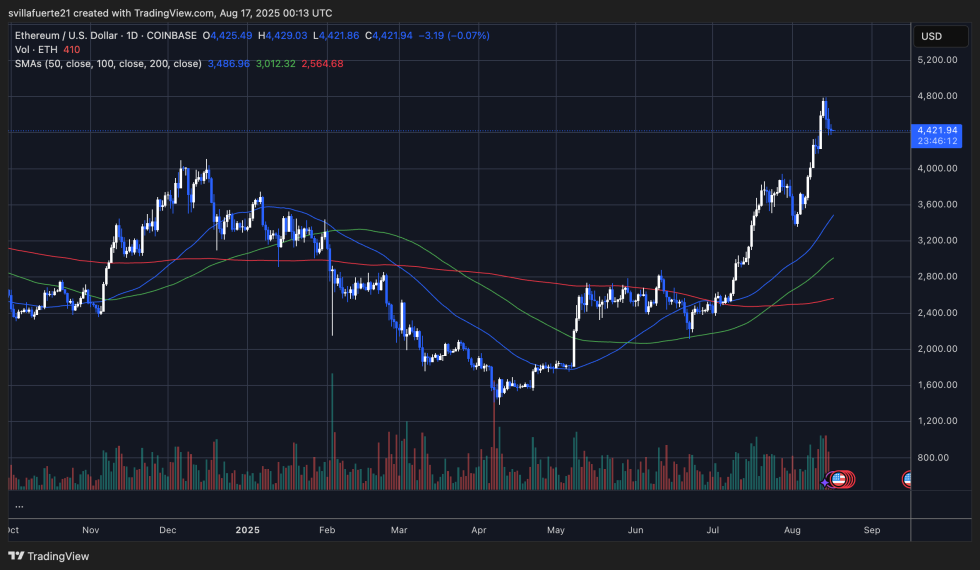
Ethereum consolidates around key level | Source: ETHUSDT chart on TradingView

The 50-day moving average (blue line) continues to trend upward, providing dynamic support near $3,480. Meanwhile, the 100-day (green) and 200-day (red) moving averages sit much lower at $3,012 and $2,564 respectively, showing how extended this move has been. ETH remains well above these long-term averages, confirming that bulls still control momentum.

The retrace resembles a healthy correction, allowing the market to digest gains and reset before the next move higher. If ETH holds above the $4,200–$4,300 zone, this level could act as a strong base for another push toward the $4,800–$5,000 resistance.

On the downside, a break below $4,200 could open the way toward the $3,800–$3,900 support area, aligning with the rising moving averages. Overall, ETH remains in a bullish trend, with corrections looking more like pauses than reversals.

Featured image from Dall-E, chart from TradingView

Editorial Process for bitcoinist is centered on delivering thoroughly researched, accurate, and unbiased content. We uphold strict sourcing standards, and each page undergoes diligent review by our team of top technology experts and seasoned editors. This process ensures the integrity, relevance, and value of our content for our readers.

Sebastian's journey into the world of crypto began four years ago, driven by a fascination with the potential of blockchain technology to revolutionize financial systems. His initial exploration focused on understanding the intricacies of various crypto projects, particularly those focused on building innovative financial solutions. Through countless hours of research and learning, Sebastian developed a deep understanding of the underlying technologies, market dynamics, and potential applications of cryptocurrencies. As his knowledge grew, Sebastian felt compelled to share his insights with others. He began actively contributing to online discussions on platforms like X and LinkedIn, focusing on fintech and crypto-related content. His goal was to expose valuable trends and insights to a wider audience, fostering a deeper understanding of the rapidly evolving crypto landscape. Sebastian's contributions quickly gained recognition, and he became a trusted voice in the online crypto community. To further enhance his expertise, Sebastian pursued a UC Berkeley Fintech: Frameworks, Applications, and Strategies certification. This rigorous program equipped him with valuable skills and knowledge regarding Financial Technology, bridging the gap between traditional finance (TradFi) and decentralized finance (DeFi). The certification deepened his understanding of the broader financial landscape and its intersection with blockchain technology. Sebastian's passion for finance and writing is evident in his work. He enjoys delving into financial research, analyzing market trends, and exploring the latest developments in the crypto space. In his spare time, Sebastian can often be found immersed in charts, studying 10-K forms, or engaging in thought-provoking discussions about the future of finance. Sebastian's journey as a crypto analyst and investor has been marked by a relentless pursuit of knowledge and a dedication to sharing his insights. His ability to navigate the complex world of crypto, combined with his passion for financial research and communication, makes him a valuable asset to the industry. As the crypto landscape continues to evolve, Sebastian remains at the forefront, providing valuable insights and contributing to the growth of this revolutionary technology.

Trending Cryptos

Related Reads

You Use Claude and Codex Every Day, but Meta Has Restricted Internal Use

In May, Meta imposed internal restrictions on its engineers regarding the use of Claude Code and Codex, two widely used AI programming tools. Despite being a major client, Meta's guidelines, still in effect, prohibit these external models from being used for specific tasks to prevent potential "escalations with partners." The core concern is "distillation"—the risk that outputs from Claude or Codex could inadvertently contaminate the training data and evaluation processes for Meta's in-house AI coding assistant, MetaCode. If MetaCode is trained or evaluated using data generated by these external models, it risks learning their capabilities rather than developing its own, blurring the line of intellectual origin. The restrictions are precise: engineers cannot use the external models to generate test questions, debug source code, or suggest test cases. AI-generated content is also barred from environments accessible to MetaCode. However, AI can still assist with peripheral tasks like workflow setup and code organization, provided all outputs are manually reviewed. This caution reflects a broader industry dilemma. While distillation is a common technique, using a competitor's model output for training raises legal and ethical questions about the ownership of derived capabilities. Contractual terms from companies like OpenAI and Anthropic explicitly forbid using their outputs to build competing products, putting enforcement power in the hands of rivals. The move is also financially motivated, as Meta seeks to reduce its hefty internal AI spending, estimated in the billions this year. Meta's policy illustrates the delicate balance companies must strike: leveraging powerful external AI tools while safeguarding the integrity and independence of their own AI development. As AI systems increasingly help build other AIs, distinguishing the origin of capabilities becomes a fundamental challenge for the entire industry.

marsbit1h ago

You Use Claude and Codex Every Day, but Meta Has Restricted Internal Use

marsbit1h ago

Why Do We Need an AI Content Perspective Today?

The article "Why Do We Need an AI Content Perspective Today?" explores the complex and often contentious integration of AI into the cultural and creative industries, particularly film and television. It begins with the cancellation of Amazon's AI-generated animation "Punky Duck," highlighting the ethical debates surrounding AI content. AI's rapid advancement is transforming video production, enabling cost-effective, full-length AI films (e.g., "RAPHAEL," "Dreams of Violets") while sparking industry resistance over issues like "synthetic actors." The core debate has shifted from whether to use AI to how to use it responsibly. The article analyzes why AI's entry into film is uniquely unsettling. It distinguishes between "cultural fast food" (short-form, fast-paced content like micro-dramas) and "cultural main courses" (traditional, long-form film/TV). AI currently excels at the former, matching its fragmented narratives, shallow emotional needs, and free-to-consumer models. However, venturing into the latter challenges the human-centric essence of storytelling—creativity, emotional depth, and the unique value of human labor and experience. While AI can generate massive volumes of content and lower costs, it risks devaluing human creativity, leading to homogenized output, and creating unfair competition through potential intellectual property infringement. Its efficiency also amplifies content safety risks, making preemptive governance crucial. To counter these risks, the article proposes establishing clear boundaries guided by a human-centered AI content perspective. It outlines four principles: 1) Amplify, rather than displace, human creative space; 2) Respect and protect human creative output; 3) Ensure human creative control and responsibility remain paramount; and 4) Guarantee transparency and traceability in AI creation. The conclusion emphasizes that humans must act as the "helmsmen" of technology, steering AI development to enhance, not replace, the core human values at the heart of cultural expression.

marsbit2h ago

Why Do We Need an AI Content Perspective Today?

marsbit2h ago

Trading

Spot

Hot Articles

Discussions

Welcome to the HTX Community. Here, you can stay informed about the latest platform developments and gain access to professional market insights. Users' opinions on the price of ETH (ETH) are presented below.

活动图片