Solana vs. Ethereum Erupts Over Nasdaq Throughput Claim

bitcoinistPublished on 2025-08-12Last updated on 2025-08-12

Abstract

A weekend post on X from the official Solana account ignited a fresh round of cross-chain sniping after it juxtaposed...

Trusted Editorial content, reviewed by leading industry experts and seasoned editors. Ad Disclosure

A weekend post on X from the official Solana account ignited a fresh round of cross-chain sniping after it juxtaposed the Ethereum network’s transaction speed with Nasdaq’s trade throughput. “When they say the future of markets runs at 22 TPS but NASDAQ handles 2k trades per second,” Solana wrote on August 9, implicitly positioning the layer-1 as better aligned with modern market plumbing.

Ethereum users bristled, arguing the comparison was a category error between an open, permissionless blockchain and a closed, centralized exchange network. The sharpest rebuttal came from the pseudonymous researcher polynya (@apolynya), who has 94,000 followers on X.

Solana Vs. Ethereum

In a detailed post, polynya argued that the technical baselines underlying US equities infrastructure dwarf anything a minimally decentralized layer-1 can achieve under global consensus. “Nasdaq’s SIP is designed to handle 10 million operations per second, with a latency of 0.02 milliseconds (though realistically, constrained by speed of light, it still gets to 0.2 ms between NYSE or Cboe and Nasdaq), and is readily parallelisable for infinite throughput. (There are three SIPs operating currently.),” polynya wrote.

From that premise, the conclusion was blunt: “Given the crippling limitation of achieving strict global consensus, Nasdaq will forever be thousands of times faster and cheaper than any minimally decentralised L1 blockchain, short of exotic new physics that does not yet exist.”

Polynya added that if blockchains want to approach real-time markets, they must lean on succinct cryptography rather than raw TPS. “The only known method to get anywhere close is by using ZK proofs instead for real-time execution and deferring & speeding up strict global consensus by orders of magnitude (as you only need to achieve consensus on a succinct proof instead of millions of transactions), and even then, it’ll cost orders of magnitude more, will take years to mature, and it’s not an appropriate use of this tech as Nasdaq does not require strict global consensus anyway.”

The post ended with an indictment of the metric itself: “Totally wild that cryptobros are still coping about ‘TPS’ like it’s 2017 instead of building applications that make people’s lives better. (Degenerate gambling does not.)”
Solana Labs founder Anatoly Yakovenko (@aeyakovenko) pushed back on both the framing and the cryptographic remedy. He first contended that “Zk proofs are always slower than classical execution.” Expanding on that, Yakovenko argued the equities-style comparison—if one is to be made—should be about intake guarantees and scheduling rather than block TPS or consensus latency.

“Nasdaq requires that every message is included, and that all messages are treated the same,” he wrote, before pointing to how priority fees alter inclusion on blockchains: “The way that priority fees work is that any txs with a priority fee lower than the floor inclusion price in the block doesn’t get included. So the comparison to Nasdaq that matters is scheduler throughput and latency, not block tps or consensus latency. You can have 10 second blocks with 1000 tps, and a scheduler on the block producer that can reliably tell the trader that their tx is included in microseconds.”

From an economic perspective, Yakovenko suggested Solana’s design already drives the cost of marginal drops toward irrelevance. “If the floor priority fee is < spread / K for a pretty small K, then including additional messages is not going to improve spreads. Solana already achieved this. The floor inclusion price is a fraction of a basis point, which means that additional dropped messages have an economic value of less than a basis point. Dropping them vs including them has nearly zero marginal difference.”

The Misconception About ZK Proofs

He later returned to the ZK debate to stress where proofs do and do not help. “I don’t understand where people get this misconception that ZK proofs are faster or can somehow make a system faster. It’s completely wrong. They can lower some of the costs for replication, but they can’t improve performance if replication cost isn’t a blocker.”

Yakovenko illustrated the point with a bandwidth-versus-execution thought experiment: “Let’s assume that zk proofs are completely free and instant. If sizeof(tx) < sizeof(state change) then it’s nearly always faster to download the tx and execute it locally because local memory bandwidth and latency is better than network bandwidth and latency. It would take more time to download the state result from the transaction than downloading the transaction itself and using local copy of the state to execute it and produce the result.”

His bottom line targeted Ethereum’s cost model: “So the only place where zk proofs actually help is if replication is expensive. Where is replication insanely expensive? On ethereum L1. It’s cheaper to post a state root and a zk proof so the L1 can skip executing all the state.”

Solana community developer João Mendonça (@joaomendoncaaaa) argued that Solana’s ambition is not to equal Nasdaq’s raw speed. “the point of solana as a replacement for nasdaq is not to be as fast as nasdaq itself,” he wrote, but to offer similar execution prices “with 1000x the accessibility, worldwide, [without] asking for permission, 24/7, with uncensorable asset ownership and portability throughout all of defi.”

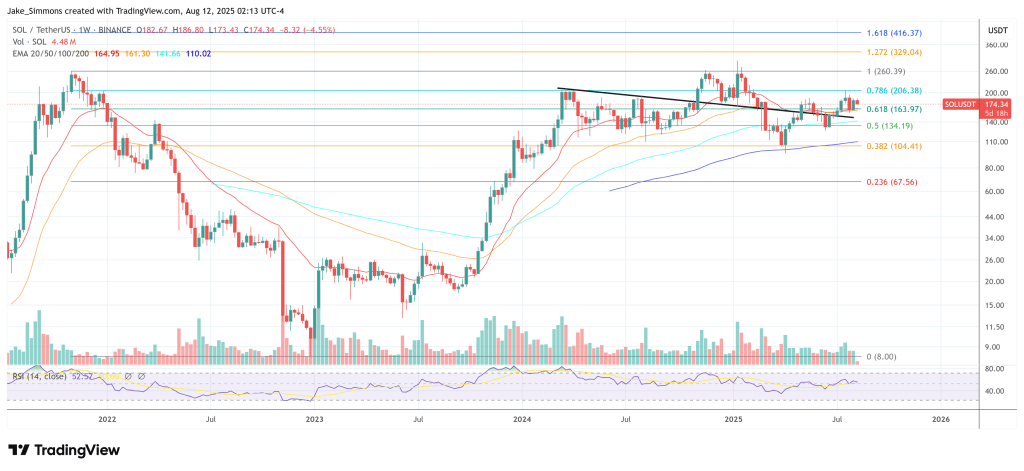
At press time, SOL traded at $174.34.
Solana news
SOL price holds above the 0.618 Fib, 1-week chart | Source: SOLUSDT on TradingView.com
Featured image created with DALL.E, chart from TradingView.com
Editorial Process for bitcoinist is centered on delivering thoroughly researched, accurate, and unbiased content. We uphold strict sourcing standards, and each page undergoes diligent review by our team of top technology experts and seasoned editors. This process ensures the integrity, relevance, and value of our content for our readers.

Jake Simmons has been a Bitcoin enthusiast since 2016. Ever since he heard about Bitcoin, he has been studying the topic every day and trying to share his knowledge with others. His goal is to contribute to Bitcoin's financial revolution, which will replace the fiat money system. Besides BTC and crypto, Jake studied Business Informatics at a university. After graduation in 2017, he has been working in the blockchain and crypto sector. You can follow Jake on Twitter at @realJakeSimmons.

Trending Cryptos

Related Reads

Karpathy's Genius Strikes Again, Challenging RAG, Turning Your Notes into a Second Brain

Andrej Karpathy has proposed a revolutionary concept for managing personal knowledge: treating notes as immutable "source code" and using LLMs as "compilers" to build a structured, interlinked wiki. This approach fundamentally shifts the cognitive workflow away from the limitations of RAG (Retrieval-Augmented Generation), which merely retrieves and pieces together fragments, leading to contradictions and "digital mummies"—unused, decaying notes. The LLM-Wiki framework introduces a three-layer architecture: the **Raw Layer** for original, immutable notes; the **Schema Layer** defining rules for structuring knowledge; and the **Wiki Layer**, where the LLM continuously compiles and maintains a coherent, cross-referenced knowledge base. Key operations are **Ingest** (adding new material, which triggers updates across related pages), **Query** (asking the compiled wiki, with answers that can become new pages), and **Lint** (periodic AI audits to find contradictions, outdated claims, or gaps). This system automates the tedious maintenance—updating links, resolving conflicts, keeping summaries fresh—that has historically made large-scale personal knowledge management unsustainable. It realizes Vannevar Bush's 1945 "Memex" vision by finally solving the maintenance problem. Karpathy's proposal represents a third piece in human-AI collaboration, following "Vibe Coding" and "Agentic Engineering." It liberates human attention from organizational drudgery, refocusing it on what matters: deciding what to read and deriving meaning.

marsbit3m ago

Karpathy's Genius Strikes Again, Challenging RAG, Turning Your Notes into a Second Brain

marsbit3m ago

Claude Science Completes Two Years' Work in a Few Weeks, Is 10x Research Acceleration Really Here?

Claude Science, a new AI workbench from Anthropic, is being tested by scientists, reportedly accelerating specific research workflows by up to 10x. A neuro-scientist at the Allen Institute completed a lengthy literature review in weeks instead of nearly two years using the tool, which automates tasks like citation verification. The platform is an integrated environment for macOS and Linux, connecting to local or remote computing resources. It streamlines the fragmented research process—literature analysis, computation, visualization, and drafting—into a single, auditable workflow. A key feature is its emphasis on reproducibility: every chart generated includes the exact code, environment, and history used to create it. Claude Science uses a multi-agent system. A coordinator manages over 60 pre-configured skills for life sciences (genomics, proteomics, etc.) and can spawn specialized agents. A dedicated reviewer agent checks citations and calculations for accuracy, creating a form of internal AI peer review. The system operates with a human-in-the-loop, requiring user approval for major steps. Initial applications are in life sciences. Examples include target identification for biotech company Manifold Bio and germline variant analysis for glioma research at UCSF, completing analyses in roughly one-tenth the previous time. The approach contrasts with competitors: Google focuses on proprietary models like AlphaFold, while OpenAI is advancing models' scientific reasoning with benchmarks like GeneBench-Pro. Claude Science differentiates by automating and integrating the practical research pipeline, not just the model's intelligence, aiming to make AI-aided science more reproducible and integrated into daily lab work.

marsbit7m ago

Claude Science Completes Two Years' Work in a Few Weeks, Is 10x Research Acceleration Really Here?

marsbit7m ago

The Invisible Force in Bitcoin's Bear Market: Accelerating On-Chain Payments and Institutional Adoption

Amidst ongoing Bitcoin price volatility, the quiet acceleration of on-chain payments and tokenized trading holds significant importance for investors and policymakers, especially with legislation like the CLARITY Act on the horizon. Major traditional financial institutions adopting these technologies are driving crucial discussions on compliance, security, and transparency, which are vital for broader market adoption. Key developments are shaping this evolution. First, blockchain traceability is moving beyond a simple "public vs. private" debate. New frameworks aim to standardize how financial data from immutable ledgers is analyzed and interpreted, making it as crucial as standardized financial reporting for building institutional trust. Second, while traditional finance supports clear digital asset regulation, they emphasize that an asset's economic function should dictate its regulatory treatment, advocating for robust consumer protections over broad exemptions. Furthermore, the growth of on-chain deposits at regulated institutions signals a shift. Major banks are leveraging blockchain not to replace but to upgrade existing services—like deposits and cross-border settlements—with benefits like 24/7 operations and programmable treasury management. This trend focuses more on modernizing financial infrastructure than creating speculative assets. Despite market turbulence, these underlying advancements in on-chain infrastructure point toward a more robust foundation for the industry's future.

Foresight News55m ago

The Invisible Force in Bitcoin's Bear Market: Accelerating On-Chain Payments and Institutional Adoption

Foresight News55m ago

Trading

Spot

Hot Articles

Discussions

Welcome to the HTX Community. Here, you can stay informed about the latest platform developments and gain access to professional market insights. Users' opinions on the price of ETH (ETH) are presented below.

活动图片