周末加密货币大涨:ETF 需求强劲,以太坊成推手

华尔街见闻Published on 2025-08-11Last updated on 2025-08-11

Abstract

瑞士区块链研究机构Swissblock预计这一趋势将持续,认为“随着市场进入新一轮周期,ETH正取代BTC成为市场主导”。

作为市值第二大的加密货币,以太坊(Ether)在刚刚过去的周末表现优于其他主要数字资产。

周一亚洲交易时段,其价格一度上涨2.9%,突破4300美元,达到自2021年12月以来的最高水平。过去7天,以太坊累计涨超20%。与此同时,比特币价格今日也突破12.1万美元,逼近历史高点。
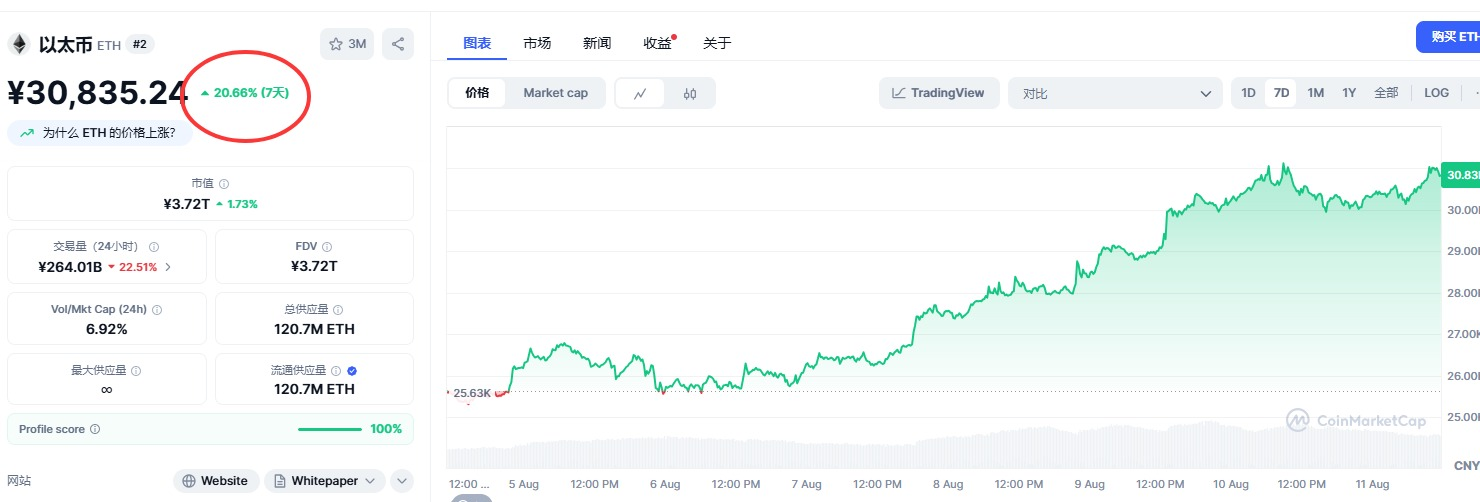
这轮上涨的背后,是大型投资者日益增长的兴趣。数据显示,今年以来,九只在美国上市的以太坊现货ETF已累计吸引了超过67亿美元的资金净流入。此外,所谓的“数字资产财务公司”——即那些将业务重心转向积累加密货币的上市公司——也为以太坊的上涨提供了动力。据strategicethreserve.xyz汇编的数据,这些公司迄今已储备了价值约130亿美元的以太坊。

数字资产大宗经纪公司FalconX Ltd的亚太区衍生品交易主管Sean McNulty表示,资金从比特币流向以太坊,构成了一次“由强劲的现货ETF资金流入、不断增长的企业财务采用以及更广泛的稳定币顺风所驱动的巨大积极情绪转变”。

期权市场同样反映出看涨情绪,以太坊整体看跌看涨比率为0.39。据Deribit数据显示,12月26日到期的看涨期权最高集中在6000美元执行价。

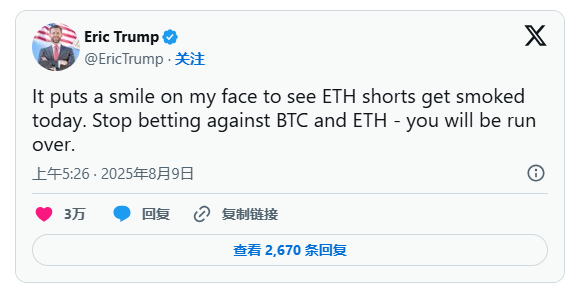
有趣的是,美国总统特朗普之子Eric Trump在X平台为以太坊涨势叫好。据彭博上周五报道,大型投资者正在就World Liberty Financial计划进行探讨,这一特朗普家族支持的企业拟设立持有其WLFI代币的上市公司。
ETF资金流向逆转

资金流动的变化是市场情绪最直接的体现。华尔街见闻文章写道,自5月以来,美国的以太坊现货ETF持续录得资金净流入,其吸金能力在近期显著超越了比特币。数据显示,在7月下旬的连续六个交易日中,以太坊ETF的净流入总额接近24亿美元,远高于同期比特币ETF的8.27亿美元。

这一趋势也反映在价格表现和衍生品市场上。过去几周,以太坊的表现持续优于比特币,两者价格比率已从2019年以来的低点强劲反弹。同时,芝加哥商品交易所(CME)的以太坊期货相对于现货的年化溢价已超过10%,高于比特币的水平,这促使部分交易员将头寸从比特币转向以太坊。

从比特币到以太坊,市场主导地位转移?

继多家企业将比特币作为财务储备资产后,一股类似的趋势正在以太坊上重演。高盛加密团队指出,与越来越多企业将比特币纳入财务储备类似,近期一些美国上市公司也开始建立以太坊储备。据估计,这些公司在过去一个月共购入超15亿美元ETH。

同时,过去几周以太坊表现远超比特币,两者价格比率自此前创下的2019年以来低点强劲反弹。以太坊CME期货相较现货的年化溢价已超过10%,超过比特币水平,促使部分头寸从比特币转向以太坊。

瑞士区块链研究机构Swissblock预计这一趋势将持续,认为“随着市场进入新一轮周期,ETH正取代BTC成为市场主导”。

Trending Cryptos

Related Reads

Robotic GPT-3 Moment Shakes Silicon Valley: Zero Lines of Code, Learns Instantly, with Investments from Jensen Huang and Fei-Fei Li

Generalist AI's newly released robot foundation model GEN-1.5 is being hailed as the "GPT-3 moment" for embodied AI. The model demonstrates remarkable one-shot and few-shot learning capabilities in physical manipulation tasks. By watching a single 3-12 second demonstration video (physical prompting) without any training or code, the robot can attempt the task with a 59% average success rate across 10 tasks. With just 5 minutes of demonstration data and minimal fine-tuning (10 gradient steps), the success rate jumps to 83%. The most significant breakthrough is the emergence of spontaneous, improvisational problem-solving abilities not present in the training data. For instance, after learning to sweep blocks with a brush, the robot can adapt to use a banana similarly or switch to a completely new "scoop-and-pour" strategy when given a dustpan. Other emergent behaviors include removing obstacles, correcting errors, and spontaneously sorting objects. These capabilities stem from over 8 months of large-scale pre-training on physical interaction data, suggesting the existence of a Scaling Law for embodied intelligence—where model generalization improves with more data and training time. This approach drastically reduces the cost and expertise needed to teach robots new skills, potentially democratizing robot programming. The release coincides with a surge in the humanoid robotics sector, marked by events like the World Robot Conference and significant investments. While the demonstrated tasks are still relatively simple, the scaling trend and emergent behaviors point toward a future where general-purpose robot "brains" could be easily adapted to various hardware "bodies," reshaping the industry's competitive landscape.

marsbit1h ago

Robotic GPT-3 Moment Shakes Silicon Valley: Zero Lines of Code, Learns Instantly, with Investments from Jensen Huang and Fei-Fei Li

marsbit1h ago

Trading

Spot

Hot Articles

Discussions

Welcome to the HTX Community. Here, you can stay informed about the latest platform developments and gain access to professional market insights. Users' opinions on the price of ETH (ETH) are presented below.

活动图片