9 万亿资金闯入加密:特朗普能否引爆一场「慢牛」长跑?

Foresight NewsPublished on 2025-08-08Last updated on 2026-06-01

Abstract

这是一场可能持续数年的长跑。

撰文:SoSoValue

8 月 7 日,特朗普一纸行政令,把美国最大的退休金池——401(k) 计划的投资菜单,从「传统三菜一汤」扩展到了「另类自助餐」,新菜包括私募股权、房地产,还有数字资产(比特币、以太坊等)。这可是历史首次,让高达 9 万亿美元、覆盖 9000 万美国人的长期资金可以开始接触加密市场。虽然这头「大象」真正迈进来,可能还要等半年到两年,但一旦它开始缓缓挪动脚步,这股稳定、持久的买盘,或许就是未来加密现货「慢牛」行情的源头活水。

什么是 401(k) 退休计划:雇主发起,雇员参与,自动扣钱,长期攒钱

401(k) 就是美国雇主帮员工开的一个长期养老储蓄账户,享有税收优惠。员工可以把一部分工资先不交税,直接存进这个账户投资,等退休了再取出来花。雇主会准备一份投资清单(一般有 20-30 只基金),员工自己决定投多少工资进去(比如 6%),再从清单里选基金、分配比例。工资会自动扣,雇主通常还会帮你「加码」——比如你投多少,他补一半,当作福利。

401(k) 计划的决策权:雇主说了算,还得当「稳妥的管家」

在 401(k) 里,雇主有很大的话语权,决定哪些基金能进清单,员工只能在清单里选,不能自己加菜。雇主在挑选基金公司或托管机构时,必须遵守「谨慎人原则」——也就是要像替自己家人理财一样小心。如果选错导致员工亏钱,雇主可能要承担法律责任。

401(k) 计划规模庞大:快到 9 万亿美元,9000 多万人参与

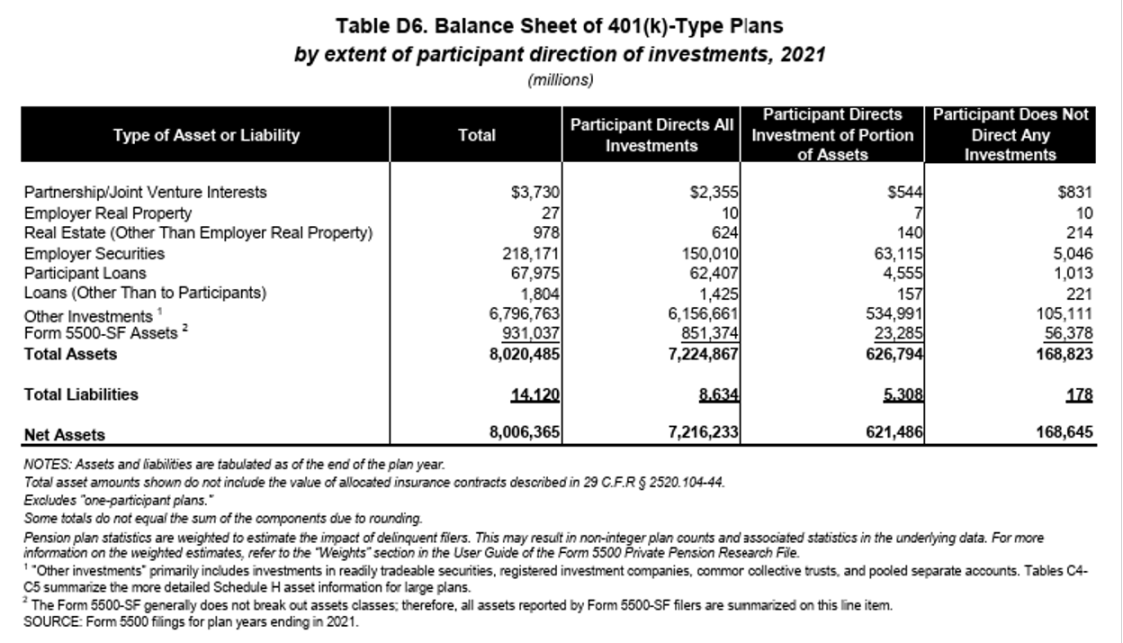
美国劳工部数据显示,2021 年 401(k) 总资产大约 8 万亿美元;美国投资公司协会的统计是,到 2025 年一季度,这个数字已经到了 8.7 万亿。白宫还透露,全美已有超过 9000 万人在用这个计划。
这次变化有多大?

历史首次:以前 401(k) 的投资清单里压根没加密资产,这次是政策首次打开大门。

潜在资金池:哪怕只有 2% 的 401(k) 资金流入加密,按 9 万亿算,就是 1700 亿美元的新买盘——而目前全球加密现货 ETF 和上市储备加起来也才 2600 亿美元。

市场影响:这样的长期资金一旦进场,足以改变加密市场结构——从短炒为主,变成更依赖长期资金的价格发现,形成稳步上涨的「慢牛」格局。

分析员观点:哪怕 401(k) 只掏出 2% 的零花钱,加密市场也能立马多出 1700 亿美元——这几乎相当于现有加密现货 ETF 和上市储备总盘子的三分之二。

资金落地还得走三步棋

先别急着欢呼,钱不会明天就砸进来,预计至少半年到两年的落地周期:

劳工部先出细则,明确 401(k) 怎么投另类资产、比例限制、产品披露等。

服务商设计符合规则的基金产品,把加密资产纳进去。

雇主决定要不要把这些新基金加入投资菜单,雇员再决定要不要配置

哪类加密资产最可能先上车?

加密现货 ETF 呼声最高,因为它们受 SEC 监管、合规性强、有稳定托管和估值机制,流动性也好。很可能被放进目标日期基金(TDF)或平衡型基金中,比例可能低于 5%,但影响依然巨大。

为什么这次和 2020 年不同?

2020 年,特朗普任内劳工部也放过类似「风声」,允许 401(k) 接触私募资产,但因为是部门自发行为,加上私募资产流动性差,最后雷声大雨点小。这次完全不同:

总统亲自签行政令,力度更高。

加密 ETF 流动性好,散户接受度高。

政策与财政部、SEC 等多方协调,是真正的顶层设计。

市场已经在反应

根据 SoSoValue 数据,配置前七大代币的 MAG7 指数代币,过去 24 小时涨幅近 5%,全年跑赢比特币 15.58 个百分点——说明资金还没来,市场的想象力已经先到了。

的加密雄心特朗普

行政令里还再次重申了他的口号——要让美国成为「世界加密之都」,并认为拥抱数字资产是推动经济增长和技术领先的必经之路。

一句话总结:这是一场可能持续数年的长跑。当 9 万亿美元的退休金大象,哪怕只是伸出一条腿踏进加密市场,也会让整个现货生态的地基发生改变。

Related Reads

Morning Post | Michael Saylor Releases Bitcoin Tracker Info; Aave Publishes Kelp rsETH Bridge Attack Post-Incident Investigation; Gravity Bridge Announces Service Suspension Following Attack

ChainCatcher Daily Summary - June 1, 2026 In regulatory news, the U.S. OCC granted preliminary conditional approval for Laser Digital to establish a federally regulated trust bank. In Vietnam, a draft law amendment proposes allowing SMEs to use digital and virtual assets as loan collateral. Hong Kong's SFC chairman reported that trading volume on the city's 12 licensed virtual asset platforms grew nearly 300% YoY in Q1 2026. Notable incidents include the Cosmos ecosystem cross-chain bridge Gravity Bridge pausing services after an attack. Aave published a post-mortem on the April 18th Kelp rsETH bridge attack, attributing it to a third-party bridge infrastructure vulnerability via an RPC poisoning attack, not the Aave protocol itself. In market developments, MicroStrategy's Michael Saylor hinted at a potential upcoming Bitcoin purchase announcement. Fed Governor Waller commented that widespread stablecoin adoption could amplify the impact of U.S. monetary policy. Meanwhile, sentiment analysis from Santiment indicates a record-high Bitcoin long/short ratio of 2.23, potentially signaling a short-term price correction, while Ethereum shows signs of FUD among commentators. In legal matters, the SEC sued the founder of Privvy Investments for an alleged $12.3 million crypto AI trading bot scam. In China, a Qingdao man was sentenced to 10 years and 9 months for stealing 107 BTC by obtaining a victim's wallet seed phrase. Top trending meme tokens on ETH, Solana, and Base networks for the past 24 hours are also listed.

链捕手39m ago

Morning Post | Michael Saylor Releases Bitcoin Tracker Info; Aave Publishes Kelp rsETH Bridge Attack Post-Incident Investigation; Gravity Bridge Announces Service Suspension Following Attack

链捕手39m ago

Alibaba 'Stocks Up', ByteDance 'Trains'

"In late May, two closely timed events in China's AI industry clearly revealed the divergent strategic approaches of two tech giants: Alibaba and ByteDance. Alibaba is aggressively integrating AI into its existing commercial ecosystem, prioritizing immediate monetization. Its Qwen App now fully integrates with Taobao, leveraging the platform's 4-billion-item database for AI-powered shopping features like virtual try-on and price comparison. Internally, Alibaba has reorganized to incentivize AI-driven business growth, notably through the 'Agentic Commerce Trust Protocol' to enable AI-agent transactions. Financially, it emphasizes ROI, with CEO Daniel Wu stating every AI chip purchased is generating revenue. Alibaba's strategy bets that foundational AI model capabilities won't be leapfrogged in the next five years, allowing its 'AI-as-a-utility' approach to succeed. In stark contrast, ByteDance's Seed division focuses on pushing the frontiers of AGI with a long-term, research-oriented mindset. Its video generation model, Seedance 2.0, topped international benchmarks. The division, led by researchers Wu Yonghui and product head Zhu Wenjia, is tasked with 'exploring the upper limits of intelligence,' even considering open-sourcing its models—a rare move among Chinese firms. ByteDance is investing heavily, with reports of its 2026 capital expenditure plan being nearly triple that of 2024, funded by its substantial private profits. This allows it to pursue projects like an 8-month research paper questioning if video models are true 'world models,' devoid of immediate commercial pressure. The core divergence is less about corporate philosophy and more about structural constraints. As a publicly traded company, Alibaba is bound to quarterly financial expectations, forcing a pragmatic, revenue-focused AI integration. As a private entity, ByteDance has the luxury to fund long-term, high-risk foundational research without answering to public markets. The article concludes that the true determinant of a Chinese company's AI path is its IPO status, suggesting that if ByteDance were public, or if Alibaba were private, their strategies might well be reversed."

marsbit2h ago

Alibaba 'Stocks Up', ByteDance 'Trains'

marsbit2h ago

Why More AI Agents Does Not Equal Higher Productivity?

Editor's Note: As AI Agents become cheaper and easier to use, a new constraint emerges: the cost isn't in launching more Agents, but in the human attention required to manage, judge, and integrate their outputs. This hidden cost is called the "orchestration tax." The article argues that a developer's cognitive bandwidth is the key bottleneck—a serial, non-parallelizable resource akin to a Global Interpreter Lock (GIL). While many Agents can run concurrently, their results ultimately require human judgment for review, conflict resolution, and final integration. Therefore, more Agents don't automatically mean higher productivity; they can simply create longer queues, lead to cognitive fatigue, and create the illusion of busyness without real output. The core solution is to design workflows around this scarce human attention. Key strategies include: scaling the number of Agents to match review capacity (not UI capacity), categorizing tasks (delegating independent ones, keeping complex judgment-heavy ones serial), batch reviewing results to minimize context-switching costs, automating verifiable checks to reserve human judgment for critical decisions, and protecting focused, uninterrupted thinking time. Ultimately, the critical skill is not launching many Agents, but architecting systems that respect the fundamental limit of human attention. Unpaid "orchestration tax" accumulates as both technical and cognitive debt, undermining system understanding and quality. True productivity comes from thoughtfully managing the single-threaded resource—your focus.

marsbit3h ago

Why More AI Agents Does Not Equal Higher Productivity?

marsbit3h ago

Trading

Spot
Futures

Hot Articles

What is $BITCOIN

DIGITAL GOLD ($BITCOIN): A Comprehensive Analysis Introduction to DIGITAL GOLD ($BITCOIN) DIGITAL GOLD ($BITCOIN) is a blockchain-based project operating on the Solana network, which aims to combine the characteristics of traditional precious metals with the innovation of decentralized technologies. While it shares a name with Bitcoin, often referred to as “digital gold” due to its perception as a store of value, DIGITAL GOLD is a separate token designed to create a unique ecosystem within the Web3 landscape. Its goal is to position itself as a viable alternative digital asset, although specifics regarding its applications and functionalities are still developing. What is DIGITAL GOLD ($BITCOIN)? DIGITAL GOLD ($BITCOIN) is a cryptocurrency token explicitly designed for use on the Solana blockchain. In contrast to Bitcoin, which provides a widely recognized value storage role, this token appears to focus on broader applications and characteristics. Notable aspects include: Blockchain Infrastructure: The token is built on the Solana blockchain, known for its capacity to handle high-speed and low-cost transactions. Supply Dynamics: DIGITAL GOLD has a maximum supply capped at 100 quadrillion tokens (100P $BITCOIN), although details regarding its circulating supply are currently undisclosed. Utility: While precise functionalities are not explicitly outlined, there are indications that the token could be utilized for various applications, potentially involving decentralized applications (dApps) or asset tokenization strategies. Who is the Creator of DIGITAL GOLD ($BITCOIN)? At present, the identity of the creators and development team behind DIGITAL GOLD ($BITCOIN) remains unknown. This situation is typical among many innovative projects within the blockchain space, particularly those aligning with decentralized finance and meme coin phenomena. While such anonymity may foster a community-driven culture, it intensifies concerns about governance and accountability. Who are the Investors of DIGITAL GOLD ($BITCOIN)? The available information indicates that DIGITAL GOLD ($BITCOIN) does not have any known institutional backers or prominent venture capital investments. The project seems to operate on a peer-to-peer model focused on community support and adoption rather than traditional funding routes. Its activity and liquidity are primarily situated on decentralized exchanges (DEXs), such as PumpSwap, rather than established centralized trading platforms, further highlighting its grassroots approach. How DIGITAL GOLD ($BITCOIN) Works The operational mechanics of DIGITAL GOLD ($BITCOIN) can be elaborated on based on its blockchain design and network attributes: Consensus Mechanism: By leveraging Solana’s unique proof-of-history (PoH) combined with a proof-of-stake (PoS) model, the project ensures efficient transaction validation contributing to the network's high performance. Tokenomics: While specific deflationary mechanisms have not been extensively detailed, the vast maximum token supply implies that it may cater to microtransactions or niche use cases that are still to be defined. Interoperability: There exists the potential for integration with Solana’s broader ecosystem, including various decentralized finance (DeFi) platforms. However, the details regarding specific integrations remain unspecified. Timeline of Key Events Here is a timeline that highlights significant milestones concerning DIGITAL GOLD ($BITCOIN): 2023: The initial deployment of the token occurs on the Solana blockchain, marked by its contract address. 2024: DIGITAL GOLD gains visibility as it becomes available for trading on decentralized exchanges like PumpSwap, allowing users to trade it against SOL. 2025: The project witnesses sporadic trading activity and potential interest in community-led engagements, although no noteworthy partnerships or technical advancements have been documented as of yet. Critical Analysis Strengths Scalability: The underlying Solana infrastructure supports high transaction volumes, which could enhance the utility of $BITCOIN in various transaction scenarios. Accessibility: The potential low trading price per token could attract retail investors, facilitating wider participation due to fractional ownership opportunities. Risks Lack of Transparency: The absence of publicly known backers, developers, or an audit process may yield skepticism regarding the project's sustainability and trustworthiness. Market Volatility: The trading activity is heavily reliant on speculative behavior, which can result in significant price volatility and uncertainty for investors. Conclusion DIGITAL GOLD ($BITCOIN) emerges as an intriguing yet ambiguous project within the rapidly evolving Solana ecosystem. While it attempts to leverage the “digital gold” narrative, its departure from Bitcoin's established role as a store of value underscores the need for a clearer differentiation of its intended utility and governance structure. Future acceptance and adoption will likely depend on addressing the current opacity and defining its operational and economic strategies more explicitly. Note: This report encompasses synthesised information available as of October 2023, and developments may have transpired beyond the research period.

363 Total ViewsPublished 2025.05.13Updated 2025.05.13

What is $BITCOIN

Discussions

Welcome to the HTX Community. Here, you can stay informed about the latest platform developments and gain access to professional market insights. Users' opinions on the price of BTC (BTC) are presented below.

活动图片