MicroStrategy 财报创历史新高:零债务比特币储备模式难被复制

比推Published on 2025-08-04Last updated on 2025-08-04

原文作者:Steven Ehrlich,Unchained

原文编译:Saoirse,Foresight News

原标题:Strategy营收创新高,比特币策略如何避免被清算?


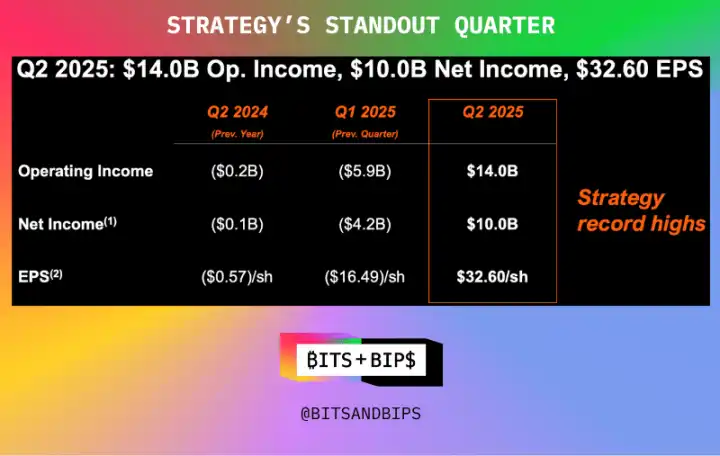
Strategy(MSTR)董事长 Michael Saylor 周五赢得了投资界的广泛赞誉,因其公司在上一季度创下了营业收入、净利润和每股收益的历史新高(见下图)。
事实上,该公司股价过去一年上涨了 166%,涨幅是同期比特币(BTC)的两倍。
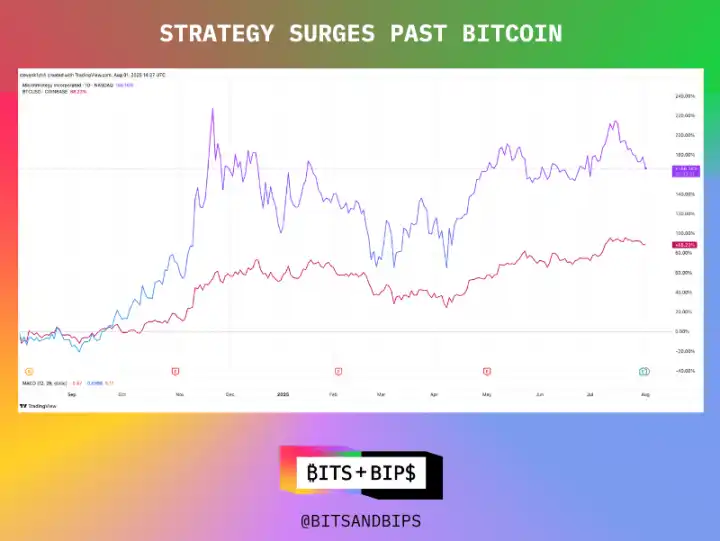
(交易视图)

无论以何种标准衡量,这样的业绩都堪称卓越。尤其在众多模仿者纷纷涌入、可能分流投资者资金的背景下,这样的表现更显难得。
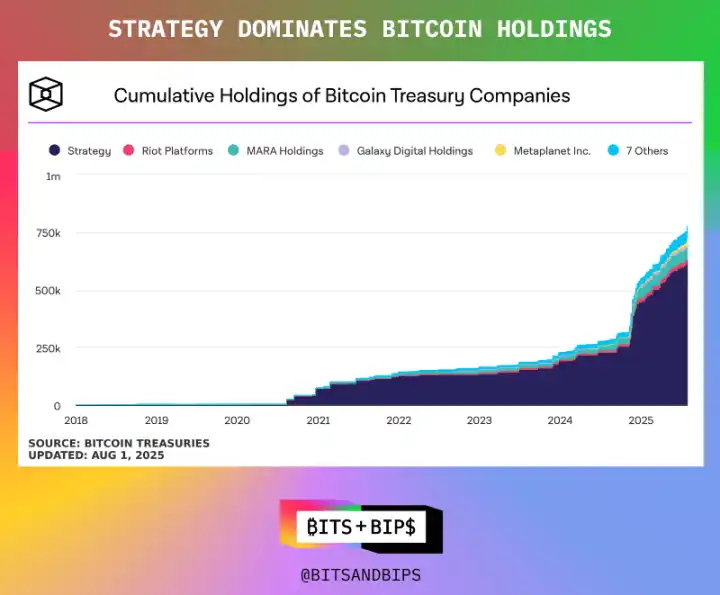
但这并不意味着 Strategy 可以固步自封。作为加密货币资金管理领域的领军者,它拥有一定特权,而如今似乎正准备充分利用这一优势。

比特币储备持续加码,策略却有新变化

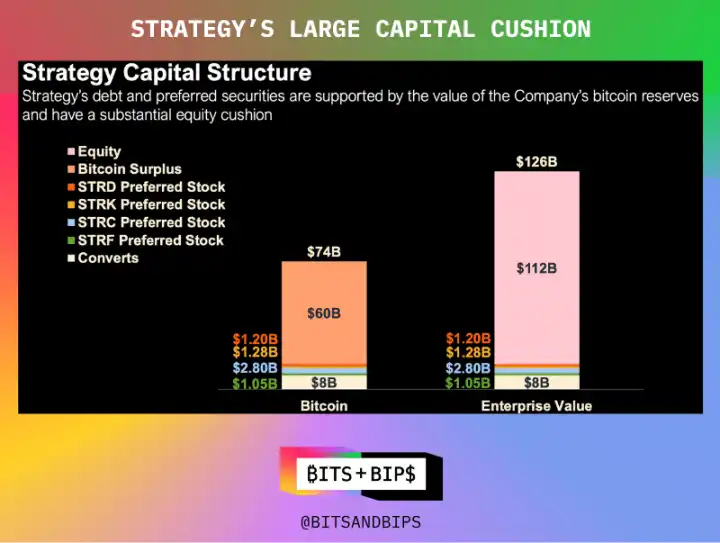
截至本文撰写时,Strategy 持有 628,791 枚比特币,价值 719 亿美元。该公司通过多种方式积累了这一资产组合:发行普通股、多种类型的优先股(这类股票在未来几年可提供股息或转换权),以及可转换债券。各类优先股的具体明细见下图。
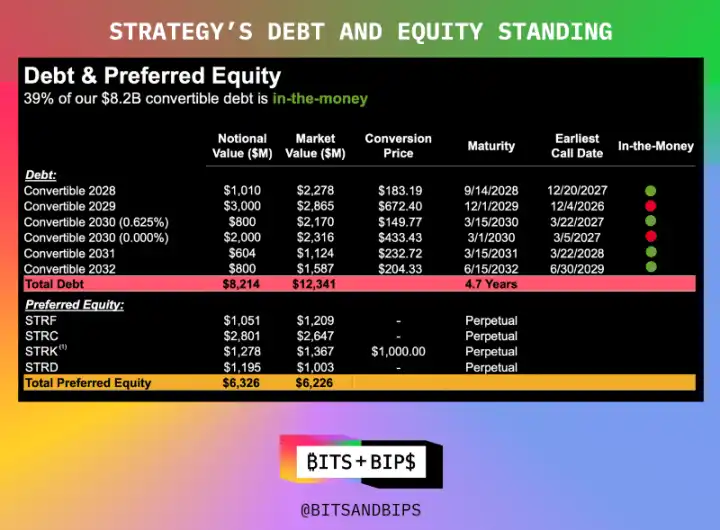
但现在,公司计划对融资方式进行重大调整——具体而言,是要彻底摆脱债务。尽管其资产负债表现状良好(根据财报,企业价值达 1260 亿美元,债务仅 82 亿美元),但公司仍希望将债务降至零。在 7 月 31 日财报发布后的投资者电话会议上,公司宣布计划赎回已发行的可转换债券,转而专注于多批次发行优先股。

这意味着其 63 亿美元的优先股发行规模有望大幅增长。事实上,在投资者说明会上,公司宣布计划通过最新的优先股产品 Stretch(STRC)再融资 42 亿美元,该产品的目标月收益率为 10%。

「这一决定体现了 Strategy 在资本市场融资能力的良性发展。可转换债券市场充斥着对冲基金和套利者,他们通过购买可转债建立对 Strategy 的多头头寸,但同时会通过大量做空股票(约 25%)来降低净风险敞口。也就是说,他们每买一份债券就会卖出大量股票,对 Strategy 其实只是轻度看多,」TD Cowen 董事总经理 Lance Vitanza 在接受《Unchained》采访时表示(完整讨论可在 X 平台或 YouTube 观看)。「几年前,可转债是公司最好的融资渠道。但随着 Strategy 的发展,他们已能进入优先股市场,这里的条款更优、增值潜力更大、定价效率更高。」
这一举措再次印证了为何 Saylor 在比特币社区被视为「半神」——他不仅因囤积比特币备受推崇,更因负责任的操作方式赢得尊重。除少数例外情况,他几乎从不通过杠杆融资,而是主要依赖股权市场。

尽管其稳健的资本结构已能避免强制清算(除非比特币价格暴跌 80% 以上),但 Saylor 仍在不断突破极限。

一直被模仿,从未被超越

但不要指望比特币、ETH、SOL、BNB 等领域的众多追随者会效仿这一做法。这些机构才刚刚起步,正如我在其他相关报道中所指出的,它们正急于通过竞争快速扩大规模。

这意味着它们会动用资本市场的所有工具:包括上市公司私募融资(PIPEs)、信贷额度,当然还有债务。

我在之前的报道中曾写道:「每种方式都各有利弊。私募融资能在短时间内筹集大量资金,有助于启动储备策略,但可能形成巨大的抛售压力。发行方也可选择向 SEC 注册股票后再发行,但融资周期更长。如今更多公司采用混合模式:三分之一资金来自私募融资,其余通过可转换债券或信贷工具筹集。这种方式虽能延缓抛售压力,却会增加资产负债表的杠杆,一旦价格暴跌就可能出问题。」

这意味着债务在融资时很实用:股东稀释可能在数年后才会显现,而且在当前的泡沫市场中,票面利率几乎为零。例如,比特币资金管理公司 Twenty One 在 5 月通过发行可转换债券融资 4.85 亿美元以启动其策略;Anthony Pompliano 6 月为其比特币资金管理公司 ProCap Financial 通过可转换债券融资 2.35 亿美元。

这本质上是一种「先买后付」的模式。

独一无二的存在

对投资者而言,这意味着他们需时刻谨记:在如今拥挤的加密货币资金管理领域,Strategy 仍是独角兽般的存在。目前,它是唯一能进入优先股市场的公司。其首次优先股发行就在今年 1 月,而未来的发行规模还将大幅扩大。

对其他公司而言,进入优先股市场并消除债务仍只是愿景。「这些公司大多会从可转换债券市场起步,希望其中一些能发展壮大,最终获得进入优先股市场的资格,」Vitanza 说。

说明: 比推所有文章只代表作者观点,不构成投资建议

Related Reads

The Merger of Codex and ChatGPT Marks the Beginning of a Major Reshuffle in Programming Tools

OpenAI is shifting its strategic focus from ChatGPT to Codex, merging them along with the browser tool Atlas into a unified desktop super-app. This move signals an internal belief that Codex, originally a programming tool, represents the next evolution of AI more than conversational models like ChatGPT. Over the past year, Codex's weekly active users have surged past 5 million. The key distinction is that while ChatGPT answers questions, Codex executes tasks. Enterprises increasingly value this ability to get work done over simply receiving advice. Consequently, Codex is attracting professionals beyond developers, including analysts, bankers, marketers, and product managers. OpenAI's reorganization and increased investment in Codex stem from recognizing that the future of AI competition lies in execution capabilities, not just conversation. The company is launching role-specific plugins (e.g., for data analysis, sales, design) to transform Codex into a broad knowledge work platform that automates and redefines white-collar workflows. Beyond being a tool, Codex reflects OpenAI's ambition to redefine software. New features like "Sites"—which generates interactive websites from documents—and collaborative "Annotations" aim to create a paradigm where the AI understands the goal and handles the tools and steps, functioning more like a digital colleague than traditional software. The ultimate goal is a unified experience where the user cares only about the completed task.

marsbit4m ago

The Merger of Codex and ChatGPT Marks the Beginning of a Major Reshuffle in Programming Tools

marsbit4m ago

Interpreting Investment Opportunities in the Age of Great Navigation, Invesco Great Wall Fund Releases '2026 Report on Chinese Enterprises Going Global'

Invesco Great Wall Fund has released its "2026 China Corporate Globalization Report," titled "The 'Great Navigation Era' of Chinese Enterprises." The report analyzes the new trends and investment opportunities as Chinese companies expand globally, moving from simple product exports to comprehensive overseas operations involving services, branding, and local production. Driven by factors like trade friction, the pursuit of higher profit margins abroad, and policy support, globalization is becoming essential for Chinese companies. The report outlines an evolution: from early product export ("Globalization 1.0") to the current "Globalization 2.0," characterized by overseas capacity, capital goods investment, consumer brand expansion, and service exports. Chinese firms' competitive advantages are highlighted, including a vast engineer talent pool, low-cost and robust infrastructure, and complete industrial clusters. Specific sectors with significant出海 potential are identified: * **Capital Goods** (e.g., engineering machinery, power equipment): Benefiting from global demand, especially in Belt & Road markets and the AI-driven power grid upgrade cycle. * **Consumer Brands**: Transitioning from cost to brand advantage, leveraging供应链 efficiency. * **Technology & Innovation**: Including AI applications, optical modules within global tech supply chains, and new energy vehicles focusing on local production. * **Pharmaceuticals**: Chinese biotech firms are becoming preferred partners for global pharma, with potential for breakthrough drugs in areas like oncology and weight loss. The report concludes that corporate globalization represents a sustained, core theme for China's capital markets, though companies must navigate challenges like geopolitics and localization.

marsbit17m ago

Interpreting Investment Opportunities in the Age of Great Navigation, Invesco Great Wall Fund Releases '2026 Report on Chinese Enterprises Going Global'

marsbit17m ago

GitHub, Transfixed by AI

On the night of February 9th, GitHub suffered a major outage caused by a simple configuration change—reducing a cache refresh interval from 12 to 2 hours—that triggered a cascade of failures. This was not an isolated event, but part of a broader pattern. In early 2026, GitHub experienced at least 8 major incidents, failing to meet its promised 99.9% availability. These outages stemmed from structural issues: explosive growth in load, tight service coupling, and insufficient protection against abnormal traffic. This unprecedented load is driven by AI Agents. In 2025, GitHub handled ~1 billion commits. By 2026, weekly commits reached 275 million, projecting to ~14 billion for the year—a 14x increase. AI tools like Claude Code now contribute 4.5% of all public repository commits, with weekly submissions surging 25x in just three months. AI-generated pull requests jumped from 4 million to 17 million per month in half a year. Unlike human developers, AI Agents work continuously, generating commits at a scale that overwhelms infrastructure designed for human rhythms. The surge also shattered GitHub's business model. Copilot's flat-rate pricing, based on assisting human developers, became unsustainable as Agentic AI sessions consumed resources worth hundreds of dollars for a few dollars in fees. In response, GitHub imposed usage limits and, by June 1st, shifted to a pay-per-use "AI Credits" system. Facing this new reality, GitHub realized a 10x scaling plan was insufficient. It announced a need to *redesign* its architecture for 30x current scale—decoupling services, adding fault isolation, and improving change management to prevent cascading failures. Other platforms like Stripe and AWS are facing similar challenges with AI Agents. Fundamentally, GitHub is transitioning from a human collaboration platform to an "exhaust pipe" for automated AI workflows. Its detailed post-mortem reports aim to maintain trust during this turbulent rebuild. The February outage was not just a technical glitch, but a signal of the software industry's entry into a new, AI-driven era.

marsbit56m ago

GitHub, Transfixed by AI

marsbit56m ago

Trading

Spot
Futures

Hot Articles

What is $BITCOIN

DIGITAL GOLD ($BITCOIN): A Comprehensive Analysis Introduction to DIGITAL GOLD ($BITCOIN) DIGITAL GOLD ($BITCOIN) is a blockchain-based project operating on the Solana network, which aims to combine the characteristics of traditional precious metals with the innovation of decentralized technologies. While it shares a name with Bitcoin, often referred to as “digital gold” due to its perception as a store of value, DIGITAL GOLD is a separate token designed to create a unique ecosystem within the Web3 landscape. Its goal is to position itself as a viable alternative digital asset, although specifics regarding its applications and functionalities are still developing. What is DIGITAL GOLD ($BITCOIN)? DIGITAL GOLD ($BITCOIN) is a cryptocurrency token explicitly designed for use on the Solana blockchain. In contrast to Bitcoin, which provides a widely recognized value storage role, this token appears to focus on broader applications and characteristics. Notable aspects include: Blockchain Infrastructure: The token is built on the Solana blockchain, known for its capacity to handle high-speed and low-cost transactions. Supply Dynamics: DIGITAL GOLD has a maximum supply capped at 100 quadrillion tokens (100P $BITCOIN), although details regarding its circulating supply are currently undisclosed. Utility: While precise functionalities are not explicitly outlined, there are indications that the token could be utilized for various applications, potentially involving decentralized applications (dApps) or asset tokenization strategies. Who is the Creator of DIGITAL GOLD ($BITCOIN)? At present, the identity of the creators and development team behind DIGITAL GOLD ($BITCOIN) remains unknown. This situation is typical among many innovative projects within the blockchain space, particularly those aligning with decentralized finance and meme coin phenomena. While such anonymity may foster a community-driven culture, it intensifies concerns about governance and accountability. Who are the Investors of DIGITAL GOLD ($BITCOIN)? The available information indicates that DIGITAL GOLD ($BITCOIN) does not have any known institutional backers or prominent venture capital investments. The project seems to operate on a peer-to-peer model focused on community support and adoption rather than traditional funding routes. Its activity and liquidity are primarily situated on decentralized exchanges (DEXs), such as PumpSwap, rather than established centralized trading platforms, further highlighting its grassroots approach. How DIGITAL GOLD ($BITCOIN) Works The operational mechanics of DIGITAL GOLD ($BITCOIN) can be elaborated on based on its blockchain design and network attributes: Consensus Mechanism: By leveraging Solana’s unique proof-of-history (PoH) combined with a proof-of-stake (PoS) model, the project ensures efficient transaction validation contributing to the network's high performance. Tokenomics: While specific deflationary mechanisms have not been extensively detailed, the vast maximum token supply implies that it may cater to microtransactions or niche use cases that are still to be defined. Interoperability: There exists the potential for integration with Solana’s broader ecosystem, including various decentralized finance (DeFi) platforms. However, the details regarding specific integrations remain unspecified. Timeline of Key Events Here is a timeline that highlights significant milestones concerning DIGITAL GOLD ($BITCOIN): 2023: The initial deployment of the token occurs on the Solana blockchain, marked by its contract address. 2024: DIGITAL GOLD gains visibility as it becomes available for trading on decentralized exchanges like PumpSwap, allowing users to trade it against SOL. 2025: The project witnesses sporadic trading activity and potential interest in community-led engagements, although no noteworthy partnerships or technical advancements have been documented as of yet. Critical Analysis Strengths Scalability: The underlying Solana infrastructure supports high transaction volumes, which could enhance the utility of $BITCOIN in various transaction scenarios. Accessibility: The potential low trading price per token could attract retail investors, facilitating wider participation due to fractional ownership opportunities. Risks Lack of Transparency: The absence of publicly known backers, developers, or an audit process may yield skepticism regarding the project's sustainability and trustworthiness. Market Volatility: The trading activity is heavily reliant on speculative behavior, which can result in significant price volatility and uncertainty for investors. Conclusion DIGITAL GOLD ($BITCOIN) emerges as an intriguing yet ambiguous project within the rapidly evolving Solana ecosystem. While it attempts to leverage the “digital gold” narrative, its departure from Bitcoin's established role as a store of value underscores the need for a clearer differentiation of its intended utility and governance structure. Future acceptance and adoption will likely depend on addressing the current opacity and defining its operational and economic strategies more explicitly. Note: This report encompasses synthesised information available as of October 2023, and developments may have transpired beyond the research period.

363 Total ViewsPublished 2025.05.13Updated 2025.05.13

What is $BITCOIN

Discussions

Welcome to the HTX Community. Here, you can stay informed about the latest platform developments and gain access to professional market insights. Users' opinions on the price of BTC (BTC) are presented below.

活动图片














