Analysts Expect a New Ethereum ATH, Despite $ETH Dropping 6% in 24H From Its $3,800 Price Point

bitcoinistPublished on 2025-08-03Last updated on 2025-08-04

Abstract

$ETH dropped 6% in the last 24 hours after touching on its target of $3.800, but crypto analysts still predict...

Trusted Editorial content, reviewed by leading industry experts and seasoned editors. Ad Disclosure

$ETH dropped 6% in the last 24 hours after touching on its target of $3.800, but crypto analysts still predict a new ATH soon.

According to a Glassnode report, $ETH owes its 6% contraction to long-term holders withdrawing their gains mid-rally.

As the report states:

‘Glassnode’s Net Unrealized Profit/Loss (NUPL) metric shows that Ethereum investor sentiment recovered from capitulation to belief, signaling a dramatic shift in market psychology.

Ethereum’s liquid supply rose by 8% while illiquid supply fell by 6% in Q2, suggesting that long-term holders were selectively realizing gains into the rally.’

Moreover, Glassnode points out that, despite trading close to its March 2024 highs, $ETH’s unrealized profits are far lower today by comparison.

This means that a 2025 Net Unrealized Profit (NUP) to match the 2024 numbers would push $ETH to $4,900, forcing the asset through the $5,000 psychological threshold.

Ethereum is Still Bullish

The investor sentiment is still bullish for Ethereum, according to Coinalyze, with the long/short ratio sitting at 72.52%-27.48%.
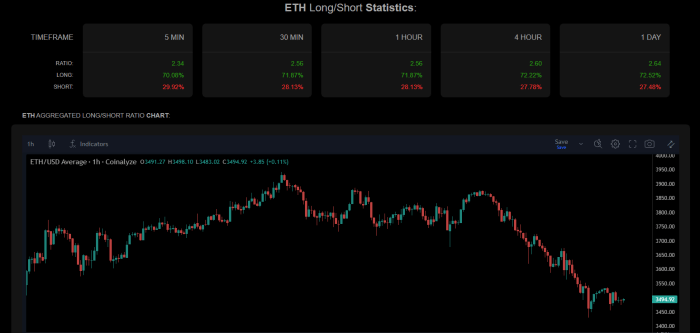
$ETH long/short statistics

These numbers showcase the overwhelming investor support and trust in the context of $ETH ETF inflows climbing to $5.38B in 19 days, between July 3 and July 22, at an average of $282.9M per day.

BlackRock’s ETHA led the rally with 78% of the total, or $4.19B, bringing the cumulative net inflows to $9.7B since July 2024.

Long-term, these numbers translate into upwards chart movement, despite temporary seatbacks like the most recent one.

Currently trading at $3,505, $ETH is once again eyeing the $3,800 resistance point after the market corrects itself. With that cleared, the $4,000 psychological threshold will be the only one holding Ethereum from a $5,000 ATH rally.

Such a performance would cause immediate ripples in the crypto market, bringing projects like SUBBD Token straight onto the main stage.

How SUBBD Token Redesigns the Content Creation Sphere

SUBBD Token ($SUBBD) aims to transform the content creation industry by empowering and bringing creators and fans closer together than ever with the power of AI.

The AI Personal Assistant has the role to manage the post-production process, cutting down some of the workflow and allowing the creator more time to produce more and higher-quality content.

SUBBD Token presale page

This will strengthen the relationship between creators and fans, which will ultimately reflect in the raw income numbers.

The AI Creator is another sophisticated AI tool that both creators and normal users can utilize to enhance their creativity. With the help of the AI Creator, anyone can now give birth to, advertise, and monetize their own digital influencer, with only their imagination as limitation.

These tools describe SUBBD Token as a transformative project that fills a niche in dire need of upgrading. In other words, SUBBD Token is the only project today that uses native AI tools to assist in the content creation process.

This fact alone imbues $SUBBD with a lot of post-launch potential, especially given the project’s current status and direction:

Despite being still in presale, SUBBD Token has already onboarded the top 2,000+ of the industry’s top earners, with a combined following of 250M+.

If you want to FOMO-join the project, you can purchase $SUBBD at the presale price of $0.056075 straight from the presale page.

Could $ETH Push Past $5,000?

It’s very difficult to predict $ETH’s movement, given the chaotic state of the crypto market, but the most relevant markers point at a coming bull run.

The increased investor interest, the low 2025 NUP, and the record-breaking ETH ETF inflows, all point at the same outcome: an imminent rally.

There’s no telling when it will start or where it’ll stop, but one thing is for certain: the market will rally with it, including presale projects like SUBBD Token ($SUBBD) with clear-cut utility and long-term potential.

Remember, this isn’t financial advice. Do your own research (DYOR) and invest wisely.

Editorial Process for bitcoinist is centered on delivering thoroughly researched, accurate, and unbiased content. We uphold strict sourcing standards, and each page undergoes diligent review by our team of top technology experts and seasoned editors. This process ensures the integrity, relevance, and value of our content for our readers.

As a crypto writer, Bogdan’s responsibilities are split between researching and writing articles and entertaining the team with his humor bordering on the politically incorrect, an aspiring Bill Burr, if you will. Thanks to his 12+ years of writing experience in just as many fields, including tech, cybersecurity, modelling, fitness, crypto, and other topics-that-shall-not-be-named, he's become a genuine asset to the team. While his position as a senior writer at PrivacyAffairs thought him valuable lessons about the power of self-management, his entire writing career was and is an exercise in self-improvement. Now, he's ready to sink his teeth into crypto and teach people how to take control of their own money on the blockchain. With fiat as an eternally devaluing currency, Bitcoin and altcoins seem like the best-fitting alternative for Bogdan. Bogdan’s biggest professional accomplishment, aside from securing a position as a main writer for Bitcoinist, was his 5-year run as a writing manager at Blackwood Productions, where he coordinated a team of four writers. During that time, he learned the value of teamwork and that of creating a working environment that breeds efficiency, positivity, and friendship.

Trending Cryptos

Related Reads

BIS Report Compliance Observations: The True Risks of Stablecoins Go Beyond 'De-pegging'

The BIS report, "Anchoring trust in money: innovation beyond stablecoins," highlights that the primary risks of stablecoins extend beyond potential de-pegging. It argues that the core challenge is whether stablecoins can be integrated into a financial system that is identifiable, monitorable, accountable, and regulatable. While acknowledging efficiency gains like faster payments and programmability, BIS emphasizes that money requires an institutional framework—including legal certainty, liquidity support, and financial integrity controls—which many stablecoins currently lack. The report details compliance risks, noting that while blockchain transactions are transparent, address visibility does not equate to identity or purpose clarity. This creates a systemic risk as pseudonymity, non-custodial wallets, and cross-chain bridges can undermine AML/CFT controls. Furthermore, these risks can spill over into the traditional financial system through on- and off-ramps. The future direction, per BIS, is not to prohibit innovation but to embed regulatory rules—such as identity verification and transaction screening—directly into the technological infrastructure of tokenized finance. The key takeaway for compliance is that any new financial instrument must clearly address questions of customer identification, transaction monitoring, accountability, and cross-border rule consistency to be viable as a mainstream payment tool.

marsbit50m ago

BIS Report Compliance Observations: The True Risks of Stablecoins Go Beyond 'De-pegging'

marsbit50m ago

When US Giants Collectively "Defect" to Chinese AI Models

When Silicon Valley Giants Turn to Chinese AI Models to Cut Costs A surprising trend is emerging: major U.S. tech companies are significantly reducing AI costs by switching to Chinese models. Coinbase, the largest U.S. cryptocurrency exchange, reportedly halved its AI spending after migrating to China's GLM-5.2 and Kimi 2.7 models, despite increasing usage. They achieved this through a sophisticated three-part strategy: implementing an automatic routing system to select the most cost-effective model per task, boosting cache hit rates from 5% to 60% to reuse computations, and employing "context engineering" to provide AI with more precise, less cluttered information. They are not alone. AI startup Lindy switched from Claude to DeepSeek, saving millions, while Snowflake's tests found GLM-5.2 solved 66% of coding tasks compared to Claude Opus's 67%—but at a fraction of the cost (output pricing is 5-7 times lower). While the top Western models may offer slightly better stability, the massive price differential is leading many businesses to reconsider their value proposition. This shift signals a deeper change in the AI industry, moving beyond pure performance benchmarks to a fierce cost competition. As pressure mounts, even OpenAI and Anthropic have begun slashing prices. For users, this means more choices, lower costs, and a crucial lesson: using multiple models based on task complexity, optimizing with caching, and keeping contexts lean are now key to leveraging AI efficiently and affordably.

marsbit57m ago

When US Giants Collectively "Defect" to Chinese AI Models

marsbit57m ago

BIS Report Compliance Watch: The Real Risks of Stablecoins Are Not Just 'De-pegging'

BIS Report Compliance Observations: The real risks of stablecoins go beyond "depegging" The BIS report "Anchoring trust in money: innovation beyond stablecoins" argues that while stablecoins and tokenization offer efficiency gains, their primary risk lies in fitting into an identifiable, monitorable, accountable, and regulatable financial system. Money's trust stems not just from technology but from institutional arrangements: a common unit of account, guaranteed redemption at par, liquidity support, regulatory frameworks, and financial integrity requirements. Stablecoins, operating on permissionless blockchains with pseudo-anonymity and non-custodial wallets, create systemic compliance gaps: unclear customer identity, incomplete fund origins, unexplained transaction purposes, fragmented cross-chain paths, and ambiguous liability. On-chain transparency does not equal compliance transparency. Public addresses don't reveal identity or intent. While blockchain analytics aid law enforcement, they cannot replace routine, large-scale AML/CFT controls. Effective compliance requires a closed-loop process encompassing customer onboarding, transaction monitoring, investigation, reporting, and audit. Stablecoin risks are not confined to the blockchain; they re-enter the traditional financial system via on/off-ramps, exchanges, and payment institutions. This forces banks to monitor client accounts for activity linked to virtual assets. The future direction is not to prohibit innovation but to embed rules into the technology. Tokenized finance should integrate with the existing two-tier monetary system, embedding compliance—like customer identification, pre-transaction screening, and auditable data trails—directly into the transaction flow. For compliance professionals, the key takeaway is that any new financial instrument must answer core questions: Who identifies the customer? Who monitors transactions? Who handles exceptions? Who is liable? Compliance is not the antithesis of innovation but the essential infrastructure for its sustainable growth.

链捕手58m ago

BIS Report Compliance Watch: The Real Risks of Stablecoins Are Not Just 'De-pegging'

链捕手58m ago

When American Giants 'Defect' to Chinese AI Models

Summary: The trend of major U.S. technology firms adopting more cost-effective Chinese AI models is gaining momentum. A prime example is Coinbase, the largest U.S. cryptocurrency exchange, which reportedly halved its AI expenditure by switching to Chinese models GLM-5.2 and Kimi 2.7, while its usage volume increased. This was achieved through a sophisticated cost-saving system featuring intelligent model routing (selecting the most suitable model per task), dramatically improving cache hit rates from 5% to 60%, and implementing "Context Engineering" to streamline prompts. This shift is not isolated. Other companies like the AI startup Lindy and data cloud firm Snowflake are making similar moves, drawn by the significant price disparity. For instance, GLM-5.2 costs $1.40/$4.40 per million tokens (input/output), compared to $5/$25 for Claude Opus 4.7. While top Western models may offer slightly higher stability or speed in complex tasks, the performance gap is narrowing, making the price difference harder to justify for many enterprise use cases. The implications are significant for both businesses and individual users. It highlights the importance of a multi-model strategy based on task requirements, the value of caching and reusing outputs, and the effectiveness of providing concise context. Ultimately, this migration signals a potential reshaping of the AI industry's pricing model, moving competition from pure performance benchmarks to practical cost-effectiveness, with increased choice and downward price pressure benefiting end-users.

链捕手1h ago

When American Giants 'Defect' to Chinese AI Models

链捕手1h ago

Trading

Spot

Hot Articles

Discussions

Welcome to the HTX Community. Here, you can stay informed about the latest platform developments and gain access to professional market insights. Users' opinions on the price of ETH (ETH) are presented below.

活动图片