In-Kind Bitcoin ETF Redemptions Are “A Bigger Deal Than You Think,” Says Expert

bitcoinistPublished on 2025-08-01Last updated on 2025-08-01

Abstract

The US Securities and Exchange Commission on July 29 approved orders permitting in-kind creations and redemptions for Bitcoin and crypto...

Trusted Editorial content, reviewed by leading industry experts and seasoned editors. Ad Disclosure

The US Securities and Exchange Commission on July 29 approved orders permitting in-kind creations and redemptions for Bitcoin and crypto exchange-traded products, reversing the cash-only constraint that governed January’s spot bitcoin launches and this spring’s ether funds. In a formal statement, the agency said bitcoin and ether ETPs “will be permitted to create and redeem shares on an in-kind basis,” aligning them with the mechanics long used by commodity ETPs. “It’s a new day at the SEC,” Chair Paul S. Atkins said, adding that the change should make the products “less costly and more efficient.”

Bloomberg Intelligence senior ETF analyst Eric Balchunas amplified the news on X, posting the Chair’s remarks: “It’s a new day at the SEC … [in-kind] creations and redemptions for a host of crypto asset ETPs.” His post underscored the policy turn: allowing authorized participants (APs) to deliver or receive bitcoin or ether directly, rather than routing cash through the issuer to buy or sell the underlying in the open market.

Why In-Kind Redemptions Are A Big Deal For The Bitcoin ETF Market

Bitwise President Teddy Fusaro followed with a technical explainer on July 30, arguing the shift will remove recurring frictions embedded in the cash-creation model. Under cash creations, an ETF facing inflows must “go out and buy bitcoin from the market,” typically paying at least some spread to the benchmark price.

For illustration, Fusaro posited a two-basis-point premium to the CME CF Bitcoin Reference Rate (New York variant) on a $100 million purchase: “If the ETF pays .02% above the benchmark price (BRRNY) on a $100 million purchase, that’s $20 [thousand].” Those costs, he wrote, do not disappear; they are billed back to the AP, passed on to the market maker, and “ultimately … the end shareholder” pays by way of a slightly higher share price. With in-kind, the AP instead delivers the requisite bitcoin, “without the .02% slippage,” taking that cost “out of the equation.”

The plumbing behind Fusaro’s example is familiar to ETF practitioners but often opaque to end investors. In the primary market, APs assemble creation units and exchange them with the trust for ETF shares; in a cash-only regime, this compels the issuer or its agent to source bitcoin at observable benchmarks plus execution costs. The BRRNY index—calculated from 3 p.m. to 4 p.m. New York time from trades on vetted constituent exchanges—anchors that pricing window in the U.S. trading day, but real-world fills still incur spreads and market impact.

In-kind substitutes bitcoin for cash in that exchange, enabling APs to contribute or receive the asset directly and net their inventory without forcing the fund to trade. Over time, that tends to tighten secondary-market spreads, reduce tracking noise around the close, and compress the “hidden” costs that wash through to investors during heavy creation or redemption day.

The SEC’s orders were broader than a single operational tweak. Alongside the in-kind relief, the Commission said it approved additional actions that “advance a merit-neutral approach” to crypto ETPs, including exchange applications to list and trade an ETP holding both spot bitcoin and spot ether, options on certain spot bitcoin ETPs, FLEX options on shares of specific BTC-based ETPs, and an increase of listed options position limits up to the generic ceilings—“up to 250,000 contracts”—for some bitcoin ETP options. The agency also issued scheduling orders to solicit comments on delegated approvals to list two large-cap crypto ETPs.

Commissioner Mark T. Uyeda framed the move as a correction of an outlier policy: before July 29, crypto ETPs “could not use in-kind creations and redemptions—in stark contrast to other forms of commodity ETPs—a limitation that resulted in unnecessary costs and burdens.” His statement dovetails with the cost channel Fusaro highlighted, and it helps explain why ETF market-makers and APs have lobbied for parity with gold and other commodity funds since spot crypto products debuted.

From a market-structure perspective, the implications are concrete rather than theoretical. In-kind mechanisms let APs manage bitcoin inventory across prime brokers, OTC desks, and custodians without compelling the fund to tap spot markets at the close. That, in turn, can sharpen the arbitrage that keeps ETF prices close to net asset value, especially during volatile sessions when cash creations may force hurried purchases above benchmarks.

The speed of implementation will vary by issuer; AP agreements, operations, and custody rails must be updated to support in-kind flows. But the policy baseline has shifted. At press time, BTC traded at $118,527.
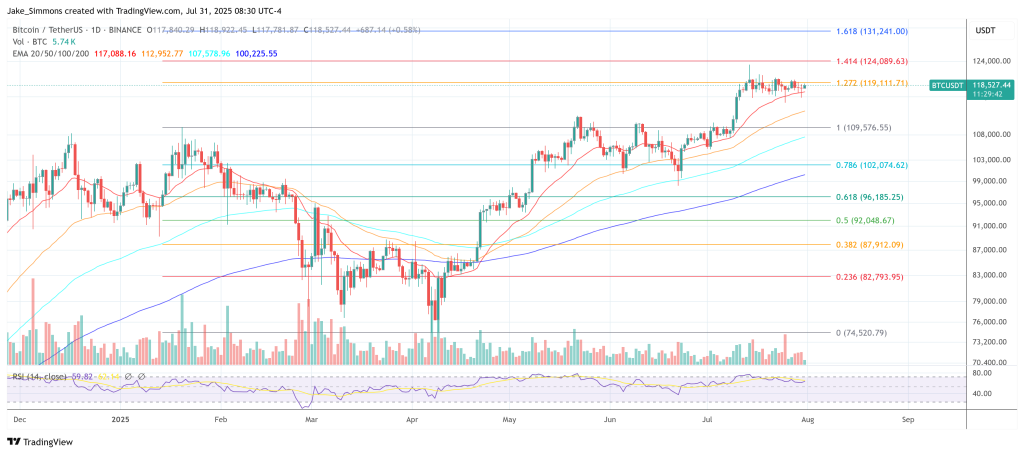
Bitcoin price
The 1.272 Fib remains key resistance, 1-day chart | Source: BTCUSDT on TradingView.com
Featured image created with DALL.E, chart from TradingView.com
Editorial Process for bitcoinist is centered on delivering thoroughly researched, accurate, and unbiased content. We uphold strict sourcing standards, and each page undergoes diligent review by our team of top technology experts and seasoned editors. This process ensures the integrity, relevance, and value of our content for our readers.

Jake Simmons has been a Bitcoin enthusiast since 2016. Ever since he heard about Bitcoin, he has been studying the topic every day and trying to share his knowledge with others. His goal is to contribute to Bitcoin's financial revolution, which will replace the fiat money system. Besides BTC and crypto, Jake studied Business Informatics at a university. After graduation in 2017, he has been working in the blockchain and crypto sector. You can follow Jake on Twitter at @realJakeSimmons.

Trending Cryptos

Related Reads

Stablecoins Are the 'Royalists' of the Crypto World: Open USD Brings the Old Monetary System into the Fray

Title: Stablecoins Are the "Royalists" of the Crypto World: Open USD Brings the Old Monetary System into the Fray The article analyzes the launch of Open USD, a new dollar-pegged stablecoin backed by a coalition of over 140 traditional financial, payment, and tech giants like Visa, BlackRock, and Google. Author Hu Yilin argues that stablecoins like Open USD represent not a "moderate" wing of the crypto revolution, but a "royalist reform" within the old monetary system. He posits that while stablecoins adopt blockchain's efficiency, programmability, and borderless nature, they fundamentally reinforce the US dollar's centrality and the Federal Reserve's authority. They aim to replace inefficient "bureaucrats" (like traditional payment networks) rather than challenge the "monarch" (the dollar-based system). Thus, Open USD symbolizes the old system co-opting blockchain technology to upgrade dollar hegemony, potentially marginalizing native crypto projects like Circle's USDC. Hu contrasts this with more revolutionary paths, like a "Bitcoin standard," which seeks to change the monetary base itself. He warns that if the crypto ecosystem's unit of account, collateral, and value anchor remain dollar-denominated stablecoins,链上繁荣 may enrich the traditional financial system ("off-chain") rather than granting monetary premium to native crypto assets like ETH. Projects with civilizational ambitions, he argues, cannot reduce their narrative to mere "fuel" or transaction fees but must grapple with the core revolutionary idea: that a decentralized market does not require a central bank as the anchor of monetary order.

marsbit2h ago

Stablecoins Are the 'Royalists' of the Crypto World: Open USD Brings the Old Monetary System into the Fray

marsbit2h ago

Trading

Spot

Hot Articles

What is $BITCOIN

DIGITAL GOLD ($BITCOIN): A Comprehensive Analysis Introduction to DIGITAL GOLD ($BITCOIN) DIGITAL GOLD ($BITCOIN) is a blockchain-based project operating on the Solana network, which aims to combine the characteristics of traditional precious metals with the innovation of decentralized technologies. While it shares a name with Bitcoin, often referred to as “digital gold” due to its perception as a store of value, DIGITAL GOLD is a separate token designed to create a unique ecosystem within the Web3 landscape. Its goal is to position itself as a viable alternative digital asset, although specifics regarding its applications and functionalities are still developing. What is DIGITAL GOLD ($BITCOIN)? DIGITAL GOLD ($BITCOIN) is a cryptocurrency token explicitly designed for use on the Solana blockchain. In contrast to Bitcoin, which provides a widely recognized value storage role, this token appears to focus on broader applications and characteristics. Notable aspects include: Blockchain Infrastructure: The token is built on the Solana blockchain, known for its capacity to handle high-speed and low-cost transactions. Supply Dynamics: DIGITAL GOLD has a maximum supply capped at 100 quadrillion tokens (100P $BITCOIN), although details regarding its circulating supply are currently undisclosed. Utility: While precise functionalities are not explicitly outlined, there are indications that the token could be utilized for various applications, potentially involving decentralized applications (dApps) or asset tokenization strategies. Who is the Creator of DIGITAL GOLD ($BITCOIN)? At present, the identity of the creators and development team behind DIGITAL GOLD ($BITCOIN) remains unknown. This situation is typical among many innovative projects within the blockchain space, particularly those aligning with decentralized finance and meme coin phenomena. While such anonymity may foster a community-driven culture, it intensifies concerns about governance and accountability. Who are the Investors of DIGITAL GOLD ($BITCOIN)? The available information indicates that DIGITAL GOLD ($BITCOIN) does not have any known institutional backers or prominent venture capital investments. The project seems to operate on a peer-to-peer model focused on community support and adoption rather than traditional funding routes. Its activity and liquidity are primarily situated on decentralized exchanges (DEXs), such as PumpSwap, rather than established centralized trading platforms, further highlighting its grassroots approach. How DIGITAL GOLD ($BITCOIN) Works The operational mechanics of DIGITAL GOLD ($BITCOIN) can be elaborated on based on its blockchain design and network attributes: Consensus Mechanism: By leveraging Solana’s unique proof-of-history (PoH) combined with a proof-of-stake (PoS) model, the project ensures efficient transaction validation contributing to the network's high performance. Tokenomics: While specific deflationary mechanisms have not been extensively detailed, the vast maximum token supply implies that it may cater to microtransactions or niche use cases that are still to be defined. Interoperability: There exists the potential for integration with Solana’s broader ecosystem, including various decentralized finance (DeFi) platforms. However, the details regarding specific integrations remain unspecified. Timeline of Key Events Here is a timeline that highlights significant milestones concerning DIGITAL GOLD ($BITCOIN): 2023: The initial deployment of the token occurs on the Solana blockchain, marked by its contract address. 2024: DIGITAL GOLD gains visibility as it becomes available for trading on decentralized exchanges like PumpSwap, allowing users to trade it against SOL. 2025: The project witnesses sporadic trading activity and potential interest in community-led engagements, although no noteworthy partnerships or technical advancements have been documented as of yet. Critical Analysis Strengths Scalability: The underlying Solana infrastructure supports high transaction volumes, which could enhance the utility of $BITCOIN in various transaction scenarios. Accessibility: The potential low trading price per token could attract retail investors, facilitating wider participation due to fractional ownership opportunities. Risks Lack of Transparency: The absence of publicly known backers, developers, or an audit process may yield skepticism regarding the project's sustainability and trustworthiness. Market Volatility: The trading activity is heavily reliant on speculative behavior, which can result in significant price volatility and uncertainty for investors. Conclusion DIGITAL GOLD ($BITCOIN) emerges as an intriguing yet ambiguous project within the rapidly evolving Solana ecosystem. While it attempts to leverage the “digital gold” narrative, its departure from Bitcoin's established role as a store of value underscores the need for a clearer differentiation of its intended utility and governance structure. Future acceptance and adoption will likely depend on addressing the current opacity and defining its operational and economic strategies more explicitly. Note: This report encompasses synthesised information available as of October 2023, and developments may have transpired beyond the research period.

588 Total ViewsPublished 2025.05.13Updated 2025.05.13

What is $BITCOIN

Discussions

Welcome to the HTX Community. Here, you can stay informed about the latest platform developments and gain access to professional market insights. Users' opinions on the price of BTC (BTC) are presented below.

活动图片