Ripple CTO Explains Why XRP Ledger Lags Despite 300+ Bank Deals

bitcoinistPublished on 2025-07-31Last updated on 2025-07-31

Abstract

Ripple chief technology officer David “JoelKatz” Schwartz moved to explain the gap between Ripple’s oft-touted roster of bank relationships and...

Trusted Editorial content, reviewed by leading industry experts and seasoned editors. Ad Disclosure

Ripple chief technology officer David “JoelKatz” Schwartz moved to explain the gap between Ripple’s oft-touted roster of bank relationships and the still-modest on-chain activity on the XRP Ledger (XRPL), responding at length on July 30 to a widely shared thread of questions from investor and YouTuber Andrei Jikh. In a series of posts on X, Schwartz pointed to compliance realities, institutional behavior, and product roadmap items—most notably a forthcoming “permissioned domains” model—as key reasons that institutional flows remain largely off-chain today.

300+ Bank Deals, Little Volume? Ripple CTO Answers

Jikh’s prompt captured long-standing critiques: after more than a decade and “300+ bank partnerships,” why isn’t the XRPL clearing “billions in daily on-chain volume,” why would payers choose a volatile asset like XRP over stablecoins, and—in a world saturated with fiat-linked tokens—do bridge assets still matter? He also raised questions about tokenization strategy, including why a firm such as BlackRock would select XRPL rather than operate a captive chain, and about geopolitical risk for non-US users.

Schwartz’s central explanation for sluggish on-chain settlement was blunt about the constraints facing regulated entities that cannot unknowingly transact against illicit counterparties on public DEX liquidity: “Even Ripple can’t use the XRPL DEX for payments yet because we can’t be sure a terrorist won’t provide the liquidity for payment. Features like permissioned domains will address this.” The post acknowledged “it has been very slow” to shift institutional flows on chain, even as he argued that institutions are “starting to see the benefits.”

Pressed by another user on whether the same counterparty-risk problem exists on other L1s, Schwartz said that, depending on how features are used, “generally decentralized exchanges on public layer 1’s don’t give you any control or knowledge of who your counterparties are.” The point was procedural rather than moral—“regulations aren’t always totally logical,” he added—underscoring why regulated payment flows have struggled to route through open liquidity.

Schwartz framed “permissioned domains” as a design intended to keep the ledger’s openness while giving compliance-bound participants a venue with rule-enforced counterparties. In follow-ups, he described a structure in which “retail is welcome in the permissioned parts provided they can prove they’re not sanctioned,” and said the “net effect” should be that liquidity in these domains remains comparable to the open side because of market-making between the two.

XRP Vs. Stablecoins

On the stablecoin question, Schwartz rejected the idea that XRP’s volatility automatically disqualifies it for payments. He argued there are use cases where volatility “isn’t a minus, or is even a plus,” and—separately—contended that a functioning bridge requires inventory: “A bridge currency only works if someone is holding it so that you can get it precisely when you need it.” He added that if users don’t know which asset they will need next, they may rationally hold the “dominant bridge” because it’s cheaper to pivot from a liquid hub asset into whatever comes next.

Schwartz also addressed whether bridge assets still matter if stablecoins increasingly cover most trading pairs. He allowed that “if one stablecoin wins,” it could act as the bridge, but said he doesn’t think a single stablecoin can win because each is “only…stable relative to one particular fiat currency” and anchored to jurisdictions. That multi-stablecoin reality, he argued, leaves room for a neutral bridge to connect a “long tail” of tokenized assets.

Asked why a heavyweight like BlackRock wouldn’t simply build its own chain for tokenization—especially as some brokerages do—Schwartz downplayed the importance of chain homogeneity in a world of interoperability and portability. He urged skeptics to “ask the same question about Circle—why don’t they launch USDC only on their own blockchain?” implying the obvious answer: ubiquity and liquidity come from meeting users where they are, across many networks.

On geopolitics, he drew a line between XRPL, which he described as neutral infrastructure, and Ripple’s enterprise products, which are segmented by jurisdiction. “If you’re asking about XRPL, it’s not really US based,” he wrote, adding that the ledger “has never discriminated against any particular participant,” and conceding that, for Ripple’s own products, licensing realities apply and some corridors—“North Korea or Cuba any time soon”—are out of bounds.

Schwartz further argued that XRP’s role within Ripple’s payments stack remains material even if much of it is not visible on public ledgers. “I don’t have the numbers in front of me,” he wrote, “but I’m pretty sure XRP’s use as a bridge in Ripple Payments dwarfs every other asset.” In a related point on XRPL design, he reminded readers that “XRP has a privileged place on the XRP Ledger.”

At press time, XRP traded at $3.13.
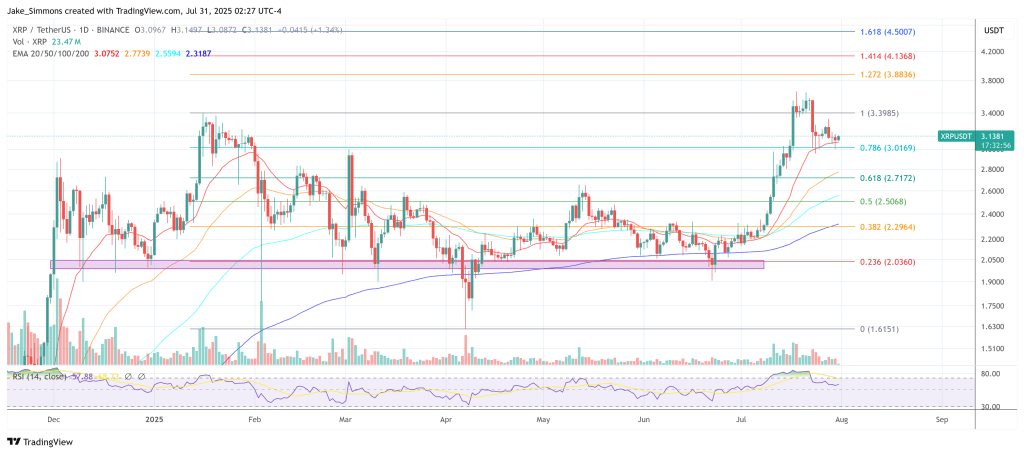
XRP price
XRP bulls defend the 0.786 Fib, 1-day chart | Source: XRPUSDT on TradingView.com
Featured image created with DALL.E, chart from TradingView.com
Editorial Process for bitcoinist is centered on delivering thoroughly researched, accurate, and unbiased content. We uphold strict sourcing standards, and each page undergoes diligent review by our team of top technology experts and seasoned editors. This process ensures the integrity, relevance, and value of our content for our readers.

Jake Simmons has been a Bitcoin enthusiast since 2016. Ever since he heard about Bitcoin, he has been studying the topic every day and trying to share his knowledge with others. His goal is to contribute to Bitcoin's financial revolution, which will replace the fiat money system. Besides BTC and crypto, Jake studied Business Informatics at a university. After graduation in 2017, he has been working in the blockchain and crypto sector. You can follow Jake on Twitter at @realJakeSimmons.

Trending Cryptos

Related Reads

Stablecoins Are the 'Royalists' of the Crypto World: Open USD Brings the Old Monetary System into the Fray

Title: Stablecoins Are the "Royalists" of the Crypto World: Open USD Brings the Old Monetary System into the Fray The article analyzes the launch of Open USD, a new dollar-pegged stablecoin backed by a coalition of over 140 traditional financial, payment, and tech giants like Visa, BlackRock, and Google. Author Hu Yilin argues that stablecoins like Open USD represent not a "moderate" wing of the crypto revolution, but a "royalist reform" within the old monetary system. He posits that while stablecoins adopt blockchain's efficiency, programmability, and borderless nature, they fundamentally reinforce the US dollar's centrality and the Federal Reserve's authority. They aim to replace inefficient "bureaucrats" (like traditional payment networks) rather than challenge the "monarch" (the dollar-based system). Thus, Open USD symbolizes the old system co-opting blockchain technology to upgrade dollar hegemony, potentially marginalizing native crypto projects like Circle's USDC. Hu contrasts this with more revolutionary paths, like a "Bitcoin standard," which seeks to change the monetary base itself. He warns that if the crypto ecosystem's unit of account, collateral, and value anchor remain dollar-denominated stablecoins,链上繁荣 may enrich the traditional financial system ("off-chain") rather than granting monetary premium to native crypto assets like ETH. Projects with civilizational ambitions, he argues, cannot reduce their narrative to mere "fuel" or transaction fees but must grapple with the core revolutionary idea: that a decentralized market does not require a central bank as the anchor of monetary order.

marsbit3h ago

Stablecoins Are the 'Royalists' of the Crypto World: Open USD Brings the Old Monetary System into the Fray

marsbit3h ago

Trading

Spot

Hot Articles

What is $BANK

Bank AI: A Revolutionary Step in the Future of Banking Introduction In an era marked by rapid advancements in technology, Bank AI stands at the intersection of artificial intelligence (AI) and banking services. This innovative project seeks to redefine the financial landscape, enhancing operational efficiency, security measures, and customer experiences through the power of AI. As we embark on this exploration of Bank AI, we will delve into what the project entails, its operational dynamics, its historical context, and significant milestones. What is Bank AI? At its core, Bank AI represents a transformative initiative aimed at integrating artificial intelligence into various banking operations. This project harnesses the capabilities of AI to automate processes, improve risk management protocols, and enhance customer interaction through personalised services. The primary objectives of Bank AI include: Automation of Banking Functions: By leveraging AI technologies, Bank AI aims to automate routine tasks, reducing the burden on human resources and enhancing efficiency. Enhanced Risk Management: The project utilises AI algorithms to predict and identify risks, thereby fortifying security measures against fraud and other threats. Personalisation of Banking Services: Bank AI focuses on offering tailored financial products and services by analysing customer data and behaviours. Improving Customer Experience: The implementation of AI-driven solutions, such as chatbots and virtual assistants, aims to provide users with more human-like interactions, revolutionising the way customers engage with banks. With these goals, Bank AI positions itself as a crucial player in rendering banking more efficient, secure, and user-centric. Who is the Creator of Bank AI? Details regarding the creator of Bank AI remain unknown. As such, no specific individual or organisation has been identified in the available information. The anonymity surrounding the project's inception raises questions but does not detract from its ambitious vision and objectives. Who are the Investors of Bank AI? Similar to the project's creator, specific information regarding the investors or supporting organisations of Bank AI has not been disclosed. Without this information, it is challenging to outline the financial backing and institutional support that might be propelling the project forward. Nevertheless, the importance of having a robust investment foundation is pivotal for sustaining development in such an innovative field. How Does Bank AI Work? Bank AI operates on several innovative fronts, focusing on unique factors that differentiate it from traditional banking frameworks. Below are key operational features: Automation: By applying machine learning algorithms, Bank AI automates various manual processes within banks. This results in reduced operational costs and allows human workers to redirect their efforts towards more strategic activities. Advanced Risk Management: The integration of AI into risk management practices equips banks with tools to accurately predict potential threats such as fraud, ensuring that customer information and assets remain secure. Tailored Financial Recommendations: Through continuous learning from customer interactions, the AI systems develop a nuanced understanding of user needs, enabling them to offer tailored advice on financial decisions. Enhanced Customer Interactions: Utilizing chatbots and virtual assistants powered by AI, Bank AI enables a more engaging customer experience, allowing users to have their queries resolved quickly, thus reducing wait times and improving satisfaction levels. Together, these operational features position Bank AI as a pioneer in the banking sector, establishing new benchmarks for service delivery and operational excellence. Timeline of Bank AI Understanding the trajectory of Bank AI requires a look at its historical context. Below is a timeline highlighting important milestones and developments: Early 2010s: The conceptualisation of AI integration into banking services began to gain attention as banking institutions recognised the potential benefits. 2018: A marked increase in the implementation of AI technologies occurred when banks started using AI tools like chatbots for basic customer service and risk management systems for improved security handling. 2023: The sophistication of AI continued to advance, with generative AI being introduced for more complex tasks such as document processing and real-time investment analysis. This year marked a significant leap in the capabilities afforded to banks by AI technology. 2024-Current Status: As of this year, Bank AI is on an upward trajectory, with ongoing research and developments poised to further enhance capabilities in banking operations. Continued exploration of AI applications hints at exciting developments yet to come. Key Points About Bank AI Integration of AI in Banking: Bank AI focuses on adopting artificial intelligence to streamline banking processes and improve user experiences. Automation and Risk Management Focus: The project strongly emphasises these areas, aiming to shift the burden of routine tasks while enhancing security frameworks through predictive analytics. Personalised Banking Solutions: By harnessing customer data, Bank AI enables tailored banking services that cater to individual user needs. Commitment to Development: Bank AI remains committed to ongoing research and development efforts, ensuring its adaptability and ongoing relevance as technology continues to evolve. Conclusion In summary, Bank AI exemplifies a crucial step forward in the banking industry, leveraging artificial intelligence to reshape operational paradigms, enhance security, and promote customer satisfaction. Despite gaps in information surrounding the creator and investors, the clear objectives and functional mechanisms of Bank AI provide a strong foundation for its ongoing evolution. As AI technology continues to advance and merge with the banking sector, Bank AI is well-positioned to significantly impact the future of financial services, enhancing the way we understand and interact with banking.

176 Total ViewsPublished 2024.04.06Updated 2024.12.03

What is $BANK

Discussions

Welcome to the HTX Community. Here, you can stay informed about the latest platform developments and gain access to professional market insights. Users' opinions on the price of BANK (BANK) are presented below.

活动图片