Bank of Korea Expands Stablecoin And CBDC Focus With New Virtual Asset Division

bitcoinistPublished on 2025-07-30Last updated on 2025-07-31

Abstract

South Korea is taking a major step toward stablecoin oversight and digital currency development. According to a July 29 report...

Trusted Editorial content, reviewed by leading industry experts and seasoned editors. Ad Disclosure

South Korea is taking a major step toward stablecoin oversight and digital currency development. According to a July 29 report from Yonhap News, the Bank of Korea has announced the installation of a new virtual asset division within its Financial Settlement Bureau. The newly formed division will monitor the broader crypto market and lead internal discussions specifically focused on the development and regulation of Korean won-based stablecoins.

As part of a broader organizational shift, the central bank will rename its Digital Currency Research Lab to the Digital Currency Lab starting July 31. This change is intended to reflect a transition from pure research toward more business-oriented development. Additionally, Team 1 and Team 2 of the former Digital Currency Technology Division will be restructured into two new units: the Digital Currency Technology Team and the Digital Currency Infrastructure Team. These teams will focus on privacy-preserving technologies, deposit-token platforms, and testing environments for stablecoin usability.

This reorganization signals South Korea’s growing commitment to leading in digital currency innovation. As stablecoins and central bank digital currencies (CBDCs) gain global momentum, the Bank of Korea appears to be aligning its internal infrastructure for a more hands-on, policy-driven role in the future of money.

Bank of Korea Signals Stronger Commitment to Stablecoin Development Despite Test Delays

A Bank of Korea official recently clarified the purpose behind renaming its Digital Currency Research Lab to the Digital Currency Lab, stating, “We wanted to make it clear that this is not a department that only does research, as there is no other department that uses the word ‘research’ in its name other than the Economic Research Institute.” The change underscores the central bank’s intention to align the unit with broader operational and policy-driven responsibilities. However, the official also noted, “There will not be much change in the original work.”

The Digital Currency Lab, which evolved from the Research Department earlier this year, remains at the forefront of South Korea’s central bank digital currency (CBDC) initiatives. One of its key projects is “Project Han River,” a long-term initiative designed to test the real-world usability of a digital won. The first phase of testing concluded successfully at the end of last month, but the second phase has been put on hold. The delay stems from concerns raised by participating banks over the lack of a long-term roadmap and the financial burden of continued participation.

Despite the temporary suspension, Bank of Korea Governor Lee Chang-yong emphasized during a press conference on July 10 that Project Han River aims to “safely introduce a won-denominated stablecoin.” He added, “Whether it’s a won stablecoin or a deposit token, digital currency is needed in the future.”

This reinforces a key trend in global finance: the accelerating adoption of stablecoins beyond the US. South Korea’s evolving framework highlights the increasing importance of national stablecoin initiatives, particularly as countries seek to modernize payment systems and maintain sovereignty over digital financial infrastructure.

USDT and USDC Dominance Holds Near 6%

The combined dominance of USDT and USDC currently sits at 5.96%, according to the weekly chart, reflecting a relatively neutral stance in stablecoin capital positioning. After peaking above 18% in early 2022—during a period of heavy risk-off sentiment—the metric has been on a gradual decline, indicating a shift of capital out of stablecoins and back into risk assets.
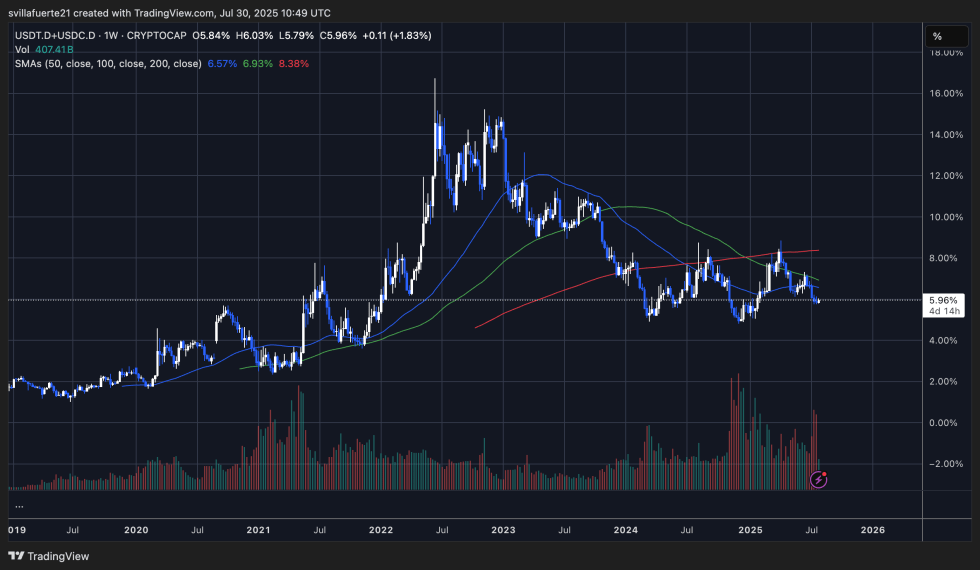
Stablecoin (USDT + USDC) Dominance | Source: USDT.D+USDC.D chart on TradingView

The chart shows that USDT+USDC dominance has consistently struggled to hold above the 50-week (6.57%), 100-week (6.93%), and 200-week (8.38%) moving averages. Recent price action confirms resistance near these levels, with dominance now testing its mid-cycle support around the 6% threshold.

This downtrend typically suggests growing risk appetite, as capital rotates out of stablecoins and into volatile assets like BTC, ETH, and altcoins. However, the fact that dominance has not broken below 5% reflects a cautious market that still maintains a strong base of sidelined capital.

Featured image from Dall-E, chart from TradingView

Editorial Process for bitcoinist is centered on delivering thoroughly researched, accurate, and unbiased content. We uphold strict sourcing standards, and each page undergoes diligent review by our team of top technology experts and seasoned editors. This process ensures the integrity, relevance, and value of our content for our readers.

Sebastian's journey into the world of crypto began four years ago, driven by a fascination with the potential of blockchain technology to revolutionize financial systems. His initial exploration focused on understanding the intricacies of various crypto projects, particularly those focused on building innovative financial solutions. Through countless hours of research and learning, Sebastian developed a deep understanding of the underlying technologies, market dynamics, and potential applications of cryptocurrencies. As his knowledge grew, Sebastian felt compelled to share his insights with others. He began actively contributing to online discussions on platforms like X and LinkedIn, focusing on fintech and crypto-related content. His goal was to expose valuable trends and insights to a wider audience, fostering a deeper understanding of the rapidly evolving crypto landscape. Sebastian's contributions quickly gained recognition, and he became a trusted voice in the online crypto community. To further enhance his expertise, Sebastian pursued a UC Berkeley Fintech: Frameworks, Applications, and Strategies certification. This rigorous program equipped him with valuable skills and knowledge regarding Financial Technology, bridging the gap between traditional finance (TradFi) and decentralized finance (DeFi). The certification deepened his understanding of the broader financial landscape and its intersection with blockchain technology. Sebastian's passion for finance and writing is evident in his work. He enjoys delving into financial research, analyzing market trends, and exploring the latest developments in the crypto space. In his spare time, Sebastian can often be found immersed in charts, studying 10-K forms, or engaging in thought-provoking discussions about the future of finance. Sebastian's journey as a crypto analyst and investor has been marked by a relentless pursuit of knowledge and a dedication to sharing his insights. His ability to navigate the complex world of crypto, combined with his passion for financial research and communication, makes him a valuable asset to the industry. As the crypto landscape continues to evolve, Sebastian remains at the forefront, providing valuable insights and contributing to the growth of this revolutionary technology.

Trending Cryptos

Related Reads

Valuation of $8 Billion, Up 200% in 8 Months! What's Behind Crypto-Friendly Bank Erebor Bank's Rise?

Erebor Bank, a digital bank founded by Palmer Luckey and backed by Peter Thiel, is in talks for new funding at a target valuation of $8 billion, double its $4.35 billion valuation from December. This surge is driven by explosive deposit growth, which soared from $1.1 billion in March to approximately $4.05 billion within a quarter, alongside adding nearly 400 new clients. The bank, launched in February 2026, holds a full national bank charter from the OCC, a strategic choice to avoid reliance on partner banks. It aims to serve tech startups, defense contractors, and crypto-native businesses, addressing gaps left by Silicon Valley Bank's collapse. Core promises include lending against non-traditional assets like hardware, offering 24/7 settlement, and integrating stablecoin services with traditional banking. It has already enabled stablecoin deposits and withdrawals on the Sui network. However, its current financials show minimal lending activity and a net loss, with high liquidity in cash and securities. The valuation hinges on future potential to monetize deposits through lending and crypto services. The bank's experienced management team includes veterans from Wells Fargo and crypto compliance firms. Risks are significant. Its concentrated customer base and exposure to volatile sectors like crypto and venture capital echo SVB's vulnerabilities. Its entire model depends on continued regulatory favor towards digital assets, which could shift. Erebor represents a high-profile experiment at the intersection of banking, crypto, and industrial policy, with its execution and market demand yet to be fully proven.

marsbit3h ago

Valuation of $8 Billion, Up 200% in 8 Months! What's Behind Crypto-Friendly Bank Erebor Bank's Rise?

marsbit3h ago

$8 Billion Valuation, 2x Growth in 8 Months! What Makes Crypto-Friendly Bank Erebor Bank So Special?

Erebor Bank, a crypto-friendly U.S. bank founded by Palmer Luckey, is reportedly in talks for a new funding round targeting a valuation of at least $8 billion, double its $4.35 billion valuation from December. Despite being operational for only a few months, its rapid growth—deposits surged from $1.1 billion in March to approximately $4.05 billion within a quarter, adding nearly 400 clients—has attracted investor interest. The bank aims to fill the void left by Silicon Valley Bank's collapse, targeting startups and businesses with non-traditional assets like defense contracts and digital tokens. Its strategy involves holding its own banking license to offer services like stablecoin deposits, payments, and 24/7 on-chain settlement. While digital assets are a core long-term focus, recent growth has been driven more by financing for U.S. manufacturing and defense sectors. Erebor's leadership combines Luckey's tech/defense background with a seasoned financial team. It received a national bank charter from the OCC in early 2026, benefiting from a favorable regulatory climate for digital assets. However, the bank faces significant risks, including reliance on a concentrated client base, exposure to crypto market volatility, potential regulatory shifts, and the unproven demand for its integrated banking model. Investors are betting on its future potential to monetize deposits through lending and crypto services, despite current losses typical for a new bank.

链捕手3h ago

$8 Billion Valuation, 2x Growth in 8 Months! What Makes Crypto-Friendly Bank Erebor Bank So Special?

链捕手3h ago

Trading

Spot

Hot Articles

What is $BANK

Bank AI: A Revolutionary Step in the Future of Banking Introduction In an era marked by rapid advancements in technology, Bank AI stands at the intersection of artificial intelligence (AI) and banking services. This innovative project seeks to redefine the financial landscape, enhancing operational efficiency, security measures, and customer experiences through the power of AI. As we embark on this exploration of Bank AI, we will delve into what the project entails, its operational dynamics, its historical context, and significant milestones. What is Bank AI? At its core, Bank AI represents a transformative initiative aimed at integrating artificial intelligence into various banking operations. This project harnesses the capabilities of AI to automate processes, improve risk management protocols, and enhance customer interaction through personalised services. The primary objectives of Bank AI include: Automation of Banking Functions: By leveraging AI technologies, Bank AI aims to automate routine tasks, reducing the burden on human resources and enhancing efficiency. Enhanced Risk Management: The project utilises AI algorithms to predict and identify risks, thereby fortifying security measures against fraud and other threats. Personalisation of Banking Services: Bank AI focuses on offering tailored financial products and services by analysing customer data and behaviours. Improving Customer Experience: The implementation of AI-driven solutions, such as chatbots and virtual assistants, aims to provide users with more human-like interactions, revolutionising the way customers engage with banks. With these goals, Bank AI positions itself as a crucial player in rendering banking more efficient, secure, and user-centric. Who is the Creator of Bank AI? Details regarding the creator of Bank AI remain unknown. As such, no specific individual or organisation has been identified in the available information. The anonymity surrounding the project's inception raises questions but does not detract from its ambitious vision and objectives. Who are the Investors of Bank AI? Similar to the project's creator, specific information regarding the investors or supporting organisations of Bank AI has not been disclosed. Without this information, it is challenging to outline the financial backing and institutional support that might be propelling the project forward. Nevertheless, the importance of having a robust investment foundation is pivotal for sustaining development in such an innovative field. How Does Bank AI Work? Bank AI operates on several innovative fronts, focusing on unique factors that differentiate it from traditional banking frameworks. Below are key operational features: Automation: By applying machine learning algorithms, Bank AI automates various manual processes within banks. This results in reduced operational costs and allows human workers to redirect their efforts towards more strategic activities. Advanced Risk Management: The integration of AI into risk management practices equips banks with tools to accurately predict potential threats such as fraud, ensuring that customer information and assets remain secure. Tailored Financial Recommendations: Through continuous learning from customer interactions, the AI systems develop a nuanced understanding of user needs, enabling them to offer tailored advice on financial decisions. Enhanced Customer Interactions: Utilizing chatbots and virtual assistants powered by AI, Bank AI enables a more engaging customer experience, allowing users to have their queries resolved quickly, thus reducing wait times and improving satisfaction levels. Together, these operational features position Bank AI as a pioneer in the banking sector, establishing new benchmarks for service delivery and operational excellence. Timeline of Bank AI Understanding the trajectory of Bank AI requires a look at its historical context. Below is a timeline highlighting important milestones and developments: Early 2010s: The conceptualisation of AI integration into banking services began to gain attention as banking institutions recognised the potential benefits. 2018: A marked increase in the implementation of AI technologies occurred when banks started using AI tools like chatbots for basic customer service and risk management systems for improved security handling. 2023: The sophistication of AI continued to advance, with generative AI being introduced for more complex tasks such as document processing and real-time investment analysis. This year marked a significant leap in the capabilities afforded to banks by AI technology. 2024-Current Status: As of this year, Bank AI is on an upward trajectory, with ongoing research and developments poised to further enhance capabilities in banking operations. Continued exploration of AI applications hints at exciting developments yet to come. Key Points About Bank AI Integration of AI in Banking: Bank AI focuses on adopting artificial intelligence to streamline banking processes and improve user experiences. Automation and Risk Management Focus: The project strongly emphasises these areas, aiming to shift the burden of routine tasks while enhancing security frameworks through predictive analytics. Personalised Banking Solutions: By harnessing customer data, Bank AI enables tailored banking services that cater to individual user needs. Commitment to Development: Bank AI remains committed to ongoing research and development efforts, ensuring its adaptability and ongoing relevance as technology continues to evolve. Conclusion In summary, Bank AI exemplifies a crucial step forward in the banking industry, leveraging artificial intelligence to reshape operational paradigms, enhance security, and promote customer satisfaction. Despite gaps in information surrounding the creator and investors, the clear objectives and functional mechanisms of Bank AI provide a strong foundation for its ongoing evolution. As AI technology continues to advance and merge with the banking sector, Bank AI is well-positioned to significantly impact the future of financial services, enhancing the way we understand and interact with banking.

177 Total ViewsPublished 2024.04.06Updated 2024.12.03

What is $BANK

Discussions

Welcome to the HTX Community. Here, you can stay informed about the latest platform developments and gain access to professional market insights. Users' opinions on the price of BANK (BANK) are presented below.

活动图片