Ethereum-ETF обгоняют продукты на базе биткоина (BTC)

cryptonews.ruPublished on 2025-07-26Last updated on 2025-07-26

Хотя IBIT от BlackRock традиционно лидирует на рынке крипто-ETF, на этой неделе продукт компании по Ethereum привлек больше средств. ETHA занял второе место по притоку средств среди всех ETF в США

После нескольких недель активных корпоративных инвестиций в биткоин, Ethereum становится популярным выбором. Эта тенденция может укрепить позиции токена на рынке.

Ethereum-ETF завоевывают популярность

IBIT — биткоин-ETF от BlackRock — называют «величайшим запуском в истории фондовой биржи». В прошлом месяце он стал крупнейшим ETF компании по доходам от комиссий. В теории он даже может превзойти кошелек Сатоши менее чем за год.

На этой неделе Ethereum-ETF от BlackRock привлек еще больше средств:

Биткоин-ETF также пользуются сильной институциональной поддержкой: он активно привлекает корпоративные инвестиции. Тем не менее продукты на базе Эфира начинают отвоевывать у них долю рынка.

В последние дни приток средств в BTC-ETF замедляется из-за того, что монета обновила исторический максимум стоимости. исторического максимума актива. В то же время, ETH-ETF продолжают стабильно привлекать средства.
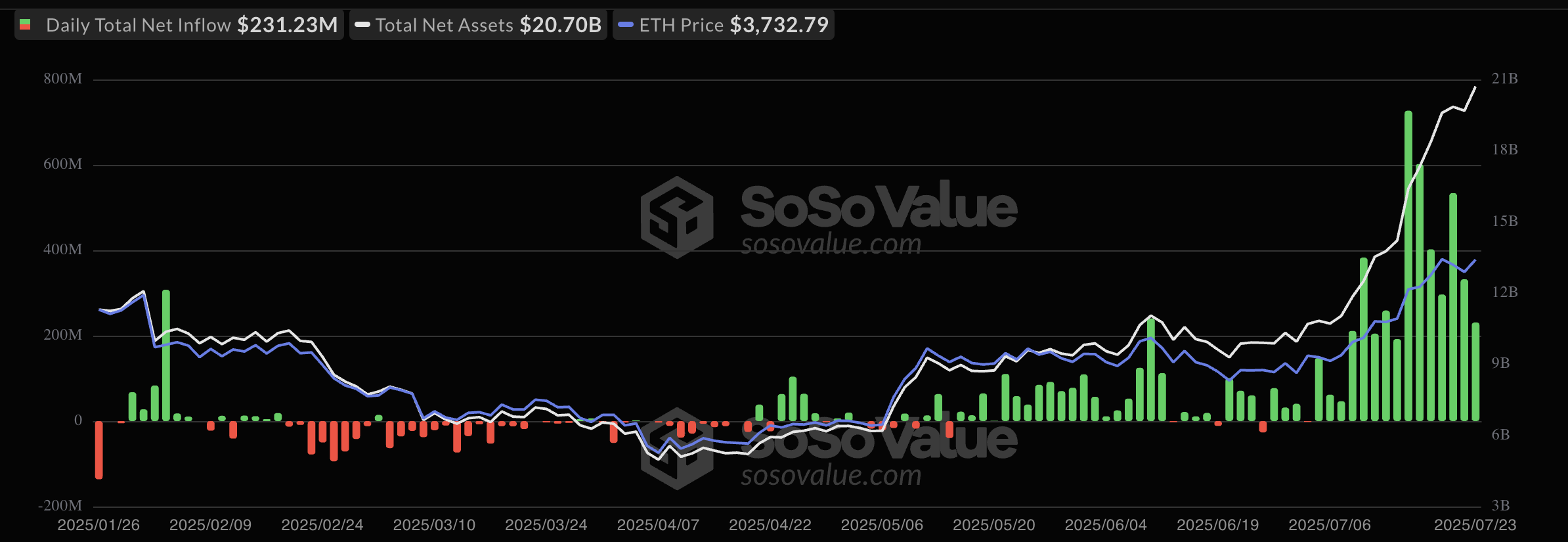
Приток средств в Ethereum ETF. Источник: SoSo Value

Даже паузы в росте Ethereum не повлияли на тренд, так как корпоративные инвестиции продолжаются быстрыми темпами. Большинство корпоративных инвесторов выбирают биткоин. Таким образом, ETH остается популярным, но менее перегретым активом, так как инвестиции с Уолл-стрит не полностью определяют рынок.

С увеличением институциональных инвестиций в Ethereum, доминирование биткоина снизилось более чем на 5% в июле.


Trending Cryptos

Related Reads

Crypto Funding Halves in Q1, Why Is Stablecoin Payment Still Attracting Money Against the Trend?

Crypto venture capital funding fell roughly 50% quarter-over-quarter in Q1 2026, yet the stablecoin payments sector was a notable exception, continuing to secure significant funding rounds. This shift signals that capital is moving away from speculative "token narratives" toward companies generating real revenue, as stablecoins evolve from a trading tool into payment infrastructure. Despite the overall funding slowdown, companies like Rain, OpenFX, and RedotPay completed major raises, focusing on areas such as card issuance, cross-border payments, and banking connectivity. Investors are attracted to the sector's potential to address long-standing inefficiencies in traditional cross-border payments through 24/7 settlement and clearer revenue models like transaction fees and FX spreads. However, the momentum may be overstated. On-chain stablecoin transaction volume does not equate to real-world payments for goods and services, and funding is concentrated in a few leading firms with reported volumes and customers. Key challenges remain, including compliance, fiat on/off-ramps, local banking relationships, and the risk of core services becoming commoditized. Looking ahead, capital is likely to flow into areas like cross-border B2B payments, bank-to-stablecoin connectivity, stablecoin-linked cards, multi-chain payment orchestration, and payments for AI agents. Ultimately, the investor interest reflects a bet on the necessary infrastructure to integrate stablecoins into the traditional financial system, with future valuations hinging on demonstrable payment volume, real revenue, and profitable market expansion.

marsbit34m ago

Crypto Funding Halves in Q1, Why Is Stablecoin Payment Still Attracting Money Against the Trend?

marsbit34m ago

South Korean Retail Investors 'Move from Seoul to Wall Street': Buying SK Hynix ADR, Betting on Triple-Leverage ETF

A surge of Korean retail investors is shifting funds from the volatile Seoul market to Wall Street, intensifying their bets on the AI theme through unconventional and high-risk instruments. Data shows Korean investors were net buyers of about $4.5 billion in US stocks in July, nearing a yearly peak. A notable trend is their purchase of approximately $840 million worth of SK Hynix American Depositary Receipts (ADRs), despite a significant 10% premium over the company's domestic shares, leading analysts to label the move as speculative and irrational. Simultaneously, Korean traders are heavily favoring leveraged ETFs. The triple-leveraged semiconductor ETF SOXL was the most-bought US product in July, with leveraged products occupying four of the top ten spots. Experts note that this shift in geography does not represent a diversification of risk; instead, investors are merely expressing the same concentrated bet on AI hardware through different, often riskier, US-listed vehicles. Analysts warn that while this capital inflow is unlikely to systemically impact the vast US institutional market, it risks creating localized distortions and amplifying volatility, particularly in the targeted sectors and instruments. The move follows a sharp correction in the Korean market, where high leverage in semiconductor stocks and related ETFs had previously led to significant losses, prompting this search for alternative avenues to chase the AI narrative.

marsbit1h ago

South Korean Retail Investors 'Move from Seoul to Wall Street': Buying SK Hynix ADR, Betting on Triple-Leverage ETF

marsbit1h ago

Bithumb's First Half Report: Net Loss Exceeds $76 Million, Where Did the Profits Go?

**Title: Bithumb H1 2026 Report: Net Loss Exceeds $76M – Where Did the Profits Go?** Despite a headline net loss of approximately 108.7 billion KRW (~$76.44 million) for the first half of 2026, a detailed breakdown reveals Bithumb's core exchange business remained profitable. The significant loss was primarily driven by two major non-operating items: substantial losses on the disposal and valuation of the company's own cryptocurrency holdings (net loss ~$48.21 million) and a sharp increase in litigation provisions (~$25.93 million), largely linked to a regulatory fine. Operating revenue fell 48.7% year-on-year to ~$119 million, almost entirely from transaction fees, as market activity cooled. While the company drastically cut marketing and subsidy expenses by ~70% to protect margins, more rigid costs like payment processing and salaries declined only modestly. This highlights the vulnerability of its highly fee-dependent revenue model in a down market. Total assets decreased by ~$584 million, but this was largely attributable to an ~86% drop in client KRW deposits. The market value of client crypto assets under custody also fell (~32.7%), partly influenced by declining cryptocurrency prices rather than solely client withdrawals. In summary, the report indicates underlying exchange profitability was eroded by significant crypto asset losses and mounting regulatory/legal costs, against a backdrop of declining trading revenue. Future focus should be on revenue recovery, managing crypto-related损益, and the ongoing impact of regulatory challenges.

marsbit1h ago

Bithumb's First Half Report: Net Loss Exceeds $76 Million, Where Did the Profits Go?

marsbit1h ago

BitMart's Final 9 Days: A True Exchange Crisis Is Never About Shutting Down

BitMart's Final 9 Days: A True Exchange Crisis Is Not About Shutting Down On August 17, 2026, with just 9 days until BitMart's scheduled cessation of trading, the focus shifted from the platform's orderly closure to serious questions about user withdrawals, platform solvency, employee payments, and reserve transparency. Stakeholders, claiming to represent users and staff, publicly demanded asset/liability disclosures, explanations for withdrawal delays, a user repayment plan, and an independent audit, setting an August 19 deadline. While BitMart CEO Sheldon Lee denied allegations of insolvency or wrongdoing, the controversy highlighted a core vulnerability of centralized exchanges (CEXs). When an exchange announces its shutdown, normal user behavior changes dramatically, triggering a mass withdrawal event—the ultimate stress test for its liquidity and custodial integrity. The key question becomes not whether the platform has assets, but whether it holds sufficient *liquid* assets to cover all user liabilities on demand. The article argues that the trust placed in CEXs is based on the convenience they provide, abstracting users from direct control of their private keys. This trust is rarely questioned during normal operations but becomes critically exposed during a wind-down. The situation underscores the limitations of simple Proof of Reserves, which shows "what we have" but not the crucial "what we owe." True financial credibility requires transparent, auditable data on assets, liabilities, and segregated user funds. BitMart's situation reflects a broader, often overlooked issue in the crypto industry: while there is extensive focus on growth mechanisms for exchanges, there is little discussion or established protocol for a safe and transparent "exit mechanism." The final measure of an exchange's integrity, the article concludes, is not its user count or trading volume during a bull market, but its ability to ensure every last user can successfully withdraw their assets when the doors are closing. The outcome will be determined not by statements, but by whether the final user's funds securely leave the platform.

marsbit2h ago

BitMart's Final 9 Days: A True Exchange Crisis Is Never About Shutting Down

marsbit2h ago

Don't Speculate on 100x Coins, Just Bet on 'Cash Cows': Which Projects Are Worth Dollar-Cost Averaging in the Bear Market?

In a bearish crypto market, finding sustainable investments is more prudent than chasing speculative meme coins. This article analyzes projects generating consistent revenue, highlighting them as potential "cash cows" for long-term dollar-cost averaging (DCA). The top performers are "picks-and-shovels" plays. **Pump.fun**, a Solana-based meme coin launchpad, leads with $415.3M in monthly revenue, profiting from a 1.25% fee on token transactions. Despite market volatility, it has averaged tens of millions in monthly income in 2024. Perpetual DEX **Hyperliquid** stands out as a "bear market star," accumulating ~$352M in revenue over seven months. Its model funnels ~99% of fees into buying back and permanently burning its HYPE token. Established giants are also adapting. **Uniswap**, after enabling its fee switch, now earns protocol revenue (e.g., $5.6M recently), which is used to buy back and burn UNI, giving the token direct value accrual. Similarly, oracle provider **Chainlink** generates stable monthly revenue (~$4.57M recently) from its essential data, cross-chain, and automation services. Its new Payment Abstraction feature automatically converts service fees into LINK, accruing value in its treasury. The core thesis is clear: in a downturn, focus on projects with proven, resilient business models—those acting as essential infrastructure or capturing consistent transaction fees—rather than speculative narratives.

marsbit3h ago

Don't Speculate on 100x Coins, Just Bet on 'Cash Cows': Which Projects Are Worth Dollar-Cost Averaging in the Bear Market?

marsbit3h ago

Trading

Spot

Hot Articles

What is $BITCOIN

DIGITAL GOLD ($BITCOIN): A Comprehensive Analysis Introduction to DIGITAL GOLD ($BITCOIN) DIGITAL GOLD ($BITCOIN) is a blockchain-based project operating on the Solana network, which aims to combine the characteristics of traditional precious metals with the innovation of decentralized technologies. While it shares a name with Bitcoin, often referred to as “digital gold” due to its perception as a store of value, DIGITAL GOLD is a separate token designed to create a unique ecosystem within the Web3 landscape. Its goal is to position itself as a viable alternative digital asset, although specifics regarding its applications and functionalities are still developing. What is DIGITAL GOLD ($BITCOIN)? DIGITAL GOLD ($BITCOIN) is a cryptocurrency token explicitly designed for use on the Solana blockchain. In contrast to Bitcoin, which provides a widely recognized value storage role, this token appears to focus on broader applications and characteristics. Notable aspects include: Blockchain Infrastructure: The token is built on the Solana blockchain, known for its capacity to handle high-speed and low-cost transactions. Supply Dynamics: DIGITAL GOLD has a maximum supply capped at 100 quadrillion tokens (100P $BITCOIN), although details regarding its circulating supply are currently undisclosed. Utility: While precise functionalities are not explicitly outlined, there are indications that the token could be utilized for various applications, potentially involving decentralized applications (dApps) or asset tokenization strategies. Who is the Creator of DIGITAL GOLD ($BITCOIN)? At present, the identity of the creators and development team behind DIGITAL GOLD ($BITCOIN) remains unknown. This situation is typical among many innovative projects within the blockchain space, particularly those aligning with decentralized finance and meme coin phenomena. While such anonymity may foster a community-driven culture, it intensifies concerns about governance and accountability. Who are the Investors of DIGITAL GOLD ($BITCOIN)? The available information indicates that DIGITAL GOLD ($BITCOIN) does not have any known institutional backers or prominent venture capital investments. The project seems to operate on a peer-to-peer model focused on community support and adoption rather than traditional funding routes. Its activity and liquidity are primarily situated on decentralized exchanges (DEXs), such as PumpSwap, rather than established centralized trading platforms, further highlighting its grassroots approach. How DIGITAL GOLD ($BITCOIN) Works The operational mechanics of DIGITAL GOLD ($BITCOIN) can be elaborated on based on its blockchain design and network attributes: Consensus Mechanism: By leveraging Solana’s unique proof-of-history (PoH) combined with a proof-of-stake (PoS) model, the project ensures efficient transaction validation contributing to the network's high performance. Tokenomics: While specific deflationary mechanisms have not been extensively detailed, the vast maximum token supply implies that it may cater to microtransactions or niche use cases that are still to be defined. Interoperability: There exists the potential for integration with Solana’s broader ecosystem, including various decentralized finance (DeFi) platforms. However, the details regarding specific integrations remain unspecified. Timeline of Key Events Here is a timeline that highlights significant milestones concerning DIGITAL GOLD ($BITCOIN): 2023: The initial deployment of the token occurs on the Solana blockchain, marked by its contract address. 2024: DIGITAL GOLD gains visibility as it becomes available for trading on decentralized exchanges like PumpSwap, allowing users to trade it against SOL. 2025: The project witnesses sporadic trading activity and potential interest in community-led engagements, although no noteworthy partnerships or technical advancements have been documented as of yet. Critical Analysis Strengths Scalability: The underlying Solana infrastructure supports high transaction volumes, which could enhance the utility of $BITCOIN in various transaction scenarios. Accessibility: The potential low trading price per token could attract retail investors, facilitating wider participation due to fractional ownership opportunities. Risks Lack of Transparency: The absence of publicly known backers, developers, or an audit process may yield skepticism regarding the project's sustainability and trustworthiness. Market Volatility: The trading activity is heavily reliant on speculative behavior, which can result in significant price volatility and uncertainty for investors. Conclusion DIGITAL GOLD ($BITCOIN) emerges as an intriguing yet ambiguous project within the rapidly evolving Solana ecosystem. While it attempts to leverage the “digital gold” narrative, its departure from Bitcoin's established role as a store of value underscores the need for a clearer differentiation of its intended utility and governance structure. Future acceptance and adoption will likely depend on addressing the current opacity and defining its operational and economic strategies more explicitly. Note: This report encompasses synthesised information available as of October 2023, and developments may have transpired beyond the research period.

1.9k Total ViewsPublished 2025.05.13Updated 2025.05.13

What is $BITCOIN

Discussions

Welcome to the HTX Community. Here, you can stay informed about the latest platform developments and gain access to professional market insights. Users' opinions on the price of BTC (BTC) are presented below.

活动图片