Bitcoin Devs Propose Sunset For Quantum-Vulnerable Addresses

bitcoinistPublished on 2025-07-17Last updated on 2025-07-17

Abstract

A draft Bitcoin Improvement Proposal authored by Casa co-founder Jameson Lopp and five collaborators sets out the most forceful roadmap...

Trusted Editorial content, reviewed by leading industry experts and seasoned editors. Ad Disclosure

A draft Bitcoin Improvement Proposal authored by Casa co-founder Jameson Lopp and five collaborators sets out the most forceful roadmap yet for hardening the network against quantum computing. Titled “Post-Quantum Migration and Legacy Signature Sunset,” the proposal was published on GitHub on 14 July and calls for a phased retirement of all outputs protected by today’s ECDSA and Schnorr signatures. The authors frame the move as a necessary pre-emptive strike: “It turns quantum security into a private incentive — fail to upgrade and you will certainly lose access to your funds.”

Plan To Secure Bitcoin From Quantum Threat

Because every public key that appears on-chain can, in principle, have its corresponding private key recovered by a sufficiently powerful quantum computer, the proposal warns that “roughly 25 % of all bitcoin have revealed a public key on-chain; those UTXOs could be stolen with sufficient quantum power.” That slice includes many early P2PK outputs, among them the roughly one million BTC widely believed to be controlled by Bitcoin’s creator, Satoshi Nakamoto.

The authors note that NIST finalised three production-grade post-quantum signature algorithms in 2024 and that academic roadmaps now place a “cryptographically-relevant” quantum computer as early as 2027-2030. At the same time, quantum factoring algorithms “are improving up to 20×,” rapidly shrinking Bitcoin’s safety margin.
To neutralise the threat, the draft prescribes a soft-fork sequence tied to the already-proposed P2QRH post-quantum output type (defined in BIP-360):

Phase A begins three years after P2QRH goes live and “disallows sending of any funds to quantum-vulnerable addresses,” forcing new coins toward quantum-safe scripts.

Phase B follows two years later, on a pre-announced flag day, when “nodes reject transactions that rely on ECDSA/Schnorr keys,” rendering legacy outputs unspendable.

Phase C is optional and, pending further research, could enable owners who missed the deadline to recover funds with a zero-knowledge proof of possession of their BIP-39 seed.

The document’s rationale is explicit: “A successful quantum attack on Bitcoin would result in significant economic disruption and damage across the entire ecosystem.” By imposing a known deadline, the authors hope to overcome what they describe as “upgrade inertia” among wallets, exchanges and custodians that historically stretches protocol roll-outs over many years.

Each stakeholder cohort is offered a blunt calculus. Miners risk producing “invalid blocks” after Phase B if they do not upgrade, but in the interim can expect heavier blocks and higher fees from the larger post-quantum signatures. Institutional holders face potential fiduciary liability should they ignore the migration timetable, while exchanges confront the prospect of overnight insolvency if quantum attackers drain custodial hot wallets. For individual users, the sunset date converts an abstract, far-off threat into a hard deadline.

A notable corollary is that coins abandoned in quantum-vulnerable scripts would become permanently frozen, echoing Satoshi’s early observation that “lost coins only make everyone else’s coins worth slightly more.” The proposal inverts that logic for quantum-recovered coins, calling them “a theft from everyone.”

The BIP remains a draft and has yet to receive a number or taproot-style activation path, but it is already shaping what is likely to become a contentious debate over backward compatibility and the treatment of dormant balances. If adopted, the migration would dwarf SegWit and Taproot in both logistical complexity and monetary stakes, directly affecting an estimated quarter of the 19.7 million BTC in existence.

For now, the authors have thrown down a clear gauntlet: either the ecosystem coordinates on a proactive timeline, or it faces the prospect of responding to an emergency only after the first quantum theft has occurred.

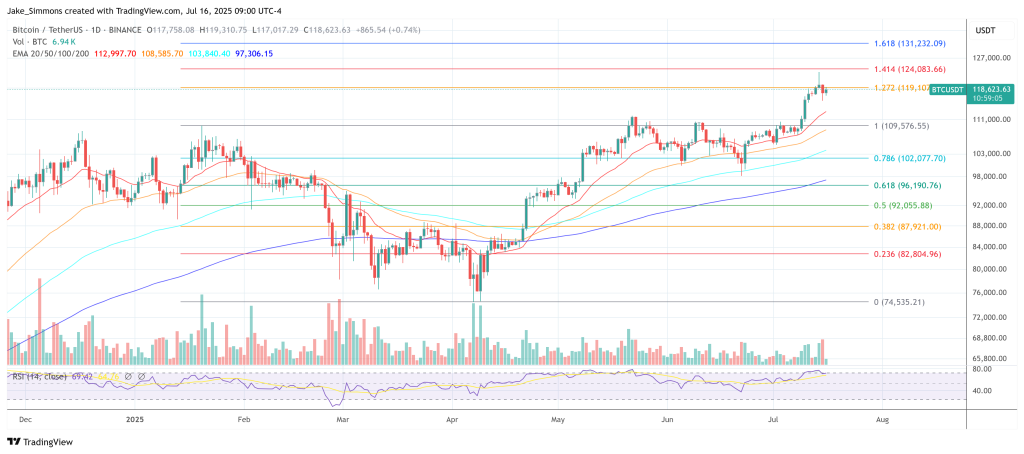
At press time, BTC traded at $118,623.
Bitcoin price
BTC price, 4-hour chart | Source: BTCUSDT on TradingView.com
Featured image created with DALL.E, chart from TradingView.com
Editorial Process for bitcoinist is centered on delivering thoroughly researched, accurate, and unbiased content. We uphold strict sourcing standards, and each page undergoes diligent review by our team of top technology experts and seasoned editors. This process ensures the integrity, relevance, and value of our content for our readers.

Jake Simmons has been a Bitcoin enthusiast since 2016. Ever since he heard about Bitcoin, he has been studying the topic every day and trying to share his knowledge with others. His goal is to contribute to Bitcoin's financial revolution, which will replace the fiat money system. Besides BTC and crypto, Jake studied Business Informatics at a university. After graduation in 2017, he has been working in the blockchain and crypto sector. You can follow Jake on Twitter at @realJakeSimmons.

Trending Cryptos

Related Reads

Trading

Spot

Hot Articles

What is $BITCOIN

DIGITAL GOLD ($BITCOIN): A Comprehensive Analysis Introduction to DIGITAL GOLD ($BITCOIN) DIGITAL GOLD ($BITCOIN) is a blockchain-based project operating on the Solana network, which aims to combine the characteristics of traditional precious metals with the innovation of decentralized technologies. While it shares a name with Bitcoin, often referred to as “digital gold” due to its perception as a store of value, DIGITAL GOLD is a separate token designed to create a unique ecosystem within the Web3 landscape. Its goal is to position itself as a viable alternative digital asset, although specifics regarding its applications and functionalities are still developing. What is DIGITAL GOLD ($BITCOIN)? DIGITAL GOLD ($BITCOIN) is a cryptocurrency token explicitly designed for use on the Solana blockchain. In contrast to Bitcoin, which provides a widely recognized value storage role, this token appears to focus on broader applications and characteristics. Notable aspects include: Blockchain Infrastructure: The token is built on the Solana blockchain, known for its capacity to handle high-speed and low-cost transactions. Supply Dynamics: DIGITAL GOLD has a maximum supply capped at 100 quadrillion tokens (100P $BITCOIN), although details regarding its circulating supply are currently undisclosed. Utility: While precise functionalities are not explicitly outlined, there are indications that the token could be utilized for various applications, potentially involving decentralized applications (dApps) or asset tokenization strategies. Who is the Creator of DIGITAL GOLD ($BITCOIN)? At present, the identity of the creators and development team behind DIGITAL GOLD ($BITCOIN) remains unknown. This situation is typical among many innovative projects within the blockchain space, particularly those aligning with decentralized finance and meme coin phenomena. While such anonymity may foster a community-driven culture, it intensifies concerns about governance and accountability. Who are the Investors of DIGITAL GOLD ($BITCOIN)? The available information indicates that DIGITAL GOLD ($BITCOIN) does not have any known institutional backers or prominent venture capital investments. The project seems to operate on a peer-to-peer model focused on community support and adoption rather than traditional funding routes. Its activity and liquidity are primarily situated on decentralized exchanges (DEXs), such as PumpSwap, rather than established centralized trading platforms, further highlighting its grassroots approach. How DIGITAL GOLD ($BITCOIN) Works The operational mechanics of DIGITAL GOLD ($BITCOIN) can be elaborated on based on its blockchain design and network attributes: Consensus Mechanism: By leveraging Solana’s unique proof-of-history (PoH) combined with a proof-of-stake (PoS) model, the project ensures efficient transaction validation contributing to the network's high performance. Tokenomics: While specific deflationary mechanisms have not been extensively detailed, the vast maximum token supply implies that it may cater to microtransactions or niche use cases that are still to be defined. Interoperability: There exists the potential for integration with Solana’s broader ecosystem, including various decentralized finance (DeFi) platforms. However, the details regarding specific integrations remain unspecified. Timeline of Key Events Here is a timeline that highlights significant milestones concerning DIGITAL GOLD ($BITCOIN): 2023: The initial deployment of the token occurs on the Solana blockchain, marked by its contract address. 2024: DIGITAL GOLD gains visibility as it becomes available for trading on decentralized exchanges like PumpSwap, allowing users to trade it against SOL. 2025: The project witnesses sporadic trading activity and potential interest in community-led engagements, although no noteworthy partnerships or technical advancements have been documented as of yet. Critical Analysis Strengths Scalability: The underlying Solana infrastructure supports high transaction volumes, which could enhance the utility of $BITCOIN in various transaction scenarios. Accessibility: The potential low trading price per token could attract retail investors, facilitating wider participation due to fractional ownership opportunities. Risks Lack of Transparency: The absence of publicly known backers, developers, or an audit process may yield skepticism regarding the project's sustainability and trustworthiness. Market Volatility: The trading activity is heavily reliant on speculative behavior, which can result in significant price volatility and uncertainty for investors. Conclusion DIGITAL GOLD ($BITCOIN) emerges as an intriguing yet ambiguous project within the rapidly evolving Solana ecosystem. While it attempts to leverage the “digital gold” narrative, its departure from Bitcoin's established role as a store of value underscores the need for a clearer differentiation of its intended utility and governance structure. Future acceptance and adoption will likely depend on addressing the current opacity and defining its operational and economic strategies more explicitly. Note: This report encompasses synthesised information available as of October 2023, and developments may have transpired beyond the research period.

616 Total ViewsPublished 2025.05.13Updated 2025.05.13

What is $BITCOIN

Discussions

Welcome to the HTX Community. Here, you can stay informed about the latest platform developments and gain access to professional market insights. Users' opinions on the price of BTC (BTC) are presented below.

活动图片