Cardano Foundation Reveals $659 Million Treasury In ADA, BTC And Fiat

bitcoinistPublished on 2025-07-15Last updated on 2025-07-15

Abstract

Cardano’s second annual Financial Insights Report lays bare the Foundation’s balance sheet and spending strategy for the first time on-chain,...

Trusted Editorial content, reviewed by leading industry experts and seasoned editors. Ad Disclosure

Cardano’s second annual Financial Insights Report lays bare the Foundation’s balance sheet and spending strategy for the first time on-chain, confirming a treasury worth $659.1 million split across ADA, bitcoin and fiat reserves. “As of 31 December 2024, the Foundation’s assets amounted to 659.1 million USD with 76.7% held in ADA, 15.0% in BTC, and the remaining 8.3% in cash, cash equivalents and financial assets,” the report states, adding that the 599.2 million ADA stake produced 17.1 million ADA in rewards last year, a 2.7 % return that now finances day-to-day operations without liquidating core holdings.

Cardano Publishes Financials On-Chain

Chief executive Frederik Gregaard sets the tone in his foreword, arguing that “sharing not only our achievements but also how we allocate resources is fundamental to building trust and ensuring long-term success.” He notes that 2024 spending reached $29.2 million, of which $22.1 million went directly into the Foundation’s three strategic pillars—adoption, operational resilience and education—while $7.1 million covered legal, governance, finance and infrastructure overheads “essential to scaling our delivery and ensuring our work remains robust, accountable and future-proof.”

More than half of last year’s budget—$15 million—fuelled adoption initiatives. Those dollars underwrote enterprise pilots ranging from a NASA tracking solution to a ballistic-identification system, the soft-launch of the Reeve on-chain accounting tool, and partnerships with Barcelona FC, Amnesty International, Swisscom and the UN Development Programme, among others.

Operational resilience absorbed $3.8 million, financing the launch of the open-source Cardano.org stack, public network-congestion monitors, preliminary work on the Ouroboros Genesis upgrade and Cardano’s contribution to the Chang hard fork era of decentralised governance. Education programmes drew $3.3 million, funding the Cardano Blockchain Certified Associate (CBCA) exam, regulatory engagement with the Bank for International Settlements and a 1,000-strong Cardano Summit in Dubai.

Transparency itself became a budget line: the Foundation has migrated its entire 2024 general ledger to Reeve, a bespoke reporting tool that anchors financial statements, treasury balances and expenditure records directly on Cardano. Reeve, the report explains, “records, verifies and shares financial data directly on the Cardano blockchain,” allowing stakeholders to audit immutable entries without relying on external gatekeepers.

That step, Gregaard says, “reaffirms our dedication to financial responsibility and strategic investment,” and signals an open invitation to the community to verify every figure. By combining on-chain disclosure with a narrative report that converts ADA and bitcoin balances into USD, the Foundation hopes to satisfy both technically minded auditors and mainstream readers.

With a war chest still dominated by native ADA—originally seeded by an endowment of 648 million ADA and 8,258 BTC—the Foundation faces no immediate liquidity pressures. Its delegation policy continues to funnel stake to mission-critical pools that contribute code or infrastructure, reinforcing a self-referential ecosystem in which staking rewards fund further development.

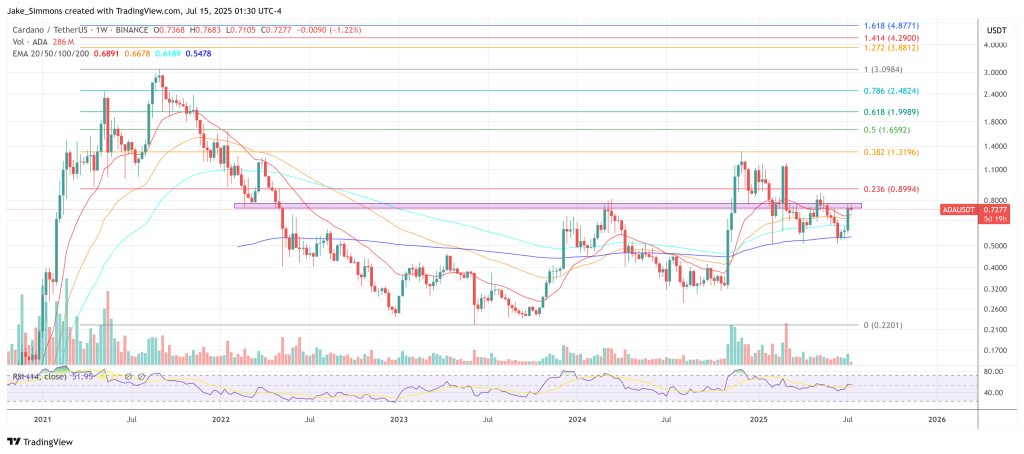
At press time, ADA traded at $0.7277.
Cardano price
ADA price inches into key resistance zone, 1-week chart | Source: ADAUSDT on TradingView.com
Featured image created with DALL.E, chart from TradingView.com
Editorial Process for bitcoinist is centered on delivering thoroughly researched, accurate, and unbiased content. We uphold strict sourcing standards, and each page undergoes diligent review by our team of top technology experts and seasoned editors. This process ensures the integrity, relevance, and value of our content for our readers.

Jake Simmons has been a Bitcoin enthusiast since 2016. Ever since he heard about Bitcoin, he has been studying the topic every day and trying to share his knowledge with others. His goal is to contribute to Bitcoin's financial revolution, which will replace the fiat money system. Besides BTC and crypto, Jake studied Business Informatics at a university. After graduation in 2017, he has been working in the blockchain and crypto sector. You can follow Jake on Twitter at @realJakeSimmons.

Trending Cryptos

Related Reads

Is Anyone Still Buying in the Crypto Market? Unpacking 3 Common Watch-and-Wait Mentalities Today

Is Anyone Still Buying in the Crypto Market? Unpacking 3 Common Wait-and-See Mindsets This article analyzes the current cautious sentiment in the crypto market, distilled from conversations with sophisticated investors. The author identifies three dominant investor mindsets: 1. **Satisfied with Current Holdings:** Many retain a long-term belief in digital assets but see no immediate catalyst for significant price appreciation. They hold positions to avoid missing a future surge but allocate minimal new capital or attention. A shift requires a new, observable catalyst or a rotation from other portfolio areas. 2. **Waiting for Lower Prices:** This reflects not just short-term timing but a belief about crypto's total addressable market and upside potential. It could change if key perceived cycle bottoms pass without a crash, a major bullish event occurs (e.g., sovereign adoption), or price rebounds trigger FOMO-driven buying. 3. **High Opportunity Cost of Allocation:** The core question is comparative growth. With AI-related equities appearing to offer relentless, high-speed growth, justifying marginal investment into assets without similar perceived momentum is difficult. A slowdown in the AI trade could potentially mark a bottom and trigger capital reallocation into crypto. In conclusion, while long-term conviction persists for many, near-term marginal capital flows are constrained by these beliefs. The author suggests the market may be closer to a bottom than a top, but the current climate is defined by this wait-and-see approach, awaiting a catalyst to reignite broader investor commitment.

marsbit42m ago

Is Anyone Still Buying in the Crypto Market? Unpacking 3 Common Watch-and-Wait Mentalities Today

marsbit42m ago

China Added 67 New Unicorns in Half a Year, with AI and Robotics Accounting for Over Half

China added 67 new unicorn companies in the first half of 2026, reaching a total of 517 unicorns with a combined valuation of approximately $2.39 trillion. This surge marks a significant rebound after a post-2022 slowdown and sets a new semi-annual record. The growth is primarily driven by Artificial Intelligence (AI) and Robotics, which together account for over 53% of the new entrants. Specifically, 19 new unicorns are in robotics and 17 in AI. Notable companies include DeepSeek ($615.38B) and Kling AI ($18B). The trend indicates a decisive shift from internet consumer models to hard tech innovation. Geographically, new unicorns are highly concentrated in four cities: Beijing (19), Shanghai (18), Shenzhen (9), and Hangzhou (5), which together host 76.1% of the new companies. Hangzhou's overall valuation is boosted significantly by DeepSeek. Valuation distribution among new unicorns is pyramidal: 77.6% are valued between $1B and $2B, indicating early-stage status, while only two exceed $10B. There is a notable "speed divide": many AI/robotics startups achieved unicorn status in under three years, often via corporate spin-offs or led by star founders, while hard tech companies in semiconductors or biotech typically took over eight years. The report concludes that this wave reflects China's accelerating transition into an AI and robotics-powered innovation cycle, characterized by faster company formation, heightened geographic concentration, and a clear focus on foundational technologies.

marsbit1h ago

China Added 67 New Unicorns in Half a Year, with AI and Robotics Accounting for Over Half

marsbit1h ago

Trading

Spot

Hot Articles

What is $BITCOIN

DIGITAL GOLD ($BITCOIN): A Comprehensive Analysis Introduction to DIGITAL GOLD ($BITCOIN) DIGITAL GOLD ($BITCOIN) is a blockchain-based project operating on the Solana network, which aims to combine the characteristics of traditional precious metals with the innovation of decentralized technologies. While it shares a name with Bitcoin, often referred to as “digital gold” due to its perception as a store of value, DIGITAL GOLD is a separate token designed to create a unique ecosystem within the Web3 landscape. Its goal is to position itself as a viable alternative digital asset, although specifics regarding its applications and functionalities are still developing. What is DIGITAL GOLD ($BITCOIN)? DIGITAL GOLD ($BITCOIN) is a cryptocurrency token explicitly designed for use on the Solana blockchain. In contrast to Bitcoin, which provides a widely recognized value storage role, this token appears to focus on broader applications and characteristics. Notable aspects include: Blockchain Infrastructure: The token is built on the Solana blockchain, known for its capacity to handle high-speed and low-cost transactions. Supply Dynamics: DIGITAL GOLD has a maximum supply capped at 100 quadrillion tokens (100P $BITCOIN), although details regarding its circulating supply are currently undisclosed. Utility: While precise functionalities are not explicitly outlined, there are indications that the token could be utilized for various applications, potentially involving decentralized applications (dApps) or asset tokenization strategies. Who is the Creator of DIGITAL GOLD ($BITCOIN)? At present, the identity of the creators and development team behind DIGITAL GOLD ($BITCOIN) remains unknown. This situation is typical among many innovative projects within the blockchain space, particularly those aligning with decentralized finance and meme coin phenomena. While such anonymity may foster a community-driven culture, it intensifies concerns about governance and accountability. Who are the Investors of DIGITAL GOLD ($BITCOIN)? The available information indicates that DIGITAL GOLD ($BITCOIN) does not have any known institutional backers or prominent venture capital investments. The project seems to operate on a peer-to-peer model focused on community support and adoption rather than traditional funding routes. Its activity and liquidity are primarily situated on decentralized exchanges (DEXs), such as PumpSwap, rather than established centralized trading platforms, further highlighting its grassroots approach. How DIGITAL GOLD ($BITCOIN) Works The operational mechanics of DIGITAL GOLD ($BITCOIN) can be elaborated on based on its blockchain design and network attributes: Consensus Mechanism: By leveraging Solana’s unique proof-of-history (PoH) combined with a proof-of-stake (PoS) model, the project ensures efficient transaction validation contributing to the network's high performance. Tokenomics: While specific deflationary mechanisms have not been extensively detailed, the vast maximum token supply implies that it may cater to microtransactions or niche use cases that are still to be defined. Interoperability: There exists the potential for integration with Solana’s broader ecosystem, including various decentralized finance (DeFi) platforms. However, the details regarding specific integrations remain unspecified. Timeline of Key Events Here is a timeline that highlights significant milestones concerning DIGITAL GOLD ($BITCOIN): 2023: The initial deployment of the token occurs on the Solana blockchain, marked by its contract address. 2024: DIGITAL GOLD gains visibility as it becomes available for trading on decentralized exchanges like PumpSwap, allowing users to trade it against SOL. 2025: The project witnesses sporadic trading activity and potential interest in community-led engagements, although no noteworthy partnerships or technical advancements have been documented as of yet. Critical Analysis Strengths Scalability: The underlying Solana infrastructure supports high transaction volumes, which could enhance the utility of $BITCOIN in various transaction scenarios. Accessibility: The potential low trading price per token could attract retail investors, facilitating wider participation due to fractional ownership opportunities. Risks Lack of Transparency: The absence of publicly known backers, developers, or an audit process may yield skepticism regarding the project's sustainability and trustworthiness. Market Volatility: The trading activity is heavily reliant on speculative behavior, which can result in significant price volatility and uncertainty for investors. Conclusion DIGITAL GOLD ($BITCOIN) emerges as an intriguing yet ambiguous project within the rapidly evolving Solana ecosystem. While it attempts to leverage the “digital gold” narrative, its departure from Bitcoin's established role as a store of value underscores the need for a clearer differentiation of its intended utility and governance structure. Future acceptance and adoption will likely depend on addressing the current opacity and defining its operational and economic strategies more explicitly. Note: This report encompasses synthesised information available as of October 2023, and developments may have transpired beyond the research period.

625 Total ViewsPublished 2025.05.13Updated 2025.05.13

What is $BITCOIN

Discussions

Welcome to the HTX Community. Here, you can stay informed about the latest platform developments and gain access to professional market insights. Users' opinions on the price of BTC (BTC) are presented below.

活动图片