$127K in sight for Bitcoin? What’s next as BTC rises amid drying supplies

AmbcryptoPublished on 2025-07-15Last updated on 2026-07-06

Abstract

Bitcoin nears $127K target as whale activity and on-chain signals align with bullish momentum.

Key Takeaways

Whale inflows surged 195% in seven days, supporting BTC’s push toward $127K. Exchange outflows and declining miner pressure limit immediate downside risk.

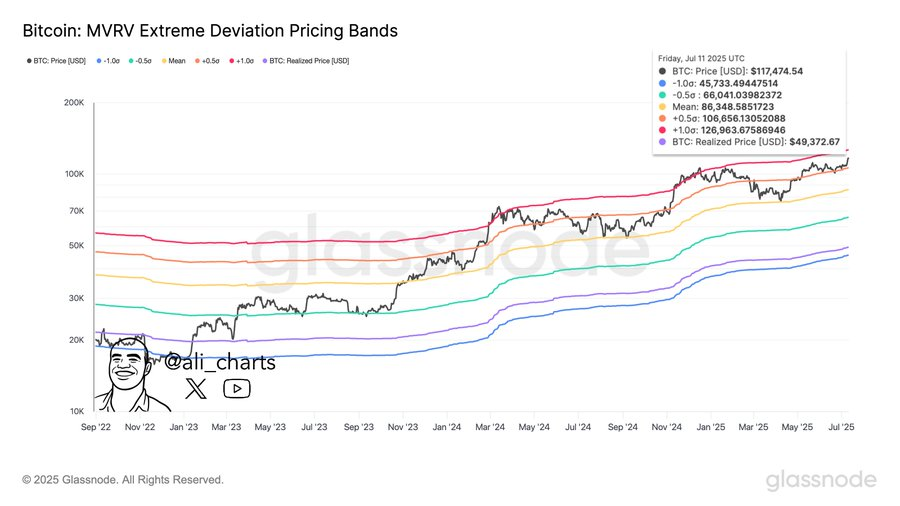
Bitcoin [BTC] is rapidly approaching the upper boundary of the MVRV Pricing Bands, with the +2.0σ zone marked at $127,000. At the time of writing, Bitcoin traded around $122,400, brushing close to the +1.5σ band.

Historically, prices near the +2.0σ level have aligned with market tops, yet BTC’s strong momentum shows no signs of exhaustion. As realized price hovers near $49K, the growing deviation signals elevated investor optimism.

Traders may need to tread carefully, as overheated valuation zones often precede corrections, even in bull markets.
Bitcoin whales load up—fuel for $127K?

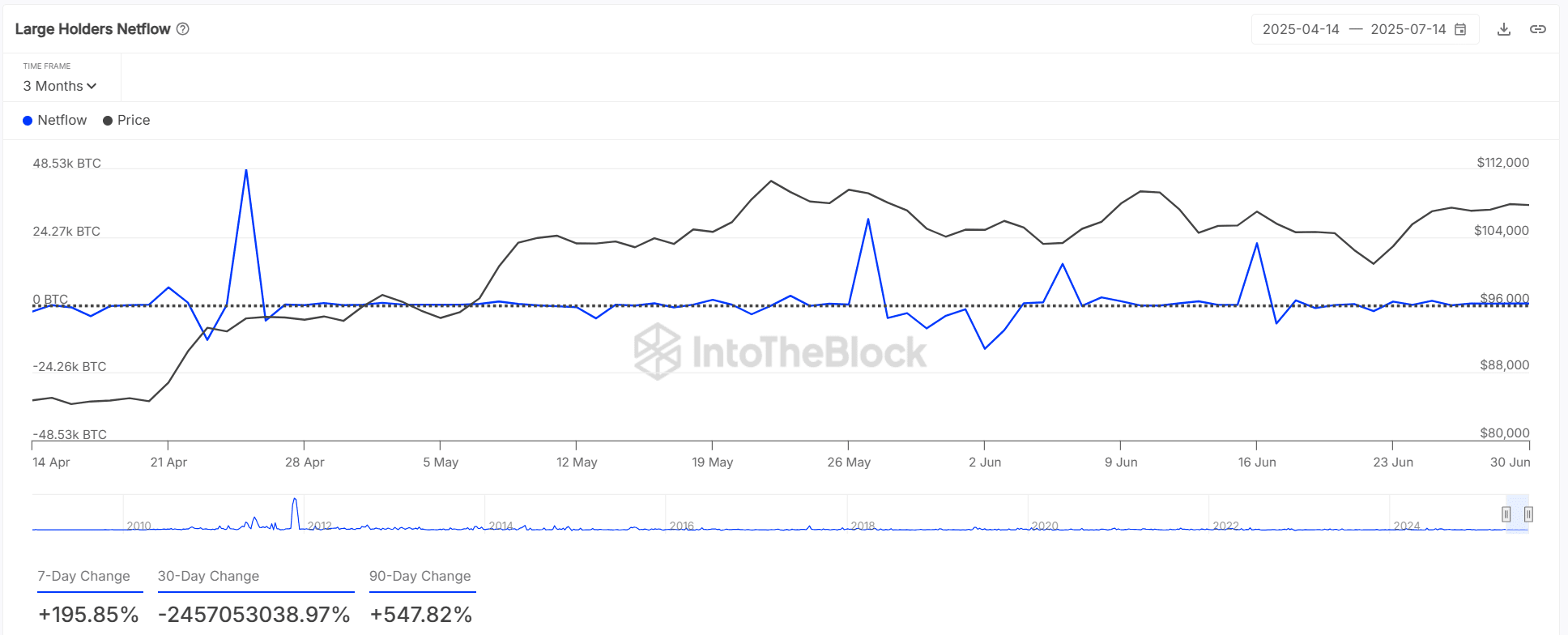
Whale accumulation has intensified dramatically, with large holder netflows surging over 195% in seven days and more than 547% in 90 days.

These sharp inflows, as shown by IntoTheBlock, suggest strategic accumulation during market dips and consolidations.

Notably, these spikes align with phases of sideways price movement, indicating high conviction buying. This behavior often acts as a precursor to bullish breakouts.

Therefore, the continued inflow from large holders could provide the necessary support to push Bitcoin toward the $127K resistance zone in the near term.
Bitcoin exchange netflows have turned significantly negative, with over 2.82K BTC exiting centralized platforms, reflecting an 18.78% decline.

This outflow pattern suggests that investors prefer holding to trading or selling, reinforcing a long-term bullish outlook.

Typically, such behavior points to decreasing sell-side liquidity, which can further fuel upside pressure.

Moreover, declining netflows also reflect growing confidence in off-exchange custody amid macro uncertainty. Persistent negative netflows can limit downside volatility and bolster upward momentum.

Miner selling dries up

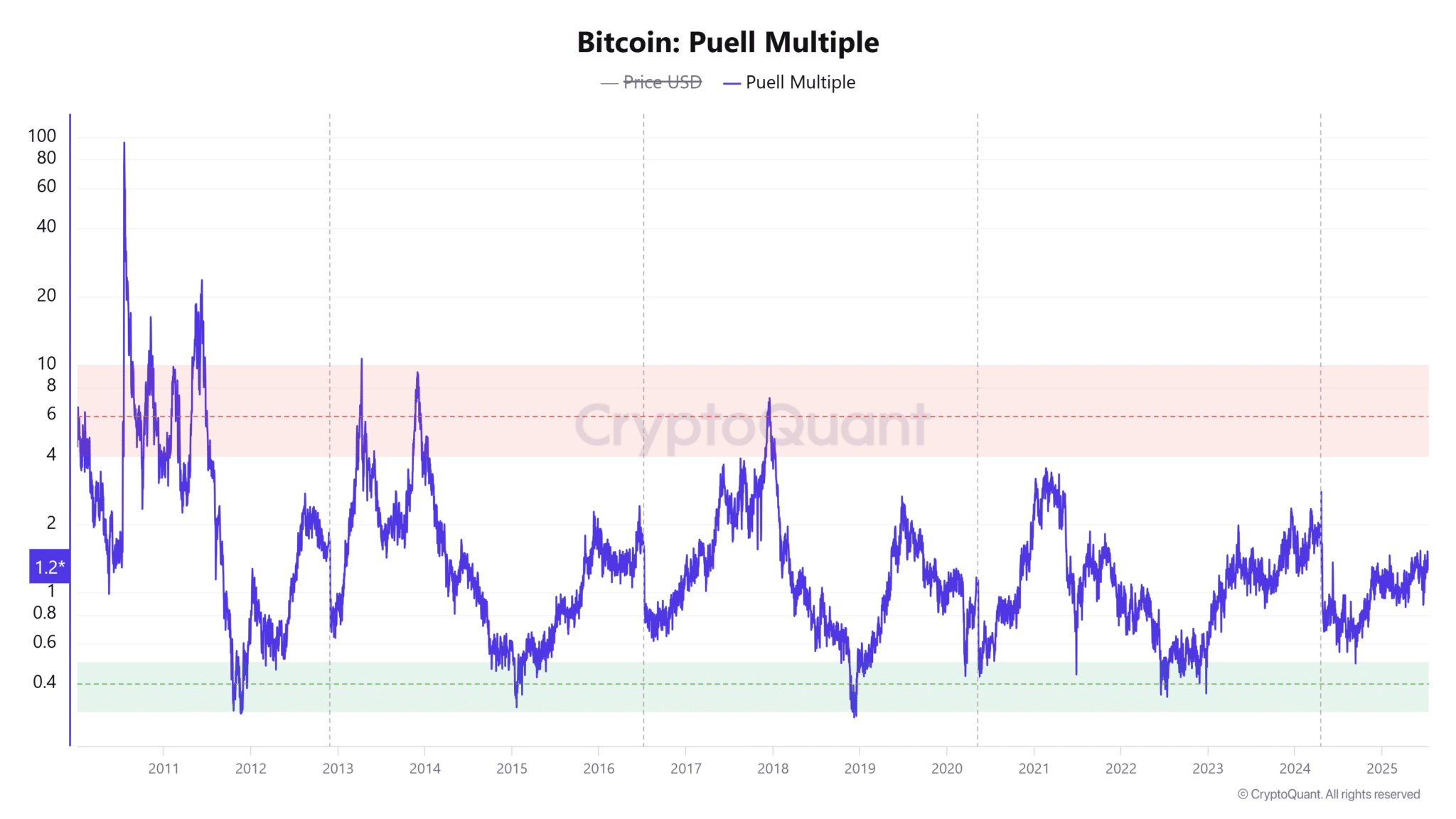
The Puell Multiple was at 1.27 at press time, showing an 11.39% drop, which places it well below historical danger zones for miner-driven corrections.

This metric reflects the ratio of daily coin issuance value relative to its yearly average, and lower values imply less incentive for miners to offload holdings. Reduced selling pressure from this cohort supports price stability.

Therefore, the decline in Puell Multiple may further reinforce the bullish structure forming above $100K by removing a key source of overhead resistance.
The NVT Golden Cross has climbed over 31% to reach 0.94, reflecting an undervalued state for Bitcoin’s network compared to transaction volume.

Historically, values under 2.2 indicate the asset is not in a speculative bubble. This surge suggests that the recent price rise is supported by genuine utility and capital movement.

As NVT diverges positively, it can indicate an early stage of organic growth rather than frothy speculation. Hence, this uptick strengthens the bullish argument, especially if sustained over the coming weeks.

Can Bitcoin break through $127K without overheating?

Bitcoin’s current position near the +1.5σ MVRV band, combined with strong whale accumulation, reduced miner pressure, and sustained outflows from exchanges, signals a structurally bullish setup.

The rise in NVT Golden Cross suggests network fundamentals are keeping pace with price. However, its proximity to overvaluation bands calls for measured optimism.

If accumulation continues and no major sell-offs emerge, Bitcoin could breach the $127K mark in this cycle before facing strong resistance.


Trending Cryptos

Related Reads

Is Anyone Still Buying in the Crypto Market? Unpacking 3 Common Watch-and-Wait Mentalities Today

Is Anyone Still Buying in the Crypto Market? Unpacking 3 Common Wait-and-See Mindsets This article analyzes the current cautious sentiment in the crypto market, distilled from conversations with sophisticated investors. The author identifies three dominant investor mindsets: 1. **Satisfied with Current Holdings:** Many retain a long-term belief in digital assets but see no immediate catalyst for significant price appreciation. They hold positions to avoid missing a future surge but allocate minimal new capital or attention. A shift requires a new, observable catalyst or a rotation from other portfolio areas. 2. **Waiting for Lower Prices:** This reflects not just short-term timing but a belief about crypto's total addressable market and upside potential. It could change if key perceived cycle bottoms pass without a crash, a major bullish event occurs (e.g., sovereign adoption), or price rebounds trigger FOMO-driven buying. 3. **High Opportunity Cost of Allocation:** The core question is comparative growth. With AI-related equities appearing to offer relentless, high-speed growth, justifying marginal investment into assets without similar perceived momentum is difficult. A slowdown in the AI trade could potentially mark a bottom and trigger capital reallocation into crypto. In conclusion, while long-term conviction persists for many, near-term marginal capital flows are constrained by these beliefs. The author suggests the market may be closer to a bottom than a top, but the current climate is defined by this wait-and-see approach, awaiting a catalyst to reignite broader investor commitment.

marsbit39m ago

Is Anyone Still Buying in the Crypto Market? Unpacking 3 Common Watch-and-Wait Mentalities Today

marsbit39m ago

China Added 67 New Unicorns in Half a Year, with AI and Robotics Accounting for Over Half

China added 67 new unicorn companies in the first half of 2026, reaching a total of 517 unicorns with a combined valuation of approximately $2.39 trillion. This surge marks a significant rebound after a post-2022 slowdown and sets a new semi-annual record. The growth is primarily driven by Artificial Intelligence (AI) and Robotics, which together account for over 53% of the new entrants. Specifically, 19 new unicorns are in robotics and 17 in AI. Notable companies include DeepSeek ($615.38B) and Kling AI ($18B). The trend indicates a decisive shift from internet consumer models to hard tech innovation. Geographically, new unicorns are highly concentrated in four cities: Beijing (19), Shanghai (18), Shenzhen (9), and Hangzhou (5), which together host 76.1% of the new companies. Hangzhou's overall valuation is boosted significantly by DeepSeek. Valuation distribution among new unicorns is pyramidal: 77.6% are valued between $1B and $2B, indicating early-stage status, while only two exceed $10B. There is a notable "speed divide": many AI/robotics startups achieved unicorn status in under three years, often via corporate spin-offs or led by star founders, while hard tech companies in semiconductors or biotech typically took over eight years. The report concludes that this wave reflects China's accelerating transition into an AI and robotics-powered innovation cycle, characterized by faster company formation, heightened geographic concentration, and a clear focus on foundational technologies.

marsbit1h ago

China Added 67 New Unicorns in Half a Year, with AI and Robotics Accounting for Over Half

marsbit1h ago

Trading

Spot

Hot Articles

What is $BITCOIN

DIGITAL GOLD ($BITCOIN): A Comprehensive Analysis Introduction to DIGITAL GOLD ($BITCOIN) DIGITAL GOLD ($BITCOIN) is a blockchain-based project operating on the Solana network, which aims to combine the characteristics of traditional precious metals with the innovation of decentralized technologies. While it shares a name with Bitcoin, often referred to as “digital gold” due to its perception as a store of value, DIGITAL GOLD is a separate token designed to create a unique ecosystem within the Web3 landscape. Its goal is to position itself as a viable alternative digital asset, although specifics regarding its applications and functionalities are still developing. What is DIGITAL GOLD ($BITCOIN)? DIGITAL GOLD ($BITCOIN) is a cryptocurrency token explicitly designed for use on the Solana blockchain. In contrast to Bitcoin, which provides a widely recognized value storage role, this token appears to focus on broader applications and characteristics. Notable aspects include: Blockchain Infrastructure: The token is built on the Solana blockchain, known for its capacity to handle high-speed and low-cost transactions. Supply Dynamics: DIGITAL GOLD has a maximum supply capped at 100 quadrillion tokens (100P $BITCOIN), although details regarding its circulating supply are currently undisclosed. Utility: While precise functionalities are not explicitly outlined, there are indications that the token could be utilized for various applications, potentially involving decentralized applications (dApps) or asset tokenization strategies. Who is the Creator of DIGITAL GOLD ($BITCOIN)? At present, the identity of the creators and development team behind DIGITAL GOLD ($BITCOIN) remains unknown. This situation is typical among many innovative projects within the blockchain space, particularly those aligning with decentralized finance and meme coin phenomena. While such anonymity may foster a community-driven culture, it intensifies concerns about governance and accountability. Who are the Investors of DIGITAL GOLD ($BITCOIN)? The available information indicates that DIGITAL GOLD ($BITCOIN) does not have any known institutional backers or prominent venture capital investments. The project seems to operate on a peer-to-peer model focused on community support and adoption rather than traditional funding routes. Its activity and liquidity are primarily situated on decentralized exchanges (DEXs), such as PumpSwap, rather than established centralized trading platforms, further highlighting its grassroots approach. How DIGITAL GOLD ($BITCOIN) Works The operational mechanics of DIGITAL GOLD ($BITCOIN) can be elaborated on based on its blockchain design and network attributes: Consensus Mechanism: By leveraging Solana’s unique proof-of-history (PoH) combined with a proof-of-stake (PoS) model, the project ensures efficient transaction validation contributing to the network's high performance. Tokenomics: While specific deflationary mechanisms have not been extensively detailed, the vast maximum token supply implies that it may cater to microtransactions or niche use cases that are still to be defined. Interoperability: There exists the potential for integration with Solana’s broader ecosystem, including various decentralized finance (DeFi) platforms. However, the details regarding specific integrations remain unspecified. Timeline of Key Events Here is a timeline that highlights significant milestones concerning DIGITAL GOLD ($BITCOIN): 2023: The initial deployment of the token occurs on the Solana blockchain, marked by its contract address. 2024: DIGITAL GOLD gains visibility as it becomes available for trading on decentralized exchanges like PumpSwap, allowing users to trade it against SOL. 2025: The project witnesses sporadic trading activity and potential interest in community-led engagements, although no noteworthy partnerships or technical advancements have been documented as of yet. Critical Analysis Strengths Scalability: The underlying Solana infrastructure supports high transaction volumes, which could enhance the utility of $BITCOIN in various transaction scenarios. Accessibility: The potential low trading price per token could attract retail investors, facilitating wider participation due to fractional ownership opportunities. Risks Lack of Transparency: The absence of publicly known backers, developers, or an audit process may yield skepticism regarding the project's sustainability and trustworthiness. Market Volatility: The trading activity is heavily reliant on speculative behavior, which can result in significant price volatility and uncertainty for investors. Conclusion DIGITAL GOLD ($BITCOIN) emerges as an intriguing yet ambiguous project within the rapidly evolving Solana ecosystem. While it attempts to leverage the “digital gold” narrative, its departure from Bitcoin's established role as a store of value underscores the need for a clearer differentiation of its intended utility and governance structure. Future acceptance and adoption will likely depend on addressing the current opacity and defining its operational and economic strategies more explicitly. Note: This report encompasses synthesised information available as of October 2023, and developments may have transpired beyond the research period.

625 Total ViewsPublished 2025.05.13Updated 2025.05.13

What is $BITCOIN

Discussions

Welcome to the HTX Community. Here, you can stay informed about the latest platform developments and gain access to professional market insights. Users' opinions on the price of BTC (BTC) are presented below.

活动图片