以太坊基金会变革开始,能否助 ETH 币价重回巅峰?

marsbitPublished on 2025-07-10Last updated on 2025-07-11

7 月 10 日,以太坊基金会发布「生态系统发展的未来」,为以太坊基金会启动了一系列深刻的架构改革,旨在应对长期以来在项目支持、生态系统运营和资金管理方面面临的挑战。

在新愿景声明中,以太坊基金会阐述了两个首要的总体目标:首先,最大化直接或间接使用以太坊并受益于其底层价值观的人数;其次,最大化以太坊技术和社会基础设施的韧性。而本次架构改革的核心在于重新定义基金会在以太坊生态系统中的角色,通过引入四个战略支柱(加速、放大、支持和长期疏通)、建立新的治理框架以及改革其资金管理策略,以增强生态的可扩展性、韧性及去中心化程度。
 Governance Reform

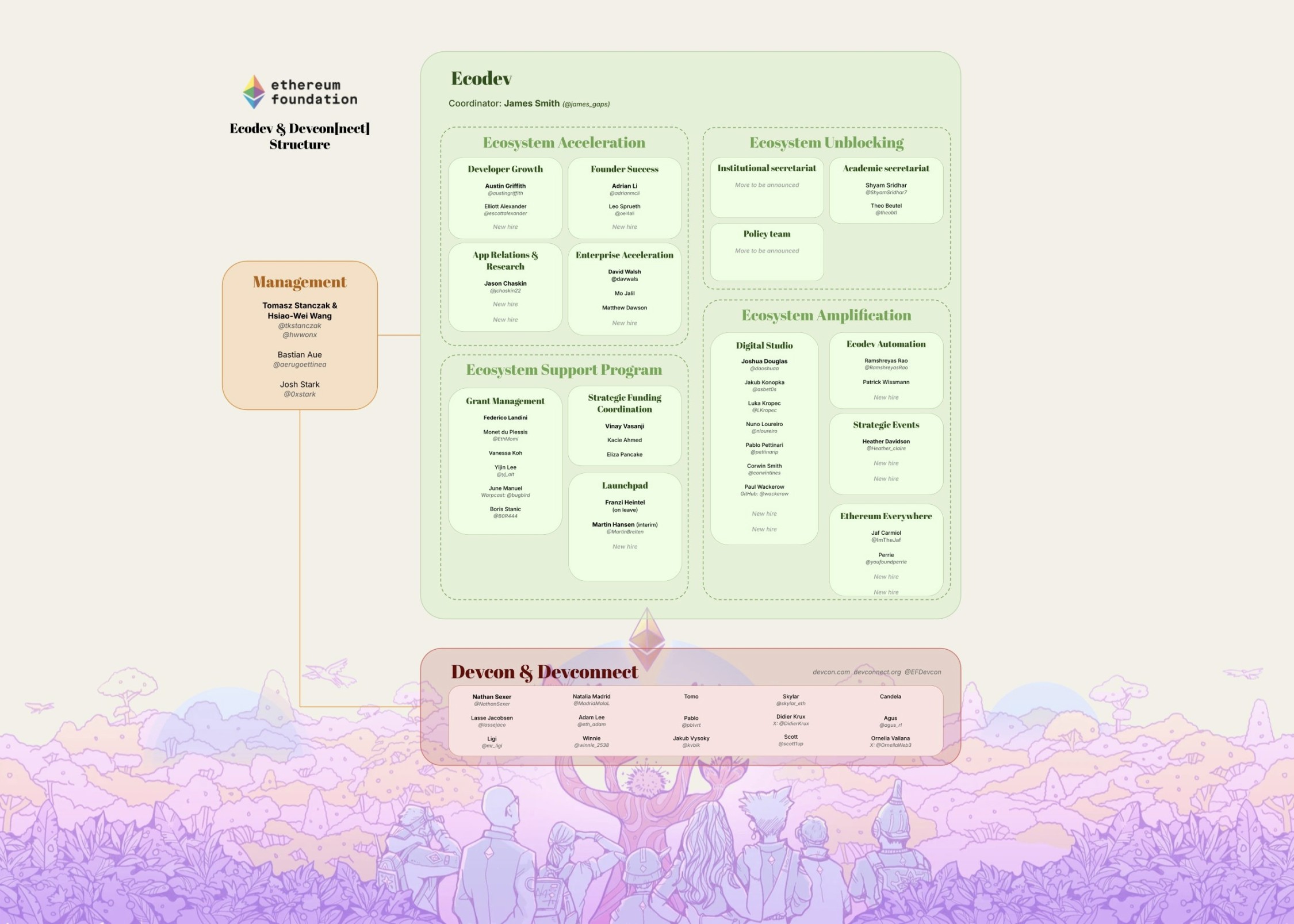
新 Ecodev 组织架构图

生态加速

此前,一些用户和开发者对以太坊基金会的指责在于:以太坊基金会长期「无为而治」的治理理念导致一系列生态分裂和叙事同一性的丧失。而随着越来越多企业正竞相建立加密储备,在储备战略上的攻城略地也成为了生态发展的关键因素。在生态加速上,以太坊基金会新成立了细分方向的支持模块,包括:


  • 企业关系:为希望采用以太坊的企业提供支持,团队将重点服务金融、供应链等垂直领域,推动实体资产(如房地产、债券)的链上代币化(RWA)。
  • 开发者成长:吸引并支持下一代以太坊生态开发者。该模块由 Gitcoin 研究主管 Austin Griffith 负责。
  • 应用程序支持:加速构建面向用户的有意义应用程序。
  • 创始人支持:非财务层面的项目相关支持,该模块由前 Consensys 前端技术主管 Adrian Li 负责。


而对之前生态加速的放大涵盖了宣传和生态系统发展方面的工作,包括:


  • Digital Studio(ethereum.org 团队):以太坊叙事引擎,制作叙事丰富的内容、视频、出版物和独特的可视化以展示以太坊的潜力。
  • 战略活动:设计和执行有针对性的活动。
  • 无处不在的以太坊:一个专注于扩展支持应用开发者的当地社区和中心的团队。
  • EcoDev 自动化:通过自动化和 AI 驱动的工具增强内部运营,使团队更有效地实现目标。


生态支持

长期以来,以太坊基金会一直因缺乏透明度而受到批评,例如在生态系统支持计划(ESP)方面,基金会此前仅披露受资助项目的名称,但未公布具体资助金额或项目进展的后续更新。而此前,以太坊早期开发者 @econoar 离职时也批评基金会“流程繁琐”、“耗时费力”,以及“领导层与更广泛社区脱节”。而在此之后,基金会也在 2025 年将未来运营支出占比从 15% 降至 5%,逐步趋近捐赠型机构标准,并进行链上资产部署,确保长期财务缓冲(目标维持 2.5 年运营现金储备)。


而在新的架构改革中,基金会新的 ESP/ 资助支持计划强调更有针对性的申请和非财务支持,并通过战略资助计划共同资助重要的公共产品组织,使更广泛的以太坊生态系统受益。另外在新的支持架构中,Launchpad 将协助组织应对运营设计、可持续资金、治理和其他挑战。对 Launchpad 支持可以来自基金会、受资助者或其他生态系统组织的衍生产品(类似 Protocol Guild)。


在未来,以太坊基金会还将参与全球加密政策协调,监控与以太坊生态系统相关的全球问题,并与世界各地的政策组织合作,与政府和非政府组织建立持续的关系。另外,作为区块链学术的实践场之一,学术秘书处将积极促进以太坊与大学、教授和学生的合作,以推进区块链技术。


结语

7 月 11 日,以太坊正式突破 3000 美元。在币价攀升的过程中,生态发展也在逐步推进。从本次架构变革来看,以太坊基金会转型的核心目标是扩大用户基础和增强基础设施韧性。它意味着基金会将更积极地协调资源,引导叙事,弥合社区分歧,并在维护以太坊核心价值的同时,推动其在关键应用领域的规模化落地。当公链优势逐渐被追赶时,基金会试图通过体系化的支持和战略引导,为以太坊生态挖掘和塑造下一个增长引擎。


Trending Cryptos

Related Reads

DRAM ETF Issuer: Samsung, SK Hynix, Micron All Surpass $1 Trillion, the AI Era of Memory Chips Has Only Just Begun

Authors: Dave Mazza, Thomas DiFazio | Source: Deep Tide TechFlow The article, written by Roundhill Investments (issuer of the DRAM ETF), responds to Morningstar's caution about investing in memory chip stocks. Morningstar warns of the sector's history of boom-bust cycles, a lack of economic moats, and potential momentum-driven overvaluation. Roundhill argues the current situation is structurally different due to AI. Key points in Roundhill's rebuttal include: * **Changed Demand & Supply Dynamics:** AI infrastructure, not consumer electronics, is now the primary growth driver for memory demand. New, strict long-term supply agreements with hyperscalers reflect the high capital intensity of advanced manufacturing. * **Existence of a Moat:** High-Bandwidth Memory (HBM), essential for AI, has extremely high manufacturing barriers. The market is dominated by Samsung, SK Hynix, and Micron, with new entrants blocked by technological complexity and long lead times for equipment like ASML's EUV machines. * **Strong Fundamental Outlook:** Analyst consensus projects the three companies will rank among the world's most profitable by 2027, with combined profits of $704 billion on over $1 trillion in revenue. Their operating margins have already reached record highs. * **Valuation Re-rating:** Despite significant stock price gains, memory stocks trade at attractive valuations (e.g., a median NTM P/E of 8.37x for the DRAM ETF) relative to projected explosive EPS growth. Roundhill suggests historical valuation frameworks may no longer apply given the new profitability paradigm. Conclusion: Roundhill contends the rally is justified by fundamentals, marking a structural shift for the memory industry into a new era of sustained, AI-driven demand against constrained supply, rather than a repeat of past cycles.

marsbit8m ago

DRAM ETF Issuer: Samsung, SK Hynix, Micron All Surpass $1 Trillion, the AI Era of Memory Chips Has Only Just Begun

marsbit8m ago

EF's Epic Reorganization: 20% Layoffs, Budget Halved, Is Ethereum Gearing Up for a Leaner Future?

The Ethereum Foundation (EF) has announced a major organizational restructuring, involving a 20% staff reduction (approx. 54 employees) and a division into functional clusters like Protocol, Access, User, Community, and Institutional layers. Co-founder Vitalik Buterin further revealed plans to cut the EF's budget by around 40% over the coming years, aiming to reduce its annual spending rate from about 15% to roughly 5% by 2030, transitioning to an endowment-driven model. This overhaul is seen as a long-overdue correction to the EF's ambiguous role. As Ethereum grew, the foundation faced persistent criticism over ETH sales, perceived lack of execution, and unclear strategy, often becoming a focal point for community frustration amid ETH's price stagnation. The reform aims to redefine the EF's boundaries, narrowing its focus to core protocol research, public goods funding, and ecosystem coordination, while offloading more applied development work to the broader market. Concurrently, ecosystem forces like the newly formed Ethlabs (founded by ex-EF researchers) and other independent groups are stepping in to fill the space, signaling a shift from a centralized model to a more distributed, collaborative ecosystem structure. The move was notably praised by Solana co-founder toly, who viewed a "leaner" EF as potentially more decisive and agile.

Odaily星球日报49m ago

EF's Epic Reorganization: 20% Layoffs, Budget Halved, Is Ethereum Gearing Up for a Leaner Future?

Odaily星球日报49m ago

Dragonfly Partner Haseeb: The Fastest-Growing Companies of the Future May All Get Stuck at 149 Employees

Dragonfly partner Haseeb explores the distorted economics of AI model pricing, drawing parallels to tax policy. He notes that startups and small teams (under 150 users) enjoy heavily subsidized, fixed-price AI subscriptions (like Claude Code), where the marginal cost of an additional token is effectively zero. This creates a powerful incentive for them to maximize token usage ("token-maxxing") and innovate aggressively with AI automation. In contrast, large enterprises (over 150 users) are forced onto "Enterprise" plans, paying per-token API fees with high (~75%) markups. This acts like a steep "tax" on AI-powered labor, disincentivizing marginal automation and experimental use, and encouraging them to retain more human workers. Haseeb argues this pricing creates a "150-person cliff," a regulatory notch similar to labor laws in France that discourage firms from growing past 50 employees. He predicts the fastest-growing future companies may deliberately cap their headcount at 149 to avoid the punitive enterprise pricing. This would foster an "AI-first" management philosophy obsessed with automation and outsourcing to stay lean. While not intentionally designed, this bifurcated pricing could become one of the most influential de facto tax policies, shaping how AI replaces labor—not through mass layoffs at big firms, but through agile, AI-native startups outcompeting them.

marsbit1h ago

Dragonfly Partner Haseeb: The Fastest-Growing Companies of the Future May All Get Stuck at 149 Employees

marsbit1h ago

How xBubble Breaks Through in the VC-Heavily-Backed OPC Economy

xBubble: Addressing the Structural Gap in the VC-Backed OPC Economy The concept of OPC (One Person Company) is evolving from a buzzword to a significant AI-driven market. While AI coding tools like Replit and Lovable have validated demand from non-technical users wanting to build applications, a key gap remains: the leap from creating a demo to running a stable, evolving business. These tools still require users to manage the development process, including technical judgments for integrations, modifications, and deployments—a major hurdle for OPCs. xBubble, by DAPPOS, tackles this by shifting from "Prompt-to-Code" to "SOP-to-Business." Instead of generating code from instructions, its core is a system of pre-organized SOPs (Standard Operating Procedures) that translate business goals—like "sell World Cup merchandise"—into complete, executable workflows. This includes generating cohesive assets, pages, payment systems, and backend logic. The platform is augmented by a network of third-party service providers who handle infrastructure (hosting, domains, payment setup), acting like "on-site service engineers." Users can pay for these services directly with xBubble credits, simplifying onboarding. This ecosystem aims to deliver not just an app, but a complete, modifiable business launch path. xBubble targets a clear OPC segment: small commercial nodes (e.g., creators, merchants) with existing products, customers, or channels, but for whom a full tech team is unjustifiable. Its potential lies in SOPs accumulating expertise from real cases, improving reliability and reducing delivery costs over time. Additionally, its native support for crypto payments caters to global or digital-native OPCs. In summary, as AI democratizes software creation, xBubble's opportunity is to prove that "SOP-to-Business" provides more immediate value for launching a real, operational business than a powerful but unstructured AI coding tool.

链捕手1h ago

How xBubble Breaks Through in the VC-Heavily-Backed OPC Economy

链捕手1h ago

Trading

Spot
Futures

Hot Articles

Discussions

Welcome to the HTX Community. Here, you can stay informed about the latest platform developments and gain access to professional market insights. Users' opinions on the price of ETH (ETH) are presented below.

活动图片