Ordinals 和 Runes 之后,Alkanes 如何拓展比特币智能合约生态?

深潮Published on 2025-06-30Last updated on 2025-06-30

Alkanes 元协议为比特币引入了应用程序、NFT 和代币的创建功能。这会引发比特币创新的新浪潮吗?

作者:Erika Lee

编译:深潮TechFlow

简述

  • Alkanes 是比特币上的一项全新元协议,可实现智能合约和代币的发布。

  • 类似于 Ordinals、BRC-20 和 Runes 协议,它正在拓展比特币的潜在可能性。

  • 如果你关注比特币的最新动态,可能已经在 Ordinals 和 Runes 爱好者的讨论中见过“Alkanes”这个名字。那么它到底是什么?

Alkanes 是一个全新的比特币元协议,它无需依赖跨链桥或外部执行层,就能为比特币基础层引入无需信任的智能合约功能。开发者可以利用它在比特币上原生构建应用程序和发布代币,从而扩展这条原始区块链的功能。

该协议由 Oyl Corp 开发,经过两年的基础设施研究,旨在直接在比特币上实现更高级的可编程性。Decrypt 与 Alkanes 的联合创始人兼 CEO Alec Taggart 进行了对话,深入了解该项目的起源、目标以及未来规划。

什么是 Alkanes?

Alkanes 是由 Alec Taggart、Cole Jorissen 和 Ray Pulver 创立的比特币元协议。它是一个框架,允许开发者使用 WASM(WebAssembly)虚拟机将智能合约直接嵌入比特币的数据层。

智能合约是去中心化应用程序的核心代码,在以太坊和 Solana 等区块链上非常常见。然而,比特币并不原生支持智能合约,这在历史上限制了其去中心化金融(DeFi)的能力。但开发者们正在探索新方法,而 Alkanes 协议使得比特币上能够实现更多功能。

Alkanes 通过一种紧凑高效的格式运行,利用比特币的见证数据和 OP_RETURN 字段来执行和追踪状态变化。它的运作方式类似于 Ordinals(比特币上的 NFT)和 Runes(可替代代币),但增加了对基于 WASM 的智能合约的支持。执行和状态转换通过一个索引框架处理,与比特币区块的最终性绑定。

与 Runes 和 BRC-20 标准主要局限于发行和转移可替代代币不同,Alkanes 提供了丰富的可编程性,包括自动化做市商(AMM)、质押合约、免费铸造、NFT 交换等功能。而这一切都在比特币上以无需信任的方式执行。

Alkanes 协议并非与 Ordinals 或 Runes 竞争,而是旨在与它们并存。Ordinals 点燃了比特币的文化势头,而 Alkanes 则为其提供了驱动引擎。
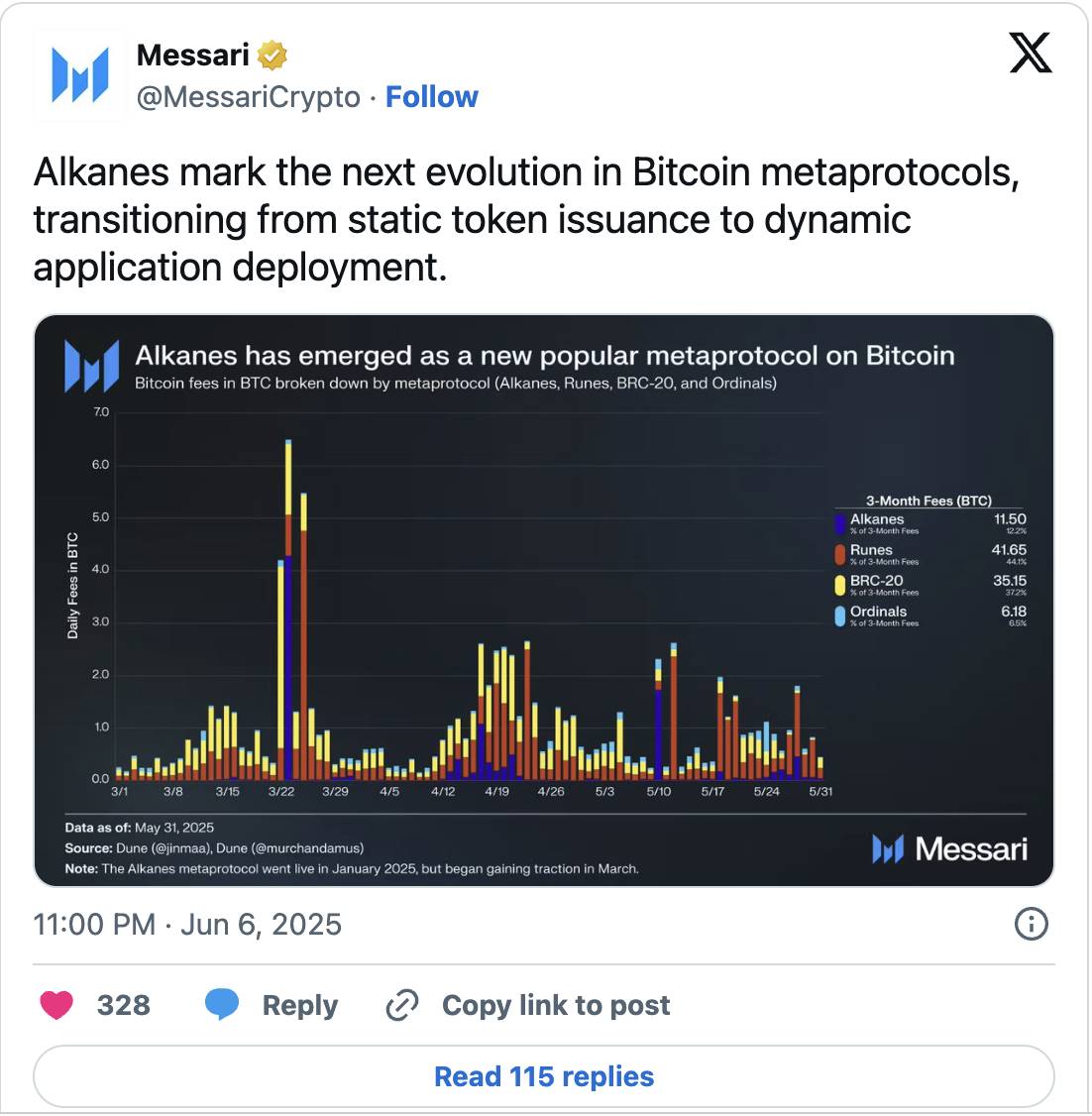
Alkanes 协议的设计支持互操作性——例如,如果你拥有一个 Ordinal,你可以用它来铸造一个新的 Alkanes 资产。这种特性使 Alkanes 成为一个中立但可扩展的基础层,为比特币的更广泛创新和开发提供了可能性。该协议无需跨链桥或独立的执行层,开发者可以直接访问比特币的原生数据,同时解锁更多的应用场景。

Oyl 的创始团队拥有以太坊 DeFi 生态的丰富经验,他们看到了比特币不仅作为价值储存工具的潜力,还将其视为一个能够承载完全表达性应用的结算层。2023 年 Ordinals 的推出点燃了比特币的文化和经济活动,但联合创始人 Taggart 表示,真正的可组合性直到现在才得以实现。

“Alkanes 是多年深入研究和坚定信念的成果,”Taggart 表示。“它证明了比特币无需模仿以太坊也能实现进化。这是为那些相信比特币本身足够强大的用户打造的原生系统。”

Alkanes 的工作原理

Alkanes 引入了一种名为“protostones”的新型数据原语,类似于 Runes 中的 runestones。每个 protostone 可以包含多个消息,支持超越简单发行的多种操作,包括创建、交换、铸造和销毁,这些功能均通过 WASM 运行时编码并执行。

在 Alkanes 中,每个资产都被视为一个代币和一个合约。平台采用工厂模型(factory model),以实现高效的合约部署。开发者无需为每个新资产重新部署合约,只需向模板传递新参数即可。这种模式显著节省了区块空间和费用。

在 Alkanes 中,无论是可替代代币还是非同质化代币(NFT),都被视为代币。NFT 被称为“Orbitals”,这是协议推出后社区开发的标准。Alkanes 的可替代代币与以太坊的 ERC-20 类似,支持完整的智能合约功能和可组合性。

Alkanes 上发布的第一个代币是 Diesel,它与比特币的发行周期保持一致。通过比特币区块铸造,Diesel 使用一个操作码(opcode)追踪区块奖励,并将发行直接与比特币的减半周期挂钩。

与 Runes 和 BRC-20 不同的是,Alkanes 的代币代码(ticker name)并非全球唯一。每个代币都有一个唯一标识符,这意味着同一个名称(例如“Methane”)可以在多个 ID 下共存,从而避免了其他标准中常见的名称抢注问题。

在 Alkanes 协议上,备受欢迎的 NFT 系列包括 Alkane Pandas,其拥有一群强大的忠实社区支持者,以及 Oyly on Alkanes,这是 Alkanes 上首个免费铸造的 NFT 系列。

接下来的计划是什么?

Alkanes 团队正在为其生态系统开发原生的自动化做市商(AMM),同时建立围绕稳定币(Bound)、区块浏览器(Ordiscan、Unisat)、钱包库(LaserEyes)以及 DeFi 协议的生态合作伙伴关系。这些组件将允许开发者仅使用比特币的原生功能构建完整的全栈应用程序。

“这些应用的目标是展示开发者如何利用 Alkanes 的基础设施,直接在比特币上构建完整的去中心化应用(dApp)。”联合创始人 Taggart 补充道。

此外,Oyl Corp 已将其索引引擎 Metashrew 以及所有相关基础设施作为开源软件发布,开发者可以检查、分叉或为协议的成长做出贡献。

Alkanes 协议于 2025 年初在比特币区块 880000 时正式启动,标志性事件是 Diesel 合约的部署。社区的铸造活动随后于 3 月初启动,并通过硬编码设置,当协议开始从指定区块扫描消息时自动初始化。

自发布以来,Alkanes 项目通过开发者的实验和开源贡献实现了有机增长,比特币开发者们正努力推动一个可持续的生态系统。

Taggart 表示:“Alkanes 的目标不仅是创建另一个代币标准,而是为开发者提供一个平台,使可组合性、流动性和主权最终能在比特币上实现交汇。”

Trending Cryptos

Related Reads

Ethereum Foundation Interim Executive Director Speaks Out: What Is Our Mission?

The Ethereum Foundation's core mission is to ensure Ethereum remains a truly permissionless, censorship-resistant, private, and open infrastructure for large-scale, sovereign coordination. The article clarifies the EF's focus and dismisses irrelevant objectives, such as pursuing institutional popularity or short-term speculation. Its core work centers on eliminating systemic weaknesses. This involves fortifying Ethereum across multiple layers—protocol, access, user, and institutional—against exploitation, control, or surveillance. Key initiatives include minimizing harmful MEV and preventing privileged control over transaction flow, making unconditional privacy a foundational default, ensuring staking remains permissionless and decentralized, and strengthening user-facing access points to uphold autonomy. Concurrently, the EF aims to seize strategic opportunities. These include leading the transition to post-quantum cryptography, achieving a fully verifiable protocol stack, establishing Ethereum as private digital cash, integrating user-owned AI agents with personal wallets, and demonstrating that trusted-neutral infrastructure can competitively handle disintermediated coordination at an institutional scale. The article also addresses recent organizational changes, stating that personnel departures were due to strategic realignment, role fit, or natural evolution. It clarifies the approach to spin-outs, emphasizing that external funding will be provided only for work critical to the EF's mission that reduces Ethereum's dependency without creating new risks or mission drift. Ultimately, the EF is committed to building an enduring, neutral system that reshapes global coordination, focusing relentlessly on the principles of censorship resistance, openness, privacy, and sovereignty (CROP).

链捕手30m ago

Ethereum Foundation Interim Executive Director Speaks Out: What Is Our Mission?

链捕手30m ago

STRC 跌破面值,比特币财库实验进入下半场

The price of STRC, Strategy's dividend-paying preferred stock, has fallen below its $100 face value, triggering a re-evaluation of the "bitcoin treasury" corporate model. This highlights a critical tension: the company's asset base consists of high-volatility, non-cash-flow-generating Bitcoin, while its capital structure requires continuous cash payouts for dividends and interest. The decline of STRC signals that market pressure is shifting from asset price volatility to the pricing of the company's financing tools. Strategy's core model involves a three-step conversion: turning equity into Bitcoin exposure, converting Bitcoin holdings into capital market credit, and packaging non-yielding BTC into cash-paying securities like STRC. While Strategy holds a massive 847,363 BTC, the focus is now on cash flow mismatches. The company faces annual preferred stock dividend obligations of approximately $1.7 billion, far exceeding the cash flow from its legacy software business. Its ability to meet these obligations relies on continued access to capital markets. The market is now scrutinizing which of three potential costs becomes untenable first: rising dividend costs to attract investors, dilution costs from issuing more common stock, or the reputational cost of selling BTC—a move contrary to its "hodl" narrative. For the broader crypto market, a constrained Strategy means the potential loss of a predictable, narrative-driven marginal buyer for Bitcoin. The STRC discount serves as a reminder that the longevity of such models depends not just on Bitcoin's price, but also on financing windows, cash reserves, and investor willingness to pay a "trust premium" for the structure.

marsbit1h ago

STRC 跌破面值,比特币财库实验进入下半场

marsbit1h ago

Standard Chartered Bank’s 50-Fold Fantasy: Predicting AAVE to Reach $3,500

Standard Chartered Bank has issued an optimistic research report predicting that the AAVE token could surge 50-fold to $3,500 by 2030. This forecast is based on the projection that the total value locked (TVL) in DeFi will grow 37x to approximately $2.7 trillion, driven by stablecoin expansion and the tokenization of real-world assets (RWA). The bank's model links Aave's potential valuation directly to its protocol revenue, which is primarily driven by net interest margins. The report highlights Aave's current dominant position, noting it captures over 80% of the net earnings ("protocol retained earnings") in the lending sector while holding only about half of its TVL. It also points to the recent launch of the Aave V4 architecture and a healthy revenue stream of $142 million in 2025 as positive fundamentals. Grayscale's separate analysis, applying traditional valuation metrics like DCF, concluded AAVE is currently undervalued. However, the article notes significant challenges. Aave's peer-to-pool lending model suffers from inherent capital inefficiency, with an estimated $52 million annual "deadweight loss" due to idle funds needed for liquidity buffers. This structural flaw was exposed during the April KelpDAO exploit, which locked a WETH pool at 100% utilization for days. Emerging protocols like Morpho, with more efficient point-to-point models, are cited as growing competitive threats. In summary, while institutional forecasts paint a macro picture of massive growth fueled by RWA adoption, Aave's path forward hinges on addressing its core structural limitations and competitive pressures within the evolving DeFi lending landscape.

链捕手2h ago

Standard Chartered Bank’s 50-Fold Fantasy: Predicting AAVE to Reach $3,500

链捕手2h ago

Trading

Spot
Futures

Hot Articles

What is $BITCOIN

DIGITAL GOLD ($BITCOIN): A Comprehensive Analysis Introduction to DIGITAL GOLD ($BITCOIN) DIGITAL GOLD ($BITCOIN) is a blockchain-based project operating on the Solana network, which aims to combine the characteristics of traditional precious metals with the innovation of decentralized technologies. While it shares a name with Bitcoin, often referred to as “digital gold” due to its perception as a store of value, DIGITAL GOLD is a separate token designed to create a unique ecosystem within the Web3 landscape. Its goal is to position itself as a viable alternative digital asset, although specifics regarding its applications and functionalities are still developing. What is DIGITAL GOLD ($BITCOIN)? DIGITAL GOLD ($BITCOIN) is a cryptocurrency token explicitly designed for use on the Solana blockchain. In contrast to Bitcoin, which provides a widely recognized value storage role, this token appears to focus on broader applications and characteristics. Notable aspects include: Blockchain Infrastructure: The token is built on the Solana blockchain, known for its capacity to handle high-speed and low-cost transactions. Supply Dynamics: DIGITAL GOLD has a maximum supply capped at 100 quadrillion tokens (100P $BITCOIN), although details regarding its circulating supply are currently undisclosed. Utility: While precise functionalities are not explicitly outlined, there are indications that the token could be utilized for various applications, potentially involving decentralized applications (dApps) or asset tokenization strategies. Who is the Creator of DIGITAL GOLD ($BITCOIN)? At present, the identity of the creators and development team behind DIGITAL GOLD ($BITCOIN) remains unknown. This situation is typical among many innovative projects within the blockchain space, particularly those aligning with decentralized finance and meme coin phenomena. While such anonymity may foster a community-driven culture, it intensifies concerns about governance and accountability. Who are the Investors of DIGITAL GOLD ($BITCOIN)? The available information indicates that DIGITAL GOLD ($BITCOIN) does not have any known institutional backers or prominent venture capital investments. The project seems to operate on a peer-to-peer model focused on community support and adoption rather than traditional funding routes. Its activity and liquidity are primarily situated on decentralized exchanges (DEXs), such as PumpSwap, rather than established centralized trading platforms, further highlighting its grassroots approach. How DIGITAL GOLD ($BITCOIN) Works The operational mechanics of DIGITAL GOLD ($BITCOIN) can be elaborated on based on its blockchain design and network attributes: Consensus Mechanism: By leveraging Solana’s unique proof-of-history (PoH) combined with a proof-of-stake (PoS) model, the project ensures efficient transaction validation contributing to the network's high performance. Tokenomics: While specific deflationary mechanisms have not been extensively detailed, the vast maximum token supply implies that it may cater to microtransactions or niche use cases that are still to be defined. Interoperability: There exists the potential for integration with Solana’s broader ecosystem, including various decentralized finance (DeFi) platforms. However, the details regarding specific integrations remain unspecified. Timeline of Key Events Here is a timeline that highlights significant milestones concerning DIGITAL GOLD ($BITCOIN): 2023: The initial deployment of the token occurs on the Solana blockchain, marked by its contract address. 2024: DIGITAL GOLD gains visibility as it becomes available for trading on decentralized exchanges like PumpSwap, allowing users to trade it against SOL. 2025: The project witnesses sporadic trading activity and potential interest in community-led engagements, although no noteworthy partnerships or technical advancements have been documented as of yet. Critical Analysis Strengths Scalability: The underlying Solana infrastructure supports high transaction volumes, which could enhance the utility of $BITCOIN in various transaction scenarios. Accessibility: The potential low trading price per token could attract retail investors, facilitating wider participation due to fractional ownership opportunities. Risks Lack of Transparency: The absence of publicly known backers, developers, or an audit process may yield skepticism regarding the project's sustainability and trustworthiness. Market Volatility: The trading activity is heavily reliant on speculative behavior, which can result in significant price volatility and uncertainty for investors. Conclusion DIGITAL GOLD ($BITCOIN) emerges as an intriguing yet ambiguous project within the rapidly evolving Solana ecosystem. While it attempts to leverage the “digital gold” narrative, its departure from Bitcoin's established role as a store of value underscores the need for a clearer differentiation of its intended utility and governance structure. Future acceptance and adoption will likely depend on addressing the current opacity and defining its operational and economic strategies more explicitly. Note: This report encompasses synthesised information available as of October 2023, and developments may have transpired beyond the research period.

450 Total ViewsPublished 2025.05.13Updated 2025.05.13

What is $BITCOIN

Discussions

Welcome to the HTX Community. Here, you can stay informed about the latest platform developments and gain access to professional market insights. Users' opinions on the price of BTC (BTC) are presented below.

活动图片