Palau Wraps XRP Ledger Stablecoin Audit: Here’s What Ripple Paid

bitcoinistPublished on 2025-06-24Last updated on 2025-06-25

Abstract

Palau’s Office of the Public Auditor (OPA) has released the long-awaited performance audit of the government’s XRP-Ledger-based stablecoin pilot, confirming...

Trusted Editorial content, reviewed by leading industry experts and seasoned editors. Ad Disclosure

Palau’s Office of the Public Auditor (OPA) has released the long-awaited performance audit of the government’s XRP-Ledger-based stablecoin pilot, confirming that Ripple Services Inc. funded the 25-month experiment with a single $25,000 payment and that just over half of that grant has been spent. The 12-page report closes the accounting on the Palau Stablecoin (PSC) project, which ran from 26 October 2021 to 27 November 2023.

Ripple’s $25K Grant Confirmed In Palau Stablecoin Audit

The audit documents show Ripple wired $25,000 into the National Treasury on 10 March 2023. Of that amount the Ministry of Finance (MOF) disbursed $14,035, mainly to reimburse three participating merchants—Surangel & Sons, Penthouse Hotel and King’s Minute Mart—for redeeming PSC tokens spent by 154 volunteer government employees, each of whom received an allocation of 100 PSC (one-to-one with the US dollar). The unspent balance of $10,965 remains in the Treasury pending a political decision on a potential second phase.

Ripple’s contribution was properly booked under the FY 2023 budget law (RPPL 11-24) and, in OPA’s words, “was properly accounted for and deposited into the National Treasury,” a finding that dispels earlier speculation that the grant bypassed normal budget channels.

OPA opened the probe at the request of Senator Mark Rudimch, whose Resources, Commerce, Trade & Development Committee raised questions in July 2023 about the programme’s constitutionality and financial controls. The audit therefore set two narrow objectives: whether the MOF had legal authority to partner with a private company and whether it followed Palauan law in doing so.

On substance, the auditors concluded the MOF “acted within its broad authority and did not violate its mandate,” but they flagged two procedural breaches. First, neither the original October 2021 memorandum of understanding nor the December 2022 Ripple Master Hosted Stablecoin Services Agreement was certified “for form and legality” by the Attorney General, as required by 40 PNC § 612. Second, the National Director of Program, Budget & Management did not certify fund availability when the services agreement was signed, a step mandated by 40 PNC § 401(b).

“The Republic of Palau cannot ascertain the form and legality of the agreements as intended by law,” OPA wrote, urging the MOF in a formal recommendation “to ensure that every government contract…is certified by the Attorney General before execution.”

The Ministry accepted the admonition, but in its written reply stressed that “agreements that do not bind the Republic are often acceptable without AG review,” adding that it had “consistently relied upon legal advice provided by the Office of the President’s legal staff.” On the budget-certification lapse, officials noted that certification did occur at the time of each disbursement and argued the grant was already covered under annual outside-assistance provisions. “Thank you for the findings, which are accepted as presented,” the MOF told auditors.

XRP Ledger Pilot Ended: What’s Next?

Beyond the procedural fixes, OPA offered a nuanced verdict on the policy experiment itself. It praised the pilot’s design for exploring “technological solutions enabling the Ministry of Finance to manage the minting, distribution, redemption and destruction of PSC…recorded on the public XRP Ledger,” and it highlighted potential benefits for financial inclusion and lower transaction costs. Yet the report also cautioned that rolling out a circulating national stablecoin would require explicit legislation by the Olbiil Era Kelulau (Palau’s Congress); without such an act, any expansion “would be unlawful.”

For Ripple, the audit caps a three-year engagement whose cash outlay—$25,000—was modest compared with typical central-bank-digital-currency pilots. While the report makes no judgement on technical performance, it confirms that the XRP Ledger handled mint-and-burn cycles and retailer redemptions. For Palau’s policymakers, the next decision is whether to draft the legislation that would turn PSC from a proof-of-concept into legal tender—or to leave the remaining grant dollars unspent and the project on the shelf.

At press time, XRP traded at $2.1696.
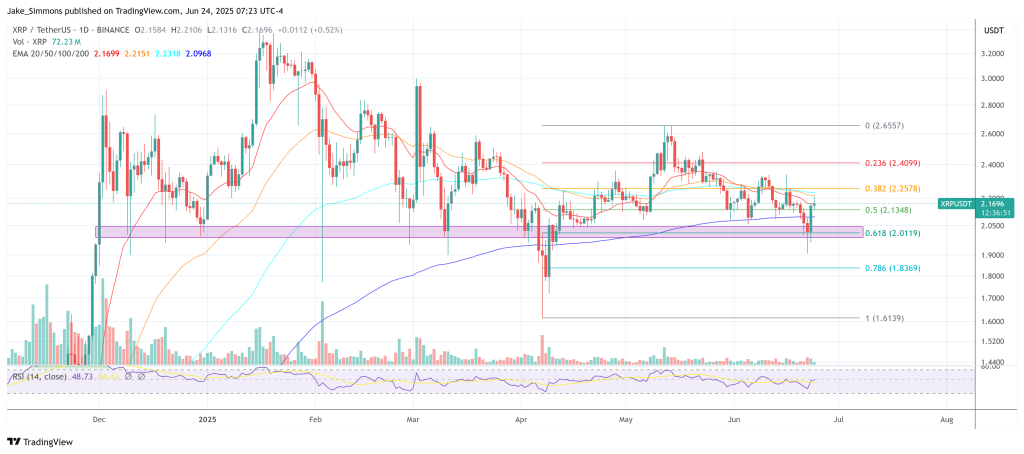
XRP price
XRP price, 1-day chart | Source: XRPUSDT on TradingView.com
Featured image created with DALL.E, chart from TradingView.com
Editorial Process for bitcoinist is centered on delivering thoroughly researched, accurate, and unbiased content. We uphold strict sourcing standards, and each page undergoes diligent review by our team of top technology experts and seasoned editors. This process ensures the integrity, relevance, and value of our content for our readers.

Jake Simmons has been a Bitcoin enthusiast since 2016. Ever since he heard about Bitcoin, he has been studying the topic every day and trying to share his knowledge with others. His goal is to contribute to Bitcoin's financial revolution, which will replace the fiat money system. Besides BTC and crypto, Jake studied Business Informatics at a university. After graduation in 2017, he has been working in the blockchain and crypto sector. You can follow Jake on Twitter at @realJakeSimmons.

Trending Cryptos

Related Reads

Securitize Drops 40% in First Week of Trading as Tokenization Industry Enters Patent Wars

The article discusses the recent stock performance of Securitize (NYSE: SECZ) and a looming patent war in the tokenization industry. Securitize, a leading tokenization platform and transfer agent for BlackRock's BUIDL fund, debuted on the NYSE via a SPAC merger on July 2. After an initial rise, its stock plummeted nearly 40% within a week, closing at $8.06 on July 7. Analysts attribute the sharp decline largely to typical post-SPAC investor turnover and broader pressure on crypto-related stocks, rather than fundamental business deterioration. Concurrently, Securitize faces significant legal challenges. On June 15, infrastructure rival tZERO accused Securitize of patent infringement concerning its core DS Protocol and Vault Registrar products. Securitize preemptively filed a lawsuit on June 22 seeking a declaratory judgment of non-infringement. tZERO, holding 105 patents, has indicated it has identified at least six other market participants for potential infringement actions, signaling a broader industry-wide patent conflict. A separate lawsuit was also filed by Liquid Rarity Exchange. The article concludes that while Securitize's stock drop may be a temporary SPAC-related correction, the patent disputes initiated by tZERO represent a more profound, long-term risk for the entire tokenization sector, potentially shifting competitive dynamics from business execution to intellectual property litigation.

Foresight News16m ago

Securitize Drops 40% in First Week of Trading as Tokenization Industry Enters Patent Wars

Foresight News16m ago

HKEX Welcomes Its Largest IPO of the Day

Today (July 8th), Momenta successfully listed on the Hong Kong Stock Exchange, becoming the "first Physical AI stock." The company, founded in 2016 by Tsinghua University alumnus Cao Xudong, focuses on autonomous driving as an entry point into Physical AI research. Momenta's IPO price was HK$295.6 per share. With a market cap exceeding HK$70 billion post-listing, it was the largest among the five companies debuting that day. The offering raised approximately HK$6.8 billion and attracted a "star-studded" lineup of 14 cornerstone investors, including top-tier international funds, leading strategic industrial investors like Mercedes-Benz and BYD, and major Chinese financial institutions. The company has pioneered a "flywheel" strategy, integrating mass-produced advanced driver-assistance systems (ADAS) with its full-self-driving (L4) development. Data from over 1 million vehicles equipped with its systems fuels its AI models, enabling continuous improvement. This massive real-world data scale is a core competitive advantage. In April, Momenta launched its self-developed R7 World Model for mass production, a foundational model designed to understand and predict physical world dynamics. The company positions itself not just as an automotive tech supplier, but as a platform-level Physical AI company. Its technology platform has the potential to expand beyond autonomous vehicles into areas like logistics and embodied AI. Financially, Momenta's revenue grew from RMB 743 million in 2023 to RMB 2.413 billion in 2025, with licensing income surging 42-fold during this period. While still reporting adjusted losses, it is nearing breakeven. The company boasts partnerships with 24 global automakers, including 9 of the world's top 10, and holds a 65% market share in China's third-party urban NOA segment. The listing marks a significant moment for Physical AI in global capital markets, reflecting strong investor confidence in Momenta's unique technology path and commercial execution.

marsbit33m ago

HKEX Welcomes Its Largest IPO of the Day

marsbit33m ago

Trading

Spot

Hot Articles

What is XRP 2.0

XRP 2.0: A New Frontier in the Cryptocurrency Landscape Introduction to XRP 2.0 In the ever-evolving realm of cryptocurrency, new projects continuously emerge, vying for attention and adoption. One such promising initiative is XRP 2.0, a novel cryptocurrency project designed to leverage advanced blockchain technology and robust encryption methodologies. While the name draws parallels with Ripple’s XRP, it’s crucial to note that XRP 2.0 operates independently, focusing on enhancing transaction security, privacy, and scalability. As the digital financial landscape increasingly embraces decentralized solutions, XRP 2.0 aims to contribute meaningfully to web3 and the overall expansion of crypto projects. What is XRP 2.0? At its core, XRP 2.0 is a cryptocurrency project that aims to create a secure and decentralized digital currency ecosystem. Its foundational technology integrates sophisticated blockchain principles with cutting-edge encryption techniques. The overarching goal of XRP 2.0 is to establish itself as a reliable and efficient platform enabling swift transaction execution while prioritizing enhanced privacy protections for its users. The project is promoted as a solution to many limitations faced by existing cryptocurrencies, proposing a system that can handle a higher volume of transactions with improved speed and privacy. This versatility positions XRP 2.0 as a significant contender in a marketplace riddled with various digital currencies. Who is the Creator of XRP 2.0? The identity of the creator behind XRP 2.0 has been flagged as ‘Wilbur.’ However, comprehensive details regarding Wilbur or their associated entity remain elusive. The anonymity of many cryptocurrency creators is not an uncommon phenomenon in the industry, often designed to maintain a degree of privacy and security. Who are the Investors of XRP 2.0? As of now, specific information related to the investment foundations or organizations supporting XRP 2.0 is not publicly available. In the cryptocurrency sector, the backing by reputed investors can significantly influence a project's credibility and success, yet the transparency regarding the financial supporters of XRP 2.0 has not been established. How Does XRP 2.0 Work? XRP 2.0 stands out by employing a combination of blockchain technology and advanced encryption algorithms that ensures secure and decentralized transactions. Its innovative structure includes unique features designed to foster user engagement and broaden functionalities beyond conventional cryptocurrency transactions. Among these features, XRP 2.0 incorporates AI-powered capabilities, such as text-to-image and text-to-speech functionalities. These additions are designed to enhance the interactive experience for users, promoting broader applicability across various sectors. By bridging technological advancements with user-centered design, XRP 2.0 aims to capture the attention of a diverse range of individuals and enterprises looking to integrate cryptocurrency solutions into their operational frameworks. Timeline of XRP 2.0 Understanding XRP 2.0 requires examining the milestones that have defined its journey thus far: July 23, 2023: XRP 2.0 is introduced as a novel cryptocurrency project, aiming to revolutionize secure and decentralized transaction capabilities in the blockchain domain. September 8, 2023: The launching of another project, XRP20, occurs, marking the emergence of an ERC-20 token on the Ethereum blockchain that remains unrelated to XRP 2.0. November 13, 2023: The XRP Ledger undergoes a significant update with the release of rippled server software version 2.0.0. It is essential to note that this development is disconnected from the XRP 2.0 cryptocurrency project. Key Points About XRP 2.0 To distill the essence of XRP 2.0, several critical factors emerge: Unique Features: The inclusion of features like AI-powered text-to-image and text-to-speech further diversifies the potential applications of XRP 2.0. Blockchain Technology: The framework utilizes advanced blockchain mechanisms and encryption protocols, ensuring a secure and decentralized environment for transactions. Scalability and Privacy: XRP 2.0 prioritizes enhanced privacy protections in transaction processes and the scalability necessary to accommodate a growing user base. No Affiliation with Ripple: Importantly, despite its name, XRP 2.0 does not have any allegiance or collaboration with Ripple’s XRP, distinguishing its operational framework and objectives within the cryptocurrency ecosystem. Conclusion XRP 2.0 represents an ambitious venture into the cryptocurrency sphere, aiming to offer a combination of security, privacy, and efficiency in digital transactions. By integrating sophisticated technologies and user-friendly features, the project sets out to broaden the horizons of what cryptocurrency can achieve in today's digital economy. While the anonymity of its creator and lack of disclosed investors might raise questions for some, XRP 2.0's focus on advanced functionalities and decentralisation enhances its appeal amidst an increasingly crowded crypto market. As the cryptocurrency landscape continues to evolve, XRP 2.0 may yet emerge as a pivotal player in the expansion of secure and scalable blockchain solutions.

1.1k Total ViewsPublished 2024.04.01Updated 2024.12.03

What is XRP 2.0

Discussions

Welcome to the HTX Community. Here, you can stay informed about the latest platform developments and gain access to professional market insights. Users' opinions on the price of XRP (XRP) are presented below.

活动图片