Ethereum Outperforms Bitcoin During Geopolitical Chaos – Is Altseason About To Ignite?

bitcoinistPublished on 2025-06-18Last updated on 2025-06-19

Abstract

Ethereum is navigating intense volatility as global tensions rise, particularly with the escalating conflict between Israel and Iran. Markets are...

Trusted Editorial content, reviewed by leading industry experts and seasoned editors. Ad Disclosure

Ethereum is navigating intense volatility as global tensions rise, particularly with the escalating conflict between Israel and Iran. Markets are on edge amid growing fears that the United States could become directly involved, further increasing uncertainty across risk assets. Despite these headwinds, Ethereum has managed to hold above the $2,500 level, showing resilience even as price action remains stuck within a range that began forming in early May.

The $2,700 level stands out as a key resistance that bulls must reclaim to spark momentum toward the $3,000 mark. However, repeated rejections from this area signal that buyers are hesitating, possibly due to the broader market’s caution and unclear macroeconomic outlook.

Top analyst Ted Pillows highlighted a notable development: despite heightened global tensions, the ETH/BTC pair is up on the weekly timeframe. This suggests relative strength from Ethereum and may indicate that the worst of the downside could be behind it. If the pair continues outperforming Bitcoin, it could signal the beginning of a new altcoin trend — but much depends on whether Ethereum can reclaim and sustain levels above $2,700 in the face of growing geopolitical risks and tightening market conditions.

Ethereum Eyes Breakout As ETH/BTC Chart Shows Strength

Ethereum is positioning for a decisive move after more than six weeks of consolidation just below the $2,800 level. Price action has been trapped between $2,500 and $2,800, with bulls repeatedly testing the upper boundary while bears continue to defend it. This prolonged standoff suggests a build-up of pressure that could soon erupt into a major directional shift.

Bulls are attempting to reclaim control as the broader crypto market stabilizes, but uncertainty remains elevated. The ongoing conflict between Israel and Iran, along with the looming risk of US involvement, continues to weigh heavily on sentiment. Investors are cautiously watching for clarity, and until geopolitical risks ease, Ethereum and other risk assets are likely to remain in a sideways trend.

Ted Pillows points to the ETH/BTC weekly chart as a leading signal. According to his analysis, despite extreme macro stress, ETH/BTC is climbing — a sign that Ethereum has likely bottomed relative to Bitcoin for this cycle. Historically, such bottom formations often precede strong altcoin rallies.
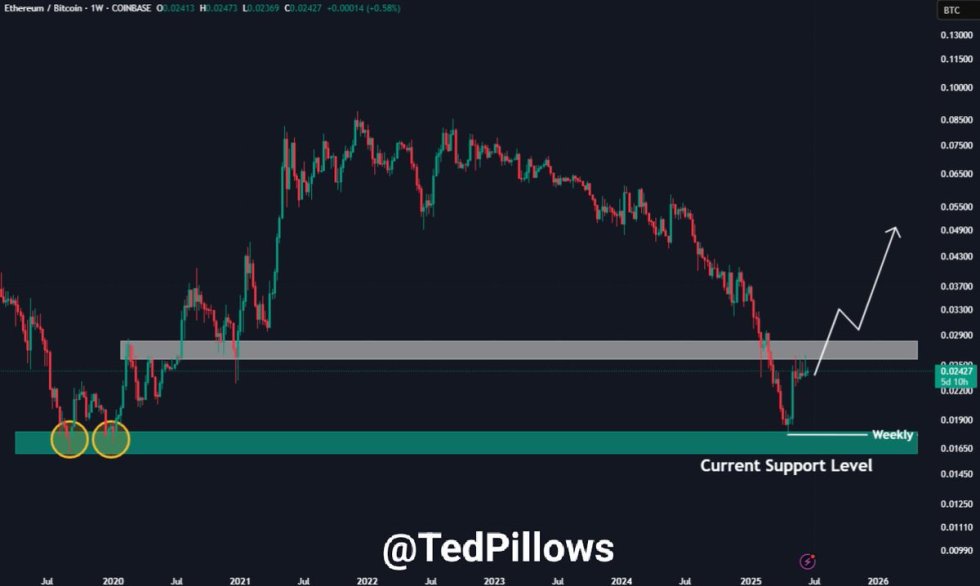
Ethereum showing strength against Bitcoin | Source: Ted Pillows on X

Pillows suggests that once macro conditions begin to stabilize, Ethereum could mirror its explosive May performance. A breakout above $2,800 would confirm bullish momentum and potentially ignite a parabolic move toward the $3,200–$3,500 range. For now, the $2,800 resistance remains the critical barrier that must be flipped into support to validate any breakout scenario.

ETH Consolidates At Critical Support

The 12-hour chart for Ethereum (ETH) shows continued consolidation within a well-defined range between $2,500 and $2,800. ETH recently tested the lower boundary of this range around $2,500 and held, suggesting bulls are still defending key demand levels. However, upside momentum has stalled multiple times at the $2,675–$2,800 resistance zone, marked by the yellow highlighted region on the chart.
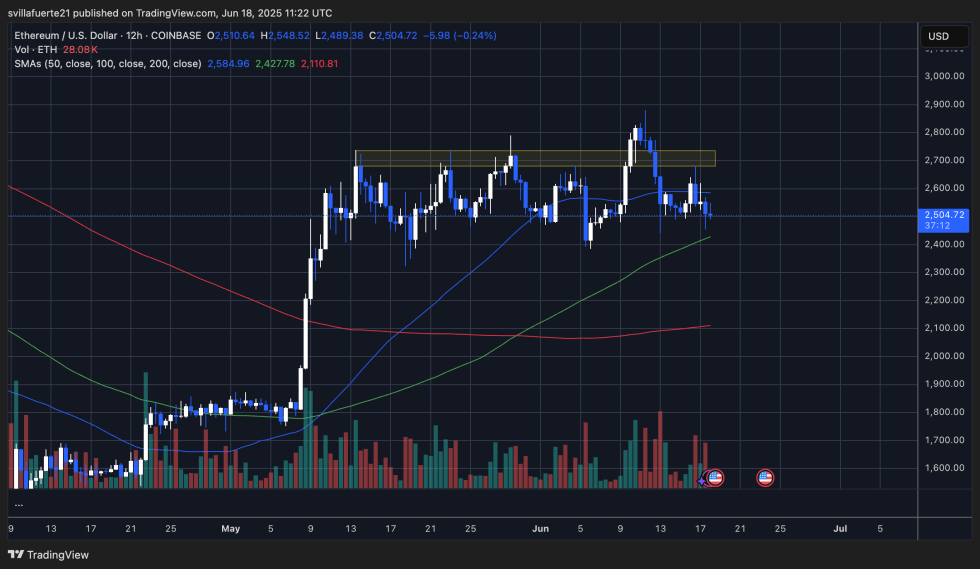
ETH testing range lows | Source: ETHUSDT chart on TradingView

Volume has remained elevated during recent attempts to break out, but each rally has met strong selling pressure, especially as price approaches the $2,750 area. This indicates bears are actively protecting that level. The 50-day and 100-day moving averages are starting to flatten, reflecting the lack of directional bias, while the 200-day MA remains comfortably below current price — a long-term bullish sign if support continues to hold.

The price action suggests that Ethereum is coiling for a decisive move. If ETH loses the $2,500 level with strong volume, a drop toward the 100-day moving average around $2,427 becomes likely. On the other hand, a clean break and close above $2,800 could open the door to a fast move toward $3,000–$3,200. For now, all eyes are on the range boundaries as market participants await resolution.

Featured image from Dall-E, chart from TradingView

Editorial Process for bitcoinist is centered on delivering thoroughly researched, accurate, and unbiased content. We uphold strict sourcing standards, and each page undergoes diligent review by our team of top technology experts and seasoned editors. This process ensures the integrity, relevance, and value of our content for our readers.

Sebastian's journey into the world of crypto began four years ago, driven by a fascination with the potential of blockchain technology to revolutionize financial systems. His initial exploration focused on understanding the intricacies of various crypto projects, particularly those focused on building innovative financial solutions. Through countless hours of research and learning, Sebastian developed a deep understanding of the underlying technologies, market dynamics, and potential applications of cryptocurrencies. As his knowledge grew, Sebastian felt compelled to share his insights with others. He began actively contributing to online discussions on platforms like X and LinkedIn, focusing on fintech and crypto-related content. His goal was to expose valuable trends and insights to a wider audience, fostering a deeper understanding of the rapidly evolving crypto landscape. Sebastian's contributions quickly gained recognition, and he became a trusted voice in the online crypto community. To further enhance his expertise, Sebastian pursued a UC Berkeley Fintech: Frameworks, Applications, and Strategies certification. This rigorous program equipped him with valuable skills and knowledge regarding Financial Technology, bridging the gap between traditional finance (TradFi) and decentralized finance (DeFi). The certification deepened his understanding of the broader financial landscape and its intersection with blockchain technology. Sebastian's passion for finance and writing is evident in his work. He enjoys delving into financial research, analyzing market trends, and exploring the latest developments in the crypto space. In his spare time, Sebastian can often be found immersed in charts, studying 10-K forms, or engaging in thought-provoking discussions about the future of finance. Sebastian's journey as a crypto analyst and investor has been marked by a relentless pursuit of knowledge and a dedication to sharing his insights. His ability to navigate the complex world of crypto, combined with his passion for financial research and communication, makes him a valuable asset to the industry. As the crypto landscape continues to evolve, Sebastian remains at the forefront, providing valuable insights and contributing to the growth of this revolutionary technology.

Trending Cryptos

Related Reads

Behind Robinhood's Chain Launch and Tokenized Stocks: No Equity Rights, How Far Can This Packaging Game Go?

Robinhood is launching its own Layer 2 blockchain (Robinhood Chain) and "tokenized stocks," but these are not actual equity shares. The tokens are legally structured as debt securities or derivatives, offering economic exposure to a reference stock without granting voting rights or direct ownership. This move represents Robinhood's strategy to expand from a traditional brokerage into a "financial super app," building a user-friendly, programmable financial interface on top of complex, legally compliant, and jurisdiction-specific backend structures. The company's existing business remains strong, driven by options, event contracts, and stock trading. The new blockchain and tokenization efforts are an ambitious layer of infrastructure built atop this core, aiming to make financial products more portable and globally accessible via crypto rails. Key components include the Robinhood Wallet, Bitstamp acquisition (for institutional reach), the Lighter perpetual contracts platform, and Robinhood Earn (DeFi yield). The central challenge is the "brokerage chain paradox": maintaining a simple, intuitive user experience while the underlying assets are highly structured, regulated, and legally distinct from direct ownership. The success of this strategy depends on users, developers, and regulators accepting this model. If the complexity is misunderstood or deemed misleading, it could create product liability issues and stall expansion. The initiative is a significant infrastructure play, but its long-term viability hinges on navigating this fundamental tension between simplicity and legal reality.

marsbit32m ago

Behind Robinhood's Chain Launch and Tokenized Stocks: No Equity Rights, How Far Can This Packaging Game Go?

marsbit32m ago

Zhipu, Afraid of Becoming the Next MiniMax

Title: Zhipu, Fearing to Become the Next MiniMax In July 2026, amid the success of its coding-focused AI, Zhipu's founder, Tang Jie, issued an internal letter titled "The Giant Wave Has Come." It notably avoided celebrating recent triumphs, such as Zhipu's trillion-HKD market cap and booming MaaS revenue driven by its GLM-5.2 model in coding applications. Instead, the letter pivoted the narrative to future-oriented concepts like Long Horizon Task, Autonomous Agents, Self-Evolving systems, and AGI. This strategic shift in messaging followed the sharp devaluation of its competitor, MiniMax. After its lock-up period expired, MiniMax's stock plummeted as the market began evaluating it with traditional SaaS metrics like ARR and user growth, rather than as a frontier AI pioneer. Seeing this, Tang Jie aimed to preempt a similar revaluation of Zhipu. He fears that if the market starts viewing Zhipu primarily as a profitable "AI coding company," its valuation would become anchored to conventional financial metrics, losing the premium associated with AGI potential. Therefore, the letter reframed Zhipu's mission. While acknowledging that coding was the current commercial driver, Tang positioned Zhipu on the "infrastructure path," akin to OpenAI and Anthropic. The new focus is on developing agents capable of complex, long-term planning and autonomous operation—moving from assisting individuals (OPC: One Person Company) to automating entire organizations (NPC: No People Company). This "Touch High" plan explicitly prioritizes long-term AGI research over short-term monetization. The article frames this as a critical divergence in China's AI landscape: the "commercialization path" (exemplified by MiniMax) versus the "infrastructure path" (chosen by Zhipu). The former risks being judged harshly by internet-era metrics once growth slows, while the latter risks failing if technological breakthroughs stall. Tang Jie's letter is thus a calculated move to secure Zhipu's identity as an AGI contender, buying time before the inevitable market demand for commercial proof. The core question remains: can Zhipu's "mo gao" (reach high) plan achieve genuine technological leaps fast enough to outpace the market's diminishing patience for stories over substance?

marsbit33m ago

Zhipu, Afraid of Becoming the Next MiniMax

marsbit33m ago

Trading

Spot

Hot Articles

Discussions

Welcome to the HTX Community. Here, you can stay informed about the latest platform developments and gain access to professional market insights. Users' opinions on the price of ETH (ETH) are presented below.

活动图片