美联储降息预期推迟 美股回吐涨幅 中心化机构已掌控31%的BTC流通供应

金色财经Published on 2025-06-13Last updated on 2025-06-13

Abstract

美联储降息预期推迟,美股回吐涨幅;中心化机构已掌控31%的BTC流通供应

美联储降息预期推迟,美股回吐涨幅;中心化机构已掌控31%的BTC流通供应

宏观解读:宏观经济为加密资产提供基础支撑,但预期博弈有点复杂。隔夜最新美国5月CPI环比仅微升0.1%,核心CPI同比2.8%,均低于市场预期,显示通胀持续温和回落。数据公布后美债收益率下滑、美元走弱,传统风险资产受提振。市场有分析认为,通胀放缓为比特币年底冲击更高或许奠定基础,机构信心恢复及州级比特币储备项目可能加速资金流入。然而现实是,加密市场对此反应相对克制,美联储6月会议大概率维持利率不变,降息窗口被普遍推迟至9月后,政策不确定性持续抑制做多动能。

中美经贸磋商取得新进展,双方就落实元首共识达成原则一致,为全球市场注入稳定性预期。更值得玩味的是美国国内政治动态:副总统万斯近期积极斡旋马斯克与特朗普关系,强调“希望确保马斯克支持总统议程”。考虑到马斯克在科技和加密领域的号召力,这种政治结盟可能对未来政策走向产生深远影响。同期,美英迅速推进“汽车换农业”贸易协定,降低英国汽车关税换取美国农产品市场准入,展现特朗普政府高效务实的经济策略。

监管与合规进程呈现“东西分化”,制度化浪潮不可逆。新加坡监管政策戏剧性转向引发行业震荡,其“无过渡期”新规显著提升合规成本,迫使部分Web3企业退出市场。与之形成对比的是,西方监管框架加速成型:法国兴业银行宣布将于7月发行美元稳定币,G7峰会拟推动跨国加密资产监管协作。这种分化印证了全球加密生态正经历残酷的合规筛选,传统金融巨头的深度介入为行业制度化发展铺平道路。

机构主导权扩张重构市场格局,稳定币成资金入口先锋。最新数据显示,中心化机构(含政府、ETF、上市公司)已掌控31%的比特币流通供应,价值高达6680亿美元,十年间增长924%。其中交易所占半壁江山,前三大实体控制65%-90%的持仓量,早期机构仍在主导市场结构。尤其值得注意的是政府持有的比特币“极少移动,与价格周期脱钩”,其潜在影响力如同悬顶之剑。与此同时,稳定币市值飙升至创纪录的2280亿美元,短短时间内激增330亿美元(涨幅17%),成为传统资金入场核心通道,其扩张直接受惠于美国监管清晰化及支付场景爆发。

比特币在2025年6月徘徊于107,700美元附近,较此前高点回落约2.3%,以太坊则稳定在2,800美元左右。表面看,加密市场正经历高位盘整,成交量下滑透露出资金谨慎情绪。然而深入剖析,多重力量正推动市场酝酿新变局。美股加密概念股盘前普跌(Coinbase、微策略等跌幅1%-2%)也反映了市场的担忧。

短期看,比特币在10万美元上方的盘整是市场消化政策预期与机构调仓的自然过程。中长期而言,三重趋势已不可逆转: 机构持仓占比跨越临界点(31%) 使市场波动逻辑改变;稳定币的合规化扩张持续拓宽资金渠道;全球监管从对抗走向建制 将淘汰投机性资本。值得警惕的是,新加坡式监管突袭预示合规成本陡升将成为常态,而美国政府比特币储备的“静默状态”可能在未来形成预期差冲击。

当传统金融巨头通过稳定币和ETF深度绑定加密市场,当主权国家将比特币纳入资产负债表,当政治领袖主动拥抱加密意见领袖。这些信号共同指向一个结论:加密资产不再游离于主流体系之外,而是在制度框架与资本博弈中寻找新平衡。比特币能否突破12万美元关口,或许取决于通胀回落与美联储转向的时点匹配度,但更长远的价格发现将取决于机构持仓结构的演变与地缘政治对合规路径的最终定义。市场在谨慎中等待下一个共识裂变的契机。
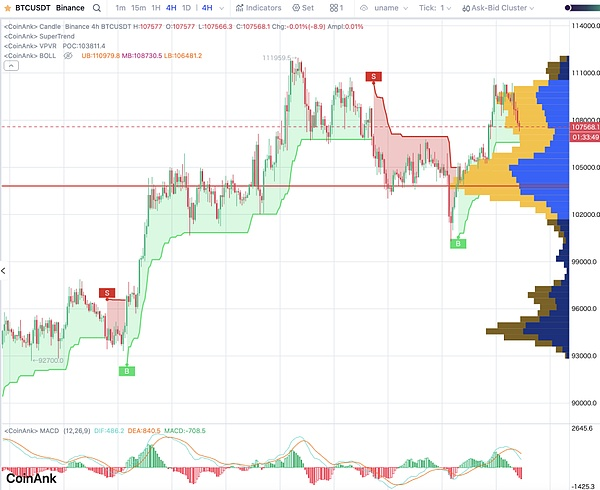
BTC 4H行情分析:

根据CoinAnk AI智能分析,行情分析报告如下:

主要支撑位:106462.07 USD(S1)

主要压力位:109512.07 USD(R1)

当前趋势:震荡偏空

1. 技术指标综合:

均线系统:形成空头排列,短期趋势偏弱。当前价格位于所有均线下方,显示上方存在较强压制。

MACD:死叉状态延续,空头动能占优。

BOLL:价格紧贴下轨(106481.23)运行,%B值为0.24%,接近超卖区域,但未有效突破下轨支撑。中轨(108730.52)向下倾斜,显示中期趋势偏空。

RSI: RSI6(29.51)进入超卖区间,但RSI12(45.22)和RSI14(47.44)仍在中性区域,未形成明显背离,需警惕短期反弹。

KDJ: K(17.81)与D(31.08)低位运行,J值(0.00)触底,短期或有反弹需求,但需结合其他指标确认。

2. 资金与量价分析:

资金费率:0.00748900%(中性),未出现极端多空情绪。

成交量:近期下跌伴随放量(如24h最低价附近成交量放大至76338.48),显示空头力量较强。 反弹时量能不足(如最新4h K线成交量仅43730.984),缺乏持续性买盘支撑。

资金流:合约资金24h净流出1083.5M USDT,短期(5m-12h)持续流出,显示杠杆资金离场。

现货资金24h净流出140.1M USD,但4h/6h有小幅流入,或为逢低吸筹信号。

3. 关键形态与行为:

K线显示连续阴线跌破前低(107259.30),形成下降通道。 最新4h K线收长上影线(108515.1→107358.40),显示反弹遇阻,空头仍主导。

分析结果:

方向:谨慎待反弹做空(需警惕超卖反弹)。 提示:若价格站稳108730(MA20)或RSI6快速回升至40上方,需平仓观望。

风险提示:当前超卖信号(RSI6、KDJ)可能引发反弹,需严格止损!

Trending Cryptos

Related Reads

Why Is No One Buying DeFi Insurance?

"Why DeFi Insurance Remains Unpurchased" explores the paradox of decentralized finance insurance. While DeFi insurance promises automatic, unbiased payouts via smart contracts—eliminating traditional insurers' denial practices—it struggles to attract users. The core issue is economic viability. Premiums are prohibitively high relative to the yields from DeFi protocols. For example, insuring a deposit on Aave or Maple Finance can consume most or even all of the annual yield, leaving returns comparable to or worse than traditional savings. Only the safest protocols, like MakerDAO, offer affordable premiums. Furthermore, the DeFi insurance model is structurally fragile. Unlike traditional insurance where risks are uncorrelated, DeFi risks are highly interconnected (e.g., oracle failures, bridge hacks). A single major exploit can simultaneously threaten multiple protocols, potentially bankrupting the entire insurance pool, which holds only millions against billions in total value locked. The governance model also creates a conflict of interest. In platforms like Nexus Mutual, token holders who vote on claims risk their own capital if payouts are approved, incentivizing denials. Consequently, the market is tiny and shrinking. Nexus Mutual dominates with $81.56 million in assets, but the industry lacks the capacity to cover a catastrophic event like the $292M Kelp DAO hack. Other providers have dwindled or shut down. The article concludes that DeFi insurance faces a "tragedy of the commons": its stability requires widespread adoption, but individual users have no incentive to pay for it, as premiums destroy their yields. Current solutions involve preventative measures like bug bounties and seeking external capital from traditional reinsurance, acknowledging that on-chain capital alone is insufficient to cover on-chain risks.

marsbit4m ago

Why Is No One Buying DeFi Insurance?

marsbit4m ago

Kraken Sets Its Sights on Aave: Why is CeFi Starting to 'Buy the Dip' in Core DeFi Assets?

Recent market rumors suggest Kraken is planning a strategic investment in Aave, sparking widespread interest. Although Aave's co-founder clarified some inaccurate details in the reports, this event highlights a significant trend: centralized exchanges are accelerating their entry into the core areas of on-chain finance. Kraken's interest in Aave reflects its strategic expansion beyond simple trading into more profitable, higher-barrier financial services like DeFi asset management. Aave, a leading DeFi lending protocol, offers a mature lending model, deep liquidity, and a growing ecosystem, making it a key gateway to future on-chain finance. Despite a major security incident in April that caused significant withdrawals, Aave's core architecture, governance, and market trust remained intact. The protocol's strong fundamentals are underscored by its $134 million in annual revenue, suggesting its valuation may be undervalued. Aave is also designing a new tokenomics model (Aavenomics 3.0) featuring an automated token buyback mechanism to better capture value for token holders, signaling DeFi's evolution towards sustainable value models. Ultimately, this potential move signals accelerated convergence between CeFi and DeFi. Kraken's target is not just an asset but a strategic position in the future of on-chain financial infrastructure, while Aave aims to prove DeFi can evolve into a cash-flow-generating, global financial system.

marsbit1h ago

Kraken Sets Its Sights on Aave: Why is CeFi Starting to 'Buy the Dip' in Core DeFi Assets?

marsbit1h ago

Trading

Spot

Hot Articles

What is $BITCOIN

DIGITAL GOLD ($BITCOIN): A Comprehensive Analysis Introduction to DIGITAL GOLD ($BITCOIN) DIGITAL GOLD ($BITCOIN) is a blockchain-based project operating on the Solana network, which aims to combine the characteristics of traditional precious metals with the innovation of decentralized technologies. While it shares a name with Bitcoin, often referred to as “digital gold” due to its perception as a store of value, DIGITAL GOLD is a separate token designed to create a unique ecosystem within the Web3 landscape. Its goal is to position itself as a viable alternative digital asset, although specifics regarding its applications and functionalities are still developing. What is DIGITAL GOLD ($BITCOIN)? DIGITAL GOLD ($BITCOIN) is a cryptocurrency token explicitly designed for use on the Solana blockchain. In contrast to Bitcoin, which provides a widely recognized value storage role, this token appears to focus on broader applications and characteristics. Notable aspects include: Blockchain Infrastructure: The token is built on the Solana blockchain, known for its capacity to handle high-speed and low-cost transactions. Supply Dynamics: DIGITAL GOLD has a maximum supply capped at 100 quadrillion tokens (100P $BITCOIN), although details regarding its circulating supply are currently undisclosed. Utility: While precise functionalities are not explicitly outlined, there are indications that the token could be utilized for various applications, potentially involving decentralized applications (dApps) or asset tokenization strategies. Who is the Creator of DIGITAL GOLD ($BITCOIN)? At present, the identity of the creators and development team behind DIGITAL GOLD ($BITCOIN) remains unknown. This situation is typical among many innovative projects within the blockchain space, particularly those aligning with decentralized finance and meme coin phenomena. While such anonymity may foster a community-driven culture, it intensifies concerns about governance and accountability. Who are the Investors of DIGITAL GOLD ($BITCOIN)? The available information indicates that DIGITAL GOLD ($BITCOIN) does not have any known institutional backers or prominent venture capital investments. The project seems to operate on a peer-to-peer model focused on community support and adoption rather than traditional funding routes. Its activity and liquidity are primarily situated on decentralized exchanges (DEXs), such as PumpSwap, rather than established centralized trading platforms, further highlighting its grassroots approach. How DIGITAL GOLD ($BITCOIN) Works The operational mechanics of DIGITAL GOLD ($BITCOIN) can be elaborated on based on its blockchain design and network attributes: Consensus Mechanism: By leveraging Solana’s unique proof-of-history (PoH) combined with a proof-of-stake (PoS) model, the project ensures efficient transaction validation contributing to the network's high performance. Tokenomics: While specific deflationary mechanisms have not been extensively detailed, the vast maximum token supply implies that it may cater to microtransactions or niche use cases that are still to be defined. Interoperability: There exists the potential for integration with Solana’s broader ecosystem, including various decentralized finance (DeFi) platforms. However, the details regarding specific integrations remain unspecified. Timeline of Key Events Here is a timeline that highlights significant milestones concerning DIGITAL GOLD ($BITCOIN): 2023: The initial deployment of the token occurs on the Solana blockchain, marked by its contract address. 2024: DIGITAL GOLD gains visibility as it becomes available for trading on decentralized exchanges like PumpSwap, allowing users to trade it against SOL. 2025: The project witnesses sporadic trading activity and potential interest in community-led engagements, although no noteworthy partnerships or technical advancements have been documented as of yet. Critical Analysis Strengths Scalability: The underlying Solana infrastructure supports high transaction volumes, which could enhance the utility of $BITCOIN in various transaction scenarios. Accessibility: The potential low trading price per token could attract retail investors, facilitating wider participation due to fractional ownership opportunities. Risks Lack of Transparency: The absence of publicly known backers, developers, or an audit process may yield skepticism regarding the project's sustainability and trustworthiness. Market Volatility: The trading activity is heavily reliant on speculative behavior, which can result in significant price volatility and uncertainty for investors. Conclusion DIGITAL GOLD ($BITCOIN) emerges as an intriguing yet ambiguous project within the rapidly evolving Solana ecosystem. While it attempts to leverage the “digital gold” narrative, its departure from Bitcoin's established role as a store of value underscores the need for a clearer differentiation of its intended utility and governance structure. Future acceptance and adoption will likely depend on addressing the current opacity and defining its operational and economic strategies more explicitly. Note: This report encompasses synthesised information available as of October 2023, and developments may have transpired beyond the research period.

470 Total ViewsPublished 2025.05.13Updated 2025.05.13

What is $BITCOIN

Discussions

Welcome to the HTX Community. Here, you can stay informed about the latest platform developments and gain access to professional market insights. Users' opinions on the price of BTC (BTC) are presented below.

活动图片