Возвращение XRP на фоне «мини-золотого креста»

cryptonews.ruPublished on 2024-06-10Last updated on 2025-06-10

XRP снова подает бычьи сигналы, но на этот раз они не связаны с традиционным «золотым крестом».

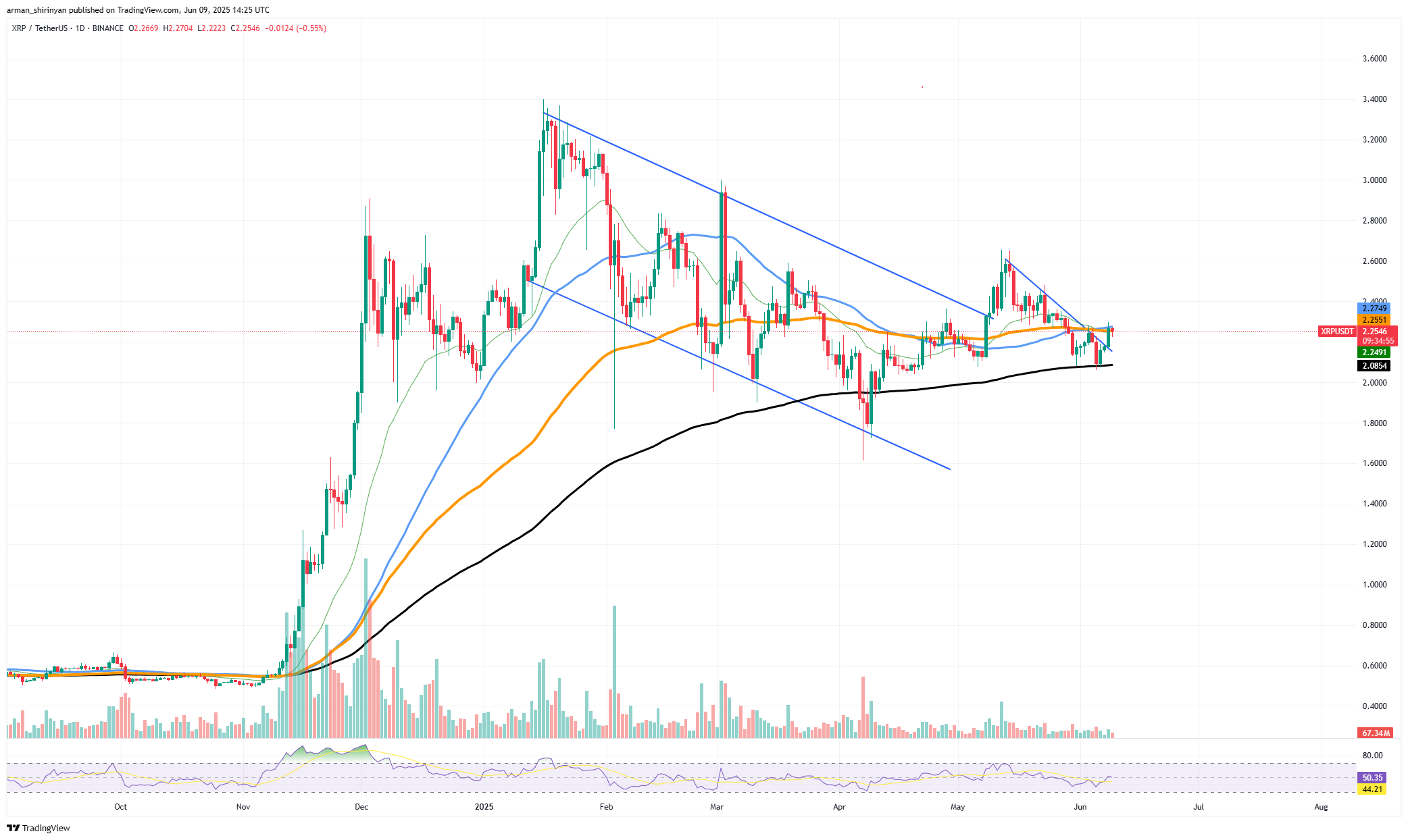
На графике сейчас виден «мини-золотой крест», при котором 50-дневная скользящая средняя вот-вот пересечет 100-дневную скользящую среднюю. Эта краткосрочная конфигурация часто указывает на более быстрый восходящий импульс, хотя о ней говорят реже, чем о традиционном пересечении 50- и 200-дневных скользящих средних. Это особенно актуально для волатильных альткоинов.

График показывает, что XRP сохраняет восходящую траекторию с тех пор, как недавно восстановился от уровня поддержки 200 EMA на отметке 2,08 доллара. Классической прелюдией к прорыву вверх или вниз является схождение скользящих средних в диапазоне 2,20–2,25 доллара, что указывает на усиление сжатия между скользящими средними. В настоящее время цена находится чуть выше этого кластера, и прорыв под действием импульса может вызвать последующую волну в направлении уровня сопротивления 2,70 доллара.
Изображение статьи

RSI развернулся вверх, указывая на то, что покупательское давление снова начинает нарастать, хотя объём торгов всё ещё довольно низкий. Кроме того, недавняя структура свечей указывает на накопление на текущих уровнях. Этот мини-золотой крест может сигнализировать о ранней возможности для инвесторов, прежде чем рынок подтвердит это более широко. Техническая основа сильна благодаря тесной консолидации вокруг долгосрочной скользящей средней (200 EMA).

Вероятность краткосрочного ускорения роста цены возрастает, если XRP удержится выше уровня 2,25 доллара и подтвердит наложение 50/100 EMA. Дальнейшее движение XRP зависит от сохранения импульса и преодоления локального уровня сопротивления на отметке 2,30 доллара. Затем откроется путь к 2,55 доллара и, в конечном итоге, к 2,70 доллара. Несмотря на то, что структурно XRP находится в одной из самых благоприятных конфигураций за последние недели, рекомендуется соблюдать осторожность до тех пор, пока объём торгов не увеличится значительно.

Dogecoin снижается

Цена Dogecoin колеблется около отметки в 0,18 доллара, и монета находится на грани очередного значительного падения. Несмотря на кратковременные подъёмы в начале года, актив не смог прорваться через ключевые зоны сопротивления и в настоящее время находится под растущим техническим давлением. Позиция DOGE на дневном графике находится прямо под группой важных экспоненциальных скользящих средних, которые все направлены вниз: 50-, 100- и 200-дневные скользящие средние. Такое расположение поддерживает пессимистичный прогноз по монете-мему.

В результате решающего отказа в мае, когда актив не смог прорваться выше 200-дневной скользящей средней (около 0,21 доллара), он вернулся в затяжную ловушку консолидации. Более того, тревожными являются тенденции по объёму торгов. Торговая активность снизилась, что говорит о том, что институциональные и розничные игроки не так заинтересованы в нём. Тем временем RSI торгуется вблизи порога перепроданности, но сильного прорыва или дивергенции, указывающих на скорое восстановление, не наблюдается.

Нисходящий тренд с момента достижения пика в апреле указывает на потерю импульса. Последовательные пробои ключевых зон сопротивления и более низкие максимумы свидетельствуют об ослаблении покупателей. Если DOGE останется на уровне или ниже 0,18 доллара без явного восстановления, следующей важной поддержкой будет уровень 0,16 доллара, а затем 0,14 доллара, которые в последний раз тестировались в начале марта.

Если рассматривать Dogecoin в более широком контексте, то его неспособность создавать более устойчивые зоны поддержки или привлекать значительный объём торгов вызывает беспокойство. Хотя катализаторы, основанные на настроениях, часто являются основой для роста активов, в настоящее время их нет, и на первый план выходят технические факторы. Вместо того чтобы просто находиться в состоянии стагнации, DOGE может начать более глубокое снижение, если в ближайшее время не появится сильный бычий импульс. Инвесторам следует быть осторожными, поскольку текущая ситуация говорит о том, что мем-монета уязвима и существует растущий риск снижения.

Солана набирает обороты

В Solana происходит потенциально важное техническое событие: формирование «золотого креста». На графике виден долгожданный бычий перекрёстный ход, когда 50-дневная EMA ускоряется в росте и приближается к 200-дневной EMA. Если этот технический индикатор подтвердится, он может сигнализировать о начале более масштабного разворота тренда и проложить путь к дальнейшему росту.

«Золотые» крестики исторически являются надёжными индикаторами значительных изменений в тренде, особенно если они сопровождаются увеличением объёма и положительным импульсом, которые, по-видимому, восстанавливаются в Solana. Благодаря недавнему внутридневному росту на +10% SOL восстановил важные позиции после отката от апрельских максимумов и теперь уверенно находится выше более коротких скользящих средних, таких как 20 и 50. Общая структура графика SOL указывает на то, что актив пытается выйти из диапазона консолидации, который характеризовал большую часть второго квартала.

По-прежнему есть много возможностей для роста, поскольку цена хорошо восстановилась после области в 140 долларов и в настоящее время торгуется на уровне 153 доллара, а индекс RSI улучшается, выходя из зоны перепроданности. Идея о том, что покупатели действуют на ключевых уровнях поддержки, подтверждается данными по объёмам, которые указывают на возрождение интереса к торговле, особенно в точках разворота.

Солана может нацелиться на повторное тестирование диапазона 170–180 долларов, за которым последует долгосрочный рост до 200 долларов и выше, если импульс сохранится и подтвердится «золотой крест». Этот возможный «золотой крест» может стать трамплином для долгосрочного бычьего тренда, который продлится до конца лета, в дополнение к краткосрочному росту. Чтобы предсказать начало следующего значительного восходящего движения Соланы, инвесторам следует обратить внимание на подтверждённый кроссовер, подкреплённый активным ценовым движением и объёмом.


Trending Cryptos

Related Reads

Countdown to Q-Day: Will Quantum Computing End Cryptocurrencies?

The article explores the existential threat quantum computing poses to cryptocurrencies and the urgent need for "post-quantum" migration. It outlines that quantum computers, through Shor's algorithm, could break the elliptic-curve cryptography (ECC) underlying blockchain security, potentially allowing private keys to be derived from public keys. The core challenge is not a lack of post-quantum cryptography (PQC) standards—like NIST's ML-KEM and ML-DSA—but the immense complexity of upgrading entire ecosystems before "Q-Day" (when quantum computers become capable of such attacks, estimated around 2035-2045). Key points include: * **Bitcoin's** risk is concentrated in legacy UTXOs with exposed public keys (e.g., early P2PK outputs). Migration faces massive hurdles: PQC signatures are much larger, increasing transaction size and cost, and the governance dilemma of handling un-migrated assets threatens its "code is law" ethos. * **Ethereum's** strategy focuses on "cryptographic agility," using Account Abstraction for user accounts and developing compressed hash-based signatures (like leanXMSS with SNARK aggregation) for consensus. Its migration is a complex, full-stack overhaul of execution, consensus, and data layers. * The "security debt" is enormous. The comfortable engineering window for a coordinated, ecosystem-wide upgrade is only 5-8 years. High-value infrastructure (exchanges, bridges) may face pressure before mainnet protocols. In conclusion, quantum computing is not an instant "doomsday" event but a forcing function for systemic change. Bitcoin's ultimate test is social consensus and property rights governance, while Ethereum's is technical complexity. Failure to migrate in time could lead to a fundamental re-pricing of crypto assets.

链捕手2m ago

Countdown to Q-Day: Will Quantum Computing End Cryptocurrencies?

链捕手2m ago

Losing $55 Million to Sell Bitcoin, MicroStrategy's Faith Reaches Its Interest Payment Day

On July 6th, Michael Saylor's MicroStrategy announced the sale of 3,588 BTC for approximately $216 million, incurring a realized loss of around $55.45 million compared to its average cost basis. This move, contradicting Saylor's long-standing "never sell" Bitcoin philosophy, was executed to pay dividends on its digital credit securities. The article traces this shift from a small "desensitization test" sale of 32 BTC in late May to the board's authorization on June 30th to sell up to $1.25 billion in Bitcoin for corporate purposes like dividends and buybacks. Analysis reveals that MicroStrategy's previous growth "flywheel"—using stock premiums to fund more Bitcoin purchases—has stalled. With its stock trading near a critical threshold (1.22x its Bitcoin NAV), issuing new shares would dilute value. Simultaneously, its financing channels (preferred stock, common stock ATM, convertible notes) are constrained while facing rigid annual dividend/interest obligations of roughly $1.76 billion. Consequently, selling Bitcoin became the calculated "optimal solution" under its own financial model. This transforms MicroStrategy from crypto's most prominent steady buyer into a predictable seller, creating a potential overhead of ~2,400 BTC in monthly selling pressure if obligations are fully covered by sales. This shift challenges the valuation models of the entire Digital Asset Treasury (DAT) sector that emulated MicroStrategy. The company's path forward now hinges on Bitcoin's price recovery, which would allow its preferred stock to trade at par and reopen its financing flywheel, creating a cyclical dependency between the firm's financial model and the asset it holds.

链捕手30m ago

Losing $55 Million to Sell Bitcoin, MicroStrategy's Faith Reaches Its Interest Payment Day

链捕手30m ago

OUSD Fake Partnership Controversy? Stablecoins and the Credit Game of Giant Endorsements

Author: Chloe, ChainCatcher Last week, Open Standard launched the dollar stablecoin OpenUSD (OUSD) with a list of over 140 supposedly supporting companies, including major names like Visa, Mastercard, Stripe, American Express, BlackRock, BNY, Standard Chartered, Google, Shopify, Samsung, Coinbase, Solana, and Ripple. The announcement initially impacted Circle's stock price, but doubts about the list quickly emerged. Several Korean firms named, including Samsung Electronics, Shinhan Financial Group, Dunamu (Upbit's parent), and K Bank, clarified they had not formally agreed to join the alliance. Some stated they were only approached for potential interest or learned of their inclusion from news reports, expressing surprise. Similar concerns were raised by U.S. entities, suggesting the list may be misleading. OUSD, led by Zach Abrams of Bridge (acquired by Stripe in 2024), promotes zero-fee minting/redemption, no transaction limits, and sharing reserve asset yields with partners instead of keeping profits. However, this model makes listed partnership imply economic benefits, turning it into a serious credibility issue. This incident reflects a common crypto marketing tactic of leveraging big names. A Chainstory analysis found over 62% of crypto press releases in late 2025 were high-risk or scams. The situation recalls Facebook's Libra (later Diem), which collapsed in 2022 after initial heavyweight backers like Visa and PayPal withdrew under regulatory pressure. Circle CEO Jeremy Allaire welcomed the competition but highlighted the challenges. He argued stablecoin success relies on network effects and real usage, not just alliances. He criticized OUSD's "free" model and full revenue sharing as potentially starving infrastructure development. Noting the dominance of USDT (~$1.84T) and USDC (~$730B) in the ~$2.91T stablecoin market, he suggested many new entrants lack real utility despite inflated circulation from incentives. In conclusion, while OUSD has genuine backing and a distinct model, its future depends on actual adoption in B2B payments, settlements, and cross-border transactions, not just a prestigious partner list. The market will determine if it is a credible challenger or merely another marketing promise.

链捕手33m ago

OUSD Fake Partnership Controversy? Stablecoins and the Credit Game of Giant Endorsements

链捕手33m ago

Trading

Spot

Hot Articles

What is XRP 2.0

XRP 2.0: A New Frontier in the Cryptocurrency Landscape Introduction to XRP 2.0 In the ever-evolving realm of cryptocurrency, new projects continuously emerge, vying for attention and adoption. One such promising initiative is XRP 2.0, a novel cryptocurrency project designed to leverage advanced blockchain technology and robust encryption methodologies. While the name draws parallels with Ripple’s XRP, it’s crucial to note that XRP 2.0 operates independently, focusing on enhancing transaction security, privacy, and scalability. As the digital financial landscape increasingly embraces decentralized solutions, XRP 2.0 aims to contribute meaningfully to web3 and the overall expansion of crypto projects. What is XRP 2.0? At its core, XRP 2.0 is a cryptocurrency project that aims to create a secure and decentralized digital currency ecosystem. Its foundational technology integrates sophisticated blockchain principles with cutting-edge encryption techniques. The overarching goal of XRP 2.0 is to establish itself as a reliable and efficient platform enabling swift transaction execution while prioritizing enhanced privacy protections for its users. The project is promoted as a solution to many limitations faced by existing cryptocurrencies, proposing a system that can handle a higher volume of transactions with improved speed and privacy. This versatility positions XRP 2.0 as a significant contender in a marketplace riddled with various digital currencies. Who is the Creator of XRP 2.0? The identity of the creator behind XRP 2.0 has been flagged as ‘Wilbur.’ However, comprehensive details regarding Wilbur or their associated entity remain elusive. The anonymity of many cryptocurrency creators is not an uncommon phenomenon in the industry, often designed to maintain a degree of privacy and security. Who are the Investors of XRP 2.0? As of now, specific information related to the investment foundations or organizations supporting XRP 2.0 is not publicly available. In the cryptocurrency sector, the backing by reputed investors can significantly influence a project's credibility and success, yet the transparency regarding the financial supporters of XRP 2.0 has not been established. How Does XRP 2.0 Work? XRP 2.0 stands out by employing a combination of blockchain technology and advanced encryption algorithms that ensures secure and decentralized transactions. Its innovative structure includes unique features designed to foster user engagement and broaden functionalities beyond conventional cryptocurrency transactions. Among these features, XRP 2.0 incorporates AI-powered capabilities, such as text-to-image and text-to-speech functionalities. These additions are designed to enhance the interactive experience for users, promoting broader applicability across various sectors. By bridging technological advancements with user-centered design, XRP 2.0 aims to capture the attention of a diverse range of individuals and enterprises looking to integrate cryptocurrency solutions into their operational frameworks. Timeline of XRP 2.0 Understanding XRP 2.0 requires examining the milestones that have defined its journey thus far: July 23, 2023: XRP 2.0 is introduced as a novel cryptocurrency project, aiming to revolutionize secure and decentralized transaction capabilities in the blockchain domain. September 8, 2023: The launching of another project, XRP20, occurs, marking the emergence of an ERC-20 token on the Ethereum blockchain that remains unrelated to XRP 2.0. November 13, 2023: The XRP Ledger undergoes a significant update with the release of rippled server software version 2.0.0. It is essential to note that this development is disconnected from the XRP 2.0 cryptocurrency project. Key Points About XRP 2.0 To distill the essence of XRP 2.0, several critical factors emerge: Unique Features: The inclusion of features like AI-powered text-to-image and text-to-speech further diversifies the potential applications of XRP 2.0. Blockchain Technology: The framework utilizes advanced blockchain mechanisms and encryption protocols, ensuring a secure and decentralized environment for transactions. Scalability and Privacy: XRP 2.0 prioritizes enhanced privacy protections in transaction processes and the scalability necessary to accommodate a growing user base. No Affiliation with Ripple: Importantly, despite its name, XRP 2.0 does not have any allegiance or collaboration with Ripple’s XRP, distinguishing its operational framework and objectives within the cryptocurrency ecosystem. Conclusion XRP 2.0 represents an ambitious venture into the cryptocurrency sphere, aiming to offer a combination of security, privacy, and efficiency in digital transactions. By integrating sophisticated technologies and user-friendly features, the project sets out to broaden the horizons of what cryptocurrency can achieve in today's digital economy. While the anonymity of its creator and lack of disclosed investors might raise questions for some, XRP 2.0's focus on advanced functionalities and decentralisation enhances its appeal amidst an increasingly crowded crypto market. As the cryptocurrency landscape continues to evolve, XRP 2.0 may yet emerge as a pivotal player in the expansion of secure and scalable blockchain solutions.

1.1k Total ViewsPublished 2024.04.01Updated 2024.12.03

What is XRP 2.0

Discussions

Welcome to the HTX Community. Here, you can stay informed about the latest platform developments and gain access to professional market insights. Users' opinions on the price of XRP (XRP) are presented below.

活动图片