Cardano’s governance experiment took a decisive step forward on 5 June, when Intersect—a member-based organisation tasked with stewarding the blockchain’s transition to on-chain self-rule—published its first Budget Info Action (BIA). The nine-minute overview lays out 39 community-driven proposals that Delegated Representatives (DReps) have already signalled for funding. “The Budget Info Action brings together 39 proposals that reflect where the community sees opportunities, needs, and momentum,” Intersect explained, stressing that the roadmap was drafted “by a network of builders, researchers, developers, and contributors working together to deliver real value.”
Cardano’s Next Chapter Begins
The package reveals where Cardano’s stakeholders think resources will matter most over the next 18 months. Nearly half the proposals address performance at the protocol layer. Input Output Global (IOG) seeks continued maintenance budgets for Hydra, its off-chain state-channel suite, and Mithril, the fast-sync protocol designed to make full-node deployment as effortless as setting up a light wallet.
IOG also asks for funding to refine stake-pool-operator (SPO) incentives, overhaul fee mechanics, and roll out new developer-testing pipelines. Two experimental designs—Leios and Peras—would push finality toward sub-second territory and multiply throughput without compromising decentralisation. Tweag, best known for its Haskell and formal-verification expertise, proposes multi-year stewardship of the critical libraries on which both the consensus layer and off-chain tooling depend.
Governance tooling emerges as the second-largest theme. A refreshed “Catalyst 2.0” initiative would wire treasury voting directly into CIP-1694 governance flows, ending the separation between project funding rounds and constitutional decision-making. Complement Catalyst—a proposal from social-impact startup Socious—introduces quadratic funding weighted by on-chain reputation scores, a mechanism it says will “boost fairness, transparency, and community impact.” Cardano Builder DAO wants a smart-contract-controlled endowment that can approve application-layer grants autonomously, while the “Beyond Minimum Viable Governance” report promises the first data-driven audit of how Voltaire-era institutions are actually functioning in practice.
Developer experience and open-source infrastructure form the third pillar. MLabs asks to maintain Plutarch, CardanoOps, and Hermes, three projects it argues “remove friction for DApp teams by letting them focus on product, not plumbing.” Pallas would continue curating the Rust libraries that power lightweight indexers and explorers, while Blockfrost seeks to keep its plug-and-play API free at the point of use. NFTCDN proposes a global, cost-free content-delivery network for native assets so marketplaces can serve media files “with Web-2 latency but Web-3 integrity.”
A cluster of proposals focuses on resilience and security. Dolos, a lightweight data-node implementation, promises “high-integrity ledger queries with minimal resource overhead,” a feature aimed at mobile developers and IoT deployers. TxPipe wants to maintain its open-source RPC server that already backs dozens of wallets, explorers, and analytics dashboards. In parallel, Eternl requests funds for ongoing hardware-wallet integration, and an independent team proposes a full rewrite of Ledger’s Cardano application to unlock advanced multi-sig features. Sundae Labs and Xerberus have submitted an auditable smart-contract framework that will govern how treasury withdrawals are disbursed, exposing live dashboards so ADA holders can watch spending as it happens.
Education, outreach, and real-world adoption round out the slate. Discover Cardano plans branded pavilions at major tech expos, offering what it calls “shared spaces to amplify the voice of Cardano’s community and lower barriers for builders.” A linked proposal seeks to centralise global events marketing so that every Summit-style gathering has consistent branding and clear onboarding funnels. On the utility front, Anzens wants funds to expand access to USDA, a USD-backed stable-asset issued natively on Cardano, through exchange listings, institutional custody, and cross-border settlement pilots. Meanwhile, MLabs’ cryptography team outlines a toolkit for privacy-preserving smart contracts that could enable anonymous voting, shielded identity credentials, and confidential DeFi.
What’s Next?
Each item in the BIA is advisory for now. Under CIP-1694, ADA holders have a 30-day review window to approve or reject the bundle. If passed, Intersect will translate the document into one or more Treasury Withdrawal actions that carry hard spending authority and require a two-thirds super-majority on-chain. The organisation has floated splitting the withdrawals into tranches so that “funds are released only as milestones are met,” a safeguard meant to reassure both sceptical stakeholders and external regulators that Cardano can allocate capital with the same rigour expected of a public-sector budget.
In publishing the BIA, Intersect framed the moment as a stress-test for decentralised governance. “This isn’t just a budget,” the post reads. “It’s a signal that Cardano’s ecosystem is ready to deliver.” If the community ratifies the 39-proposal slate, Cardano will move beyond ad-hoc Catalyst rounds toward a predictable, constitutional funding cycle—transforming Voltaire’s aspirational blueprint into the network’s first working balance sheet.
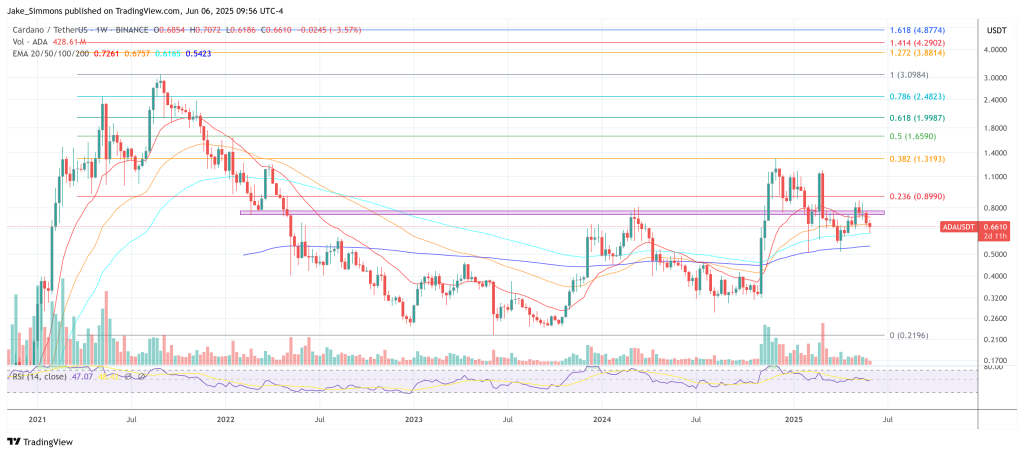
At press time, ADA traded at $0.661.

Related Posts