Bitcoin ETFs Green After Losing Over $1B, ETH Funds Hit New Highs With 12-Day Inflow Streak

ccn.comPublished on 2025-06-04Last updated on 2025-06-04

Key Takeaways
  • U.S. spot Bitcoin ETFs command $128.13 billion in net assets or 6.1% of BTC’s market cap.
  • The SEC has clarified that certain proof-of-stake blockchain staking services do not constitute a securities activity.
  • U.S. spot Ethereum ETFs hold $9.81 billion in net assets or 3.11% of ETH’s market cap.

U.S. spot Bitcoin (BTC) exchange-traded funds (ETFs) have broken free from a significant outflow streak that saw funds lose over $1 billion across three days.

Though perhaps more importantly, Ethereum (ETH) funds are carving out a record-setting inflow streak.

This has been bolstered by the U.S. Securities and Exchange Commission’s (SEC’s) clarification that ETH staking does not constitute a security.

Now, ETH ETFs could soon have staking enabled, and unlock billions in value for investors.

Bitcoin ETFs

As per data gathered by SoSoValue, Bitcoin ETFs tallied $378.04 million in daily total net inflows on June 3, ending a three-day outflow streak that saw roughly $1.3 billion in outflows.
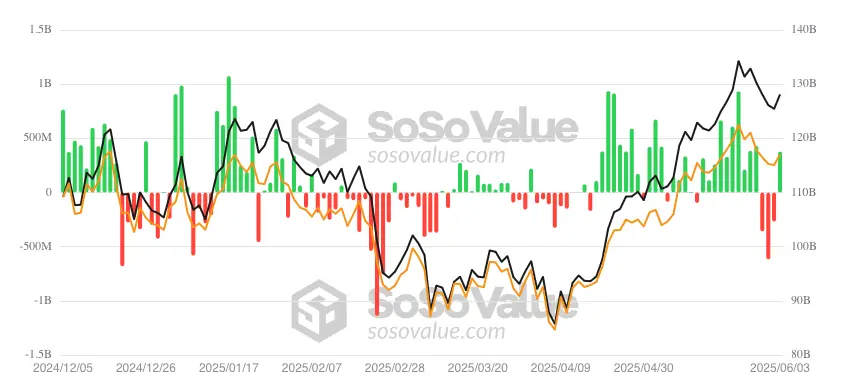
Bitcoin ETF daily inflows/outflows.
Bitcoin ETF flows. | Source: SoSoValue.

Taking the lead is ARK 21Shares Bitcoin ETF (ARKB), which raked in $139.93 million.

To date, ARKB has recorded $2.51 billion in cumulative net inflows and holds $4.95 billion in net assets, ranking it third and fourth, respectively.

It’s closely followed by Fidelity’s Wise Origin Bitcoin Fund (FBTC), which garnered $136.83 million, bringing its cumulative net inflows to $11.69 billion, and net assets to $21.15 billion, ranking it second overall.

Up next is top-ranking fund, the BlackRock iShares Bitcoin Trust (IBIT), which netted a cool $57.97 million in net inflows.

The titan has seen a gigantic $48.5 billion in cumulative net inflows, and commands $70.16 billion in net assets.

As for the smaller gainers, VanEck’s Bitcoin ETF (HODL) pulled $18.79 million, followed by the Bitwise Bitcoin ETF (BITB), which secured $14.46 million.

Finally, the Grayscale Bitcoin Mini Trust notched a modest $7.06 million in net inflows, as did the Valkyrie Bitcoin Fund (BRRR) with $3.01 million.

Ethereum ETFs

Interestingly, SoSoValue data reveals that Ethereum funds have maintained bullish momentum and pulled $109.43 million in daily total net inflows on day 12 of their current inflow streak.

This marks the longest consecutive run of daily inflows since funds launched in May 2024, and it comes as the U.S. SEC finally clarifies that ETH staking does not constitute a security offering.

This is big news, as funds that were initially not allowed to offer staking within ETH ETFs could soon be able to.

Ethereum ETF daily inflows/outflows.
Ethereum ETF flows. | Source: SoSoValue.

Up top is BlackRock’s iShares Ethereum Trust (ETHA), which posted $77.06 million in daily net inflows.

This brings its cumulative net inflows to $4.73 billion and total net assets to $3.85 billion, ranking it first amongst the competition.

It’s followed by Fidelity’s Ethereum Fund (FETH), which garnered $20.97 million in daily net inflows.

To date, it has tallied $1.56 billion in cumulative net inflows and commands $1.19 billion in net assets, ranking it second and fourth, respectively.

The Grayscale Ethereum Mini Trust captured a humble $8.41 million in net inflows, raising its cumulative net inflows to $677.31 million and net assets to $1.33 billion. It ranks third and second, respectively.

Finally, one of the smaller funds, the Franklin Ethereum Trust (EZET), notched $2.99 million in net inflows, bringing its cumulative inflows to $42.55 million and net assets to $36.88 million.


Was this Article helpful? Yes No

Trending Cryptos

Related Reads

From Transaction Fees to Stablecoins: The Revenue Drivers and Economic Moats Behind Web3 Business Models

"From Transaction Fees to Stablecoins: Revenue Drivers and Moats in Verified Web3 Business Models" This analysis explores five established Web3 revenue models, examining their drivers and long-term sustainability. 1. **Transaction Fees**: This model is highly cyclical, with income tied to market activity and user risk appetite (formula: volume × fee rate). Growth depends on expanding the market, gaining market share, and maintaining stable fees amid intense competition. 2. **Stablecoin Reserve Yield**: Revenue stems from the scale of issued stablecoins and the interest earned on their underlying reserves (like US Treasuries). While predictable with strong moats (high user migration costs), growth is tied to adoption as on-chain dollar infrastructure and is sensitive to interest rate cycles. 3. **Funding Rate Arbitrage & Lending Spreads**: Protocols like Aave and Ethena profit from capital supply-demand imbalances. Similar to transaction fees, this model is cyclical and driven by user leverage demand during bullish market phases. 4. **Block Space Sales**: Chains sell computational resources (formula: demand × gas price). A key challenge is the ongoing decline in gas fees due to technological advances and competition among L1s and L2s. Future viability hinges on whether demand growth can offset falling unit prices. 5. **Protocol-Level Service Fees**: Similar to SaaS, this model involves charging other protocols for essential services (e.g., oracles like Chainlink). Revenue scales with ecosystem adoption. The primary moat is high switching costs once integrated, making market leadership crucial. In summary: Transaction fees and funding spreads are highly cyclical. Stablecoin yields and protocol services build strong, durable moats. Block space sales face the structural challenge of perpetually declining unit revenue despite growing demand.

marsbit1h ago

From Transaction Fees to Stablecoins: The Revenue Drivers and Economic Moats Behind Web3 Business Models

marsbit1h ago

Trading

Spot

Hot Articles

What is $BITCOIN

DIGITAL GOLD ($BITCOIN): A Comprehensive Analysis Introduction to DIGITAL GOLD ($BITCOIN) DIGITAL GOLD ($BITCOIN) is a blockchain-based project operating on the Solana network, which aims to combine the characteristics of traditional precious metals with the innovation of decentralized technologies. While it shares a name with Bitcoin, often referred to as “digital gold” due to its perception as a store of value, DIGITAL GOLD is a separate token designed to create a unique ecosystem within the Web3 landscape. Its goal is to position itself as a viable alternative digital asset, although specifics regarding its applications and functionalities are still developing. What is DIGITAL GOLD ($BITCOIN)? DIGITAL GOLD ($BITCOIN) is a cryptocurrency token explicitly designed for use on the Solana blockchain. In contrast to Bitcoin, which provides a widely recognized value storage role, this token appears to focus on broader applications and characteristics. Notable aspects include: Blockchain Infrastructure: The token is built on the Solana blockchain, known for its capacity to handle high-speed and low-cost transactions. Supply Dynamics: DIGITAL GOLD has a maximum supply capped at 100 quadrillion tokens (100P $BITCOIN), although details regarding its circulating supply are currently undisclosed. Utility: While precise functionalities are not explicitly outlined, there are indications that the token could be utilized for various applications, potentially involving decentralized applications (dApps) or asset tokenization strategies. Who is the Creator of DIGITAL GOLD ($BITCOIN)? At present, the identity of the creators and development team behind DIGITAL GOLD ($BITCOIN) remains unknown. This situation is typical among many innovative projects within the blockchain space, particularly those aligning with decentralized finance and meme coin phenomena. While such anonymity may foster a community-driven culture, it intensifies concerns about governance and accountability. Who are the Investors of DIGITAL GOLD ($BITCOIN)? The available information indicates that DIGITAL GOLD ($BITCOIN) does not have any known institutional backers or prominent venture capital investments. The project seems to operate on a peer-to-peer model focused on community support and adoption rather than traditional funding routes. Its activity and liquidity are primarily situated on decentralized exchanges (DEXs), such as PumpSwap, rather than established centralized trading platforms, further highlighting its grassroots approach. How DIGITAL GOLD ($BITCOIN) Works The operational mechanics of DIGITAL GOLD ($BITCOIN) can be elaborated on based on its blockchain design and network attributes: Consensus Mechanism: By leveraging Solana’s unique proof-of-history (PoH) combined with a proof-of-stake (PoS) model, the project ensures efficient transaction validation contributing to the network's high performance. Tokenomics: While specific deflationary mechanisms have not been extensively detailed, the vast maximum token supply implies that it may cater to microtransactions or niche use cases that are still to be defined. Interoperability: There exists the potential for integration with Solana’s broader ecosystem, including various decentralized finance (DeFi) platforms. However, the details regarding specific integrations remain unspecified. Timeline of Key Events Here is a timeline that highlights significant milestones concerning DIGITAL GOLD ($BITCOIN): 2023: The initial deployment of the token occurs on the Solana blockchain, marked by its contract address. 2024: DIGITAL GOLD gains visibility as it becomes available for trading on decentralized exchanges like PumpSwap, allowing users to trade it against SOL. 2025: The project witnesses sporadic trading activity and potential interest in community-led engagements, although no noteworthy partnerships or technical advancements have been documented as of yet. Critical Analysis Strengths Scalability: The underlying Solana infrastructure supports high transaction volumes, which could enhance the utility of $BITCOIN in various transaction scenarios. Accessibility: The potential low trading price per token could attract retail investors, facilitating wider participation due to fractional ownership opportunities. Risks Lack of Transparency: The absence of publicly known backers, developers, or an audit process may yield skepticism regarding the project's sustainability and trustworthiness. Market Volatility: The trading activity is heavily reliant on speculative behavior, which can result in significant price volatility and uncertainty for investors. Conclusion DIGITAL GOLD ($BITCOIN) emerges as an intriguing yet ambiguous project within the rapidly evolving Solana ecosystem. While it attempts to leverage the “digital gold” narrative, its departure from Bitcoin's established role as a store of value underscores the need for a clearer differentiation of its intended utility and governance structure. Future acceptance and adoption will likely depend on addressing the current opacity and defining its operational and economic strategies more explicitly. Note: This report encompasses synthesised information available as of October 2023, and developments may have transpired beyond the research period.

713 Total ViewsPublished 2025.05.13Updated 2025.05.13

What is $BITCOIN

Discussions

Welcome to the HTX Community. Here, you can stay informed about the latest platform developments and gain access to professional market insights. Users' opinions on the price of BTC (BTC) are presented below.

活动图片