Injective 数据飙升背后,是昙花一现还是王者归来?

深潮Published on 2025-06-04Last updated on 2025-06-04

根据Artemis的数据显示,Injective近30天净流入约1.42亿美元,仅低于以太坊。

作者:Frank,PANews

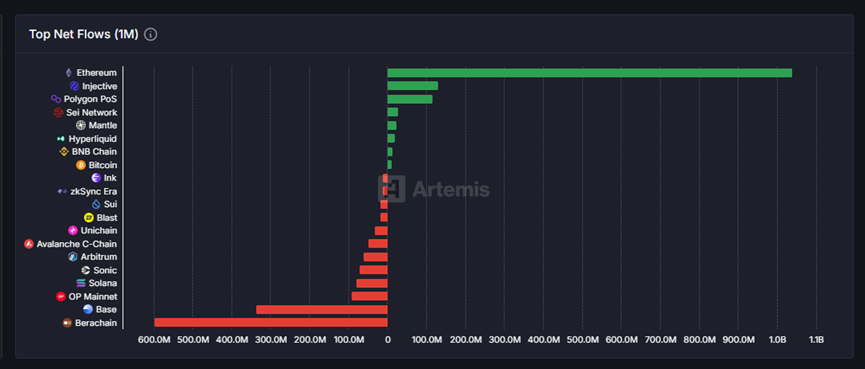
近一个月内,老牌公链Injective以净流入资金排名第二的成绩再次回到了大众视野。根据Artemis的数据显示,Injective近30天净流入约1.42亿美元,仅低于以太坊。

PANews观察Injective的其他数据方面也发现,这种资金净流入现象并非单一情况。在链上费用、活跃用户、代币交易量等方面都有了明显提升。在沉寂许久之后,这个曾经的公链新星Injective是否又将迎来生态爆发?还是一次短暂的昙花一现?

月流入1.42亿美元,高收益是“蜜糖”还是“信号弹”?

截至6月4日的数据显示,Injective近一个月内实现了1.42亿美元的净流入资金。虽然金额并不算高,但仍排到了所有公链近期数据的第二名。仔细观察数据层面,能够看到造成这种净流入明显的原因是Injective一方面的确迎来了一波快速大额资金流入,另一方面则是净流出资金极少,仅为1100万美元。因此,若细究其原因,Injective此次资金净流入排名靠前,并非因为其整体资金流动异常活跃(即同时存在大规模的资金流入与流出)。实际上,其单纯的资金流入量在与其他公链的横向比较中,仅位列第十名左右。其之所以能在‘净流入’指标上表现突出,关键在于同期的资金流出量微乎其微。
Injective数据飙升背后,是昙花一现还是王者归来?

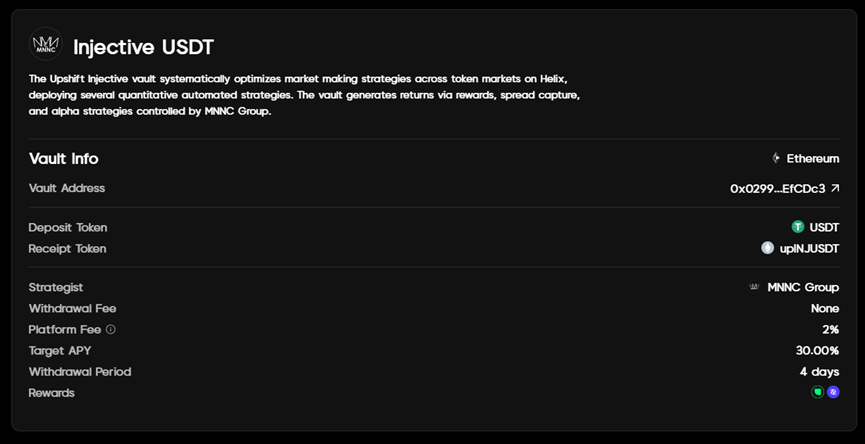
不过,这种链上资金的异动对Injective网络来说,也属罕见。这1.42亿的资金流入,有1.4亿是通过peggy跨链桥完成,占据了98.5%的份额。市场分析机构Keyrock在其5月26日发布的报告《Key Insights, Bond Appetit》中指出,此次大规模资金流入主要归因于机构级收益平台Upshift在Injective上的启动。据了解,Upshift在Injective的金库APY达到30%,这一高收益的确可能成为吸引资金转移资产至Injective的重要原因。
Injective数据飙升背后,是昙花一现还是王者归来?

不过,PANews通过调查发现,Upshift在Injective所建立的金库硬顶为500万美元,并不能完全承接这部分资金的流入利用,那些未能参与到这次金库投资的资金,有可能会在短期内再次流失。

从衍生品折戟到RWA寄望,Injective能否开辟新局?

除了资金上的产生流入之外,Injective也确实在近期迎来了生态的一些重要变化。4月22日,Lyora主网正式上线,此次升级是Injective发展历程中的一个重要里程碑。这次主网升级后,引入了动态费用结构和智能内存池等技术优化,据官方的资料称,升级后,Injective被描述为“更快”,并声称具有更低的延迟和更高的吞吐量 。

此外,Injective也推出了专门针对RWA的预言机框架iAssets,Upshift的金库正是一个RWA DeFi金库。5月29日,Injective官方宣布推出欧元和英镑的链上外汇市场,采用的正是iAsset 框架。从这个角度来看,Injective的新叙事似乎与RWA密不可分。

作为一个老牌公链,Injective原本的核心叙事是去中心化衍生品交易所。最初的Injective也是由去中心化衍生品交易所演变为公链的,这一路线似乎和今天风头正盛的Hyperliquid如出一辙。

不过,Injective当前的衍生品交易似乎未能实现预想的目标,6月4日的数据显示,24小时内在Injective上交易量最高的BTC合约交易对交易量约为3975万美元,全链的衍生品交易量约为9000万美元,作为对比,Hyperliquid的当日数据约为70亿美元,相差约77倍。

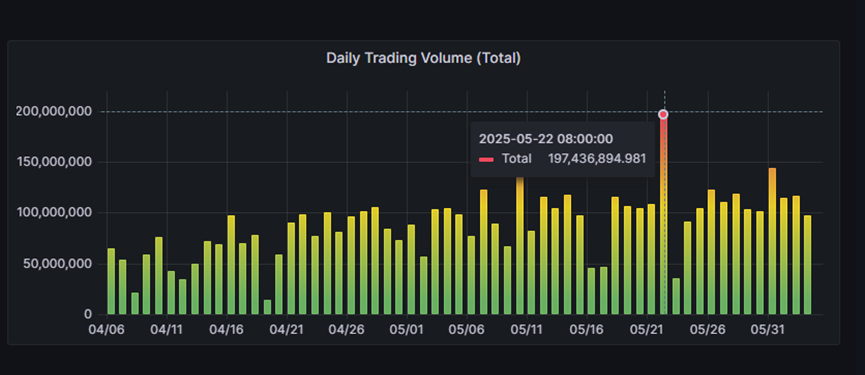
或许是在加密衍生品方面难以打开局面,Injective才选择转向RWA结合的方向。从生态自身发展的对比来看,这一个转型似乎有一定的效果,5月22日,Injective的衍生品交易最高达到了19.7亿美元,显著高于其他时间,并且在近期整体上呈现出上涨的趋势。
Injective数据飙升背后,是昙花一现还是王者归来?

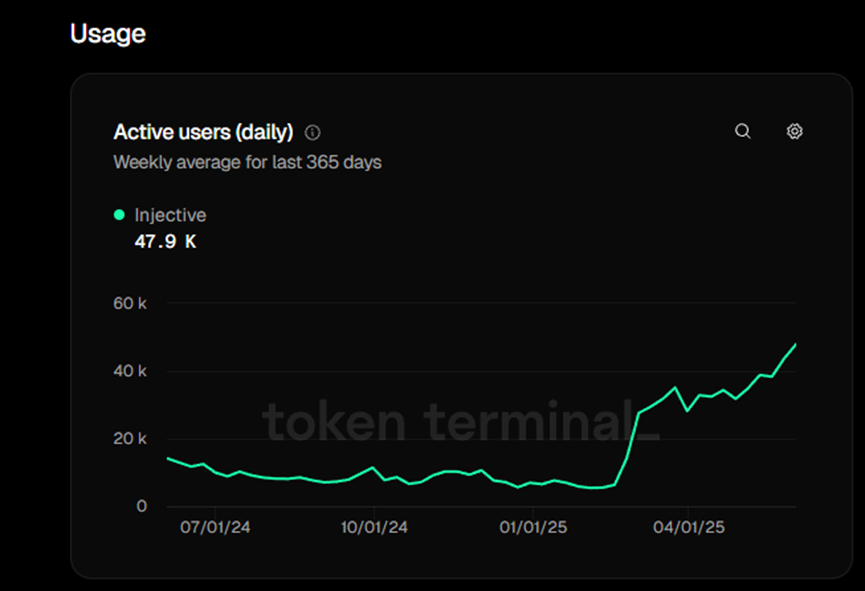
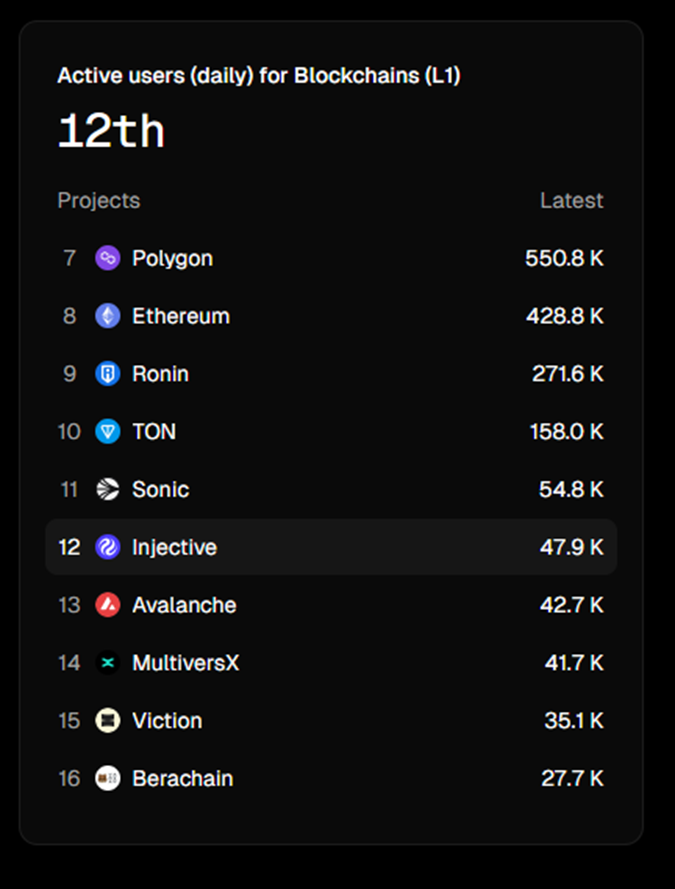
此外,在日活用户方面,从2月份最低的6300个地址在近期激增至4.79万个,增长了约7.6倍。尽管这一数据在所有的公链当中只排名第12位,不过考虑到短期内的快速增长,并且超越了Avalanche和Berachain等公链,也算是一个较为明显的突破。
Injective数据飙升背后,是昙花一现还是王者归来?

Injective数据飙升背后,是昙花一现还是王者归来?

不过,即便日活明显增长,Injective的TVL却没有明显的变化,从2024年3月以来就一路下滑,目前的TVL仅为2633万美元。至少从目前来看,Injective上的DeFi项目对资金对吸引力仍不高。

代币表现短期反弹亮眼,距历史高位仍有4倍差距

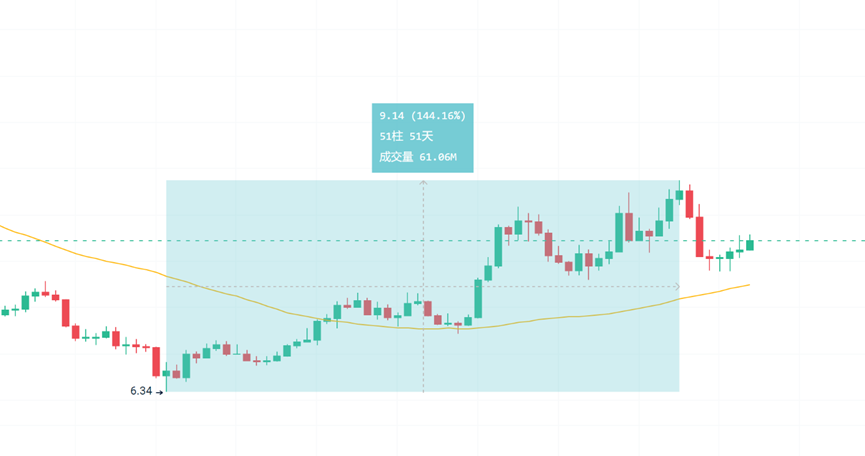
在经济方面,其治理代币INJ的市值目前约为12.6亿美元,排名第82。距离最高市值53亿美元相比,下跌了76%。不过从4月份的最低点6.34美元最高反弹至15.48美元,涨幅达到了144%,这个数据表现在老牌公链当中也算较为亮眼。只是这种持续性能维持多久仍属未知。
Injective数据飙升背后,是昙花一现还是王者归来?

当然,Injective近期的动作不仅限于上述的这些内容,比如在近期还吸引了Republic、谷歌云、德国电信MMS等多个知名机构加入验证者行列的合作,以及推出了AI相关的一些产品与动态。从总体来看,Injective在最近一年正在积极的抓住AI、RWA等新叙事进行转型。截止到6月的数据来看,在最近几个月也的确起到了一定的增长。但从数量级来看,仍和现在的主流公链有着较大的差距。

而这种追赶者,并不是Injective一家,上一轮的几个明星公链,如今都面临着类似的窘境。不少通过开始改名,品牌升级等方式再度回到大众视野。只是,这种新瓶装旧酒的模式是否真的能让市场尝出新味道,还是只能留在包装焕然一新?

目前来看,Injective的生态改造与复兴之路尚处起步阶段。Upshift引发的资金流入更像是一次重要的市场情绪测试和生态潜力展示,而非根本性的格局扭转。其向RWA的战略倾斜能否真正开辟出差异化的竞争优势,并转化为持续的生态繁荣和价值捕获,仍需克服诸多挑战,并接受市场的长期检验。

短期的数据反弹究竟是昙花一现,还是漫长复苏征程中的一个积极信号,唯有时间能给出最终答案。对于Injective而言,真正的考验才刚刚开始。

Trending Cryptos

Related Reads

STRC Unpegged by 11%, Can Strategy's Perpetual Motion Machine Keep Turning?

STRC, the perpetual preferred stock of MicroStrategy, is experiencing a persistent de-pegging from its target par value of $100, with the discount recently widening to over 11%. This de-anchoring challenges the core design of STRC, which was intended as a stable, income-oriented security operating near $100. As a crucial funding engine for MicroStrategy's Bitcoin acquisition strategy, STRC's price reflects market confidence in the company's entire capital model. The company's "capital flywheel" relies on issuing STRC at or above $100 via an At-the-Market (ATM) program to raise cash for buying Bitcoin, thereby boosting company equity and theoretically supporting STRC's value. A monthly adjustable dividend mechanism was designed to maintain this peg. Despite raising the dividend to 11.5% and increasing payment frequency, the de-pegging persists. Market concerns extend beyond technical factors like leveraged arbitrage unwinding. Analysts point to MicroStrategy's limited cash reserves relative to its ~$1.7 billion annual dividend obligation for preferred shares. While the company counters that its vast Bitcoin holdings could cover decades of payments, this argument hinges on the potential need to sell Bitcoin—a shift from its longstanding "hodl" narrative. The company's recent sale of a small amount of BTC, framed as a test, amplified these liquidity and strategy concerns. If STRC remains discounted, impairing MicroStrategy's ability to raise cheap capital, fears may grow that the company could sell more Bitcoin to meet obligations. This scenario could transform MicroStrategy from a major market buyer into a potential seller, posing significant downside risk for Bitcoin. The re-pegging of STRC is thus a key indicator for the health of MicroStrategy's capital structure and its market impact.

Odaily星球日报12m ago

STRC Unpegged by 11%, Can Strategy's Perpetual Motion Machine Keep Turning?

Odaily星球日报12m ago

Silicon Valley's Most Sought-After New Role Has Emerged

Silicon Valley's New Most Wanted Job: The Rise of the Forward Deployment Engineer The AI industry is witnessing a significant shift. The focus has moved from developing cutting-edge models to deploying them effectively within enterprises. This has made the "Forward Deployment Engineer" (FDE) a critical and highly sought-after role at major firms like OpenAI, Anthropic, and Google. For the past three years, the industry prioritized model scientists. However, companies are now facing a harsh reality: purchasing powerful AI tools does not guarantee productivity gains or organizational change. The biggest hurdle is not the technology itself, but integrating it into complex legacy systems, workflows, and corporate cultures. This includes challenges like data silos, compliance requirements, and internal resistance. The FDE role, pioneered by Palantir Technologies, addresses this "last-mile" problem. FDEs are deployed on-site with clients for extended periods. Their job is to deeply understand the client's specific organizational structure, processes, and pain points, then tailor and implement the AI solution accordingly. They combine skills in technology, project management, and organizational change. A clear signal of this trend emerged in May 2026 when three AI giants made major moves. Anthropic launched a $1.5B joint venture for enterprise deployment. OpenAI formed an independent deployment subsidiary, DeployCo, with over $4B in commitments and acquired a deployment consultancy. Google Cloud's CEO publicly announced a large-scale recruitment drive for FDEs. This shift represents a fundamental change in the software business model: from selling tools to selling guaranteed outcomes. FDEs are the agents of this change, responsible for delivering a working system within the production environment, not just a demo. Real-world cases, such as challenges at Goldman Sachs (compliance barriers) and Target (internal cultural resistance), illustrate that the primary obstacles to AI adoption are organizational, not technical. An FDE's value lies in navigating these human and procedural complexities to facilitate a successful "AI migration." In essence, as core AI technology becomes more accessible and affordable, the true premium is shifting to the human expertise required to understand organizations and drive change—making the FDE role pivotal for the next phase of the AI revolution.

marsbit12m ago

Silicon Valley's Most Sought-After New Role Has Emerged

marsbit12m ago

When the World Cup Collides with Agents: From Web2 to Web3, How Are Wallets Evolving into Agentic Wallets?

World Cup as a Catalyst for Agentic Wallets: From Web2 to Web3 This article explores how the World Cup provides a real-world scenario for observing the evolution of digital wallets from simple asset managers towards "Agentic Wallets"—intelligent, AI-powered interfaces. Using the example of prediction markets like Polymarket, it illustrates how AI Agents can lower the barrier to Web3 interaction. Instead of navigating complex DApps, users can express intent in natural language (e.g., "I think Portugal will win") within platforms like Discord or web pages. The Agent then interprets this intent, finds the relevant market, and seamlessly guides the user through the on-chain transaction via their wallet. The core shift is from wallets as mere "function menus" for signing transactions to "intent interpreters" that understand user goals. The article highlights parallel developments in traditional finance, such as Mastercard's "Agent Pay" and WeChat Pay's AI tests, which focus on granting AI controlled, authorized, and auditable payment capabilities. This underscores a broader trend of AI entering the financial layer. However, the article emphasizes that the primary challenge for Agentic Wallets in Web3 is not automation but establishing clear security boundaries. Unlike traditional systems with chargebacks, on-chain transactions are often irreversible. Therefore, future wallets must ensure users retain ultimate control and comprehension. They need to transparently communicate an Agent's permissions, spending limits, authorized durations, and provide easy ways to pause or revoke access. The World Cup experiments represent early steps toward wallets that are not just applications but ubiquitous, intelligent interfaces that simplify Web3 while keeping users securely in control.

marsbit1h ago

When the World Cup Collides with Agents: From Web2 to Web3, How Are Wallets Evolving into Agentic Wallets?

marsbit1h ago

Options Don't Work in DeFi? Vitalik Might Not Agree

For years, the prevailing view has been that options struggle to gain traction in DeFi due to complexity, fragmented liquidity, and lack of natural demand compared to products like perpetual futures. However, a recent algorithmic stablecoin design proposed by Vitalik Buterin presents a different perspective, using options not as a standalone trading product, but as foundational infrastructure for other financial instruments. In this design, one unit of ETH is split into two components: a "stable" side (P) that retains value up to a specified strike price, and an "upside" side (N) that captures all appreciation above that strike. Combined, they always equal one ETH, eliminating debt, margin, and liquidation risks inherent in typical collateralized debt position (CDP) stablecoins. The stable component essentially mimics the payoff of a covered call option. To function as a stablecoin, this structure requires continuously rolling deep in-the-money calls, which introduces challenges like rollover slippage, predictable transaction flow vulnerable to front-running, and persistent liquidity needs. A core hurdle is finding consistent buyers for the leveraged ETH upside exposure (N). While it offers leverage without funding rates or liquidation, it must compete with simpler alternatives like direct call options or perpetuals. The system's scalability depends on a sustained demand for this specific form of leverage. The author draws parallels to their experience with Rysk, where earlier versions of DeFi options protocols struggled. The breakthrough came with Rysk V12, which aligns incentives: asset holders generate yield by selling covered calls against their holdings, while market makers efficiently acquire the desired option exposure. This demonstrates that options can find product-market fit when embedded as a risk distribution and pricing engine within structured products, stablecoins, or yield-generating assets, rather than marketed as a complex direct trading instrument. Vitalik's proposal reinforces this architectural approach—using fully collateralized, non-custodial, and physically settled options as a fundamental building block. The real opportunity for options in DeFi may lie not in becoming the next perpetual swap, but in powering the next generation of on-chain financial products.

marsbit2h ago

Options Don't Work in DeFi? Vitalik Might Not Agree

marsbit2h ago

Trading

Spot
Futures

Hot Articles

Discussions

Welcome to the HTX Community. Here, you can stay informed about the latest platform developments and gain access to professional market insights. Users' opinions on the price of ETH (ETH) are presented below.

活动图片