当企业争相豪赌BTC时,Strategy的成功还能复制吗?

比推Published on 2025-06-03Last updated on 2025-06-03

原标题:The $Strategy Strategy Proliferation

作者:Breed 投资合伙人 Nick D. Garcia

编译:比推BitpushNews


图像

关键要点

比特币发展的下一个阶段已经到来:公司在资产负债表上采用比特币。截至 2025 年 5 月,共有 199 家实体合计持有 301 万枚 BTC(约合 3150 亿美元),且这一数字仍在快速增长。

那些以持有比特币为主要目的的公司,将被视为比特币持股公司,其估值方式类似于最大的比特币公司 Strategy。为了生存,这些公司必须注意一项关键溢价指标“净资产价值倍数”(MNAV: Multiple on Net Asset Value)——这是最关键的衡量指标。

MNAV 溢价取决于市场对核心团队的信任及其执行能力。这些团队必须执行 Strategy 的战略:通过债务融资、股票发行和现金流再投资的方式,提高每股比特币的持有量。目前,新进入者正在扩展这一方法。

最大威胁是熊市持续时间过长,削弱 MNAV 溢价,恰逢债务到期之际。新成立的比特币财资公司面临更大风险,因为他们在资本筹集上的条件更严苛,杠杆率也更高。

一旦行业开始出现失败,最强大的玩家可能会收购陷入困境的公司并进行整合。幸运的是,由于大部分融资是基于股权,传染风险有限;但那些严重依赖债务的公司则构成了更大的系统性威胁。

新的阶段:企业争相采纳比特币

Image

我们已经见证了比特币近年来的崛起。不仅价格上涨,其采用程度和认可度也已经跨越了鸿沟。关键节点包括:

  • 2021 年 9 月,萨尔瓦多将比特币认定为法定货币;

  • 2024 年 1 月,贝莱德推出 IBIT ETF;

  • 美国总统将比特币作为战略经济重点;

  • 以及 2025 年夏天,比特币在公司资产负债表上的采用激增。

根据 Bitcointreasuries.net 数据,目前有 199 家实体共持有 301 万 BTC(3150 亿美元)。其中,147 家私人和上市公司持有 110 万 BTC(1150 亿美元)。

最近,一波公司宣布了新的比特币财资策略。这些公司包括多元化资产负债表的企业和专门从事比特币财资的公司,涵盖了不同国家和行业,并由值得信赖的团队领导。
Image

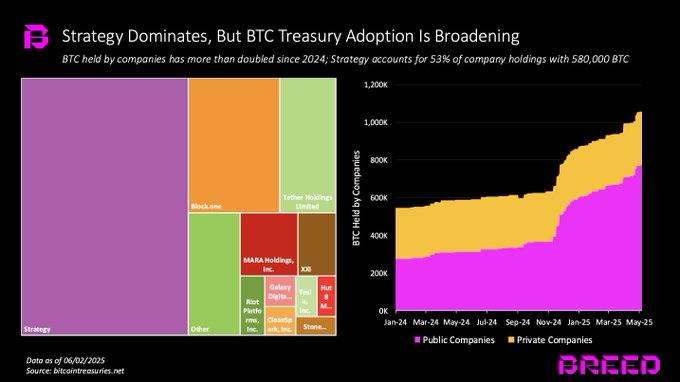
自 2024 年初以来,公司持有的比特币数量翻了一倍多。Strategy 公司持有超过 580,000 枚 BTC,占企业持仓总量的 53%。其他持有超过 1 万枚 BTC 的公司包括:

  • Block.one(164,000 枚)

  • Tether(100,500 枚)

  • MARA Holdings(49,140 枚)

  • Twenty One(31,500 枚)

  • Riot Platforms(19,200 枚)

  • Galaxy Digital(12,800 枚)

  • CleanSpark(12,100 枚)

  • 特斯拉(11,500 枚)

  • Hut 8(10,300 枚)

凭借其规模、声誉和抗周期性,Strategy 基本上注定将继续成为比特币持有公司的领头羊。但更值得注意的是 Strategy 的模式正在被模仿。越来越多的公司将比特币纳入资产负债表,以及专门从事比特币财资的新公司涌现,对比特币具有深远意义。

运作机制及估值方法
Image

那些在保持主营业务的同时,将比特币加入资产负债表的公司,其估值仍以主营业务为主。但一旦公司唯一目的是持有比特币,就会以其持有的比特币为主要估值依据。

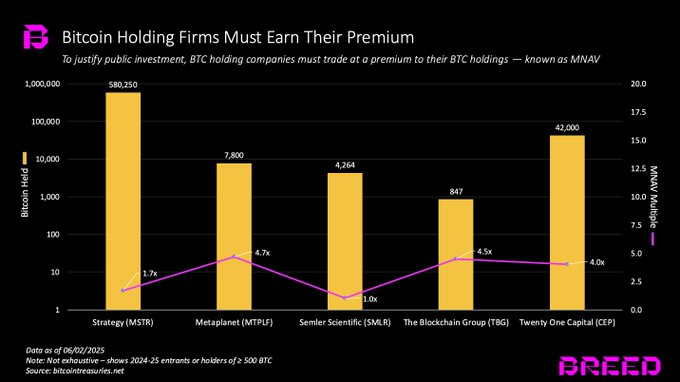
为了吸引投资者购买其股票而非直接持有比特币,这类公司必须实现超过比特币本身表现的超额回报。这种超额回报被称为“净资产价值倍数”(MNAV)。

例如,Strategy 公司持有 580,250 枚 BTC,价值约 600 亿美元,而其市值为 1040 亿美元,MNAV 为 1.7 倍。

MNAV 的波动取决于公司规模、市场经验、其他业务等多种因素。不过,Strategy 历史上维持的 2 倍 MNAV 是长期的黄金标准。
Image

市场不会仅因公司持有比特币而赋予 MNAV 溢价,前提是投资者相信该公司管理层能持续稳定地增长“每股比特币”数量。

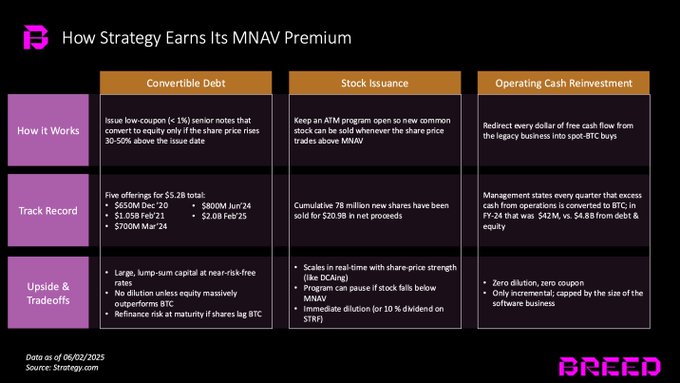
自 2020 年以来,Strategy 一直通过三种资本杠杆手段来证明其能力:

  1. 可转换债券:发行低息的可转换债券,仅在股价比发行价上涨 30–50% 时才转换为股权,从而以较低成本大额融资,且不会轻易摊薄股权。

  2. 市场中股票发行(ATM):当股价高于 MNAV 时,持续通过 ATM 程序发行新股,相当于用平均成本法不断购入比特币。

  3. 运营现金流再投资:将传统业务产生的自由现金流全部用于购买现货比特币。

后进公司也在采用并创新这一策略。某些创新方式包括:

  • 允许比特币持有者通过换股方式转换为股票,避免触发资本利得税;

  • 收购低于净现金价值的公司并将其价值转化为比特币;

  • 收购陷入困境的比特币相关诉讼索赔;

  • 借助媒体和活动提高影响力;

  • 通过 PIPE(私募股权投资)方式融资;

  • 利用监管套利。

参与者都有谁?

图像

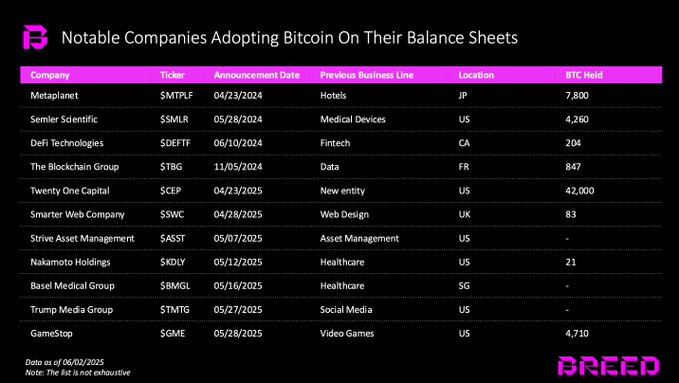
截至 2025 年上半年,已有超过 40 家公司公开宣布将在资产负债表上采纳比特币,共筹集了数百亿美元以执行这些战略,这些公司在行业、地域、执行模式和上市路径方面各不相同。

值得注意的包括:

  • Metaplanet(日本):最早一批国际参与者,利用日本的超低利率环境;

  • Semler Scientific 与 GameStop(美国):其比特币财资战略引起主流媒体关注;

  • Twenty One Capital:由 Tether 和 Cantor 支持的专门企业;

  • StriveNakamoto:通过反向并购迅速上市。

请查看上方图表,了解截至 2025 年 5 月已经宣布比特币财资战略的更多公司。

模式是否可持续?
图像

金融领域没有任何策略是万无一失的——比特币财资公司也不例外。

Strategy 曾在 2022–23 年熊市中经历重大考验:
比特币暴跌 80%,MNAV 溢价消失,新资本来源也枯竭。尽管如此,公司还是生存了下来,尽管 Saylor 可能几个晚上都睡不着觉。

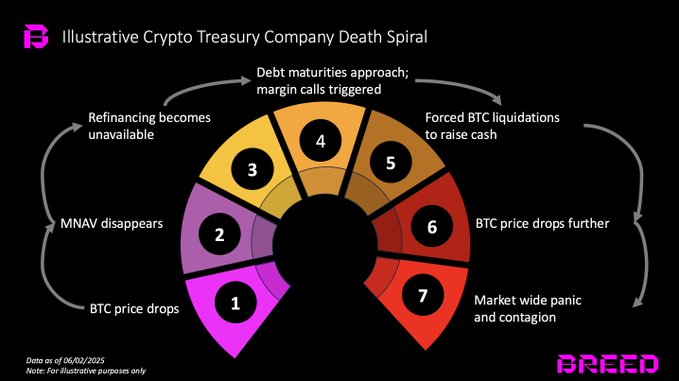
最大的生存风险是熊市时间过长,MNAV 溢价被侵蚀,而债务又将到期。如果股价跌至或低于净资产价值,且贷款人拒绝再融资,公司可能被迫抛售比特币来还债——引发价格下跌与抛售的恶性循环。

新成立的财资公司风险更高。没有 Strategy 的规模、声誉和被动指数资金流,他们融资条件更差,杠杆率更高。在下行市场中,这些结构可能迅速触发追加保证金要求+贱卖比特币,进一步加剧市场下跌。

接下来的方向

比特币财资公司的扩张仍处于早期阶段;但这一模式已开始向其他加密资产延伸——

例如:Solana:DeFi Development Corp(市值 1 亿美元,持有超 42 万枚 SOL)、UpexiSol Strategies以太坊SharpLink Gaming,在 Consensys 牵头的融资中筹集了 4.25 亿美元。

预计全球将有更多公司采纳这一模式,涵盖更多资产,并使用更高杠杆以追求成功。

大多数公司将失败。幸运的是,由于大部分融资基于股权,传染风险较低。但严重依赖债务的公司则构成系统性威胁。

最终,只有少数几家公司能长期维持 MNAV 溢价,他们需要依靠强大的领导力、严格的执行力、精明的市场操作和独特的战略,这样的话,无论市场如何波动,都能持续推动比特币每股价值的增长。


Twitter:https://twitter.com/BitpushNewsCN

比推 TG 交流群:https://t.me/BitPushCommunity

比推 TG 订阅: https://t.me/bitpush

说明: 比推所有文章只代表作者观点,不构成投资建议

Trending Cryptos

Related Reads

Apple and the Power Rebalancing with 'The Microns': Dissecting the Profit Ledger Behind the iPhone

The article analyzes the shifting profit dynamics and power balance between Apple and memory suppliers like Micron within the iPhone supply chain. It highlights a social media post criticizing Apple for raising iPhone prices while blaming memory chip cost increases, despite historically paying suppliers like Micron very little. An estimated iPhone 18 cost breakdown is referenced. Historically, memory was a minor cost component. In 2017's iPhone X, memory accounted for only about 1.6-2.3% of the price, with Apple capturing nearly 50% net profit. Over time, memory's share of the Bill-of-Materials (BOM) cost has grown significantly, reaching an estimated 12-15% for the iPhone 17 series. The core driver of this change is soaring demand for memory from the AI industry, particularly for High Bandwidth Memory (HBM) and AI servers, which is diverting production capacity and squeezing supply for consumer electronics. Memory manufacturers, after enduring periods of low profits, now hold greater pricing power. This is reflected in their recent strong financials, like Micron's 84.6% gross margin. Apple CEO Tim Cook initially described the memory price pressure as unprecedented in his 40-year career, later calling it a "once-in-a-century flood," before Apple announced price hikes across several product lines, causing a significant stock drop. Elon Musk echoed Cook's sentiment about the dramatic cost surge. The article concludes that the era of memory suppliers being at the mercy of Apple's pricing power has temporarily reversed, thanks to AI-driven demand. It notes Apple is reportedly seeking to diversify its supply chain, including exploring chips from China's CXMT.

Odaily星球日报1h ago

Apple and the Power Rebalancing with 'The Microns': Dissecting the Profit Ledger Behind the iPhone

Odaily星球日报1h ago

Conversation with the Founder of 42 Macro: The Fed's 'Boiling the Frog Slowly' and the K-Shaped Economy

In a conversation with Anthony Pompliano, Darius Dale, founder of 42 Macro, discusses the Federal Reserve's monetary policy and the K-shaped U.S. economy. Dale characterizes new Fed Chair Kevin Warsh as a "dove in hawk's clothing," expecting the Fed to signal or enact policy tightening in the coming quarters to create room for later easing. He argues current economic signals, including high deficit spending, debt monetization, and credit growth, strongly indicate inflation is not on a credible path back to 2%, forcing the Fed to act. The discussion highlights the stark "K-shaped" economic reality. While top earners, buoyed by massive cash savings (up ~$8 trillion since pre-pandemic), continue robust spending, those at the bottom face severe financial strain, with delinquency rates on consumer loans reaching crisis-era highs. Dale attributes much of the current social and political anxiety to this divergence, driven by the "Cantillon effects" of monetary expansion, which disproportionately benefits asset owners. He emphasizes that in this environment of "financial repression," individuals must participate in asset markets to avoid being left behind. On equities, Dale notes a rotation from the "Magnificent Seven" tech giants into broader AI-exposed companies, while warning that the tech giants' massive capital expenditure cycles could eventually puncture over-optimistic cash flow projections. Dale concludes by stressing that the core desire across all economic strata is simply the dignity to provide for one's family, a goal currently undermined by systemic policies that act as a "wealth siphon" from the bottom to the top.

marsbit1h ago

Conversation with the Founder of 42 Macro: The Fed's 'Boiling the Frog Slowly' and the K-Shaped Economy

marsbit1h ago

The Domestic Answer to Space Computing Power: Photonics Are More Efficient, Musk and Huang's Approaches Are Too Roundabout

The Space Computing Race: A Photonic Advantage The competition for space-based computing has intensified, with figures like Elon Musk and NVIDIA's Jensen Huang highlighting its potential. Musk predicts solar-powered AI satellites could offer the most cost-effective computing by 2032. However, space presents extreme challenges for traditional electronic chips: radiation from cosmic particles can cause errors, the vacuum environment hinders heat dissipation, and limited solar power constrains energy-hungry systems. Photonic computing, using light instead of electrons, offers a promising solution. Its core advantages for space are threefold: 1) **Radiation Resistance**: Photons are charge-neutral, making them inherently immune to particle interference. 2) **Low Heat Generation**: Light propagation in waveguides generates minimal heat, bypassing critical thermal management issues. 3) **Low Power Consumption**: Photonic chips have near-zero static power draw, aligning perfectly with the energy constraints of satellites. Furthermore, for a given payload weight and volume, photonic systems can potentially deliver higher total compute density. Since they require less bulky cooling and power infrastructure, more space can be allocated to the compute units themselves. While photonic computing holds great promise, current industry approaches face hurdles like the memory-compute bottleneck (separate storage and processing) and challenges in large-scale integration. Engineering for space—withstanding launch vibrations and validating full system operation in orbit—remains a critical step. The path forward resembles the evolution from single GPUs to computing clusters, but via a photonic route. As electronic chips approach physical limits in miniaturization, photonic computing and optical interconnects (光算光联) may provide a key alternative to bypass these constraints and define the next generation of space-based computing capabilities.

marsbit2h ago

The Domestic Answer to Space Computing Power: Photonics Are More Efficient, Musk and Huang's Approaches Are Too Roundabout

marsbit2h ago

Trading

Spot

Hot Articles

What is $BITCOIN

DIGITAL GOLD ($BITCOIN): A Comprehensive Analysis Introduction to DIGITAL GOLD ($BITCOIN) DIGITAL GOLD ($BITCOIN) is a blockchain-based project operating on the Solana network, which aims to combine the characteristics of traditional precious metals with the innovation of decentralized technologies. While it shares a name with Bitcoin, often referred to as “digital gold” due to its perception as a store of value, DIGITAL GOLD is a separate token designed to create a unique ecosystem within the Web3 landscape. Its goal is to position itself as a viable alternative digital asset, although specifics regarding its applications and functionalities are still developing. What is DIGITAL GOLD ($BITCOIN)? DIGITAL GOLD ($BITCOIN) is a cryptocurrency token explicitly designed for use on the Solana blockchain. In contrast to Bitcoin, which provides a widely recognized value storage role, this token appears to focus on broader applications and characteristics. Notable aspects include: Blockchain Infrastructure: The token is built on the Solana blockchain, known for its capacity to handle high-speed and low-cost transactions. Supply Dynamics: DIGITAL GOLD has a maximum supply capped at 100 quadrillion tokens (100P $BITCOIN), although details regarding its circulating supply are currently undisclosed. Utility: While precise functionalities are not explicitly outlined, there are indications that the token could be utilized for various applications, potentially involving decentralized applications (dApps) or asset tokenization strategies. Who is the Creator of DIGITAL GOLD ($BITCOIN)? At present, the identity of the creators and development team behind DIGITAL GOLD ($BITCOIN) remains unknown. This situation is typical among many innovative projects within the blockchain space, particularly those aligning with decentralized finance and meme coin phenomena. While such anonymity may foster a community-driven culture, it intensifies concerns about governance and accountability. Who are the Investors of DIGITAL GOLD ($BITCOIN)? The available information indicates that DIGITAL GOLD ($BITCOIN) does not have any known institutional backers or prominent venture capital investments. The project seems to operate on a peer-to-peer model focused on community support and adoption rather than traditional funding routes. Its activity and liquidity are primarily situated on decentralized exchanges (DEXs), such as PumpSwap, rather than established centralized trading platforms, further highlighting its grassroots approach. How DIGITAL GOLD ($BITCOIN) Works The operational mechanics of DIGITAL GOLD ($BITCOIN) can be elaborated on based on its blockchain design and network attributes: Consensus Mechanism: By leveraging Solana’s unique proof-of-history (PoH) combined with a proof-of-stake (PoS) model, the project ensures efficient transaction validation contributing to the network's high performance. Tokenomics: While specific deflationary mechanisms have not been extensively detailed, the vast maximum token supply implies that it may cater to microtransactions or niche use cases that are still to be defined. Interoperability: There exists the potential for integration with Solana’s broader ecosystem, including various decentralized finance (DeFi) platforms. However, the details regarding specific integrations remain unspecified. Timeline of Key Events Here is a timeline that highlights significant milestones concerning DIGITAL GOLD ($BITCOIN): 2023: The initial deployment of the token occurs on the Solana blockchain, marked by its contract address. 2024: DIGITAL GOLD gains visibility as it becomes available for trading on decentralized exchanges like PumpSwap, allowing users to trade it against SOL. 2025: The project witnesses sporadic trading activity and potential interest in community-led engagements, although no noteworthy partnerships or technical advancements have been documented as of yet. Critical Analysis Strengths Scalability: The underlying Solana infrastructure supports high transaction volumes, which could enhance the utility of $BITCOIN in various transaction scenarios. Accessibility: The potential low trading price per token could attract retail investors, facilitating wider participation due to fractional ownership opportunities. Risks Lack of Transparency: The absence of publicly known backers, developers, or an audit process may yield skepticism regarding the project's sustainability and trustworthiness. Market Volatility: The trading activity is heavily reliant on speculative behavior, which can result in significant price volatility and uncertainty for investors. Conclusion DIGITAL GOLD ($BITCOIN) emerges as an intriguing yet ambiguous project within the rapidly evolving Solana ecosystem. While it attempts to leverage the “digital gold” narrative, its departure from Bitcoin's established role as a store of value underscores the need for a clearer differentiation of its intended utility and governance structure. Future acceptance and adoption will likely depend on addressing the current opacity and defining its operational and economic strategies more explicitly. Note: This report encompasses synthesised information available as of October 2023, and developments may have transpired beyond the research period.

494 Total ViewsPublished 2025.05.13Updated 2025.05.13

What is $BITCOIN

Discussions

Welcome to the HTX Community. Here, you can stay informed about the latest platform developments and gain access to professional market insights. Users' opinions on the price of BTC (BTC) are presented below.

活动图片