BNB Chain приближается к скорости Ethereum после форка Maxwell на тестнете

cryptonews.ruPublished on 2025-02-28Last updated on 2025-05-28

Сеть BNB запустила тестовую версию своего форка Maxwell. Цель обновления в том, чтобы сделать работу блокчейна быстрее и стабильнее, сократив задержки и ускорив отклик.

Пока это только тестнет, но уже объявлена дата запуска в основной сети, 30 июня 2025. По скорости и техническим возможностям BNB теперь всё больше приближается к таким гигантам, как Ethereum и Solana.

Что меняет Maxwell в сети BNB

Обновление стартовало на блоке 5 255 2978 и стало серьёзным улучшением всей внутренней архитектуры. В сети ускорили генерацию блоков, улучшили связь между валидаторами и упростили синхронизацию узлов. Это важные шаги к масштабируемости и комфортной работе как для пользователей, так и для разработчиков.

«Maxwell HardFork успешно активирован в тестовой сети BNB Chain. Разработчикам и валидаторам стоит начинать тесты», — написали в официальном канале проекта.

Форк назван в честь Джеймса Клерка Максвелла, учёного, который объединил электромагнитные силы. В BNB провели аналогию: они тоже пытаются соединить две ключевые цели блокчейна — высокую скорость и устойчивость сети.

Одна из главных фишек это скорость. Время между блоками сократили вдвое. Теперь новый блок появляется каждые 0,75 секунды вместо прежних 1,5. Чтобы сеть не сломалась от такого ускорения, команда добавила техничку, которая поддерживает синхронность узлов и стабильность сети.

Изменения затронули и сам алгоритм работы. Эпоха теперь длится не 500, а 1000 блоков. Лидером валидации каждый узел становится на 16 блоков подряд. Это помогает сохранить равномерную нагрузку даже при более быстром темпе.

Газовый лимит в блоке порезали с 70 до 35 миллионов, чтобы избежать перегрузки и сохранить устойчивость. Это не про ограничение, а скорее про баланс: чем быстрее блоки, тем аккуратнее нужно обращаться с данными внутри них.

Кроме того, добавили оптимизацию сетевого уровня. Блоки теперь передаются между валидаторами за 400 миллисекунд. И даже если какой-то узел начал отставать, улучшенная система синхронизации помогает быстро подтянуться, не теряя связи с сетью.

Что это значит для пользователей и других блокчейнов

Для обычных пользователей такие изменения чувствуется сразу. При времени генерации блока меньше секунды и финализации около 1,9 секунды BNB Chain начинает ощущаться почти как Web2.

Действия вроде свапов, минтов или внутриигровых действий подтверждаются практически мгновенно. Это делает взаимодействие с Web3 не только удобным, но и знакомым по ощущениям, как в привычных централизованных сервисах.

Для разработчиков это целое поле для экспериментов. Теперь можно запускать игры в реальном времени, рынки предсказаний или децентрализованные платформы с высокой скоростью обновлений прямо на первом уровне.

И пока технические апгрейды только тестируются, по факту BNB Chain уже показывает уверенные цифры. По данным DefiLlama, именно она сейчас лидирует среди DEX-сетей, более $13 млрд объёма за сутки. Это почти в шесть раз больше, чем у Solana.

Объёмы торгов на DEX в BNB Chain. Источник: DefiLlama

Читайте также: Moonpig отскакивает вверх: скоро новый ATH?

BNB Chain против Ethereum

По данным Chainspect, производительность сети выросла на 37%, а по количеству транзакций BNB Chain обходит Ethereum в 12 раз. Однако по времени блока и финализации сеть всё ещё отстаёт: на 87,5% и 99,21% соответственно.
Сравнение BNB Chain и Ethereum по TPS и скорости. Источник: Chainspect

В индустрии обновление Maxwell уже называют прорывом. Известный DeFi-инфлюенсер Elja напомнил, что прошлый хардфорк Lorentz снизил комиссии в 10 раз и ускорил сеть. По его словам, Maxwell это более мощный шаг вперёд для всей экосистемы:

«Lorentz сократил комиссии в 10 раз и поднял TPS. Maxwell даст сети ещё больший буст», — написал он.

Похожее мнение выразил и один из пользователей, отметив, что теперь сеть должна решить проблему частых ошибок при покупке с кошельков.

Основной запуск Maxwell намечен на конец июня. После этого BNB Chain станет одной из самых быстрых и технологичных L1 сетей, сочетающих быструю обработку, поддержку EVM и надёжную архитектуру.
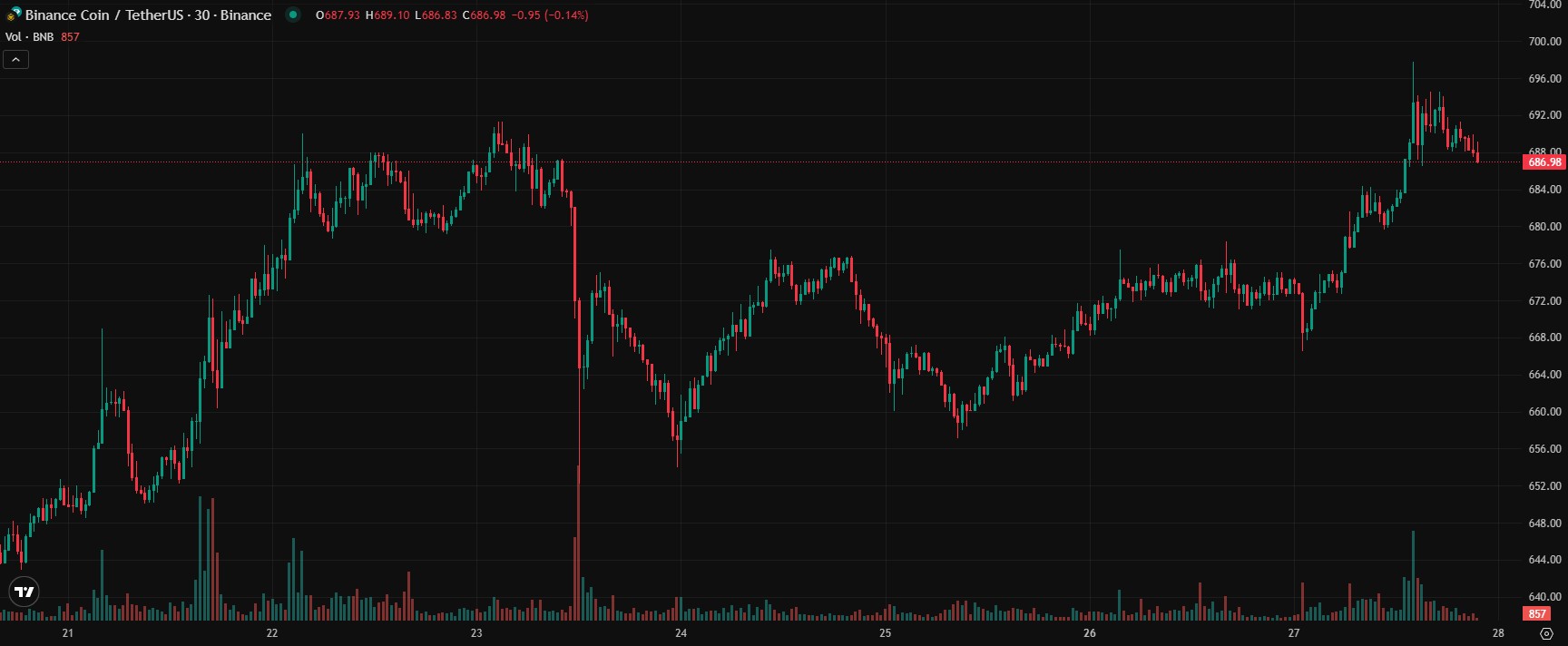
Динамика цены токена BNB. Источник: CoinMarketCap

Несмотря на новости, цена BNB почти не изменилась, монета выросла на 0,05% за последние сутки. Сейчас токен торгуется на уровне $674,08.


Trending Cryptos

Related Reads

Apple and the Power Rebalancing with 'The Microns': Dissecting the Profit Ledger Behind the iPhone

The article analyzes the shifting profit dynamics and power balance between Apple and memory suppliers like Micron within the iPhone supply chain. It highlights a social media post criticizing Apple for raising iPhone prices while blaming memory chip cost increases, despite historically paying suppliers like Micron very little. An estimated iPhone 18 cost breakdown is referenced. Historically, memory was a minor cost component. In 2017's iPhone X, memory accounted for only about 1.6-2.3% of the price, with Apple capturing nearly 50% net profit. Over time, memory's share of the Bill-of-Materials (BOM) cost has grown significantly, reaching an estimated 12-15% for the iPhone 17 series. The core driver of this change is soaring demand for memory from the AI industry, particularly for High Bandwidth Memory (HBM) and AI servers, which is diverting production capacity and squeezing supply for consumer electronics. Memory manufacturers, after enduring periods of low profits, now hold greater pricing power. This is reflected in their recent strong financials, like Micron's 84.6% gross margin. Apple CEO Tim Cook initially described the memory price pressure as unprecedented in his 40-year career, later calling it a "once-in-a-century flood," before Apple announced price hikes across several product lines, causing a significant stock drop. Elon Musk echoed Cook's sentiment about the dramatic cost surge. The article concludes that the era of memory suppliers being at the mercy of Apple's pricing power has temporarily reversed, thanks to AI-driven demand. It notes Apple is reportedly seeking to diversify its supply chain, including exploring chips from China's CXMT.

Odaily星球日报9m ago

Apple and the Power Rebalancing with 'The Microns': Dissecting the Profit Ledger Behind the iPhone

Odaily星球日报9m ago

Conversation with the Founder of 42 Macro: The Fed's 'Boiling the Frog Slowly' and the K-Shaped Economy

In a conversation with Anthony Pompliano, Darius Dale, founder of 42 Macro, discusses the Federal Reserve's monetary policy and the K-shaped U.S. economy. Dale characterizes new Fed Chair Kevin Warsh as a "dove in hawk's clothing," expecting the Fed to signal or enact policy tightening in the coming quarters to create room for later easing. He argues current economic signals, including high deficit spending, debt monetization, and credit growth, strongly indicate inflation is not on a credible path back to 2%, forcing the Fed to act. The discussion highlights the stark "K-shaped" economic reality. While top earners, buoyed by massive cash savings (up ~$8 trillion since pre-pandemic), continue robust spending, those at the bottom face severe financial strain, with delinquency rates on consumer loans reaching crisis-era highs. Dale attributes much of the current social and political anxiety to this divergence, driven by the "Cantillon effects" of monetary expansion, which disproportionately benefits asset owners. He emphasizes that in this environment of "financial repression," individuals must participate in asset markets to avoid being left behind. On equities, Dale notes a rotation from the "Magnificent Seven" tech giants into broader AI-exposed companies, while warning that the tech giants' massive capital expenditure cycles could eventually puncture over-optimistic cash flow projections. Dale concludes by stressing that the core desire across all economic strata is simply the dignity to provide for one's family, a goal currently undermined by systemic policies that act as a "wealth siphon" from the bottom to the top.

marsbit38m ago

Conversation with the Founder of 42 Macro: The Fed's 'Boiling the Frog Slowly' and the K-Shaped Economy

marsbit38m ago

The Domestic Answer to Space Computing Power: Photonics Are More Efficient, Musk and Huang's Approaches Are Too Roundabout

The Space Computing Race: A Photonic Advantage The competition for space-based computing has intensified, with figures like Elon Musk and NVIDIA's Jensen Huang highlighting its potential. Musk predicts solar-powered AI satellites could offer the most cost-effective computing by 2032. However, space presents extreme challenges for traditional electronic chips: radiation from cosmic particles can cause errors, the vacuum environment hinders heat dissipation, and limited solar power constrains energy-hungry systems. Photonic computing, using light instead of electrons, offers a promising solution. Its core advantages for space are threefold: 1) **Radiation Resistance**: Photons are charge-neutral, making them inherently immune to particle interference. 2) **Low Heat Generation**: Light propagation in waveguides generates minimal heat, bypassing critical thermal management issues. 3) **Low Power Consumption**: Photonic chips have near-zero static power draw, aligning perfectly with the energy constraints of satellites. Furthermore, for a given payload weight and volume, photonic systems can potentially deliver higher total compute density. Since they require less bulky cooling and power infrastructure, more space can be allocated to the compute units themselves. While photonic computing holds great promise, current industry approaches face hurdles like the memory-compute bottleneck (separate storage and processing) and challenges in large-scale integration. Engineering for space—withstanding launch vibrations and validating full system operation in orbit—remains a critical step. The path forward resembles the evolution from single GPUs to computing clusters, but via a photonic route. As electronic chips approach physical limits in miniaturization, photonic computing and optical interconnects (光算光联) may provide a key alternative to bypass these constraints and define the next generation of space-based computing capabilities.

marsbit1h ago

The Domestic Answer to Space Computing Power: Photonics Are More Efficient, Musk and Huang's Approaches Are Too Roundabout

marsbit1h ago

Trading

Spot

Hot Articles

Discussions

Welcome to the HTX Community. Here, you can stay informed about the latest platform developments and gain access to professional market insights. Users' opinions on the price of ETH (ETH) are presented below.

活动图片