- Bullish ETH price prediction for 2025 is $3,113.88 to $4089.81.
- Ethereum (ETH) price might reach $6000 soon.
- Bearish ETH price prediction for 2025 is $1,911.70.
In this Ethereum (ETH) price prediction 2025, 2026-2030, we will analyze the price patterns of ETH by using accurate trader-friendly technical analysis indicators and predict the future movement of the cryptocurrency.
TABLE OF CONTENTSINTRODUCTION
- Ethereum (ETH) Current Market Status
- What is Ethereum (ETH)?
- Ethereum (ETH) 24H Technicals
ETHEREUM (ETH) PRICE PREDICTION 2025
- Ethereum (ETH) Suppo-rt and Resistance Levels
- Ethereum (ETH) Price Prediction 2025 — RVOL, MA, and RSI
- Ethereum (ETH) Price Prediction 2025 — ADX, RVI
- Comparison of ETH with BTC, ETH
ETHEREUM (ETH) PRICE PREDICTION 2026, 2027-2030CONCLUSIONFAQ Ethereum (ETH) Current Market Status
Current Price $2,503.21 24 – Hour Price Change 7.66% Down/td> 24 – Hour Trading Volume $31.06B Market Cap $301.65B Circulating Supply 120.57M ETH All – Time High $4891.70 (On Nov 16, 2021) All – Time Low $0.4209(On Oct 22, 2015) ETH Current Market Status (Source: CoinMarketCap) What is Ethereum (ETH)
TICKERETHBLOCKCHAINEthereumCATEGORYERC-20 tokenLAUNCHED ONJuly 2015UTILITIESGovernance, Fast Transactions, gas fees & rewards Ethereum (ETH), known as Ether, is the native cryptocurrency of Ethereum. Ethereum is an open-source blockchain platform that revolutionized the blockchain and DeFi sector by the introduction of smart contracts. This second-generation blockchain was launched in 2015. Its native crypto coin, ether (ETH) was launched through an initial coin offering (ICO) in August 2014. The entire Ethereum network is fueled by Ether (ETH).
The blueprint of the Ethereum network was first released in its whitepaper in 2013 by Ethereum Co-founder Vitalik Buterin. Since its launch, the blockchain-based software platform functions as a potential launchpad for several other crypto tokens, DeFi protocols, and numerous decentralized applications (dApps). Thus, Ethereum is regarded as the “world computer.”
The smart contracts are coded programs that execute autonomously with pre-defined conditions on Ethereum. These smart contracts are deployed and executed via the Ethereum Vending Machine (EVM).
Ethereum has successfully transitioned to Proof-of-Stake (PoS) with The Merge completed on September 15, 2022. Originally built on the energy-intensive Proof-of-Work (PoW) system, Ethereum developers began preparing for this shift in 2020. However, the PoS upgrade reduces Ethereum’s energy consumption, as validators now stake ETH instead of mining. Additionally, this transition has turned Ether from an inflationary asset into a deflationary one, with reduced new ETH supply and transaction fee burns.
Ethereum 24H Technicals
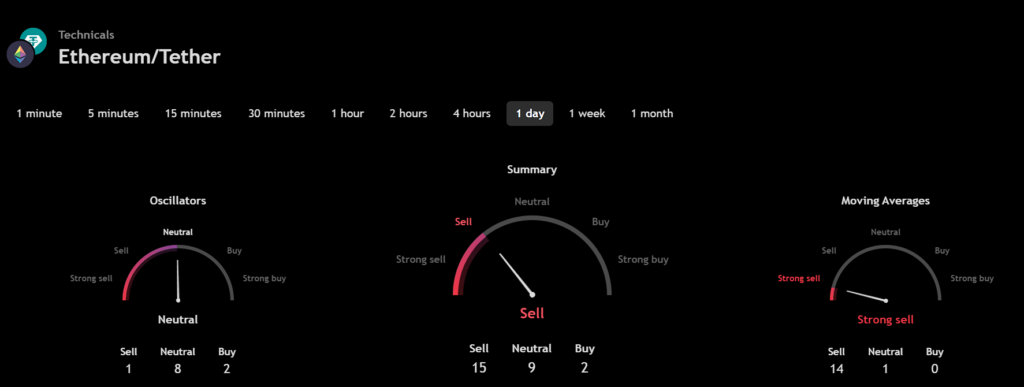
(Source: TradingView)
Ethereum (ETH) Price Prediction 2025
Ethereum (ETH) ranks 2nd on CoinMarketCap in terms of its market capitalization. The overview of the Ethereum price prediction for 2025 is explained below with a daily time frame.
ETH/USDT Horizontal Channel Pattern (Source: TradingView)
In the above chart, Ethereum (ETH) laid out a Descending Broadening Wedge, The descending broadening wedge occurs when price moves within two diverging trendlines, creating a broadening shape. This indicates increased market volatility and suggests a potential trend reversal. As price fluctuates, it forms lower highs and higher lows, signaling a shift in market sentiment.
Investors should watch for a breakout, as moving past the resistance level could signal a bullish reversal, despite the pattern’s bearish appearance. Proper timing and caution are key for capturing potential upside.
At the time of analysis, the price of Ethereum (ETH) was recorded at $2,503.21. If the pattern trend continues, then the price of ETH might reach the resistance levels of $2644.65, $2853.56, and $3347.07. If the trend reverses, then the price of ETH may fall to the support of $2463.85.
Ethereum (ETH) Resistance and Support Levels
The chart given below elucidates the possible resistance and support levels of Ethereum (ETH) in 2025.
ETH/USDT Resistance and Support Levels (Source: TradingView)
From the above chart, we can analyze and identify the following as resistance and support levels of Ethereum (ETH) for 2025.
Resistance Level 1$3,113.88Resistance Level 2$4,089.81Support Level 1$2,489.05Support Level 2$1,911.70 ETH Resistance & Support Levels
Ethereum (ETH) Price Prediction 2025 — RVOL, MA, and RSI
The technical analysis indicators such as Relative Volume (RVOL), Moving Average (MA), and Relative Strength Index (RSI) of Bitcoin (ETH) are shown in the chart below.
ETH/USDT RVOL, MA, RSI (Source: TradingView)
From the readings on the chart above, we can make the following inferences regarding the current Ethereum (ETH) market in 2025.
INDICATORPURPOSEREADINGINFERENCE50-Day Moving Average (50MA)Nature of the current trend by comparing the average price over 50 days50 MA = $2993.89Price = $2503.11
(50MA > Price)Bearish/DowntrendRelative Strength Index (RSI)Magnitude of price change;Analyzing oversold & overbought conditions36.60
<30 = Oversold
50-70 = Neutral>70 = OverboughtNearly Oversold Relative Volume (RVOL)Asset’s trading volume in relation to its recent average volumesBelow cutoff lineWeak volume Ethereum
(ETH) Price Prediction 2025 — ADX, RVI
In the below chart, we analyze the strength and volatility of Ethereum (ETH) using the following technical analysis indicators — Average Directional Index (ADX) and Relative Volatility Index (RVI).
ETH/USDT ADX, RVI (Source: TradingView)
From the readings on the chart above, we can make the following inferences regarding the price momentum of Ethereum (ETH).
INDICATORPURPOSEREADINGINFERENCEAverage Directional Index (ADX)Strength of the trend momentum37.86Strong TrendRelative Volatility Index (RVI)Volatility over a specific period38.13
<50 = Low
>50 = HighLow volatility Comparison of ETH with BTC
Let us now compare the price movements of Ethereum (ETH) with that of Bitcoin (BTC), and Ethereum (ETH).
BTC Vs ETH Price Comparison (Source: TradingView)
From the above chart, we can interpret that the price action of ETH is similar to that of BTC. That is, when the price of BTC increases or decreases, the price of ETH also increases or decreases respectively.
Ethereum (ETH) Price Prediction 2026, 2027 – 2030
With the help of the aforementioned technical analysis indicators and trend patterns, let us predict the price of Ethereum (ETH) between 2026, 2027, 2028, 2029, and 2030.
Year Bullish Price Bearish PriceEthereum (ETH) Price Prediction 2026$7,877$1,400Ethereum (ETH) Price Prediction 2027$8,123$1,350Ethereum (ETH) Price Prediction 2028$8,500$1,300Ethereum (ETH) Price Prediction 2029$8,768$1,250Ethereum (ETH) Price Prediction 2030$9,156$1,200 Conclusion
If Ethereum (ETH) establishes itself as a good investment in 2025, this year would be favorable to the cryptocurrency. In conclusion, the bullish Ethereum (ETH) price prediction for 2025 is $4,089.81. Comparatively, if unfavorable sentiment is triggered, the bearish Ethereum (ETH) price prediction for 2025 is $1,911.70.
If the market momentum and investors’ sentiment positively elevate, then Ethereum (ETH) might hit $6000. Furthermore, with future upgrades and advancements in the Ethereum ecosystem, ETH might surpass its current all-time high (ATH) of $4891.70. and mark its new ATH.
FAQ
1. What is Ethereum (ETH)?
Ethereum or Ether (ETH) is the native cryptocurrency of Ethereum. Ethereum is a second-generation blockchain platform that launched in 2015. Ether (ETH) was launched in 2014.
2. Where can you buy Ethereum (ETH)?
Traders can trade Ethereum (ETH) on the following cryptocurrency exchanges such as Binance, WEEX, OKX, LBank, and Bybit.
3. Will Ethereum (ETH) record a new ATH soon?
With the ongoing developments and upgrades within the Ethereum platform, Ethereum (ETH) has a high possibility of reaching its ATH soon.
4. What is the current all-time high (ATH) of Ethereum (ETH)?
Ethereum (ETH) hit its current all-time high (ATH) of $4,891.70 on November 16, 2021.
5. What is the lowest price of Ethereum (ETH)?
According to CoinMarketCap, ETH hit its all-time low (ATL) of $0.4209 on October 22, 2015.
6. Will Ethereum (ETH) hit $6000?
If Ethereum (ETH) becomes one of the active cryptocurrencies that majorly maintain a bullish trend, it might rally to hit $6000 soon.
7. What will be the Ethereum (ETH) price by 2026?
Ethereum (ETH) price might reach $7,877 by 2026.
8. What will be the Ethereum (ETH) price by 2027?
Ethereum (ETH) price might reach $8,123 by 2027.
9. What will be the Ethereum (ETH) price by 2028?
Ethereum (ETH) price might reach $8,500 by 2028.
10. What will be the Ethereum (ETH) price by 2029?
Ethereum (ETH) price might reach $8,768 by 2029.
Disclaimer: The opinion expressed in this article is solely the author’s. It does not represent any investment advice. TheNewsCrypto team encourages all to do their own research before investing.
share