IOTA 重磅宣布 Rebased 主网升级正式上线

深潮Published on 2025-05-07Last updated on 2025-05-07

升级后的IOTA主网将在第一层支持基于Move语言的智能合约,同时保持第二层的EVM兼容性。

作为IOTA史上最受期待的更新之一,IOTA基金会已成功完成Rebased升级,这项重大更新显著增强了网络技术能力,使其成为首个双智能合约生态系统。升级后的IOTA主网将在第一层支持基于Move语言的智能合约,同时保持第二层的EVM兼容性。

作为区块链领域历史最悠久、最具声望的机构之一,IOTA基金会自2015年起持续构建创新。早期网络依赖中心化的协调器(Coordinator)运行。为实现完全去中心化和可扩展的架构,基金会启动了"协调器移除计划",这一重要里程碑后来被称为IOTA 2.0(Coordicide),旨在实现完全去中心化并大幅提升扩展性与安全性。

随着Move虚拟机带来的L1智能合约革命——这项安全高性能编程技术的突破,IOTA基金会重新评估了技术路线。多数网络受困于层级割裂导致的效率低下和原生代币功能弱化问题,而IOTA则致力于强化其核心资产价值而非稀释。经过长期审慎论证,决定对主层进行重构并增加即时L1可编程性,这被视为未来成功的关键。若坚持IOTA 2.0路线需经历多次破坏性变更,而Rebased方案能实现一次性 decisive 转型,使网络全力前进。

自创立伊始,IOTA就选择了与众不同的发展路径——通过解决现实问题来创造实际价值。凭借Rebased升级,IOTA已全面具备引领行业进入实用化时代的能力,推动区块链技术超越投机属性,实现大规模实体应用。
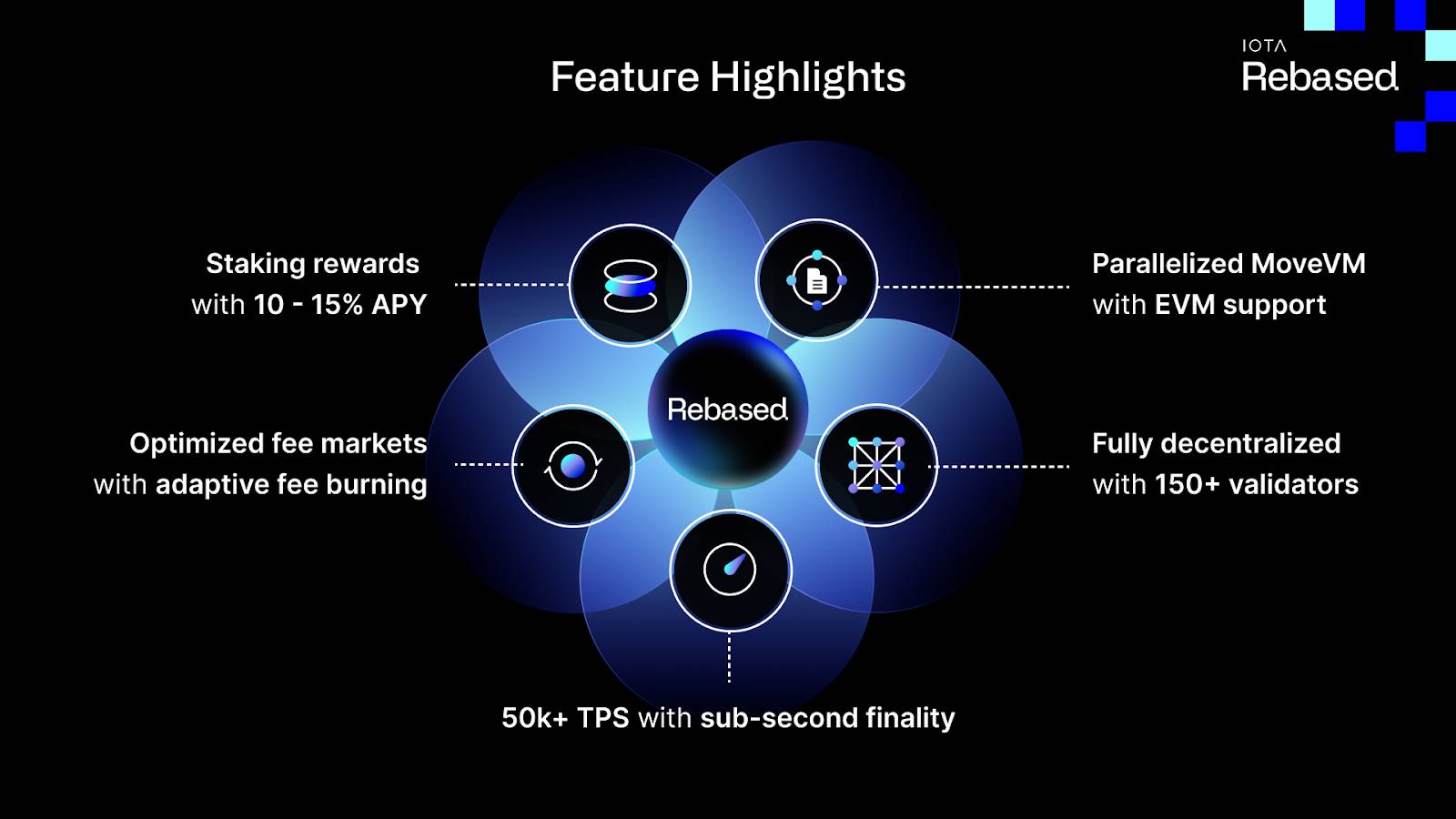
IOTA Rebased核心数据指标

本次协议升级使IOTA成为Move编程语言的早期采用者,继Aptos和Sui之后,成为第三个采用Move的头部L1网络,进一步巩固其行业领导地位。

新网络主要特性包括:

•50,000+ TPS处理能力

• 500毫秒确认速度

• 首个双智能合约生态系统(L1 MoveVM + L2 EVM)

• 网络活跃时可触发通缩的代币销毁机制

• 最高15%的质押年化收益(根据质押总量浮动)

为确保强大安全性和去中心化,升级后的IOTA网络将获得行业顶级机构的节点支持,包括LugaNodes、KILN、Twinstake、Ankr、P2P等知名企业。

打造变革性技术

IOTA作为DAG技术的先驱,其理念已获得Aptos、Sui等重量级项目的追随。凭借经验证的专家团队和加密领域最大规模的研发部门之一,IOTA持续突破技术边界。目前正在积极开发的新版本将进一步提升网络技术能力。

如今,IOTA已具备持续引领行业的所有要素:活跃的开发者生态、明确的监管定位、清晰的未来愿景。值得注意的是,IOTA还成为阿布扎比全球市场(ADGM)首个正式注册的DLT基金会,标志着其全球化布局的重要里程碑。

凭借强大的主网升级和全球化分布式架构,IOTA正推动实体应用落地。在成功完成欧盟区块链预商业化采购项目后,IOTA正积极塑造欧盟范围内的创新实践,巩固其作为企业和政府项目可信合作伙伴的地位。

(可见附文:solidifying its role as a trusted partner

IOTA的影响力远不止于欧洲。基金会近期已与世界经济论坛、英国出口与国际贸易研究所、托尼·布莱尔全球变化研究所等权威机构建立合作,共同通过关键流程的全面数字化革新全球贸易,为更高效透明的未来铺路。

(可见附文:The foundation recently joined forces with leading organizations

Rebased升级标志着IOTA连接区块链技术与现实应用使命的关键转折点。欲了解升级详情、最新动态和未来计划,请关注IOTA官方社交平台,加入蓬勃发展的社区:

X:https://x.com/iota

领英:https://www.linkedin.com/company/iotafoundation/

Discord:https://discord.iota.org/

Telegram:https://t.me/IOTA_Official_Community

更多信息请访问:www.iota.org

Trending Cryptos

Related Reads

Ethereum Q1 2026 Review: On-chain Activity Hits New Highs, Tokenized Assets Lead the Industry

Ethereum Q1 2026 Review: Chain Activity Hits Record High, Tokenized Assets Lead the Industry In Q1 2026, the Ethereum ecosystem displayed a dual narrative: record-high on-chain activity coincided with declining USD-denominated metrics. User adoption surged, with monthly active addresses reaching 13.2 million (up 53.5% QoQ) and layer-1 transactions hitting 200.4 million (up 38% QoQ). However, the total value locked (TVL) decreased 11% to $316.2B, and protocol revenue fell 16.9% to $2.0B, largely due to a broader crypto market downturn. Tokenized assets emerged as a key strength. Their total market cap reached $203.4B, with significant growth in tokenized funds (+73.1% YoY) and commodities (+325.9% YoY). Ethereum dominated cross-chain comparisons, holding over 61% of stablecoin value and 84% of tokenized commodities value among top chains. A major development was the impact of network scaling. The "Blob" upgrade significantly increased data capacity, causing average transaction fees on layer-1 to plummet 47.9% QoQ despite higher usage. This demonstrates the "Jevons Paradox" in action: cheaper block space stimulates demand. The report highlights Ethereum's established position as the primary settlement layer for institutional tokenization, evidenced by new fund launches from giants like BlackRock and JPMorgan in May. Analysts draw parallels between Ethereum's current stage and the internet in the mid-1990s, suggesting its open, neutral network is poised to become the foundational infrastructure for global finance, outcompeting closed, private alternatives.

Foresight NewsJust now

Ethereum Q1 2026 Review: On-chain Activity Hits New Highs, Tokenized Assets Lead the Industry

Foresight NewsJust now

Gate Research Institute: ETF Outflows Suppress Risk Appetite, Two-Way System Navigates Weak Market

Gate Institute Research Report: May 2026 Crypto Market Review & Strategy Analysis In May 2026, the crypto market shifted from an early-month rally to a mid-month correction, concluding with low-volatility consolidation. BTC, ETH, and SOL peaked in early May before declining. The primary market dynamic was a divergence between weakening spot ETF inflows and persistently high leverage-driven perpetual trading volume. A dual-direction moving average cluster breakout strategy outperformed, returning +2.11% for an equally-weighted BTC/ETH/SOL portfolio. This contrasted with a -6.09% return for buy-and-hold and -3.65% for a long-only version of the strategy. Profits were primarily generated from short positions on ETH and SOL during the mid-to-late May downtrend, demonstrating the month's suitability for two-way trend trading. Market structure evolved in three phases: an initial surge (May 1-6), a failure and reversal (starting May 7), and low-volatility compression (May 22 onward). While stablecoin supply remained stable, significant outflows from mainstream BTC and ETH ETFs created selling pressure. Concurrently, high correlation with the S&P 500 (~0.6) and stronger performance from AI equities like Nvidia highlighted crypto's position as a high-beta risk asset within a broader risk-budget framework, lacking independent momentum. The successful strategy employed a 4-hour chart system using a cluster of six moving averages (EMA6,12,24 & SMA6,12,24). A breakout signal was triggered after the cluster width compressed below 2.2%. Trades were managed with a 2.5% fixed stop-loss, a 3:1 Risk/Reward (7.5%) take-profit, and an EMA12-based exit rule to control losses from false breakouts. The strategy's low win rate but high payoff from a few large trend moves was effective in May's conditions. The report concludes that for June, a disciplined, bidirectional approach remains superior to subjective directional bets. The framework should adapt signal weighting based on BTC's position relative to key EMAs, ETF flow trends, and the relative strength of the Nasdaq, prioritizing risk management and trend preservation.

marsbit30m ago

Gate Research Institute: ETF Outflows Suppress Risk Appetite, Two-Way System Navigates Weak Market

marsbit30m ago

Anthropic CEO's Latest Interview: On Technological Explosion, Safety Red Lines, and the Civilization Contract

Interview with Anthropic CEO Dario Amodei covers the intense pressures and ethical dilemmas of leading AI development. He describes the experience as "exponential growth," feeling constant acceleration akin to relativistic time dilation. The discussion delves into his departure from OpenAI, rooted in a fundamental loss of trust and divergent values rather than mere technical disagreements. Amodei emphasizes Anthropic's enterprise-focused business model, arguing it aligns better with safety and responsible deployment than consumer-facing, ad-driven models. He addresses critical issues like AI's impact on employment, advocating for proactive macroeconomic policies and a shift towards "doing more with the same resources" to avoid widespread job displacement. On safety and governance, he details Anthropic's cautious approach, including delaying the release of the powerful "Mythos" model due to its advanced cyber capabilities. He stresses the need for "human-in-the-loop" principles in military applications, setting red lines against autonomous weapons and mass surveillance. Amodei calls for industry collaboration among trustworthy actors to establish standards and advocates for a balanced regulatory framework with checks and balances, such as Anthropic's Long-term Benefit Trust, rather than corporate or government monopoly over the technology. He expresses geopolitical concerns, particularly regarding China, and a belief that AI should bolster liberal democracies. While acknowledging a non-zero risk of civilizational catastrophe from advanced AI, he asserts Anthropic's actions are aimed at significantly reducing that probability. The interview concludes with Amodei arguing that trust must be earned through concrete actions, like sacrificing commercial gain for safety, to distinguish Anthropic in a Silicon Valley landscape he criticizes for eroded public trust.

marsbit34m ago

Anthropic CEO's Latest Interview: On Technological Explosion, Safety Red Lines, and the Civilization Contract

marsbit34m ago

Trading

Spot
Futures

Hot Articles

How to Buy IOTA

Welcome to HTX.com! We've made purchasing IOTA (IOTA) simple and convenient. Follow our step-by-step guide to embark on your crypto journey.Step 1: Create Your HTX AccountUse your email or phone number to sign up for a free account on HTX. Experience a hassle-free registration journey and unlock all features.Get My AccountStep 2: Go to Buy Crypto and Choose Your Payment MethodCredit/Debit Card: Use your Visa or Mastercard to buy IOTA (IOTA) instantly.Balance: Use funds from your HTX account balance to trade seamlessly.Third Parties: We've added popular payment methods such as Google Pay and Apple Pay to enhance convenience.P2P: Trade directly with other users on HTX.Over-the-Counter (OTC): We offer tailor-made services and competitive exchange rates for traders.Step 3: Store Your IOTA (IOTA)After purchasing your IOTA (IOTA), store it in your HTX account. Alternatively, you can send it elsewhere via blockchain transfer or use it to trade other cryptocurrencies.Step 4: Trade IOTA (IOTA)Easily trade IOTA (IOTA) on HTX's spot market. Simply access your account, select your trading pair, execute your trades, and monitor in real-time. We offer a user-friendly experience for both beginners and seasoned traders.

1.9k Total ViewsPublished 2024.03.29Updated 2026.06.02

How to Buy IOTA

Discussions

Welcome to the HTX Community. Here, you can stay informed about the latest platform developments and gain access to professional market insights. Users' opinions on the price of IOTA (IOTA) are presented below.

活动图片