Ethereum Open Interest Drops To November 2024 Levels, But Price Remains Below $2,000

bitcoinistPublished on 2025-05-06Last updated on 2025-05-06

Abstract

Ethereum open interest has fluctuated wildly through the last few months as the market had been under the control of...

Trusted Editorial content, reviewed by leading industry experts and seasoned editors. Ad Disclosure

Ethereum open interest has fluctuated wildly through the last few months as the market had been under the control of sellers. Ethereum especially suffered after crashing from $4,000 to below $2,000 in the space of four months. During this time, the Bitcoin price has remained close to its all-time high, highlighting ETH’s underperformance during this time.

Ethereum Open Interest Falls To November 2024 Levels

Currently, the Ethereum open interest has fallen below $20 billion again, representing the lack of interest that has plagued the second-largest cryptocurrency over the last few months. This is the result of a steady decline since December 2024, following the Ethereum price crash of over 50% so far.

An interesting fact about the open interest now is the fact that it has now fallen back to levels where it was back in November 2024. This was the time period when the ETH price was rising and eventually hit a 3-year peak of $4,000. This could suggest that the Ethereum price could see a recovery soon in the same vein. However, the differences in circumstances do not exactly scream bullish, though, as bears are more in control than bulls at this point.
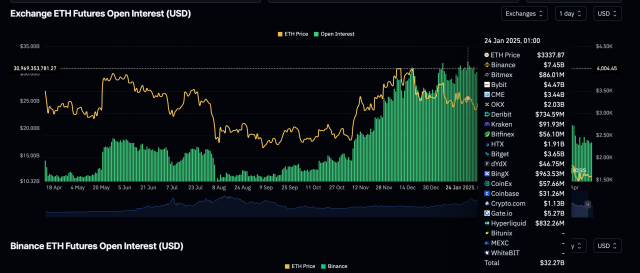
Ethereum open interest
Source: Coinglass

The open interest had climbed above $32 billion toward the end of January 2025, as shown on Coinglass. Since then though, it has continually crashed, making its way down with the ETH price. However, this could end up being good news for the cryptocurrency.

Usually, during times of low interest is when a reversal begins, as has been shown times without number. As such, with interest in Ethereum so low, it is possible that this is where the altcoin begins to register a bottom and start moving upward again.

ETH Whales Returning To The Table Or Leaving?

Ethereum whale transactions have continued to fall, and over the last seven days, there have been a notable decline . According to data from IntoTheBlock, the month of May started out especially bearish with less than 3,000 transactions carrying $100,000 or more worth of ETH by May 3-4. This follows the lack of interest that has been seen in the open interest as well.

Profitability has also declined notably during this time. Where a whopping 91% of all Bitcoin holders are currently sitting in profit, the majority of Ethereum investors are nursing losses at 52%. This leaves only 42% of holders seeing a profit, and 7% sitting at breakeven. This figure could decline further if Ethereum fails to recover and falls toward $1,500.

Ethereum price chart from TradingView.com
ETH bulls still struggling to hold $1,800 | Source: ETHUSDT on TradingView.com
Chart from TradingView.com
Editorial Process for bitcoinist is centered on delivering thoroughly researched, accurate, and unbiased content. We uphold strict sourcing standards, and each page undergoes diligent review by our team of top technology experts and seasoned editors. This process ensures the integrity, relevance, and value of our content for our readers.

Scott Matherson is a leading crypto writer at Bitcoinist, who possesses a sharp analytical mind and a deep understanding of the digital currency landscape. Scott has earned a reputation for delivering thought-provoking and well-researched articles that resonate with both newcomers and seasoned crypto enthusiasts. Outside of his writing, Scott is passionate about promoting crypto literacy and often works to educate the public on the potential of blockchain.

Trending Cryptos

Related Reads

In the MiCA Era, Europe's New Cryptography Landscape: Why is Germany Taking Center Stage?

With MiCA's transitional arrangements concluding, Europe's crypto industry has undergone a regulatory consolidation. Post-MiCA, platforms must secure CASP authorization to operate compliantly within the EU. As of July 1st, only about 12% of crypto firms have received authorization, with Germany emerging as a key player, holding 57 authorizations (roughly 23% of the EU total). This positions Germany as a primary compliance gateway to the EU's unified market. Germany's advantage stems from its established, function-based regulatory framework, which integrated crypto activities into existing banking, securities, and payment systems pre-MiCA. This allowed a smoother transition and attracted both domestic platforms (like Bitcoin.de, BISON) and international ones (like Coinbase Germany). A distinctive trend is German banks becoming direct retail entry points for crypto services. Examples include DZ Bank integrating "meinKrypto" into its VR Banking App and the Sparkassen savings bank network planning to offer crypto trading via DekaBank. This mainstreams crypto access for ordinary users. Beyond trading, Germany is evolving into a digital asset infrastructure hub. Deutsche Börse Group's Clearstream is developing a next-generation platform for issuing, settling, and servicing both traditional and tokenized securities. Furthermore, German banks like DekaBank and DZ Bank are key participants in the Qivalis project, a European initiative for a regulated euro stablecoin, positioning Germany at the intersection of critical future capabilities like custody, settlement, and cross-border services.

marsbit22m ago

In the MiCA Era, Europe's New Cryptography Landscape: Why is Germany Taking Center Stage?

marsbit22m ago

Glassnode: Cryptocurrency Market Entering Late-Stage Consolidation Phase

Bitcoin has now been trading below the realized price and short-term holder cost basis for nearly five months, indicating a prolonged period of undervaluation. The market exhibits late-stage accumulation characteristics. Long-term holders (LTHs) are the primary source of sell-side pressure, with their realized losses reaching a daily peak of $280 million, the highest since December 2022, and accounting for 43% of total on-chain realized losses. A sustained decline in this LTH selling is a crucial prerequisite for a meaningful reversal. Spot ETF flows, while moderating from June peaks, remain in a state of monthly net outflows. Daily trading volumes have collapsed roughly 80% from the October 2025 highs, reflecting weak institutional demand and lack of confidence. Derivatives markets show a cautious tilt towards bullishness, with the put/call ratio hitting a 2026 low and funding rates neutral. However, the options volatility skew remains in "put premium," indicating persistent demand for downside protection, even as the absolute cost of that protection has declined. The spot price currently trades approximately 6% below the $66,000 max pain level. In summary, key conditions for a market bottom are in place, including sustained undervaluation and significant LTH capitulation. However, definitive signals for a transition to a bull market—namely, a sustained drop in LTH realized losses, stabilization of ETF fund flows, and price reclaiming key on-chain cost bases—are not yet confirmed. The market is in the late stages of basing, awaiting these catalysts for a sustained recovery.

marsbit2h ago

Glassnode: Cryptocurrency Market Entering Late-Stage Consolidation Phase

marsbit2h ago

Trading

Spot

Hot Articles

Discussions

Welcome to the HTX Community. Here, you can stay informed about the latest platform developments and gain access to professional market insights. Users' opinions on the price of ETH (ETH) are presented below.

活动图片