Solana Inflation Reform Gets Second Try From Galaxy Research

bitcoinistPublished on 2025-04-19Last updated on 2025-04-19

Abstract

Galaxy Research has returned to the Solana governance arena with a fresh proposal that seeks to sidestep the deadlock that...

Trusted Editorial content, reviewed by leading industry experts and seasoned editors. Ad Disclosure

Galaxy Research has returned to the Solana governance arena with a fresh proposal that seeks to sidestep the deadlock that stymied last month’s SIMD‑228 vote on inflation. Published on GitHub on April 17 and titled “Multiple Election Stake‑Weight Aggregation (MESA) Vote for Reducing Inflation,” the document lays out a procedure that would let validators express a full spectrum of preferences instead of the blunt YES / NO / ABSTAIN triad that governs Solana referenda today.

New Solana Inflation Proposal Follows First Failure

Solana’s monetary schedule is presently hard‑coded: annual issuance starts at 8 %, declines by 15 % each year, and plateaus at a 1.5 % “terminal” inflation rate. According to dashboard provider Solana Compass, the network’s effective inflation stands at 4.591 %. While SIMD‑228 revealed broad agreement that those figures amount to “security overpayment,” the binary ballot failed to gather the two‑thirds super‑majority needed to tighten the curve.

Galaxy’s new plan keeps the familiar fixed, time‑dependent decline toward 1.5 % but replaces single‑outcome votes with what it calls a market‑driven aggregation. “Instead of throwing darts until the community is happy with an individual proposal,” the authors write, “it is more efficient to simply ask each person what they want and settle on the aggregate.”

Under MESA, validators would send stake to multiple YES accounts representing discrete disinflation rates—15 %, 17.5 %, 20 % and so on—while NO and ABSTAIN remain unchanged. The weighted average of those YES buckets would set the new curve. A worked example in the post shows how 5 % of YES stake for “unchanged,” 50 % for 30 % deflation and 45 % for 33 % would yield a composite 30.6 % rate.

Galaxy stresses that the scheme is “not to be confused with a market‑driven curve as detailed in SIMD‑228,” because the underlying schedule would still be deterministic once chosen. Yet, the firm argues, the method is “democratic and progressive” and could “eliminate the need to repeatedly take the idea to single‑outcome vote until a universally acceptable number is proposed.”

The pitch has already drawn scrutiny from core developers. Max Resnick of Anza responded on GitHub that the arithmetic of averaging creates a perverse incentive to vote tactically rather than truthfully: “Suppose I believe the best policy is 25 % a year. … With the average aggregation rule the best thing to do is try to forecast where the final outcome will be and set the most extreme policy in whichever direction you want to pull the policy from there.”

Resnick argues that selecting the median of submitted preferences would be “a truthful aggregation rule” and reiterates his preference for “a dynamic market‑based approach to issuance” over any static curve, adding, “I have faith that the Solana community is intelligent enough to understand a dynamic inflation policy.”

Galaxy’s authors acknowledge that critical implementation details remain open. They invite debate on how many YES buckets to include, whether SIMD‑228’s 33 % quorum and two‑thirds super‑majority thresholds should carry over, and whether a weighted average is in fact the fairest way to collapse the vote.

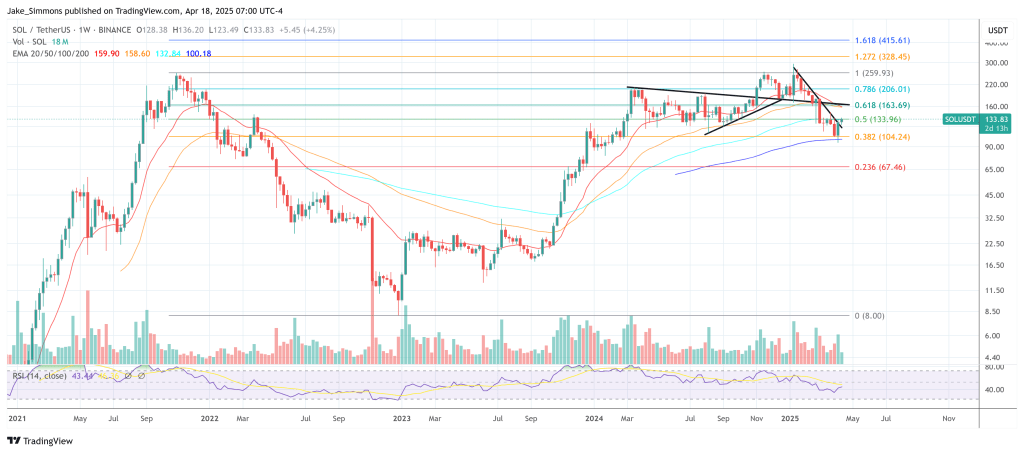
At press time, SOL traded at $133.83.
Solana price
Solana broke the downtrend, 1-week chart | Source: SOLUSDT on TradingView.com
Featured image created with DALL.E, chart from TradingView.com
Editorial Process for bitcoinist is centered on delivering thoroughly researched, accurate, and unbiased content. We uphold strict sourcing standards, and each page undergoes diligent review by our team of top technology experts and seasoned editors. This process ensures the integrity, relevance, and value of our content for our readers.

Jake Simmons has been a Bitcoin enthusiast since 2016. Ever since he heard about Bitcoin, he has been studying the topic every day and trying to share his knowledge with others. His goal is to contribute to Bitcoin's financial revolution, which will replace the fiat money system. Besides BTC and crypto, Jake studied Business Informatics at a university. After graduation in 2017, he has been working in the blockchain and crypto sector. You can follow Jake on Twitter at @realJakeSimmons.

Trending Cryptos

Related Reads

Not Betting on Goals but on 'Tears': Polymarket Users Argue Over Ronaldo's Final World Cup Match

Title: Beyond Goals, Betting on Tears: Polymarket Users Clash Over Ronaldo's Emotional World Cup Exit On July 6, Portugal's 0-1 loss to Spain in the World Cup round of 16 marked the final tournament for Cristiano Ronaldo. The 41-year-old star's emotional reaction—red eyes, wiping his face, fighting back tears—was captured globally. Concurrently, a fierce debate erupted on the crypto prediction platform Polymarket over a specific market: "Will Ronaldo cry during the 2026 FIFA World Cup?" The market, with over $23 million in volume, saw its "YES" probability surge to 99% after the match, but the result was disputed and entered a final review phase. The core conflict centered on the market's precise rules: it required "clearly visible tears streaming down [Ronaldo's] face" in photos/videos taken on the field or bench area during Portugal's matches. While major media outlets described Ronaldo as "in tears" and footage showed him emotional, "NO" bettors argued visible tear tracks were not conclusively evident, only red eyes and dampness. Polymarket's official clarification on July 8 stated that eligible evidence existed showing Ronaldo crying with visible tears on his face post-match. The dispute now goes to a UMA oracle community vote for resolution. This incident highlights a recurring challenge for prediction markets: they excel with quantifiable events but can spark major controversies over subjective, visual, or emotional interpretations. It also serves as a reminder for participants to scrutinize rule wording meticulously, not rely on general perception. Ultimately, such high-profile disputes drive significant trading volume and attention for the platform.

Foresight News58m ago

Not Betting on Goals but on 'Tears': Polymarket Users Argue Over Ronaldo's Final World Cup Match

Foresight News58m ago

DeepSeek Secretly Builds AI Chip, Specializing in Inference, Project Started a Year Ago with No Public Recruitments

DeepSeek, the Chinese AI company known for its algorithmic models, is secretly developing its own AI chip to reduce dependence on Nvidia, according to a Reuters report. The chip is designed specifically for AI inference, not training, and the project began approximately a year ago. Currently in early stages, DeepSeek is reportedly in discussions with chip design firms, foundries, and memory suppliers. The company, historically focused on algorithmic efficiency, has been discreetly hiring chip design engineers without public job postings. This move aligns with a global trend where major AI model companies like OpenAI and Anthropic are also pursuing custom chip development. DeepSeek founder Liang Wenfeng previously highlighted chip shortages as a challenge. While the company initially trained models on Nvidia H800s and later adapted to Huawei's Ascend chips, it now seeks greater control over its hardware foundation. Designing a competitive AI chip is a significant challenge, requiring years and substantial investment with no guarantee of success. However, DeepSeek's efforts are backed by a recent major funding round of approximately 51 billion RMB (about $7.4 billion) raised in June 2026. The funds are designated for expanding data centers based on domestic chips, developing proprietary AI chips, and recruiting top global talent. Infrastructure plans are also advancing, with job postings for data center design engineers, including projects in locations like Ulanqab, Inner Mongolia. The company remains characteristically low-key, with sources speaking anonymously and no official comment from DeepSeek itself. Nevertheless, this initiative marks a strategic expansion from software algorithms into the hardware layer that powers its AI systems.

marsbit1h ago

DeepSeek Secretly Builds AI Chip, Specializing in Inference, Project Started a Year Ago with No Public Recruitments

marsbit1h ago

Trading

Spot

Hot Articles

Discussions

Welcome to the HTX Community. Here, you can stay informed about the latest platform developments and gain access to professional market insights. Users' opinions on the price of SOL (SOL) are presented below.

活动图片