如何通过“右侧信号”抓住市场机会?

投研日志Published on 2025-04-10Last updated on 2025-04-10

Abstract

通过类似这样的方法综合,全面,客观的相互验证,就能最大程度避免如“假突破”信号干扰我们对趋势的判断。

作者:Murphy

由于川普政策多变以及宏观经济的不确定性,我们应该将交易思路从2024年的“乐观为先”转变为2025年的“谨慎为先,乐观为后”。将风险和收益控制在一个相对平衡的范围内,等待趋势反转的右侧信号再出手会是一个较为合理的交易策略。

当然“右侧信号”不是指某一个数据或指标,而是从多个维度去观察和验证。例如昨天提到的“投资者对趋势信心”就是从情绪变化的考量。而今天我们要说的是从成本基础的角度 —— 反向排列结构。

不同持币群体的成本基础出现“反向排列结构”完全体时,就是我们要等的右侧信号之一。虽然此时的价格未必是回调的绝对低点,但却可以兼具性价比和确定性。

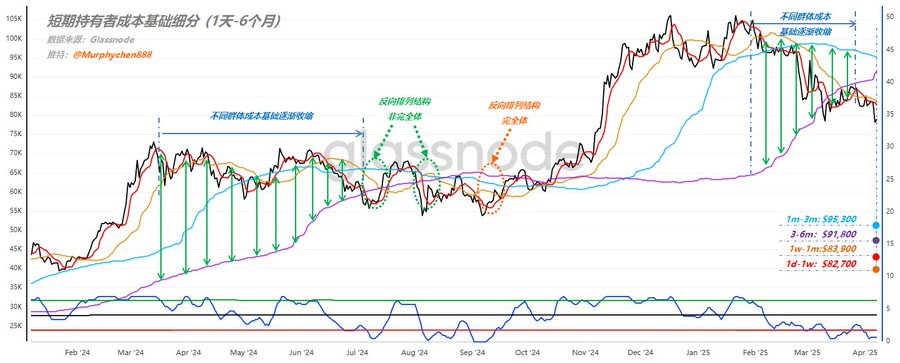
其背后逻辑,简单说就是当市场经过一段时间的“洗礼”后,越来越多的短期筹码不愿卖(紫线上升),同时新资金入场积极的拉低平均成本(红线下降),所以更容易产生阶段性的底部共识。

(图1)

在实际观察和判断时需要注意2点(需同时满足):

1、必须等到完全体形成,即从上到下依次排序为紫蓝黄红。

2、必须整体处于收缩形态。即上下空间越来越小,尤其以各成本基本粘合在一起为最佳。

当前紫线($91,800)距离上方蓝线($95,300)还有一段距离(如图1),因此反向排列的结构还未形成。

但通过仔细观察,我们可以发现由于近期的快速下跌导致橙线和红线被带着一起快速下降,这样就有产生了一个问题:即便现在紫线超过蓝线形成反向排列结构,但却也产生了扩张形态(由于橙/红线快速下降拉开了空间)。

所以真正的右侧信号可能还需要我们耐心等待一段时间。

图2

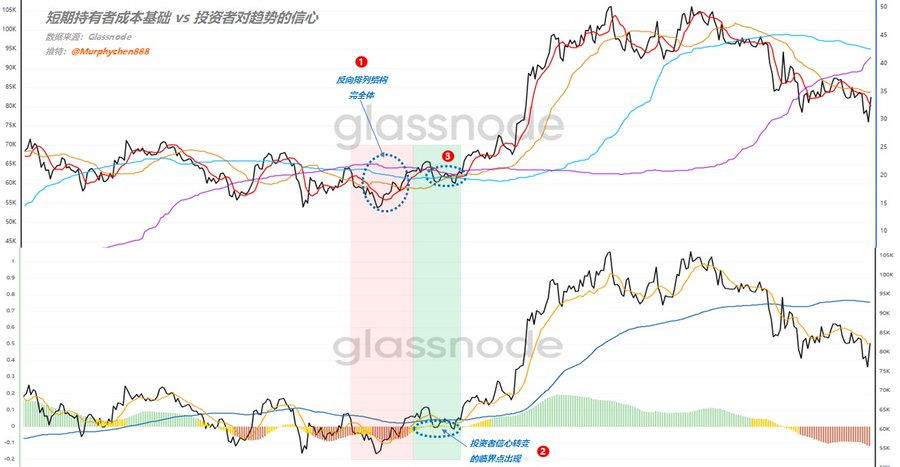
如果我们把2个数据叠加,就能更好的做出对信号的验证。如图2所示,先出现了反向排列结构完全体(标注1),随后投资者信心转变的临界点出现(标注2)。

2个右侧信号一前一后分别出现,且出现信号2的时候各群体的成本基本粘合在一起(标注3),说明此时大家的成本线都差不多,是一种最为稳定的结构。

通过类似这样的方法综合,全面,客观的相互验证,就能最大程度避免如“假突破”信号干扰我们对趋势的判断。

Trending Cryptos

Related Reads

BIS Report Compliance Observations: The True Risks of Stablecoins Go Beyond 'De-pegging'

The BIS report, "Anchoring trust in money: innovation beyond stablecoins," highlights that the primary risks of stablecoins extend beyond potential de-pegging. It argues that the core challenge is whether stablecoins can be integrated into a financial system that is identifiable, monitorable, accountable, and regulatable. While acknowledging efficiency gains like faster payments and programmability, BIS emphasizes that money requires an institutional framework—including legal certainty, liquidity support, and financial integrity controls—which many stablecoins currently lack. The report details compliance risks, noting that while blockchain transactions are transparent, address visibility does not equate to identity or purpose clarity. This creates a systemic risk as pseudonymity, non-custodial wallets, and cross-chain bridges can undermine AML/CFT controls. Furthermore, these risks can spill over into the traditional financial system through on- and off-ramps. The future direction, per BIS, is not to prohibit innovation but to embed regulatory rules—such as identity verification and transaction screening—directly into the technological infrastructure of tokenized finance. The key takeaway for compliance is that any new financial instrument must clearly address questions of customer identification, transaction monitoring, accountability, and cross-border rule consistency to be viable as a mainstream payment tool.

marsbit1h ago

BIS Report Compliance Observations: The True Risks of Stablecoins Go Beyond 'De-pegging'

marsbit1h ago

When US Giants Collectively "Defect" to Chinese AI Models

When Silicon Valley Giants Turn to Chinese AI Models to Cut Costs A surprising trend is emerging: major U.S. tech companies are significantly reducing AI costs by switching to Chinese models. Coinbase, the largest U.S. cryptocurrency exchange, reportedly halved its AI spending after migrating to China's GLM-5.2 and Kimi 2.7 models, despite increasing usage. They achieved this through a sophisticated three-part strategy: implementing an automatic routing system to select the most cost-effective model per task, boosting cache hit rates from 5% to 60% to reuse computations, and employing "context engineering" to provide AI with more precise, less cluttered information. They are not alone. AI startup Lindy switched from Claude to DeepSeek, saving millions, while Snowflake's tests found GLM-5.2 solved 66% of coding tasks compared to Claude Opus's 67%—but at a fraction of the cost (output pricing is 5-7 times lower). While the top Western models may offer slightly better stability, the massive price differential is leading many businesses to reconsider their value proposition. This shift signals a deeper change in the AI industry, moving beyond pure performance benchmarks to a fierce cost competition. As pressure mounts, even OpenAI and Anthropic have begun slashing prices. For users, this means more choices, lower costs, and a crucial lesson: using multiple models based on task complexity, optimizing with caching, and keeping contexts lean are now key to leveraging AI efficiently and affordably.

marsbit1h ago

When US Giants Collectively "Defect" to Chinese AI Models

marsbit1h ago

BIS Report Compliance Watch: The Real Risks of Stablecoins Are Not Just 'De-pegging'

BIS Report Compliance Observations: The real risks of stablecoins go beyond "depegging" The BIS report "Anchoring trust in money: innovation beyond stablecoins" argues that while stablecoins and tokenization offer efficiency gains, their primary risk lies in fitting into an identifiable, monitorable, accountable, and regulatable financial system. Money's trust stems not just from technology but from institutional arrangements: a common unit of account, guaranteed redemption at par, liquidity support, regulatory frameworks, and financial integrity requirements. Stablecoins, operating on permissionless blockchains with pseudo-anonymity and non-custodial wallets, create systemic compliance gaps: unclear customer identity, incomplete fund origins, unexplained transaction purposes, fragmented cross-chain paths, and ambiguous liability. On-chain transparency does not equal compliance transparency. Public addresses don't reveal identity or intent. While blockchain analytics aid law enforcement, they cannot replace routine, large-scale AML/CFT controls. Effective compliance requires a closed-loop process encompassing customer onboarding, transaction monitoring, investigation, reporting, and audit. Stablecoin risks are not confined to the blockchain; they re-enter the traditional financial system via on/off-ramps, exchanges, and payment institutions. This forces banks to monitor client accounts for activity linked to virtual assets. The future direction is not to prohibit innovation but to embed rules into the technology. Tokenized finance should integrate with the existing two-tier monetary system, embedding compliance—like customer identification, pre-transaction screening, and auditable data trails—directly into the transaction flow. For compliance professionals, the key takeaway is that any new financial instrument must answer core questions: Who identifies the customer? Who monitors transactions? Who handles exceptions? Who is liable? Compliance is not the antithesis of innovation but the essential infrastructure for its sustainable growth.

链捕手1h ago

BIS Report Compliance Watch: The Real Risks of Stablecoins Are Not Just 'De-pegging'

链捕手1h ago

Trading

Spot

Hot Articles

What is $BITCOIN

DIGITAL GOLD ($BITCOIN): A Comprehensive Analysis Introduction to DIGITAL GOLD ($BITCOIN) DIGITAL GOLD ($BITCOIN) is a blockchain-based project operating on the Solana network, which aims to combine the characteristics of traditional precious metals with the innovation of decentralized technologies. While it shares a name with Bitcoin, often referred to as “digital gold” due to its perception as a store of value, DIGITAL GOLD is a separate token designed to create a unique ecosystem within the Web3 landscape. Its goal is to position itself as a viable alternative digital asset, although specifics regarding its applications and functionalities are still developing. What is DIGITAL GOLD ($BITCOIN)? DIGITAL GOLD ($BITCOIN) is a cryptocurrency token explicitly designed for use on the Solana blockchain. In contrast to Bitcoin, which provides a widely recognized value storage role, this token appears to focus on broader applications and characteristics. Notable aspects include: Blockchain Infrastructure: The token is built on the Solana blockchain, known for its capacity to handle high-speed and low-cost transactions. Supply Dynamics: DIGITAL GOLD has a maximum supply capped at 100 quadrillion tokens (100P $BITCOIN), although details regarding its circulating supply are currently undisclosed. Utility: While precise functionalities are not explicitly outlined, there are indications that the token could be utilized for various applications, potentially involving decentralized applications (dApps) or asset tokenization strategies. Who is the Creator of DIGITAL GOLD ($BITCOIN)? At present, the identity of the creators and development team behind DIGITAL GOLD ($BITCOIN) remains unknown. This situation is typical among many innovative projects within the blockchain space, particularly those aligning with decentralized finance and meme coin phenomena. While such anonymity may foster a community-driven culture, it intensifies concerns about governance and accountability. Who are the Investors of DIGITAL GOLD ($BITCOIN)? The available information indicates that DIGITAL GOLD ($BITCOIN) does not have any known institutional backers or prominent venture capital investments. The project seems to operate on a peer-to-peer model focused on community support and adoption rather than traditional funding routes. Its activity and liquidity are primarily situated on decentralized exchanges (DEXs), such as PumpSwap, rather than established centralized trading platforms, further highlighting its grassroots approach. How DIGITAL GOLD ($BITCOIN) Works The operational mechanics of DIGITAL GOLD ($BITCOIN) can be elaborated on based on its blockchain design and network attributes: Consensus Mechanism: By leveraging Solana’s unique proof-of-history (PoH) combined with a proof-of-stake (PoS) model, the project ensures efficient transaction validation contributing to the network's high performance. Tokenomics: While specific deflationary mechanisms have not been extensively detailed, the vast maximum token supply implies that it may cater to microtransactions or niche use cases that are still to be defined. Interoperability: There exists the potential for integration with Solana’s broader ecosystem, including various decentralized finance (DeFi) platforms. However, the details regarding specific integrations remain unspecified. Timeline of Key Events Here is a timeline that highlights significant milestones concerning DIGITAL GOLD ($BITCOIN): 2023: The initial deployment of the token occurs on the Solana blockchain, marked by its contract address. 2024: DIGITAL GOLD gains visibility as it becomes available for trading on decentralized exchanges like PumpSwap, allowing users to trade it against SOL. 2025: The project witnesses sporadic trading activity and potential interest in community-led engagements, although no noteworthy partnerships or technical advancements have been documented as of yet. Critical Analysis Strengths Scalability: The underlying Solana infrastructure supports high transaction volumes, which could enhance the utility of $BITCOIN in various transaction scenarios. Accessibility: The potential low trading price per token could attract retail investors, facilitating wider participation due to fractional ownership opportunities. Risks Lack of Transparency: The absence of publicly known backers, developers, or an audit process may yield skepticism regarding the project's sustainability and trustworthiness. Market Volatility: The trading activity is heavily reliant on speculative behavior, which can result in significant price volatility and uncertainty for investors. Conclusion DIGITAL GOLD ($BITCOIN) emerges as an intriguing yet ambiguous project within the rapidly evolving Solana ecosystem. While it attempts to leverage the “digital gold” narrative, its departure from Bitcoin's established role as a store of value underscores the need for a clearer differentiation of its intended utility and governance structure. Future acceptance and adoption will likely depend on addressing the current opacity and defining its operational and economic strategies more explicitly. Note: This report encompasses synthesised information available as of October 2023, and developments may have transpired beyond the research period.

576 Total ViewsPublished 2025.05.13Updated 2025.05.13
What is $BITCOIN

Discussions

Welcome to the HTX Community. Here, you can stay informed about the latest platform developments and gain access to professional market insights. Users' opinions on the price of BTC (BTC) are presented below.

活动图片