$2.7M Bitcoin Buy: Politician-Backed Stack BTC Expands Treasury

bitcoinistPublished on 2026-04-14Last updated on 2026-04-14

Abstract

Reform UK leader Nigel Farage has become the first sitting British MP and party leader to publicly endorse Bitcoin. Stack BTC, a company chaired by former UK Chancellor Kwasi Kwarteng, purchased 37 Bitcoin for approximately $2.7 million, bringing its total holdings to 68.19 BTC. The firm allows UK investors to gain crypto exposure through public markets. Farage holds a 6.31% stake in the company. This move comes amid scrutiny over Reform UK receiving around $18 million in crypto-linked donations last year, prompting proposed government bans on such contributions. Farage’s investment marks a significant moment for Bitcoin in UK politics.

Reform UK leader Nigel Farage has become the first sitting British MP and party leader to publicly back Bitcoin — a distinction his own company was quick to highlight when it announced his involvement.

A Company Built Around A Single Asset

Stack BTC, listed on the Aquis exchange and chaired by former UK Chancellor Kwasi Kwarteng, bought 37 Bitcoin on Monday for roughly $2.7 million, or about £2 million. The purchase price worked out to approximately $72,385 per coin. The company now holds 68.19 BTC in total.

Stack BTC markets itself as a way for UK investors to gain crypto exposure through public markets — essentially a listed vehicle that holds Bitcoin so ordinary shareholders don’t have to hold it themselves. Its share price climbed 7.3% on Monday, closing at $14.42, up from $13.42 at Friday’s close.

Farage already had skin in the game before Monday’s announcement. He disclosed a $286,000 equity stake in Stack BTC, giving him a 6.31% minority holding in the company. Kwarteng holds a stake as well. Both investments were disclosed in March.

In a video tied to Monday’s purchase, Farage said a Bitcoin treasury company could not function without actually holding BTC. Kwarteng said the firm had made significant progress over recent weeks.
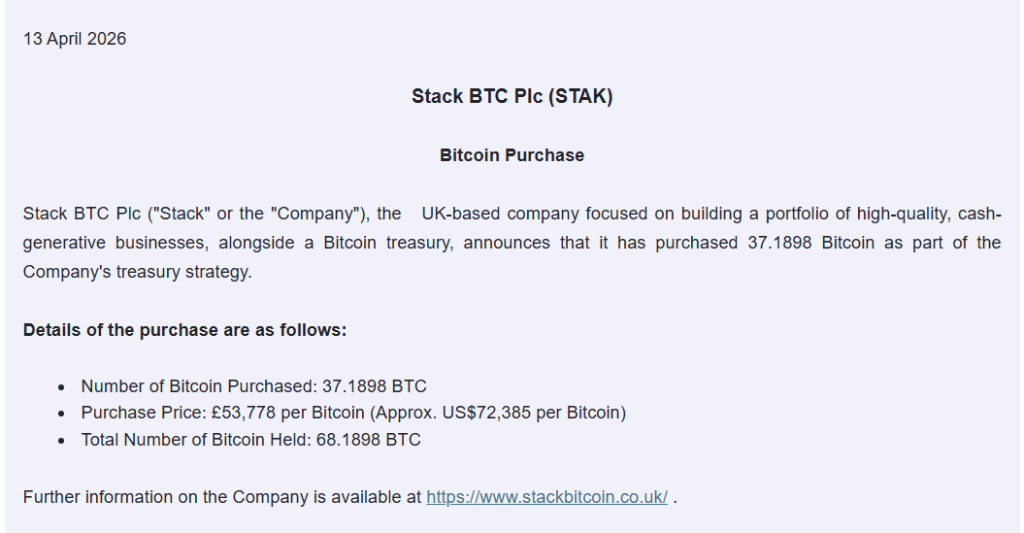
Source: Investegate

Reform UK Pulled In $18M In Crypto Donations Last Year

The announcement lands at an awkward moment for Farage politically. Over the past year, Reform UK collected around $18 million in crypto-linked donations — more than either the ruling Labour Party or the Conservatives.

BTCUSD trading at $71,961 on the 24-hour chart: TradingView

That figure drew scrutiny from regulators and transparency groups. The UK government responded by pushing forward plans to temporarily prohibit crypto donations to political parties. UK lawmakers have since called for a moratorium on such contributions.

The proposed ban would cut off one of Reform UK’s most productive funding streams. Farage has not publicly addressed that conflict directly.

Bitcoin Backing Puts Farage Ahead Of His UK Political Rivals

Reports indicate that no other sitting British MP or party leader has taken a comparable financial position in Bitcoin. Stack BTC described Farage’s involvement as a landmark moment for Bitcoin in British politics.

Whether that framing holds depends partly on what happens next in Parliament, where the crypto donation restrictions are still working their way through.

Featured image from Protos, chart from TradingView

Trending Cryptos

Related Questions

QWho is the first sitting British MP and party leader to publicly back Bitcoin, and what company is he associated with?

ANigel Farage, leader of Reform UK, is the first sitting British MP and party leader to publicly back Bitcoin. He is associated with the company Stack BTC, where he holds a minority stake.

QHow much Bitcoin did Stack BTC purchase, and what was the total value and per-coin price of this purchase?

AStack BTC purchased 37 Bitcoin for approximately $2.7 million (£2 million), which worked out to a price of roughly $72,385 per coin.

QWhat is the primary business model of Stack BTC as described in the article?

AStack BTC markets itself as a way for UK investors to gain exposure to cryptocurrency through public markets. It is essentially a listed vehicle that holds Bitcoin so that ordinary shareholders do not have to hold it themselves.

QHow much in crypto-linked donations did Reform UK collect last year, and what was the political response to this?

AReform UK collected around $18 million in crypto-linked donations last year. This drew scrutiny from regulators, leading the UK government to push forward plans to temporarily prohibit such donations to political parties.

QWhat significant financial interest did Nigel Farage have in Stack BTC prior to the recent Bitcoin purchase announcement?

APrior to the announcement, Nigel Farage disclosed a $286,000 equity stake in Stack BTC, giving him a 6.31% minority holding in the company.

Related Reads

South Korean Stock Market Sees Sharp Rebound After Forceful De-leveraging, SK Hynix Rises 30%

On July 31, South Korean stocks staged a historic rebound. The benchmark KOSPI index surged 18.27%, with chipmaker SK Hynix hitting a 30% gain limit. This followed a brutal, near-40% decline in the KOSPI over the previous month, driven largely by a deleveraging spiral involving leveraged ETFs. Analysts attributed the sharp sell-off to structural liquidity issues rather than deteriorating corporate fundamentals. The rally was triggered by a confluence of positive catalysts. Firstly, strong earnings from U.S. cloud giants Microsoft and Amazon alleviated fears of an "AI bubble burst," boosting global tech sentiment. Secondly, SK Group Chairman Chey Tae-won made a rare personal purchase of SK Hynix shares, seen as a strong vote of confidence. Thirdly, the South Korean government announced a 20 trillion won ($139 billion) AI investment fund. In response to the market turmoil, South Korean regulators are tightening controls on leveraged ETFs, admitting oversight shortcomings. Measures include raising minimum cash保证金 requirements for散户 investors and suspending new product launches. While the rebound signals eased liquidity pressure, analysts note deep structural issues remain. The market's future stability is seen as dependent on global tech capital expenditure trends and memory chip price cycles, with some viewing the surge as a technical correction rather than a definitive trend reversal.

marsbit15m ago

South Korean Stock Market Sees Sharp Rebound After Forceful De-leveraging, SK Hynix Rises 30%

marsbit15m ago

Cryptocurrency Company Wintermute Makes Pessimistic Statements Regarding Expected Altcoin Growth! Here are the Details

Crypto market maker Wintermute has made a pessimistic assessment regarding the anticipated altcoin season, suggesting that any upcoming rally may benefit only a limited number of projects. The company reports a record 72% of its spot OTC trading volume in H1 2026 came from institutional clients, whose capital is becoming more selective and concentrated. Data shows institutional traders act quickly on price spikes, while retail interest lasts longer. This selective behavior indicates the classic altcoin season, where hundreds of tokens rise simultaneously, may be changing. Wintermute believes only projects with strong use cases, high liquidity, and institutional appeal will stand out. Supporting this view, CryptoQuant data shows altcoin trading volume against Bitcoin is near its lowest since 2021, with the top 10 altcoins (excluding stablecoins) holding about 80.5% of the total altcoin market cap. Similarly, Kaiko reports that the top 10 altcoins now account for 63% of total altcoin trading volume, up from ~50% a few months ago, indicating capital concentration. Analysts suggest that in the current cautious institutional climate, projects with advanced technology, liquidity, and robust ecosystems will attract disproportionate attention. Therefore, any potential new altcoin season may be less broad than past bull markets, with gains concentrated in a narrower set of promising tokens.

cryptonews.ru16m ago

Cryptocurrency Company Wintermute Makes Pessimistic Statements Regarding Expected Altcoin Growth! Here are the Details

cryptonews.ru16m ago

UNI Activates Fee Switch: Uniswap Completes Commercial Debut, Faces First Test in September

Uniswap's Fee Switch activation on V4 has driven a surge in protocol revenue, with daily income jumping from $118,000 to $318,000. The newly launched Robinhood Chain has become the primary contributor, accounting for over 52% of total revenue, largely fueled by meme coin trading. This revenue fuels a new tokenomic "flywheel": fees accumulate in a pool, incentivizing arbitrageurs to buy and burn UNI tokens, creating deflationary pressure and boosting the token's price. However, concerns loom beneath the surface. Uniswap's revenue is now highly concentrated and dependent on the speculative, volatile activity on Robinhood Chain, which is currently subsidized by free gas fees. This subsidy is set to expire in late September, posing a significant test for sustained transaction volume and, consequently, protocol revenue. Furthermore, UNI's high valuation faces pressure if growth expectations aren't met. Debate also centers on the Fee Switch's impact. While Uniswap founder Hayden Adams clarified that the protocol fee is an "add-on" for traders and does not cut into Liquidity Providers' (LPs) existing share, questions remain about whether higher overall trading costs could indirectly reduce volume and LP earnings over time. Despite these challenges, Uniswap's Fee Switch marks a major step in protocol monetization, with its long-term success hinging on cultivating more sustainable usage beyond speculative trading.

marsbit24m ago

UNI Activates Fee Switch: Uniswap Completes Commercial Debut, Faces First Test in September

marsbit24m ago

Trading

Spot

Hot Articles

What is $BITCOIN

DIGITAL GOLD ($BITCOIN): A Comprehensive Analysis Introduction to DIGITAL GOLD ($BITCOIN) DIGITAL GOLD ($BITCOIN) is a blockchain-based project operating on the Solana network, which aims to combine the characteristics of traditional precious metals with the innovation of decentralized technologies. While it shares a name with Bitcoin, often referred to as “digital gold” due to its perception as a store of value, DIGITAL GOLD is a separate token designed to create a unique ecosystem within the Web3 landscape. Its goal is to position itself as a viable alternative digital asset, although specifics regarding its applications and functionalities are still developing. What is DIGITAL GOLD ($BITCOIN)? DIGITAL GOLD ($BITCOIN) is a cryptocurrency token explicitly designed for use on the Solana blockchain. In contrast to Bitcoin, which provides a widely recognized value storage role, this token appears to focus on broader applications and characteristics. Notable aspects include: Blockchain Infrastructure: The token is built on the Solana blockchain, known for its capacity to handle high-speed and low-cost transactions. Supply Dynamics: DIGITAL GOLD has a maximum supply capped at 100 quadrillion tokens (100P $BITCOIN), although details regarding its circulating supply are currently undisclosed. Utility: While precise functionalities are not explicitly outlined, there are indications that the token could be utilized for various applications, potentially involving decentralized applications (dApps) or asset tokenization strategies. Who is the Creator of DIGITAL GOLD ($BITCOIN)? At present, the identity of the creators and development team behind DIGITAL GOLD ($BITCOIN) remains unknown. This situation is typical among many innovative projects within the blockchain space, particularly those aligning with decentralized finance and meme coin phenomena. While such anonymity may foster a community-driven culture, it intensifies concerns about governance and accountability. Who are the Investors of DIGITAL GOLD ($BITCOIN)? The available information indicates that DIGITAL GOLD ($BITCOIN) does not have any known institutional backers or prominent venture capital investments. The project seems to operate on a peer-to-peer model focused on community support and adoption rather than traditional funding routes. Its activity and liquidity are primarily situated on decentralized exchanges (DEXs), such as PumpSwap, rather than established centralized trading platforms, further highlighting its grassroots approach. How DIGITAL GOLD ($BITCOIN) Works The operational mechanics of DIGITAL GOLD ($BITCOIN) can be elaborated on based on its blockchain design and network attributes: Consensus Mechanism: By leveraging Solana’s unique proof-of-history (PoH) combined with a proof-of-stake (PoS) model, the project ensures efficient transaction validation contributing to the network's high performance. Tokenomics: While specific deflationary mechanisms have not been extensively detailed, the vast maximum token supply implies that it may cater to microtransactions or niche use cases that are still to be defined. Interoperability: There exists the potential for integration with Solana’s broader ecosystem, including various decentralized finance (DeFi) platforms. However, the details regarding specific integrations remain unspecified. Timeline of Key Events Here is a timeline that highlights significant milestones concerning DIGITAL GOLD ($BITCOIN): 2023: The initial deployment of the token occurs on the Solana blockchain, marked by its contract address. 2024: DIGITAL GOLD gains visibility as it becomes available for trading on decentralized exchanges like PumpSwap, allowing users to trade it against SOL. 2025: The project witnesses sporadic trading activity and potential interest in community-led engagements, although no noteworthy partnerships or technical advancements have been documented as of yet. Critical Analysis Strengths Scalability: The underlying Solana infrastructure supports high transaction volumes, which could enhance the utility of $BITCOIN in various transaction scenarios. Accessibility: The potential low trading price per token could attract retail investors, facilitating wider participation due to fractional ownership opportunities. Risks Lack of Transparency: The absence of publicly known backers, developers, or an audit process may yield skepticism regarding the project's sustainability and trustworthiness. Market Volatility: The trading activity is heavily reliant on speculative behavior, which can result in significant price volatility and uncertainty for investors. Conclusion DIGITAL GOLD ($BITCOIN) emerges as an intriguing yet ambiguous project within the rapidly evolving Solana ecosystem. While it attempts to leverage the “digital gold” narrative, its departure from Bitcoin's established role as a store of value underscores the need for a clearer differentiation of its intended utility and governance structure. Future acceptance and adoption will likely depend on addressing the current opacity and defining its operational and economic strategies more explicitly. Note: This report encompasses synthesised information available as of October 2023, and developments may have transpired beyond the research period.

1.2k Total ViewsPublished 2025.05.13Updated 2025.05.13

What is $BITCOIN

Discussions

Welcome to the HTX Community. Here, you can stay informed about the latest platform developments and gain access to professional market insights. Users' opinions on the price of BTC (BTC) are presented below.

活动图片