ETH难道真的是在“换庄”?

投研日志Published on 2025-03-18Last updated on 2026-07-05

Abstract

确实有个别大资金正在积累筹码,使得ETH筹码集中度慢慢上升。

作者:推特大V Murphy

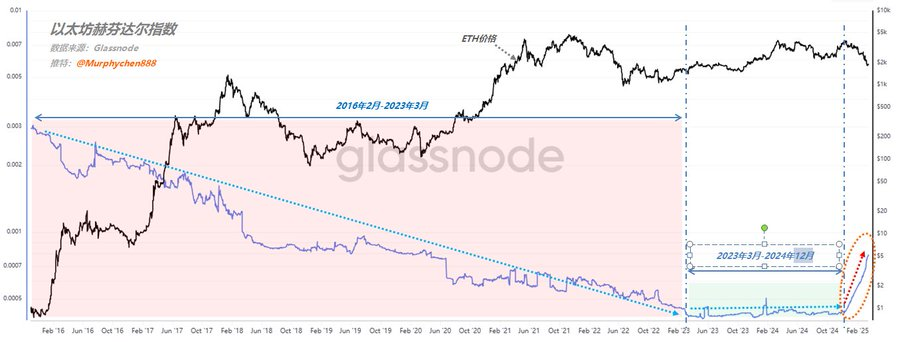
以太坊赫芬达尔指数,用来衡量网络地址在当前供应量中所占的份额,即筹码集中度。指数高表示少数的大持有者正在主导市场,指数低则表示筹码分布更均匀。

在代币刚发行时,早期持有者往往集中了大量的供应,从而导致较高的赫芬达尔指数。随着这些早期持有者的抛售,指数开始下降,反映了代币分布从集中慢慢变得分散。
(图1)

图1就是ETH赫芬达尔指数;可以看到这个指数从2016年2月-2023年3月一直处于持续下降状态,说明在这段周期中ETH的筹码集中度越来越分散。到了2023年3月以后指标开始最走平,说明分散度见底。从2023年3月-2024年12月这段时间始终保持这样的分散程度。

但是,从24年12月后,筹码集中度突然开始上升了,这是从2016年以来从未发生过的事情。那会不会是因为现货ETF的余额增加,导致了赫芬达尔指数上升呢?
(图2)

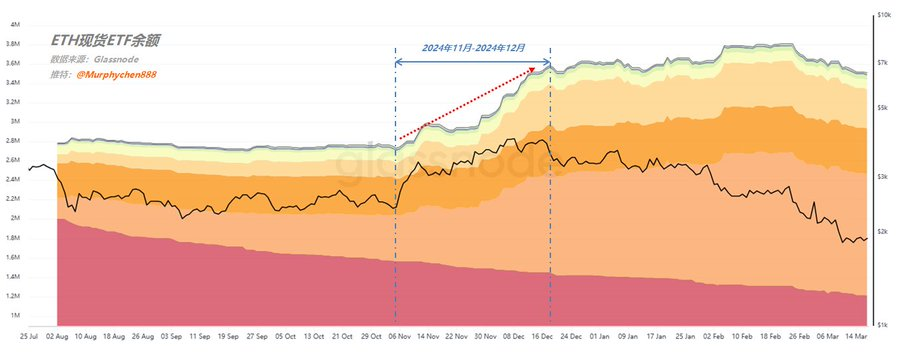
图2是ETH现货ETF余额数据。可以看到现货ETF余额增长最快的时候是在2024年11月-2024年12月,期间从273w枚ETH增长到358w枚。12月以后增长速度明显放缓,基本保持平稳。而ETH赫芬达尔指数是在12月以后开始上升的,因此并不是现货ETF余额变化所导致。

说明确实有个别大资金正在积累筹码,使得ETH筹码集中度慢慢上升。

例如,我在3月15日的这篇推文(见引文)中所提到的,在$3,500建仓的大额地址群体,随时ETH跌至$1,900的过程中不断的补仓,从原先的166w枚ETH增加到194w枚;另外,当价格触及一群大户在2年前的建仓成本$1,850时,他们开始将之前高位卖出的部分又买回来平摊成本。从160w枚ETH增加到212w枚;

无论这些鲸鱼们是被动自救式买入还是主动低位加仓,都会让筹码集中度慢慢变高。所以,ETH难道真的是在“换庄”?

但这是一个非常缓慢的过程,因为在此期间也会有其他鲸鱼的筹码继续卖出从而降低集中度。筹码集中度变高有利有弊,有利的一面是当高到一定程度时,价格更容易被控制(容易拉升);不利的一面是在大资本收集筹码的过程中,市场或许会比较痛苦和煎熬。

当初筹码分散(派发)用了7年时间,而现在筹码集中(积累)又需要几年呢......

Trending Cryptos

Related Reads

The Impact of OUSD on Circle, Tether, and Paxos: Not a Simple Negative, but a More Complex Competitive Landscape

OUSD's Impact on Circle, Tether, and Paxos: A Nuanced Competitive Reshuffle The launch of OUSD, a new stablecoin initiative, has complex implications for the stablecoin market. For Circle (CRCL), the initial 15-20% stock drop reflects legitimate competitive concerns but is not a "death sentence." Circle retains deep liquidity, existing integrations, and first-mover advantages. A potential restructuring or termination of its Coinbase partnership could even double its net revenue in the short term, providing more competitive freedom. However, OUSD, backed by Stripe's engineering and product strengths, could become the default stablecoin within the Stripe ecosystem for new adopters, challenging USDC's position. OUSD does not solve the core barrier for corporate adoption: it remains a credit exposure to its issuer (likely a Bridge-related entity), which, like Circle, is not an investment-grade entity. Large banks and asset managers could still capture the most lucrative enterprise use cases. Circle must accelerate its payment/fintech product development and consider defensive M&A. For Tether, OUSD targets a different market segment. Tether will continue focusing on distribution channels not prioritized by Stripe or Circle. Its market share may decline over time, but within a significantly growing total market. Paxos faces the greatest pressure. OUSD undermines the key selling points of its USDG stablecoin, and Paxos's regulatory advantages may diminish as frameworks mature. This poses a more existential challenge, explaining Paxos's recent shift back to its brokerage-as-a-service business.

marsbit1h ago

The Impact of OUSD on Circle, Tether, and Paxos: Not a Simple Negative, but a More Complex Competitive Landscape

marsbit1h ago

OUSD's Impact on Circle, Tether, and Paxos: Not a Simple Negative, but a More Complex Competitive Reshuffle

This article analyzes the impact of the newly announced stablecoin OUSD, backed by a consortium including Stripe, on major incumbents like Circle (USDC), Tether (USDT), and Paxos (USDG). For Circle, the announcement is not a simple negative. While the initial market reaction was rational, it's not a "death sentence." Circle retains deep liquidity, existing integrations, and first-mover advantage. A potential restructuring or termination of its exclusive revenue-sharing deal with Coinbase could even near-double its net income in the short term, providing more competitive flexibility. However, within the Stripe ecosystem, OUSD, with its strong engineering and product focus, could become the default choice, displacing USDC for new integrations. Circle must accelerate its own fintech product development and consider defensive M&A. OUSD does not directly threaten Tether's core markets, which focus on different distribution channels. Tether's market share may decline over time but within a significantly growing overall market. Paxos faces the greatest pressure. OUSD undermines the primary value proposition of its USDG stablecoin, and Paxos's regulatory advantages may erode as frameworks mature, posing a more existential challenge. This explains Paxos's recent strategic pivot towards brokerage-as-a-service. A fundamental unresolved issue for enterprise adoption remains: if issued by a Bridge-related entity, OUSD, like USDC, still represents a credit exposure to a non-investment-grade issuer, unless a parent company guarantee is provided. Large banks and asset managers entering the space later could still compete for the most lucrative enterprise use cases.

链捕手1h ago

OUSD's Impact on Circle, Tether, and Paxos: Not a Simple Negative, but a More Complex Competitive Reshuffle

链捕手1h ago

Trading

Spot

Hot Articles

Discussions

Welcome to the HTX Community. Here, you can stay informed about the latest platform developments and gain access to professional market insights. Users' opinions on the price of ETH (ETH) are presented below.

活动图片