Ripple Vs. SEC Lawsuit: XRP Price Balks At The Latest Developments

BitcoinistPublished on 2025-02-07Last updated on 2025-02-08

Abstract

The Ripple vs. SEC lawsuit has taken an interesting turn. A recent development suggests that this long-running legal battle might...

The Ripple vs. SEC lawsuit has taken an interesting turn. A recent development suggests that this long-running legal battle might end soon. Surprisingly, the XRP price has failed to react positively to this development and has, instead, crashed significantly. 
XRP Price Fails To Respond Positively To Recent Ripple Vs. SEC Development


CoinMarketCap data shows that the XRP price crashed over 6% and 24% in the last 24 hours and seven days, respectively. This price crash occurred despite positive developments in the Ripple vs. SEC lawsuit, including the US SEC’s decision to reassign its Chief Litigation Council, Jorge Tenreiro, to the agency’s IT department. 


This development is positive for the Ripple vs. SEC lawsuit as Tenreiro led the agency’s crypto unit and oversaw the lawsuits against Ripple and other crypto lawsuits. Following this move and the reassignment of over 50 SEC lawyers, crypto experts like Del Crypto have speculated that the Commission could soon make an announcement, which would mark the end of the lawsuit. 


As Bitcoinist reported, the US SEC is also scaling back its crypto enforcement efforts by downsizing the special unit designated for this purpose. Indeed, this suggests that the Commission is ready to drop the Ripple lawsuit and other crypto-related actions that the new administration feels were wrongly pursued by Gary Gensler’s administration. 


These developments are bullish for the XRP price, considering how it has been greatly impacted by the long-running Ripple vs. SEC lawsuit. Still, the crypto has failed to rally in response to these positive developments, which is undoubtedly concerning. 

However, a plausible explanation for the XRP price crash amid these positive Ripple vs. SEC lawsuit developments is the bearish sentiment in the broader crypto market. The Bitcoin price is currently failing to hold critical support levels, which explains why XRP and other altcoins have crashed.


Meanwhile, the XRP price may have priced into a potential end to the Ripple vs. SEC lawsuit since Donald Trump won the election. Since Trump’s victory, there have been speculations that the Commission would drop its appeal against Ripple, especially given the president’s pro-crypto stance and his nomination of Paul Atkins for the SEC Chair role. 

XRP Still Has Room To Run In This Bull Run


Despite the XRP price crash and its failure to react positively to the developments in the Ripple vs. SEC lawsuit, crypto analysts have suggested that XRP still has more room to run to the upside in this bull run. One of these analysts is Dark Defender, who predicted that the crypto could rally to $8 soon enough. 


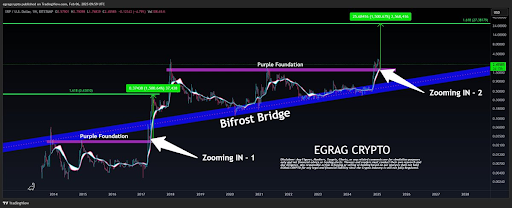
Crypto analyst Egrag Crypto also recently revealed that the XRP price is mirroring a 2017 pattern. Based on the similarities, the analyst stated that XRP could surge by 1,500% and rally to as high as $27 in the coming weeks. 
Ripple

XRP trending similar to 2017 bull cycle | Source: Egrag Crypto on X

At the time of writing, the XRP price is trading at around $2.29, down almost 7% in the last 24 hours, according to data from CoinMarketCap.

Ripple

XRP trading at $2.3 on the 1D chart | Source: XRPUSDT on Tradingview.com Featured image from Medium, chart from Tradingview.com

Trending Cryptos

Related Reads

Buyback and Burn: Just Empty Promises? The Unbridgeable Rights Gap Between Tokens and Equity

"Token Repurchase and Burn: An Empty Promise? The Unbridgeable Rights Gap Between Tokens and Equity" Holding company stock grants shareholders residual claim rights - a legally enforceable entitlement to remaining assets after all other obligations are paid. This comes with rights like voting, dividends, and a share in sale proceeds. Crypto protocols have long promised token holders similar benefits: governance participation and a share of future growth. However, this narrative is fundamentally flawed and built on voluntary promises, not enforceable legal rights. The core difference is that token holders lack any legally enforceable claim to a protocol's underlying value or revenues. Common mechanisms like using protocol revenue to buy back and burn tokens are purely discretionary; the team can alter or stop the policy at any time. Token holders have no legal recourse. This rights gap becomes critically apparent when protocols introduce traditional equity alongside tokens, as seen with Venice AI's $65M funding round. Equity investors hold legal contracts with rights to company assets and profits, while token holders' benefits depend entirely on the continued goodwill of the protocol's management. The acquisition of Houdini Swap, where equity holders were paid while token holders received nothing, starkly illustrates this disparity. Upcoming legislation like the CLARITY Act threatens to eliminate the regulatory gray area that has allowed this ambiguous "pseudo-equity" narrative. The Act would classify tokens as either digital commodities (regulated by CFTC) or investment contract assets/securities (regulated by SEC). Protocols aiming for the "digital commodity" classification would be explicitly prohibited from granting token holders any legal claim to corporate revenue, profits, or assets. Promising that tokens will appreciate from protocol profits would likely classify them as securities. Projects like Aave are attempting technical solutions, such as its automated, on-chain "Aavenomics 3.0" buyback mechanism. However, this remains code that the governance body could still vote to change, not an immutable legal contract. The industry faces a clear fork: either acknowledge tokens as digital commodities and stop promising economic rights tied to corporate profits, or formally register tokens as securities and bear the associated compliance burden. The decade-long narrative equating tokens with ownership is built on unenforceable promises. The entry of traditional equity investors with real legal rights exposes this foundational weakness, which may unravel with the next major funding deal.

Foresight News2h ago

Buyback and Burn: Just Empty Promises? The Unbridgeable Rights Gap Between Tokens and Equity

Foresight News2h ago

Trading

Spot

Hot Articles

What is XRP 2.0

XRP 2.0: A New Frontier in the Cryptocurrency Landscape Introduction to XRP 2.0 In the ever-evolving realm of cryptocurrency, new projects continuously emerge, vying for attention and adoption. One such promising initiative is XRP 2.0, a novel cryptocurrency project designed to leverage advanced blockchain technology and robust encryption methodologies. While the name draws parallels with Ripple’s XRP, it’s crucial to note that XRP 2.0 operates independently, focusing on enhancing transaction security, privacy, and scalability. As the digital financial landscape increasingly embraces decentralized solutions, XRP 2.0 aims to contribute meaningfully to web3 and the overall expansion of crypto projects. What is XRP 2.0? At its core, XRP 2.0 is a cryptocurrency project that aims to create a secure and decentralized digital currency ecosystem. Its foundational technology integrates sophisticated blockchain principles with cutting-edge encryption techniques. The overarching goal of XRP 2.0 is to establish itself as a reliable and efficient platform enabling swift transaction execution while prioritizing enhanced privacy protections for its users. The project is promoted as a solution to many limitations faced by existing cryptocurrencies, proposing a system that can handle a higher volume of transactions with improved speed and privacy. This versatility positions XRP 2.0 as a significant contender in a marketplace riddled with various digital currencies. Who is the Creator of XRP 2.0? The identity of the creator behind XRP 2.0 has been flagged as ‘Wilbur.’ However, comprehensive details regarding Wilbur or their associated entity remain elusive. The anonymity of many cryptocurrency creators is not an uncommon phenomenon in the industry, often designed to maintain a degree of privacy and security. Who are the Investors of XRP 2.0? As of now, specific information related to the investment foundations or organizations supporting XRP 2.0 is not publicly available. In the cryptocurrency sector, the backing by reputed investors can significantly influence a project's credibility and success, yet the transparency regarding the financial supporters of XRP 2.0 has not been established. How Does XRP 2.0 Work? XRP 2.0 stands out by employing a combination of blockchain technology and advanced encryption algorithms that ensures secure and decentralized transactions. Its innovative structure includes unique features designed to foster user engagement and broaden functionalities beyond conventional cryptocurrency transactions. Among these features, XRP 2.0 incorporates AI-powered capabilities, such as text-to-image and text-to-speech functionalities. These additions are designed to enhance the interactive experience for users, promoting broader applicability across various sectors. By bridging technological advancements with user-centered design, XRP 2.0 aims to capture the attention of a diverse range of individuals and enterprises looking to integrate cryptocurrency solutions into their operational frameworks. Timeline of XRP 2.0 Understanding XRP 2.0 requires examining the milestones that have defined its journey thus far: July 23, 2023: XRP 2.0 is introduced as a novel cryptocurrency project, aiming to revolutionize secure and decentralized transaction capabilities in the blockchain domain. September 8, 2023: The launching of another project, XRP20, occurs, marking the emergence of an ERC-20 token on the Ethereum blockchain that remains unrelated to XRP 2.0. November 13, 2023: The XRP Ledger undergoes a significant update with the release of rippled server software version 2.0.0. It is essential to note that this development is disconnected from the XRP 2.0 cryptocurrency project. Key Points About XRP 2.0 To distill the essence of XRP 2.0, several critical factors emerge: Unique Features: The inclusion of features like AI-powered text-to-image and text-to-speech further diversifies the potential applications of XRP 2.0. Blockchain Technology: The framework utilizes advanced blockchain mechanisms and encryption protocols, ensuring a secure and decentralized environment for transactions. Scalability and Privacy: XRP 2.0 prioritizes enhanced privacy protections in transaction processes and the scalability necessary to accommodate a growing user base. No Affiliation with Ripple: Importantly, despite its name, XRP 2.0 does not have any allegiance or collaboration with Ripple’s XRP, distinguishing its operational framework and objectives within the cryptocurrency ecosystem. Conclusion XRP 2.0 represents an ambitious venture into the cryptocurrency sphere, aiming to offer a combination of security, privacy, and efficiency in digital transactions. By integrating sophisticated technologies and user-friendly features, the project sets out to broaden the horizons of what cryptocurrency can achieve in today's digital economy. While the anonymity of its creator and lack of disclosed investors might raise questions for some, XRP 2.0's focus on advanced functionalities and decentralisation enhances its appeal amidst an increasingly crowded crypto market. As the cryptocurrency landscape continues to evolve, XRP 2.0 may yet emerge as a pivotal player in the expansion of secure and scalable blockchain solutions.

1.1k Total ViewsPublished 2024.04.01Updated 2024.12.03

What is XRP 2.0

Discussions

Welcome to the HTX Community. Here, you can stay informed about the latest platform developments and gain access to professional market insights. Users' opinions on the price of XRP (XRP) are presented below.

活动图片