浅谈EVM兼容性:为什么非EVM公链都在拥抱EVM

链捕手Published on 2022-02-26Last updated on 2022-02-27

Abstract

几乎所有大型开发商都在集成EVM这一事实表明该堆栈是当今的必备品。

以太坊在第一波“以太坊杀手”中幸存下来,随后运行以太坊虚拟机(EVM)的低成本链(Polygon、BSC、Fantom)大受欢迎。而现在,在推出有限的成功之后,这些相同的以太坊杀手正在整合 EVM 并竞相进入多链世界。
具体来说,Polkadot 已经添加了 Moonbeam、Near 推出 Aurora,并且很快(已宣布但尚未发布),Evmos 将在 Cosmos 上线和 Neon 将在 Solana 上线。 
当这些链首次推出时(不兼容 EVM),它们声称拥有卓越的设计,具有流行的编程语言支持和速度等特性。随着这些链开始支持 EVM,现在他们似乎不那么看好自己技术的优势,而是意识到需要支持以太坊的。通过这样做,这些链正在回溯其最初的愿景,以构建以太坊的替代技术堆栈。
在这里,我们将看看不同的架构,以及围绕跨区块链的 EVM 的新兴标准将如何创造更多的可组合性。此外,我们看到由此产生的特定于链的生态系统成为产品实验的温床。 

建设阶段

将 EVM 视为一台计算机,它在给定特定输入的情况下计算智能合约的操作输出结果。EVM 的副本在每个节点上运行——必须记住它并不位于一个地方。EVM 也称为“runtime”或“环境”。
除了runtime,还有一些围绕 EVM 构建的重要工具,它们在下面以红色突出显示。
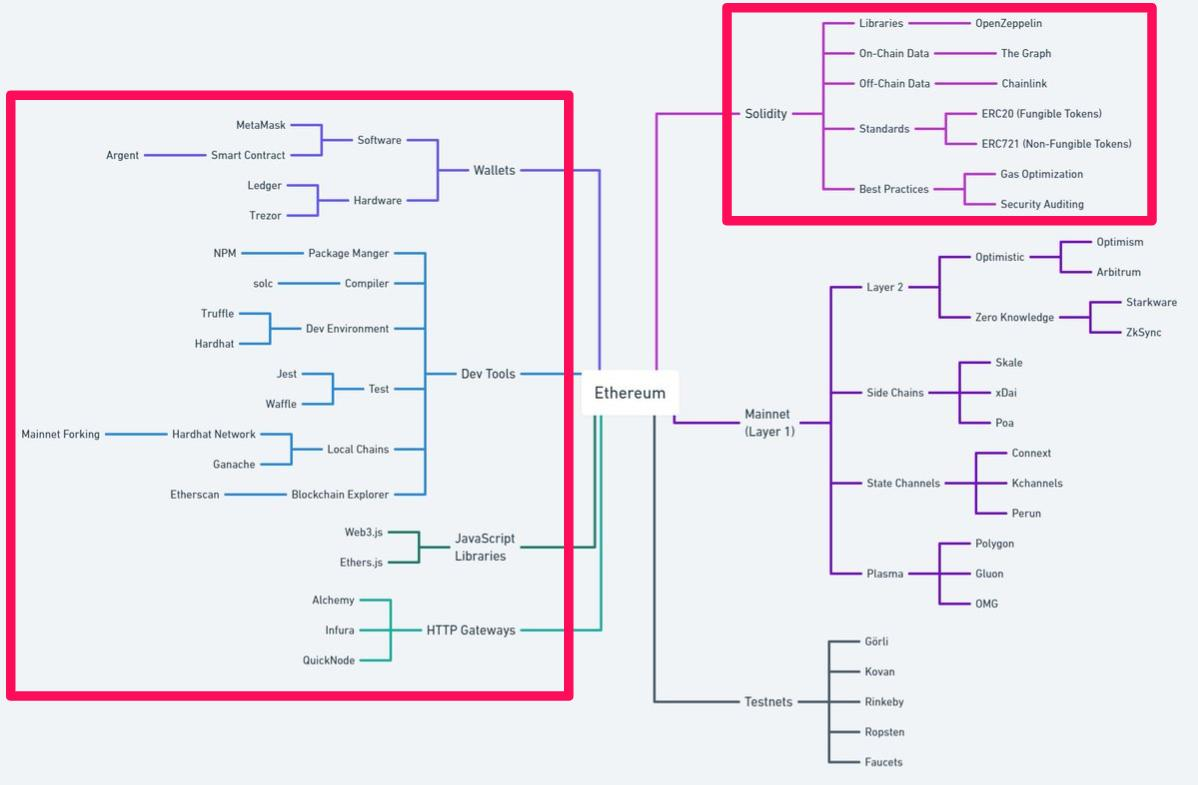
EVM 接收用 Solidity 语言编写的程序,为了使该语言更强大,创建了许多“库”。Truffle 或 Hardhat 等开发人员工具使智能合约的编写和测试变得更加容易。此外,因为我们谈论的是网络环境,外部钱包通过 API 库(例如 Web3.js)连接到 EVM。 
在普通用户更熟悉的这些工具中,有强大的区块链浏览器 Etherscan。它知道如何查看数以千计的交易并以人类可读的方式呈现它们。此外,还有 MetaMask 钱包,它通过网络广播用户的命令将用户连接到 EVM。
数百名高技能开发人员花费了数千小时来构建这些工具和基础设施。在某些情况下,使用成熟工具和未完善工具创建 dApp 所需的时间差异可能是 100:1。这就是为什么专有堆栈区块链构建的工具和基础设施按照行业标准进展非常缓慢。 
除了卓越的技术外,EVM 生态系统还拥有庞大的区块链开发者和开源项目市场。这些项目可以快速复制,不需要耗时的代码重写。

模型比较

专有的堆栈链在 EVM 的集成中使用了不同的方法。
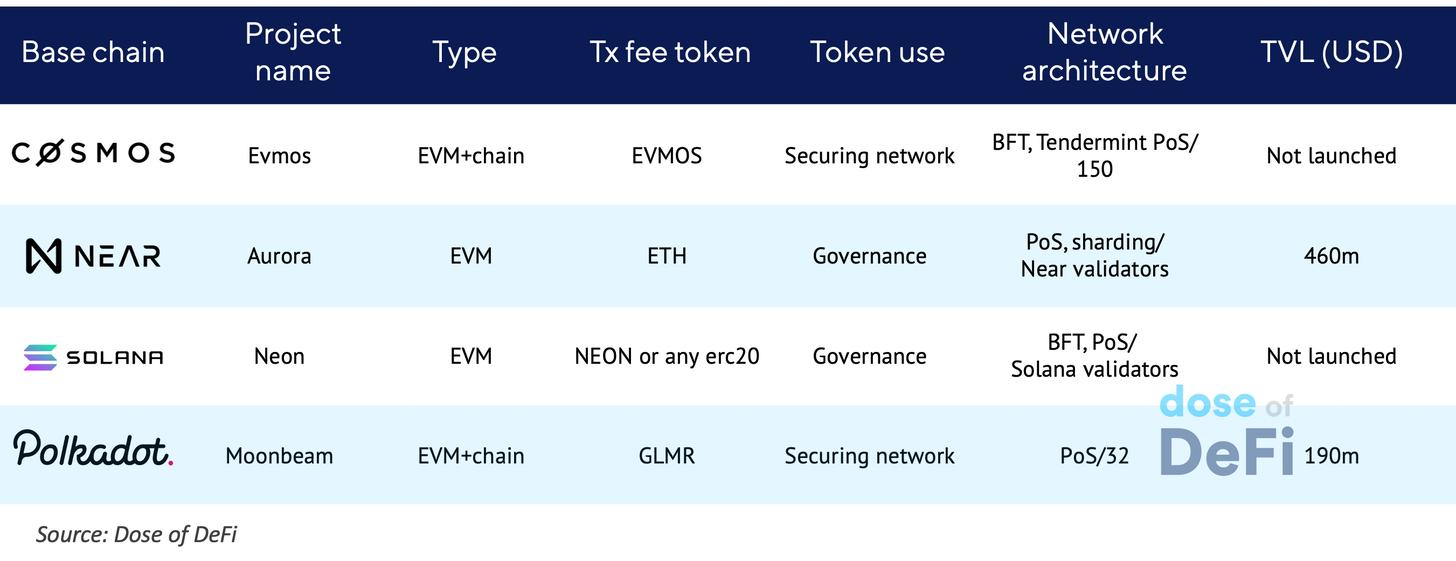
Solana 和 Near 使用单链,因此在这些情况下,EVM 将与区块链的主要“智能合约计算机”一起运行。这也可以在 Near 的 Aurora EVM 设计中看到。
引用一位Aurora 开发人员的话: 
“我们重写了所有 EVM 逻辑并将其编译为 WASM 字节码,因此它在 Near 运行时的 WASM 片段中执行。现在它是一个近乎原生的合约,EVM 合约没有什么特别之处。仅仅将 EVM 添加到 Near 内核中就会引入很多复杂性”。
所以需要注意的是,Aurora 不是链,而是 Near 上的 EVM 环境(尽管它有自己的区块浏览器)。这就是为什么 Near-Aurora 桥不是链之间的桥,而是runtime之间的桥。这种技术设计会影响业务战略:Aurora 没有验证器,它的代币不能保护网络。 因此,在评估使用类似设计的 Aurora 或 Neon 时,必须使用不同的模型,而 Evmos 或 Moonbeam 则拥有自己的原生费用代币。
有趣的是,EVM + Near 的PoS共识和数据可用性分片使得整体架构类似于 ETH 2.0 的愿景。Neon 的优势在于 Solana 的速度:Neon EVM 声称每秒可处理 4,500 笔交易,并支持不到一秒的确认时间。总的来说,这种将 EVM 与不同类型架构相结合的实验推动了行业的创新。以太坊现在太大了,无法灵活地改变,因此 EVM 市场的出现创造了一个快速行动和打破事物的机会,而无需以太坊主网的成本和风险。 
分别支持 Moonbeam 和 Evmos 的 Polkadot 和 Cosmos 是多链设计的区块链。他们没有选择将 EVM 与主计算机并排添加,而是专门为其创建了一个子链。这意味着如果需要可扩展性,更多 EVM 实例可以作为 Cosmos/Polkadot 上的新子链(以及 Near 上的新分片)启动,为可扩展性铺平道路。另一方面,Solana 的模型似乎缺乏这种可扩展性。
EVM 集成之间的设计还有其他较小的差异。Aurora 使用 ETH 支付交易费用,这(可能间接地)帮助他们获得了以太坊生态系统的支持。Evmos 将根据其 dApp 的活跃度奖励开发者,通过内置的共享费用收入模式在开发者和网络运营商之间分享部分费用。

区块链 EVM 未来 

从底层链的角度来看,使用 EVM 有各种优点和缺点。他们需要考虑的主要问题如下。
优点:

  • 这些 EVM 还将底层区块链的代币连接到更广泛的 EVM 生态系统。例如,Polkadot 的代币 DOT 通过官方跨链桥连接到 Moonriver,然后通过广泛可用的 EVM 跨链桥(如 Synapse、Allbridge 等)进一步传播。查看下图,它突出显示了在基于 EVM 的 Moonriver 上使用 DOT 进行的挖矿。一般来说,构建 EVM-EVM 桥比 EVM 不同共识桥更容易。

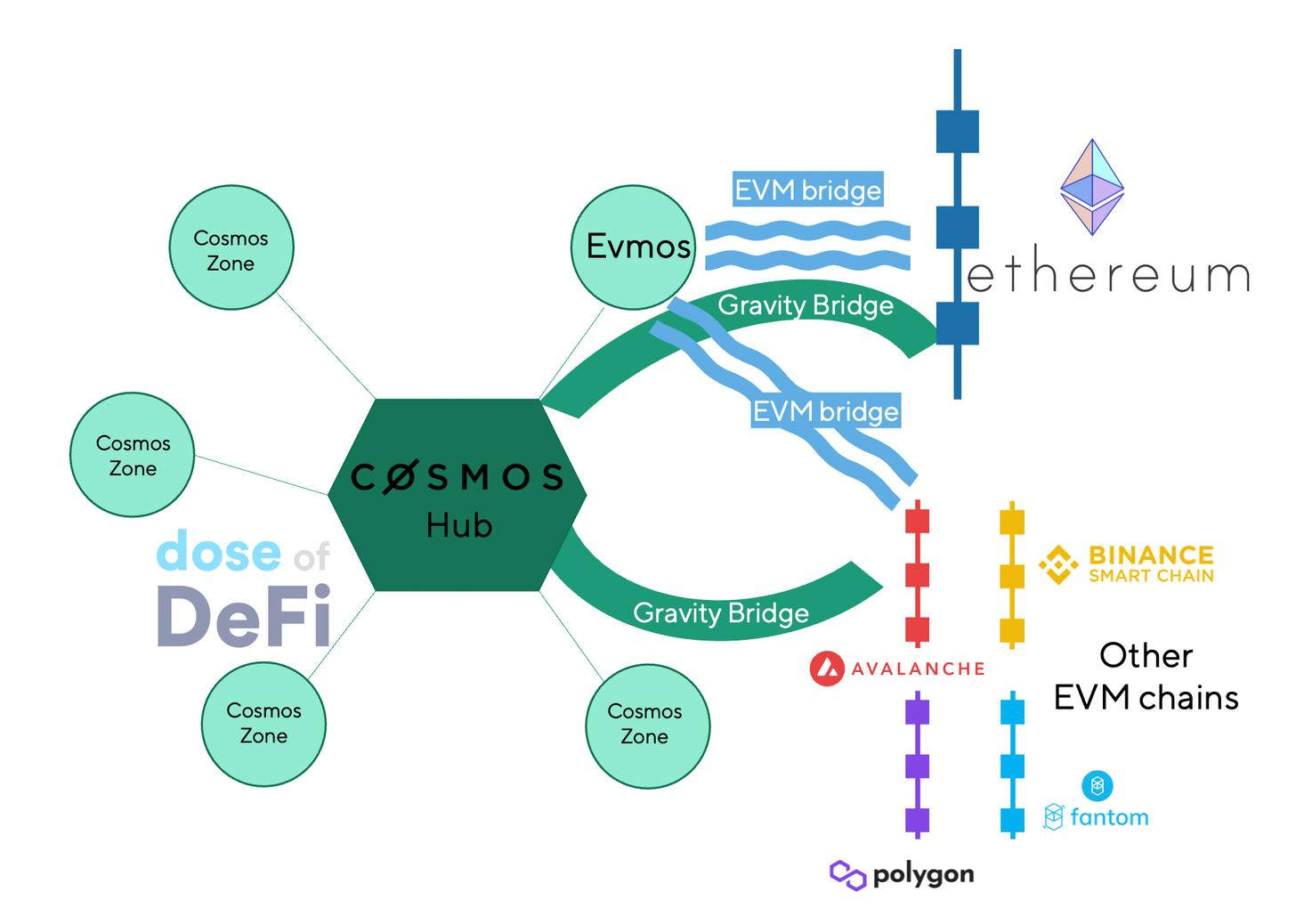
  • EVM 环境可以成为资产从 EVM 链到这些底层链的入口点。用户将选择对他们来说最方便和最安全的桥。下图展示了 Cosmos Hub 和 Evmos 与 EVM 链交互的示例。
  • EVM 环境可以成为新用户的底层区块链的演示版本。通过使用熟悉的工具,他们将了解新的生态系统、技术、原生项目和资产。想象一下,在买家第一次习惯了普锐斯之后,丰田开始对其电动汽车产生兴趣。

缺点:

  • 该模型进一步加强了以太坊,对以太坊工具的更多需求意味着花费更多的资源来改进它们,而以牺牲底层链的专有堆栈为代价。
  • 早期的以太坊杀手最初通过流行的编程语言支持和独特的设计(如链的应用程序特异性)来区分自己。这个新方向使他们远离了最初的哲学。缺乏差异化是否会使用户和开发人员的区块链商品化?
  • EVM 的加入也带来了产品自相残杀的威胁。如果通过 EVM 和基础区块链实现都可以使用同一个应用程序,则后者必须为用户提供切实的优势,以放弃熟悉的体验。

总而言之,底层链在添加 EVM 兼容性方面的最大优势可能是为用户和资产提供了一个新的入口通道。但是有一个缺点。如果所有链都提供相同的用户体验,他们可以获取的品牌溢价就会变小。 

EVM 标准

EVM 市场的出现为协议架构师创造了推动创新的机会,例如分片(以太坊交付缓慢的东西)或特定于应用程序的链。 
一个被广泛接受的标准很可能会带来更多的可组合性,这将加强 DeFi 中的网络效应。2021 年独立区块链的快速增长已经足够快,但由于共同的 EVM 支持标准,更大的连接性可能会在未来几年引发更快的增长。
不管对行业有利与否,几乎所有大型开发商都在集成 EVM 这一事实表明该堆栈是当今的必备品,而且如果没有 EVM 兼容性,就很难竞争。

Trending Cryptos

Related Reads

Claude Doesn't Submit Code Directly After Writing It: Runs 4 Skills for Self-Check, Fixes Issues, Then Comes Back to You

Claude No Longer Submits Code Directly: 4 Self-Check Skills to Run Before Coming Back to You AI already writes code, but the burden of reviewing it still falls on you. To address this, Anthropic has built a "verification loop" into Claude Code. After writing code, Claude now runs four self-check skills before delivering the work: * `/code-review`: Finds potential bugs and provides review feedback. * `/simplify`: Cleans up the diff, removing redundant or over-complex implementations to reduce future maintenance costs. * `/verify`: Performs end-to-end validation, actually running the application to confirm the feature works, not just appears to. * `/design`: Used only for UI changes; cross-references the implementation against the project's DESIGN.md file. This loop extends the AI agent's workflow from "gather context → execute" to "gather context → execute → auto-verify → fix → re-verify." It tackles the new bottleneck in AI-assisted development: the speed of verifying code now outpaces human review. These skills are built on Claude Code's existing verification foundation (like running apps and using linters). Teams can create their own custom verification skills by documenting their repetitive manual checks in plain language as Markdown files. Verification can be triggered at four levels: manually (Standalone), embedded in a task, chained with other skills, or automatically on every PR (On every PR). The shift signifies that competition in AI programming is moving from code generation to robust verification and self-correction. Well-built verification loops allow AI agents to run longer and more autonomously with less human supervision. Skills, which encapsulate team knowledge and workflows, are becoming a cross-vendor standard, meaning a team's efficiency gap will depend less on the AI model and more on their investment in these automated workflows and verification mechanisms.

marsbit3m ago

Claude Doesn't Submit Code Directly After Writing It: Runs 4 Skills for Self-Check, Fixes Issues, Then Comes Back to You

marsbit3m ago

How Has Beijing Become a 'Global High Ground'?

How did Beijing become a "global highland"? In the first half of the year, Beijing's GDP grew by 5.4%, with growth in Q1 reaching 5.9%. Key drivers were not consumption or real estate, but hardcore sectors like chips, robotics, computing power, and large AI models. Investment concentrated sharply in tech, with high-tech manufacturing investment up 36% and technology services investment up 87.2%. Nearly 90% of venture capital flowed into hard tech. Output figures were strong: integrated circuit production rose 17.8%, industrial robots 75.5%, and service robots surged 230%. Companies like Qianxun AI and Galaxy General Robotics are deploying robots in real-world logistics and manufacturing, moving beyond demonstrations. The services sector is also being reshaped by tech, with software, IT, and finance growing faster than the sector average. Beijing leads in AI and embodied intelligence. Galaxy General Robotics secured significant funding, including from state-backed funds. The city released foundational AI models and its independent AI ecosystem, FlagOS, is expanding. Companies like Jiuzhang Yunjie provide neutral computing power and base models, supporting the broader ecosystem. Infrastructure is expanding, with Beijing aiming to add over 70,000 Petaflops of intelligent computing power annually. A "Beijing R&D, surrounding training" model is emerging, with computing resources being allocated to regions like Hebei and Tianjin. Efforts to deepen integration within the Beijing-Tianjin-Hebei region include industrial relocation and improved transport links. To bridge the gap between lab and market, Beijing is establishing pilot-scale production platforms. The underlying trend is the convergence of computing power, capital, talent, and real-world applications. While challenges remain in commercialization and regional integration, Beijing's focus on strengthening these interconnected elements is building the foundation for its claim as a global innovation hub.

marsbit4m ago

How Has Beijing Become a 'Global High Ground'?

marsbit4m ago

How Did the Target Price of 116 Yuan and a Market Cap of 7.9 Trillion for CXMT Come About?

Nomura's inaugural coverage report on ChangXin Memory Technologies (CXMT) gives a 'Buy' rating with a highly aggressive target price of 116 RMB, implying a 1239.5% upside from the IPO price of 8.66 RMB. The valuation is derived by applying a 20x P/E multiple to projected 2028 EPS of 5.79 RMB. The 20x multiple combines Micron's historical valuation with a premium for Chinese A-shares. The report's financial forecasts are exceptionally bullish. It projects revenue to soar from 62B RMB in 2025 to 773B RMB in 2028, with net profit surging to 393B RMB. A key, and arguably unsustainable, assumption is gross margin expanding to over 90% by 2028, driven almost entirely by price increases with minimal cost growth. This optimism is rooted in a forecast that global DRAM demand will grow over 7x from 2026 to 2030 (CAGR >60%), fueled by agentic AI. Nomura argues that supply growth (30-40% CAGR) will lag far behind demand, creating a persistent shortage. Bottlenecks in cleanroom space, equipment, materials, and skilled engineers will constrain rapid industry expansion. For CXMT, Nomura expects capacity to reach 550k wafers/month by 2028. The company's bit output is forecast to grow 40-45% annually, allowing its global market share to rise from ~10% to ~18%. While CXMT's technology lags leaders by about five years, limiting its wafer ASP, it benefits from supportive domestic procurement policies. Key risks include the cyclicality of memory pricing, with the 90% margin assumption representing a peak-cycle scenario rather than a sustainable norm.

链捕手13m ago

How Did the Target Price of 116 Yuan and a Market Cap of 7.9 Trillion for CXMT Come About?

链捕手13m ago

What Will Ethereum Look Like in 2030?

**Title: What Will Ethereum Look Like in 2030?** **Summary:** This article outlines the "Lean Ethereum" vision, a unified roadmap for Ethereum's evolution leading up to 2030, centered around five key "North Star" goals: 1. **Fast L1:** The goal is to reduce transaction finality from ~15 minutes to seconds and block times from 12 seconds to 4 seconds. This will be achieved through a streamlined consensus mechanism using zero-knowledge proofs (ZK proofs) to aggregate validator votes efficiently. The minimum staking requirement will also be lowered to 1 ETH, promoting greater decentralization. 2. **Billion-Gas L1:** Ethereum aims to increase its Layer 1 throughput by ~200x, targeting 1 billion gas per second. The breakthrough relies on implementing an L1 ZK-EVM, where a single cryptographic proof verifies all transactions in a block, eliminating the need for every node to re-execute them. This enables massive scalability while allowing even light clients (like phones) to fully verify the chain. 3. **Trillion-Gas L2:** The focus shifts to scaling Layer 2 networks (Rollups). Enhancements like PeerDAS and planned upgrades will expand data bandwidth (blob capacity) to 1GB per second, supporting a vast ecosystem of high-throughput L2s. Ethereum will solidify its role as a secure settlement layer, with specialized L2s (e.g., for tokenized stocks) handling application-specific logic. 4. **Quantum-Resistant L1:** To counter future quantum computing threats, Ethereum plans to transition its cryptographic signature schemes (ECDSA, BLS) to quantum-safe, hash-based alternatives. A dedicated post-quantum research team is working on this transition, slated for completion around 2029. 5. **Privacy-Native L1:** For the first time, native privacy is an official goal. Using ZK proofs, transactions could hide sender, receiver, and amount details while proving compliance with network rules. This addresses critical privacy concerns for both individuals and enterprises, though regulatory uncertainty remains. The article notes that development is becoming more decentralized, with new institutions like Ethlabs emerging alongside a downsized Ethereum Foundation. While the "Strawmap" document guiding this vision is a living draft subject to change and delays, the core ambition is clear: to make Ethereum faster, more scalable, quantum-secure, and privacy-preserving while retaining its foundational properties of neutrality and trustlessness.

Foresight News16m ago

What Will Ethereum Look Like in 2030?

Foresight News16m ago

A Critical Week Begins for Bitcoin and Altcoins: All Eyes on the Fed's Interest Rate Decision! When Will It Be Announced? What Message Will the Chairman Send...

This week is critical for Bitcoin and altcoins, as all eyes turn to the Federal Reserve's (Fed) July interest rate decision. The Fed is set to announce its decision on Wednesday, July 29th, at 21:00 Turkey Time (GMT+3). Following the announcement, new Fed Chair Kevin Warsh will hold a press conference at 21:30. Markets currently expect the Fed to hold interest rates steady in July, with probabilities at 66.3% for no change and 33.7% for a 25-basis-point hike. This follows the Fed's decision in June to leave rates unchanged at 5.25-5.50%. Many experts anticipate the Fed will not raise rates for the rest of the year, citing limited inflationary impact from recent tariffs. Bitcoin, having surpassed $65,000 again, and global markets started the week positively after the de-escalation of U.S.-Iran tensions. However, investors will closely monitor the Fed's statement and Chair Warsh's comments for clues on future policy. Chief Economist Mark Zandi of Moody's Analytics stated he expects rates to remain unchanged this year and next, noting inflation has likely peaked. A significant source of uncertainty is the new Fed Chair, Kevin Warsh. Analysts note Warsh maintains a more opaque and less communicative style than his predecessor, Jerome Powell, preferring brief answers and offering fewer forward-looking signals. This shift in communication style makes policy predictions more difficult and could lead to increased bond yield volatility as markets parse his words for hints.

cryptonews.ru18m ago

A Critical Week Begins for Bitcoin and Altcoins: All Eyes on the Fed's Interest Rate Decision! When Will It Be Announced? What Message Will the Chairman Send...

cryptonews.ru18m ago

Trading

Spot

Hot Articles

Discussions

Welcome to the HTX Community. Here, you can stay informed about the latest platform developments and gain access to professional market insights. Users' opinions on the price of ETH (ETH) are presented below.

活动图片