Solana Trader Makes Over $35 Million From ai16z And Fartcoin, Here’s What He’s Buying Now

bitcoinistPublished on 2025-01-08Last updated on 2025-01-09

Abstract

As noted by Lookonchain, a Solana trader has turned heads with profits of almost $20 million each from $ai16z and...

As noted by Lookonchain, a Solana trader has turned heads with profits of almost $20 million each from $ai16z and $Fartcoin, and with an 89.07% win rate over the past 30 days. As shown by on-chain data, these profits have been made through a strategy of buying very early into low market cap cryptocurrencies. Interestingly, on-chain movements in the past 24 hours show that the trader is now making more moves into other low market cap cryptocurrencies.

Solana Trader Makes 6,400x And 1,490x Returns On $ai16z And $Fartcoin

The crypto industry is home to millions of cryptocurrencies, and thousands more are created each day. Identifying the most promising cryptocurrencies to invest in out of the multitude is a daunting task for crypto investors. 

However, a few investors shoot up from time to time with crazy returns and make crypto investments look very easy. Such is the case of this Solana smart trader, who has made quite a return on crypto investments in the past few months. The most notable of these investments are $ai16z and $Fartcoin. 

The Solana trader’s success with $ai16z stands out as one of the most impressive returns in recent months. On October 25, 2024, he identified the token early and purchased 9.16 million $ai16z for just 18 SOL, roughly $3,000. Since then, the value of $ai16z has grown massively, and he has sold a portion of his holdings (1.32 million tokens) for $1.71 million, but he continues to hold 7.85 million $ai16z valued at $17.26 million. His total profit from this trade has reached $19 million, translating to a 6,400x return on his initial investment.

Another significant win for the trader came from $Fartcoin, where he invested $12,200 to acquire 17.31 million $Fartcoin at a market cap of $83,000. At the time of writing, $Fartcoin has a market cap of $1.02 billion, meaning the initial investment has yielded a total profit of more than $18 million. He has since sold 6.71 million tokens for $5.41 million while still holding 10.6 million $Fartcoin worth $12.83 million.

What’s Next? Low-Cap Tokens And A Major Bet On $OPAIUM

As noted by Lookonchain, the trader’s latest moves involve a series of small bets on low-cap tokens such as $eef, $DEAL, $GG, $SXBT, $FARTOLOGY, and $TBOO, which are relatively high-risk, high-reward opportunities. However, the most substantial recent investment is in $OPAIUM, where he has allocated 400 SOL, approximately $86,000.
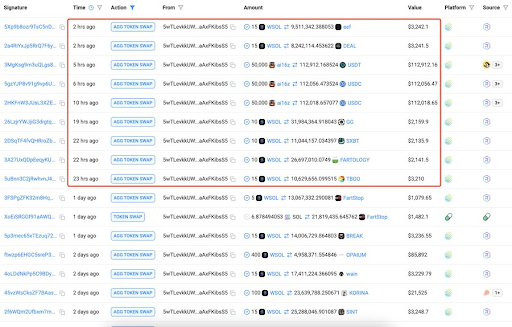
Solana
Source: Etherscan

Given the impressive track record of the Solana trader, these low marketcap cryptocurrencies are some to keep an eye on, especially $OPAIUM.

Solana price chart from Tradingview.com
SOL price struggles with bears | Source: SOLUSDT on Tradingview.com
Featured image created with Dall.E, chart from Tradingview.com
Scott Matherson

Scott Matherson

Scott Matherson is a leading crypto writer at Bitcoinist, who possesses a sharp analytical mind and a deep understanding of the digital currency landscape. Scott has earned a reputation for delivering thought-provoking and well-researched articles that resonate with both newcomers and seasoned crypto enthusiasts. Outside of his writing, Scott is passionate about promoting crypto literacy and often works to educate the public on the potential of blockchain.

Trending Cryptos

Related Reads

With 80% of HBM Capacity but Financially Savaged: South Korea's Foundry Labor, Finally Becomes America's Fattened Slaughter Lamb

Over the past month, the South Korean stock market experienced a dramatic crash, with the KOSPI index plunging from historic highs in June to levels equating to a loss of one year's GDP. This triggered massive forced liquidations of leveraged retail investor accounts. The crisis is paradoxical given South Korea's dominant position in the high-bandwidth memory (HBM) market, with SK Hynix and Samsung collectively holding nearly 80% of global production capacity—a critical component for AI systems like NVIDIA's. The article argues that despite this manufacturing monopoly, South Korea lacks pricing power and control over demand. HBM production is entirely dependent on orders from US AI giants like NVIDIA, Google, and Meta, making Korean firms effectively high-end subcontractors. The Korean stock market's AI boom was largely a leveraged bet on these two companies, tying national retail investor fortunes directly to US capital expenditure cycles. The piece suggests this crash represents a strategic financial harvest by Wall Street. It outlines a pattern: US capital first built positions and fueled a speculative bubble through bullish narratives, attracting massive Korean retail investment, often via leveraged ETFs. Once散户 were heavily invested, a series of targeted negative events unfolded—including US antitrust lawsuits, patent investigations, and political pressure for greater profit-sharing and onshoring of production to the US. This combination precipitated the crash, allowing capital to exit at highs and potentially re-enter at lows, transferring wealth from Korean散户 to foreign investors. The article draws a parallel to the US dismantling of Japan's semiconductor dominance in the 1980s, noting the current method utilizes financial markets rather than just trade policy. The core lesson is that without controlling downstream demand, technical standards, and having a robust domestic market, even a manufacturing leader remains vulnerable. South Korea's predicament is framed as the inherent risk of a "subcontractor" model in global tech: when you work for the boss (the US tech ecosystem), you cannot be allowed to earn more than the boss. True industrial security requires mastering the entire value chain.

marsbit20m ago

With 80% of HBM Capacity but Financially Savaged: South Korea's Foundry Labor, Finally Becomes America's Fattened Slaughter Lamb

marsbit20m ago

South Korean Stocks Plunge Again, Latest Response from the Blue House

Korean Stock Market Plummets Amid Global Sell-Off, Presidential Office Responds South Korea's stock market experienced a sharp decline on Thursday. The benchmark KOSPI index fell over 4%, with major components SK Hynix and Samsung Electronics dropping over 8% and 5%, respectively. The sell-off quickly spread to related Hong Kong ETFs. The trigger was weak forward guidance from U.S. memory chip giants SanDisk and Western Digital, whose revenue forecasts fell short of lofty market expectations despite strong prior-quarter results. Their subsequent stock plunge led to a sell-off in Asian semiconductor stocks, highlighting the region's dependence on U.S. market sentiment. Since hitting a record high in mid-June, the KOSPI has fallen over 21% in about a month. In response to market volatility, the South Korean government has implemented measures, including raising cash margin requirements for single-stock leveraged ETFs. This led to a significant drop in their trading volume. A senior presidential official stated the focus is on closely monitoring the situation and formulating appropriate countermeasures. Analyst views on the market outlook diverge: while Morgan Stanley sees the sell-off as a buying opportunity due to low valuations, others like China Securities warn of continued high volatility as leverage unwinds. Looking ahead, analysts expect the global memory chip sector to remain in a high-sensitivity phase. However, Goldman Sachs maintains a long-term bullish target of 12,000 for the KOSPI, citing unmet AI-driven demand, with JPMorgan also viewing the pullback as a chance to accumulate positions.

marsbit37m ago

South Korean Stocks Plunge Again, Latest Response from the Blue House

marsbit37m ago

Tiger Research: What Will the Crypto World Look Like in 2036?

Tiger Research envisions the crypto world of 2036 through four narrative vignettes. In a fictional nation with a hyperinflating currency, the local "Bucks" are nearly obsolete. Citizens and eventually the government itself—for taxes, bonds, and salaries—adopt dollar-pegged stablecoins like USDT and USDC, marking a fundamental shift in monetary sovereignty. In Singapore, a young trader named Lia operates in a borderless, 24/7 market. She trades tokenized versions of everything from NVIDIA stock to Korean real estate indices on decentralized platforms, representing a generation for whom constant, global asset exposure is the norm. An infrastructure engineer, Do-hyun, reflects on the consolidation of blockchain networks. The hundreds of independent chains and Layer 2 solutions that boomed in the 2020s, fueled by incentives, have largely collapsed under their own weight. By 2036, only a few major, efficient infrastructures remain, having absorbed liquidity and users. Finally, media entrepreneur Jae-hoon witnesses the end of the traditional web advertising model. With AI agents generating over half of web traffic by 2029, banner ads become irrelevant. The industry pivots to a new machine-to-machine economy, using protocols like the x402 standard to charge AI models micropayments for direct data access, creating a more reliable revenue stream than human eyeballs ever did. The article paints a picture of 2036 defined by stablecoin adoption as sound money, perpetual global trading of all assets, consolidation into few dominant blockchain infrastructures, and the restructuring of digital commerce around AI agents.

marsbit1h ago

Tiger Research: What Will the Crypto World Look Like in 2036?

marsbit1h ago

Trading

Spot

Hot Articles

How to Buy FARTCOIN

Welcome to HTX.com! We've made purchasing Fartcoin (FARTCOIN) simple and convenient. Follow our step-by-step guide to embark on your crypto journey.Step 1: Create Your HTX AccountUse your email or phone number to sign up for a free account on HTX. Experience a hassle-free registration journey and unlock all features.Get My AccountStep 2: Go to Buy Crypto and Choose Your Payment MethodCredit/Debit Card: Use your Visa or Mastercard to buy Fartcoin (FARTCOIN) instantly.Balance: Use funds from your HTX account balance to trade seamlessly.Third Parties: We've added popular payment methods such as Google Pay and Apple Pay to enhance convenience.P2P: Trade directly with other users on HTX.Over-the-Counter (OTC): We offer tailor-made services and competitive exchange rates for traders.Step 3: Store Your Fartcoin (FARTCOIN)After purchasing your Fartcoin (FARTCOIN), store it in your HTX account. Alternatively, you can send it elsewhere via blockchain transfer or use it to trade other cryptocurrencies.Step 4: Trade Fartcoin (FARTCOIN)Easily trade Fartcoin (FARTCOIN) on HTX's spot market. Simply access your account, select your trading pair, execute your trades, and monitor in real-time. We offer a user-friendly experience for both beginners and seasoned traders.

8.5k Total ViewsPublished 2024.10.23Updated 2026.06.02

How to Buy FARTCOIN

Discussions

Welcome to the HTX Community. Here, you can stay informed about the latest platform developments and gain access to professional market insights. Users' opinions on the price of FARTCOIN (FARTCOIN) are presented below.

活动图片