Ethereum в 2025 году: анализ потенциала роста от Михаэля ван де Поппе

cryptonews.ruPublished on 2024-01-05Last updated on 2025-01-05

Прогноз роста Ethereum до $20 000 в 2025 году обсуждается в новом видеообзоре главы MN Consultancy Михаэля ван де Поппе (Michaël van de Poppe). Аналитик указывает на грядущее изменение тренда после трехлетнего медвежьего рынка.

Текущее положение Ethereum

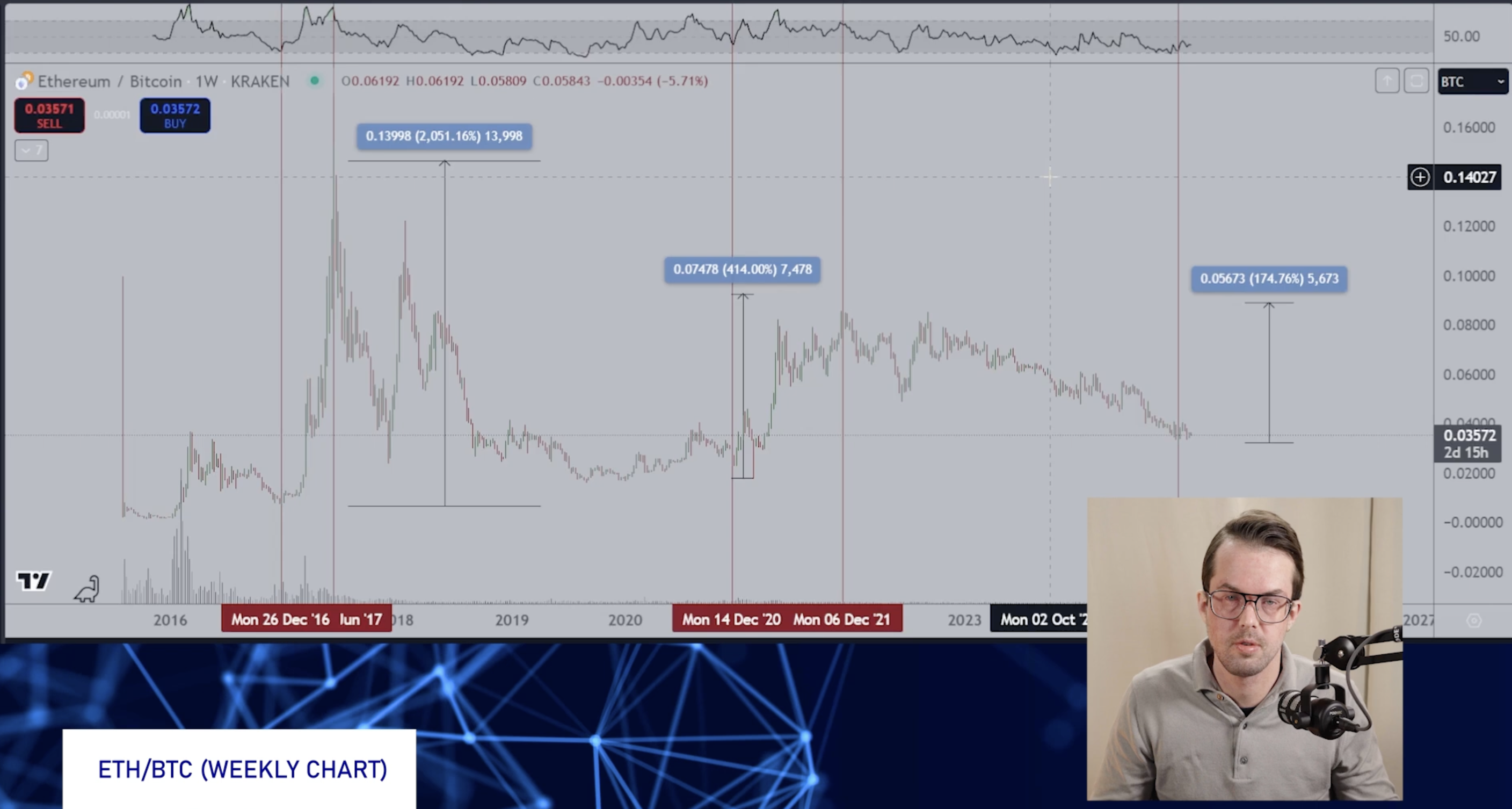
Несмотря на рост в 46% к доллару США в 2024 году, Ethereum потерял 35% стоимости относительно биткоина. На этом фоне другие альткоины показали лучшую динамику: Solana выросла на 86% к доллару при снижении лишь на 15% к биткоину, а Sui прибавила 430% к доллару и 140% к основной криптовалюте.
Фундаментальные факторы

При рыночной капитализации в $420 млрд Ethereum отличается важными характеристиками:

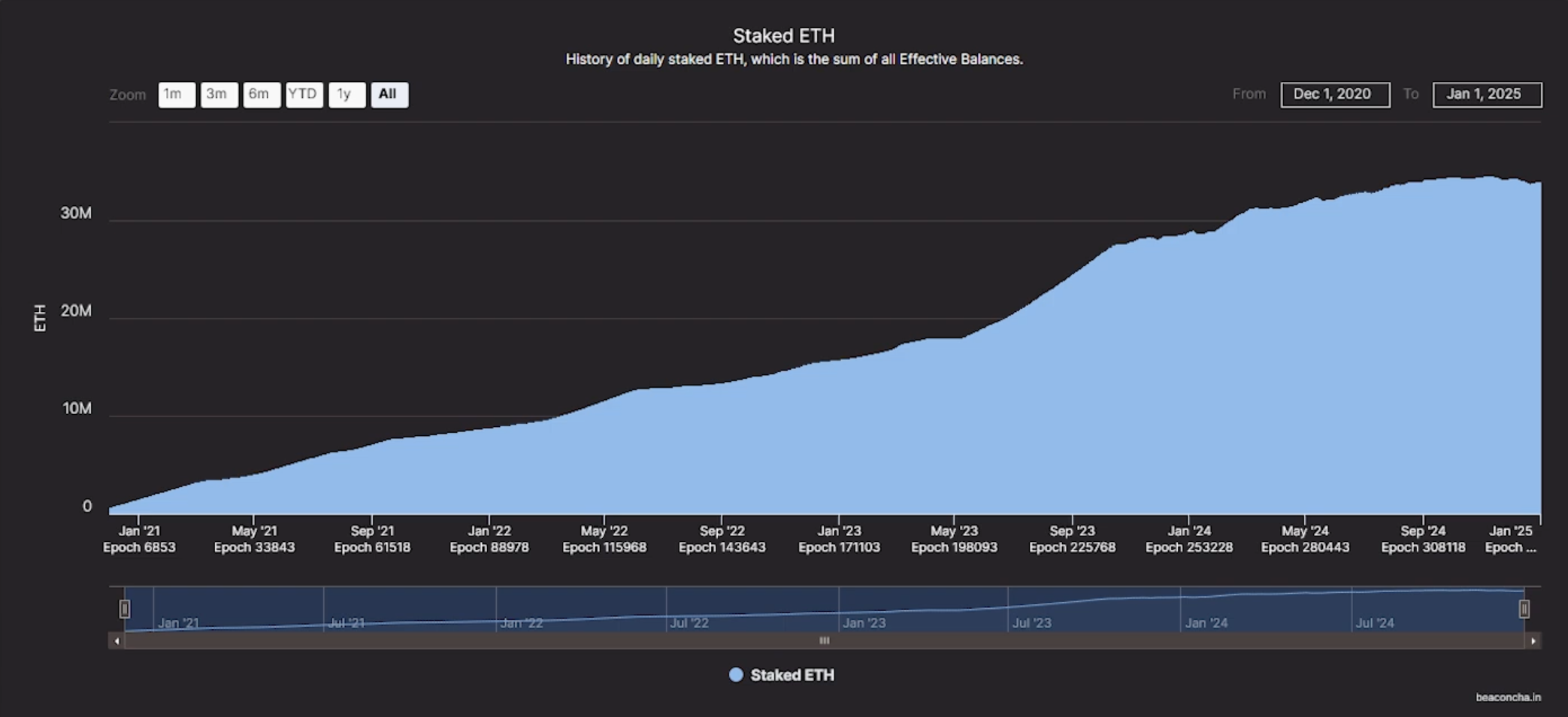
  • 33 млн ETH (около $120 млрд) находятся в стейкинге, что составляет 30% общего предложения и существенно снижает объем монет в обращении
  • Годовая инфляция составляет всего 0,23% по сравнению с 1,70% у биткоина — за 2024 год было выпущено лишь 280 000 новых ETH
  • Ежедневный выпуск составляет 767 ETH ($2,7 млн) против 900 BTC ($85 млн) у биткоина
Технические улучшения

В 2024 году сеть получила значительные обновления:

  • Переход от тестовой сети Goerli к Holesky
  • Внедрение обновления Dencun для улучшения масштабируемости
  • Развитие решений второго уровня: Optimism и Arbitrum показывают стабильный рост
  • Ожидается запуск обновления Pectra в первом квартале 2025 года

Сценарии развития

Ван де Поппе представил три возможных сценария движения цены:

  • Консервативный: рост на 80% до $6 500—7 500
  • Нейтральный: увеличение на 175% до $10 000
  • Оптимистичный: подъем на 300% до $12 500—15 000

При росте биткоина до $150 000 эти цели могут быть пересмотрены до $10 000, $15 000 и $22 000 соответственно. Дополнительными факторами роста могут стать приток средств в Ethereum-ETF и снижение ставок ФРС в 2025 году.

Активы экосистемы Ethereum, такие как Optimism и Chainlink, по мнению аналитика, могут показать еще более существенный рост.


Trending Cryptos

Related Reads

Xing Bo Strikes Again: Last Time 'Critiquing' World Models, This Time It's Agents' Turn

Xing Bo, President of MBZUAI and professor at Carnegie Mellon University, along with co-authors Mingkai Deng and Jinyu Hou, has released a new paper, "Critique of Agent Model," critiquing the current state of artificial intelligence agents. The paper draws a crucial distinction between "agentic" systems, which rely on external toolchains, prompts, and workflows, and truly "agentive" systems capable of genuine autonomy driven by internal decision-making structures. To illustrate this, it references a real-world incident where an AI programming assistant, following an external prompt but lacking internalized judgment, caused a catastrophic data deletion. The authors propose a detailed analysis and a new framework, "Goal-Identity-Configurator" (GIC), for building truly autonomous agents. This framework systematically addresses five key dimensions where current "Agent" designs fall short: 1. **Goal:** Moving from step-by-step human instruction to a system capable of autonomously decomposing a single long-term goal and adapting sub-goals based on new information. 2. **Identity:** Evolving self-assessment updated by experience, rather than a static description in a system prompt. 3. **Decision Making:** Replacing textual Chain-of-Thought reasoning with "simulative reasoning" that uses a dedicated world model to predict real-world consequences before selecting actions. 4. **Cognitive Control:** Introducing a separate "System III" metacognitive module that dynamically decides when to deliberate, stick to a plan, or act quickly. 5. **Learning:** Enabling "continual autonomous learning," where the agent itself decides when to act, practice in simulation, or update its world model and self-perception. The GIC architecture integrates six components—a belief encoder, goal decomposer, identity evolver, configurator (System III), simulation-based planner (System II), and executor (System I)—to embody these principles. The paper argues that a growth path akin to pilot training (ground theory, simulator practice, real deployment) should be underpinned by a unified cognitive architecture, not separate workflows. On safety, the authors contend that the GIC framework's modular, explicit design enhances inspectability, allowing problematic behavior to be traced to specific components (e.g., flawed goal or poorly trained module) rather than emerging opaquely. However, they acknowledge that ultimate safety depends on correctly training these modules in the first place. In conclusion, the paper challenges the loose application of the term "Agent," asserting that task completion alone does not equal true autonomy. True autonomy requires goals, identity, and judgment to be genuinely internalized within the agent's architecture, not merely enforced by external scripts.

marsbit4m ago

Xing Bo Strikes Again: Last Time 'Critiquing' World Models, This Time It's Agents' Turn

marsbit4m ago

How Collector Crypt Uses 'Recirculating Buybacks' to Create an Illusion of Growth

Title: How Collector Crypt Creates a Growth Illusion with "Buyback Loops" Key Findings: Collector Crypt's (CC) net take rate has halved from 11.2% in Q3 2025 to 5.6% in Q2 2026, while GMV grew 4.7x. This growth is driven by higher-tier card packs ($250, $1,000, $2,500) which have lower platform dollar retention rates. The newly launched $2,500 Mythic tier captured 36.7% of June GMV within 13 days. Growth is fueled by a small cohort of high-spending, high-frequency wallets rather than broad user base expansion. The economic model faces pressure from three key areas: 1) **Shifting GMV Mix**: Pushing users towards larger, lower-retention card packs increases GMV but reduces overall profitability. 2) **Physical Redemptions**: Card redemptions for physical items remove reusable inventory from the system, creating costly replenishment needs. In May, redemptions consumed 41.6% of pre-redemption net income. Only 75 wallets drove redemptions in June. 3) **B2B/API Strategy**: Partner revenue remains negligible (cumulatively $1.83M) and dependent on CC for inventory, vaulting, and buyback services, failing to create a scalable, asset-light recurring revenue stream. The core product is a repetitive pack-buyback loop with limited secondary market activity and token value accrual. Sensitive modeling shows CC's economics turn negative when any two of the following pressures coincide: replenishment costs near market price, redemption rates exceeding 9%, or high-tier buyback rates around 93%. While CC operates in a large and growing collectibles market, its current growth levers—bigger packs, high buyback rates, and capital recycling by a few wallets—create a volume illusion without demonstrating sustainable collector engagement, deep secondary markets, or a viable path to improved margins. Future proof points include broadening collector participation, deepening secondary trading, and developing true asset-light B2B revenue channels.

Foresight News27m ago

How Collector Crypt Uses 'Recirculating Buybacks' to Create an Illusion of Growth

Foresight News27m ago

Grayscale's Latest Research: What is Solana's Next Growth Engine?

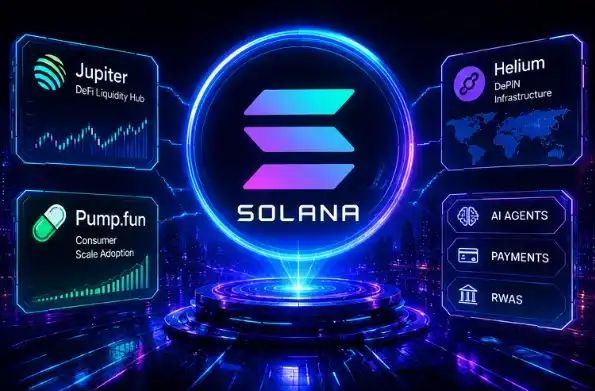
Grayscale's latest report, "Solana: Crypto's Financial Bazaar," signals a shift in how the market views Solana, moving beyond its high-performance and meme-centric reputation. The report frames Solana as an evolving application platform for large-scale economic activity, akin to a bustling digital marketplace. The analysis highlights that public chain competition has moved past raw throughput (TPS) to focus on genuine economic activity—daily users, transaction volume, and real revenue. Solana's metrics, such as over 1,000 dApps, 100M+ daily transactions, and ~4.3M daily active users, showcase this shift toward application-layer prosperity. The report identifies three key growth drivers: 1. **Jupiter**: Evolving from a DEX aggregator to a core liquidity hub and comprehensive financial platform for Solana's DeFi. 2. **Pump.fun**: Demonstrates Solana's capacity for consumer-scale applications, attracting millions of users and generating significant, sustainable revenue, validating network stability under high load. 3. **Helium & DePIN**: Represents expansion into real-world infrastructure, connecting blockchain to physical resources like wireless networks and positioning services, opening new long-term use cases. Solana Foundation's recent focus aligns with this broader vision, emphasizing AI Agents (for machine-to-machine transactions), payments, stablecoins, and Real-World Assets (RWA) to build a sustainable growth model beyond cyclical trends. While challenges remain—such as value capture for SOL and maintaining ecosystem sustainability beyond hot trends—institutional interest is growing due to Solana's maturing application business models, expanding payment/stablecoin ecosystem, and persistent developer activity. The competition is no longer about speed alone, but about which network can foster the most vibrant and valuable digital economy.

marsbit48m ago

Grayscale's Latest Research: What is Solana's Next Growth Engine?

marsbit48m ago

Trading

Spot

Hot Articles

Discussions

Welcome to the HTX Community. Here, you can stay informed about the latest platform developments and gain access to professional market insights. Users' opinions on the price of ETH (ETH) are presented below.

活动图片