Макроэкономист Рауль Пал верит в будущих успех Solana и Sui

cryptonews.ruPublished on 2023-11-05Last updated on 2025-01-05

Известный макроэкономист и генеральный директор Real Vision Рауль Пал оптимистично воспринимает две криптовалюты Solana (SOL) и Sui (SUI), которые, по его мнению, имеют неплохую долгосрочную перспективу.
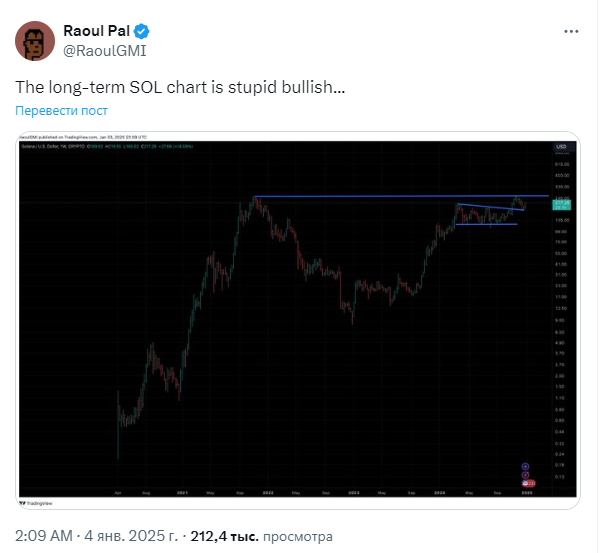
Opera Снимок_2025-01-04_195629_x.com

Эксперт считает, что пятая по величине рыночной капитализации Solana является «глупым быком» на долгосрочных временных рамках. В своём анализе он указал, что недавно SOL пробил важный уровень сопротивления, который сохранялся более четырёх лет.

Он предполагает, что для продолжения восходящего импульса Solana необходимо удерживаться выше максимума ноября 2021 года более $250. Основываясь на этом, Пал обозначил цель на отметке $410, что соответствует уровню Фибоначчи 1,618.
Opera Снимок_2025-01-04_165628_www.coingecko.com

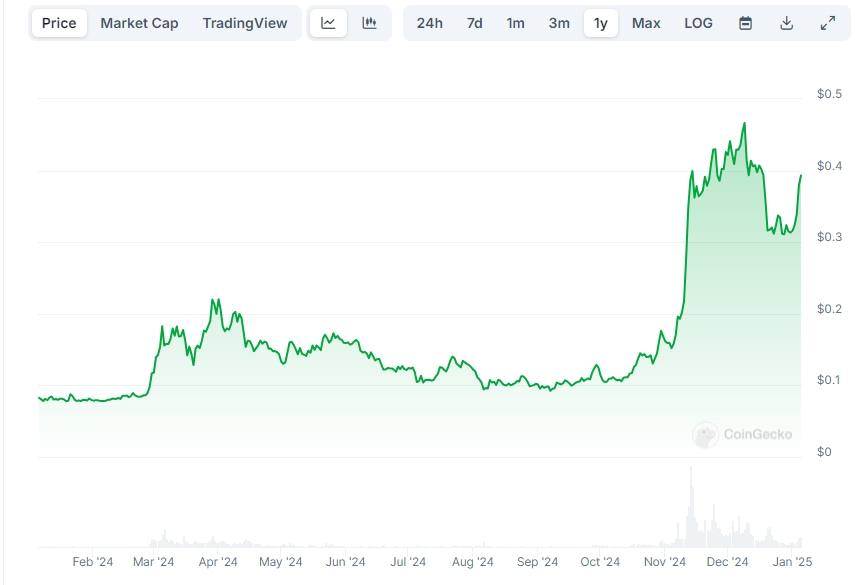
Изменение цены Solana за 24 часа. Данные CoinGecko

Успех Solana подкрепляется анонсом нового решения Winternitz Vault, использующего квантово-устойчивые хэш-функции для защиты Solana от атак квантовых вычислений.

Одновременно с этим Пал напомнил, что в ближайшее время предложение Solana увеличится за счёт масштабной разблокировки токенов в первом квартале 2025 года, что может создать давление продаж. Несмотря на это он верит в будущий успех Solana.

Кроме Solana Пал полон оптимизма в отношении относительно новой криптовалюты Sui (SUI). Он отметил важный пробой Sui уровня сопротивления на $4,88. После этого прорыва цена Sui достигла нового исторического максимума в $5,30.

Всего за 24 часа объём торгов Sui вырос почти в три раза, достигнув $2,45 млрд, что указывает на интерес рынка и потенциал для дальнейшего роста.

Ожидается, что импульс Sui сохранится, более того, Пал полагает, что после преодоления этого ключевого сопротивления криптовалюта готова «войти в гиперпространство».


Trending Cryptos

Related Reads

Opinion: AI Bubble Bursts, Bitcoin and Other Risky Assets Are the First to Be Impacted

BIS Warns AI Investment Boom Could Trigger Market Stress, Impacting Bitcoin First The Bank for International Settlements (BIS) warns that a potential bursting of the "AI bubble" could tighten liquidity and severely impact risk assets like Bitcoin in the near term. Major tech firms are projected to spend over $1 trillion on AI infrastructure in 2025-2026. The BIS cautions that if returns fail to meet expectations, a sudden withdrawal of financing could turn this investment boom into a prolonged bust, creating ripple effects across financial markets. While AI holds long-term economic promise, the current scale and speed of investment, coupled with intense competition and physical bottlenecks (e.g., semiconductors, power grids), mirror historical bubbles. The report highlights that the AI funding web—spanning corporate debt, private credit, and complex vendor agreements—makes systemic risks harder to see. A disappointment in AI adoption could transmit stress through this chain, widening credit spreads and pressuring weaker borrowers. For Bitcoin, the initial reaction to such a market shock would likely be defensive. As liquidity tightens, investors typically sell liquid assets first, and Bitcoin often trades in line with other risk assets during portfolio de-risking. Recent correlations, like Bitcoin's drop following a sharp decline in South Korea's stock market, support this view. However, the longer-term outcome for Bitcoin depends on the policy response. If an AI-driven credit crunch forces central banks to inject liquidity and ease policy eventually, it could reignite Bitcoin's narrative as a hedge against monetary debasement. Yet, traders betting on this outcome may first have to endure significant market volatility and potential price declines.

marsbit1h ago

Opinion: AI Bubble Bursts, Bitcoin and Other Risky Assets Are the First to Be Impacted

marsbit1h ago

South Korea Reaps Riches, America Turns Hostile

The US has filed a collective antitrust lawsuit in California against Samsung, SK Hynix, and US-based Micron, alleging they colluded to create a "RAMpocalypse" by slashing traditional DRAM production and raising prices 700% over four years amid the AI boom. This lawsuit targets the heart of the AI supply chain: High Bandwidth Memory (HBM), critical for Nvidia's GPUs. Currently, SK Hynix (57%), Samsung (22%), and Micron (21%) dominate global HBM production. The case highlights a deeper US concern: in the AI era, South Korea, through its HBM dominance, is capturing an estimated 35% of global AI profits, second only to the US (49%). SK Hynix's operating profit margin recently hit a record 72%. In response to the lawsuit, South Korea announced a massive $800 trillion won investment to build four new chip plants, doubling down on its strategic position. Analysts see the lawsuit not merely as a consumer price issue but as strategic pressure. It aims to support Micron's US manufacturing expansion (subsidized by the CHIPS Act) and secure America's share of AI profits by bringing more HBM production onshore. However, South Korea's rapid execution and massive cash flow from current HBM sales give it a significant speed advantage over US build-out timelines. The conflict underscores a fundamental shift: AI infrastructure like GPUs and HBM is becoming a new form of strategic national resource, akin to oil. While Nvidia and Korean memory giants are interdependent, the struggle over profit distribution and industrial sovereignty in this new landscape is just beginning. This lawsuit may be the first major skirmish in the AI resource wars.

marsbit1h ago

South Korea Reaps Riches, America Turns Hostile

marsbit1h ago

Trading

Spot

Hot Articles

Discussions

Welcome to the HTX Community. Here, you can stay informed about the latest platform developments and gain access to professional market insights. Users' opinions on the price of SOL (SOL) are presented below.

活动图片