Worried About When To Sell Your Bitcoin? Analyst Provides ‘Sweet Spot’ – And It’s Much Higher

bitcoinistPublished on 2025-01-03Last updated on 2025-01-04

Abstract

Using technical indicators like Fibonacci extensions and the Elliott Wave Theory, a crypto analyst pinpoints an ideal “sweet spot” for...

Using technical indicators like Fibonacci extensions and the Elliott Wave Theory, a crypto analyst pinpoints an ideal “sweet spot” for selling Bitcoin (BTC). According to the analysis, specific price zones have been identified as target BTC sell areas that investors and traders could use to exit positions strategically ahead of possible downtrend. 

Analyst Sets $169,000 And $194,000 As BTC Sell Zones

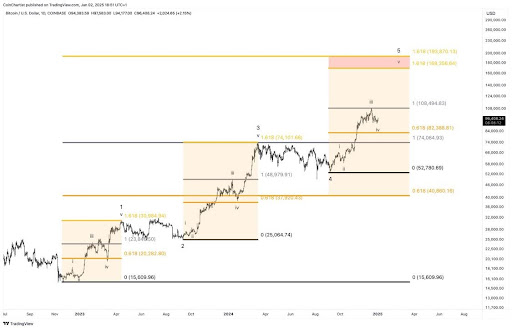
In an X (formerly Twitter) post, crypto analyst Tony Severino revealed that Bitcoin is currently in Wave 5, experiencing the final push of its bullish Elliott Wave cycle. In previous cycles, the BTC price has consistently terminated near the 1.618 Fibonacci extension of subwaves i through iii.

Severino’s Bitcoin chart shows that its price action is segmented into five distinctive waves. Wave 1 represents the initial bullish movement, followed by Wave 2, a corrective pullback. Wave 3 stands out as the most powerful and extended wave, while Wave 4 introduces another corrective phase. Finally, Wave 5, where BTC currently trades within, signals a possible final bullish push upwards

Bitcoin 1
Source: X

Each wave in the BTC chart has triggered a price increase to different levels, whether to new highs or lows. For Wave 5, however, Severino has proposed an ambitious price target that would act as an important sell zone for investors and traders. 

The analyst questioned whether BTC could repeat historical trends and terminate again at the 1.618 Fibonacci extension of Waves 1 through 3 combined. This points to a price range between $169,366 and $194,000. According to Severino, these price levels, marked in the red zone on the chart, are called a “sweet spot.” He identified these price areas as a significant sell zone for Bitcoin.   

Currently, BTC is trading at $96,341, meaning Severino expects the leading cryptocurrency to surge 75.31% and 101.24% to reach the projected target range between $169,000 and $194,000, respectively. The analyst asserts that his bullish projections are reasonable price targets for Bitcoin, underscoring his confidence that the cryptocurrency could hit these new ATHs.  

For traders and investors, a sell zone is an ideal exit point to potentially lock in profits and prevent financial loss before a trend reversal. Whether or not Severino’s projected “sweet spot” holds, his analysis provides valuable insights into Bitcoin’s potential price movements and potential sell targets for investors. 

Bitcoin Market Top Expected In 2025

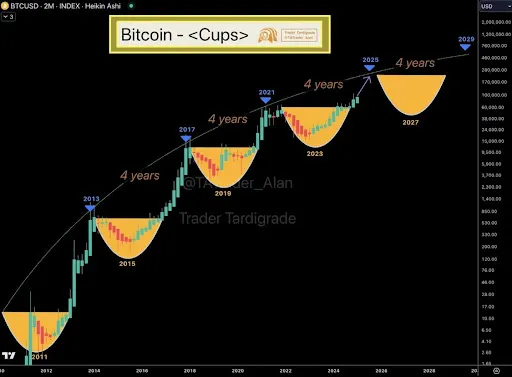
Trader Tardigrade, a prominent crypto analyst, declared on X that the Bitcoin 4-year cycle is still in play. The analyst warns that 2025 could still be a pivotal year for Bitcoin. He predicts that BTC will hit a market peak in 2025, creating a prime opportunity for investors who missed its ATH in 2024

However, investors who overlook this window of opportunity in 2025 may have to wait until 2029, after the next halving event, for BTC’s next market peak. Sharing a price chart, Trader Tardigrade highlighted Bitcoin’s price performance during each four-year cycle.  
Bitcoin 2
Source: X

The analyst noted that during each halving cycle from 2011 to 2023, Bitcoin rose to a peak the following year after the halving event. If this historical trend holds, Bitcoin could experience another final surge to new heights in 2025.

Bitcoin price chart from Tradingview.com
BTC price moves toward $97,000 | Source: BTCUSD on Tradingview.com
Featured image created with Dall.E, chart from Tradingview.com
Scott Matherson

Scott Matherson

Scott Matherson is a leading crypto writer at Bitcoinist, who possesses a sharp analytical mind and a deep understanding of the digital currency landscape. Scott has earned a reputation for delivering thought-provoking and well-researched articles that resonate with both newcomers and seasoned crypto enthusiasts. Outside of his writing, Scott is passionate about promoting crypto literacy and often works to educate the public on the potential of blockchain.

Trending Cryptos

Related Reads

77 Bloody Codes: When the '$5 Wrench' Shatters the Privacy Myth of France's Crypto Elite

**Summary** In the first half of 2026, France recorded 77 violent crimes—including kidnappings, illegal confinement, and extortion—targeting cryptocurrency holders, a 71% increase over the 45 cases in all of 2025. This equates to an attack every 2.3 days, making France a global hotspot for so-called "wrench attacks," where criminals use physical violence to coerce victims into surrendering crypto assets. High-profile cases include the 2025 kidnapping of Ledger co-founder David Balland, who was shown with a severed finger in a ransom video, and an attempted kidnapping of the family of Paymium's CEO in Paris. Prosecutors note these are not isolated incidents but part of structured criminal networks, sometimes involving minors. Several factors contribute to France's vulnerability: a large holder base (approx. 7.3 million people), the presence of major crypto firms and executives, a culture of public disclosure among enthusiasts, and potential data leaks. The trend is spreading across Europe, which now accounts for over 40% of such global attacks. Research indicates a correlation between Bitcoin price surges and increased wrench attacks. In response, French Interior Minister Laurent Nuñez announced a three-pillar action plan focusing on enhanced intelligence sharing, deeper cooperation with the industry association Adan, and improved operational and cross-border coordination. Authorities have made over 200 arrests in the past year. Security experts warn that digital asset safety now extends to the physical world. They advise holders to use hardware wallets, avoid disclosing holdings on social media, enable multi-factor authentication, and report suspicious activity. The situation underscores the urgent need for the crypto community to shift from a "show-off" culture to one of discretion as physical security becomes paramount.

marsbit1h ago

77 Bloody Codes: When the '$5 Wrench' Shatters the Privacy Myth of France's Crypto Elite

marsbit1h ago

Both OpenAI and Anthropic are 'Developing Their Own Chips' — Beyond Cost, the Control Over Computing Power is Paramount

OpenAI and Anthropic are both advancing plans to develop custom AI chips, driven by the need to control computing power and reduce costs. According to reports, Anthropic is in early-stage development of its own chips and in talks with Samsung for manufacturing, while OpenAI is collaborating with Broadcom and TSMC, aiming to deploy its first inference chip by late 2026. The primary motivation extends beyond just lowering expenses. For these large model companies, chips are core production assets. By designing specialized hardware (ASICs) tailored to their specific model architectures—OpenAI's being more sparse and Anthropic's more dense—they aim to achieve deeper software-hardware co-design. This synergy can significantly improve inference speed, energy efficiency, and overall unit economics, offering advantages that off-the-shelf GPUs cannot. This move does not signify an immediate replacement for suppliers like Nvidia. The process from design to deployment takes 18-24 months, and Nvidia's GPU ecosystem remains deeply entrenched. Instead, custom chips provide a strategic alternative and negotiating leverage, allowing companies to use them for specific, high-volume workloads like inference while still relying on external GPUs and TPUs for other tasks. The trend reflects a broader industry shift where AI competition is evolving from pure algorithmic prowess to integrated control over the entire software-hardware stack. Companies like Google, Amazon, Meta, and Microsoft are already on this path. For foundries like Samsung, securing orders from AI leaders like Anthropic represents a significant opportunity to expand its footprint in the advanced semiconductor market for AI. Ultimately, the race for "computing sovereignty" is now a central battleground for major AI players.

marsbit1h ago

Both OpenAI and Anthropic are 'Developing Their Own Chips' — Beyond Cost, the Control Over Computing Power is Paramount

marsbit1h ago

Trading

Spot

Hot Articles

What is $BITCOIN

DIGITAL GOLD ($BITCOIN): A Comprehensive Analysis Introduction to DIGITAL GOLD ($BITCOIN) DIGITAL GOLD ($BITCOIN) is a blockchain-based project operating on the Solana network, which aims to combine the characteristics of traditional precious metals with the innovation of decentralized technologies. While it shares a name with Bitcoin, often referred to as “digital gold” due to its perception as a store of value, DIGITAL GOLD is a separate token designed to create a unique ecosystem within the Web3 landscape. Its goal is to position itself as a viable alternative digital asset, although specifics regarding its applications and functionalities are still developing. What is DIGITAL GOLD ($BITCOIN)? DIGITAL GOLD ($BITCOIN) is a cryptocurrency token explicitly designed for use on the Solana blockchain. In contrast to Bitcoin, which provides a widely recognized value storage role, this token appears to focus on broader applications and characteristics. Notable aspects include: Blockchain Infrastructure: The token is built on the Solana blockchain, known for its capacity to handle high-speed and low-cost transactions. Supply Dynamics: DIGITAL GOLD has a maximum supply capped at 100 quadrillion tokens (100P $BITCOIN), although details regarding its circulating supply are currently undisclosed. Utility: While precise functionalities are not explicitly outlined, there are indications that the token could be utilized for various applications, potentially involving decentralized applications (dApps) or asset tokenization strategies. Who is the Creator of DIGITAL GOLD ($BITCOIN)? At present, the identity of the creators and development team behind DIGITAL GOLD ($BITCOIN) remains unknown. This situation is typical among many innovative projects within the blockchain space, particularly those aligning with decentralized finance and meme coin phenomena. While such anonymity may foster a community-driven culture, it intensifies concerns about governance and accountability. Who are the Investors of DIGITAL GOLD ($BITCOIN)? The available information indicates that DIGITAL GOLD ($BITCOIN) does not have any known institutional backers or prominent venture capital investments. The project seems to operate on a peer-to-peer model focused on community support and adoption rather than traditional funding routes. Its activity and liquidity are primarily situated on decentralized exchanges (DEXs), such as PumpSwap, rather than established centralized trading platforms, further highlighting its grassroots approach. How DIGITAL GOLD ($BITCOIN) Works The operational mechanics of DIGITAL GOLD ($BITCOIN) can be elaborated on based on its blockchain design and network attributes: Consensus Mechanism: By leveraging Solana’s unique proof-of-history (PoH) combined with a proof-of-stake (PoS) model, the project ensures efficient transaction validation contributing to the network's high performance. Tokenomics: While specific deflationary mechanisms have not been extensively detailed, the vast maximum token supply implies that it may cater to microtransactions or niche use cases that are still to be defined. Interoperability: There exists the potential for integration with Solana’s broader ecosystem, including various decentralized finance (DeFi) platforms. However, the details regarding specific integrations remain unspecified. Timeline of Key Events Here is a timeline that highlights significant milestones concerning DIGITAL GOLD ($BITCOIN): 2023: The initial deployment of the token occurs on the Solana blockchain, marked by its contract address. 2024: DIGITAL GOLD gains visibility as it becomes available for trading on decentralized exchanges like PumpSwap, allowing users to trade it against SOL. 2025: The project witnesses sporadic trading activity and potential interest in community-led engagements, although no noteworthy partnerships or technical advancements have been documented as of yet. Critical Analysis Strengths Scalability: The underlying Solana infrastructure supports high transaction volumes, which could enhance the utility of $BITCOIN in various transaction scenarios. Accessibility: The potential low trading price per token could attract retail investors, facilitating wider participation due to fractional ownership opportunities. Risks Lack of Transparency: The absence of publicly known backers, developers, or an audit process may yield skepticism regarding the project's sustainability and trustworthiness. Market Volatility: The trading activity is heavily reliant on speculative behavior, which can result in significant price volatility and uncertainty for investors. Conclusion DIGITAL GOLD ($BITCOIN) emerges as an intriguing yet ambiguous project within the rapidly evolving Solana ecosystem. While it attempts to leverage the “digital gold” narrative, its departure from Bitcoin's established role as a store of value underscores the need for a clearer differentiation of its intended utility and governance structure. Future acceptance and adoption will likely depend on addressing the current opacity and defining its operational and economic strategies more explicitly. Note: This report encompasses synthesised information available as of October 2023, and developments may have transpired beyond the research period.

575 Total ViewsPublished 2025.05.13Updated 2025.05.13

What is $BITCOIN

Discussions

Welcome to the HTX Community. Here, you can stay informed about the latest platform developments and gain access to professional market insights. Users' opinions on the price of BTC (BTC) are presented below.

活动图片