Цена Cardano стабилизировалась выше 0,90 доллара и движется к недавнему максимуму

cryptonews.ruPublished on 2023-11-02Last updated on 2024-12-02

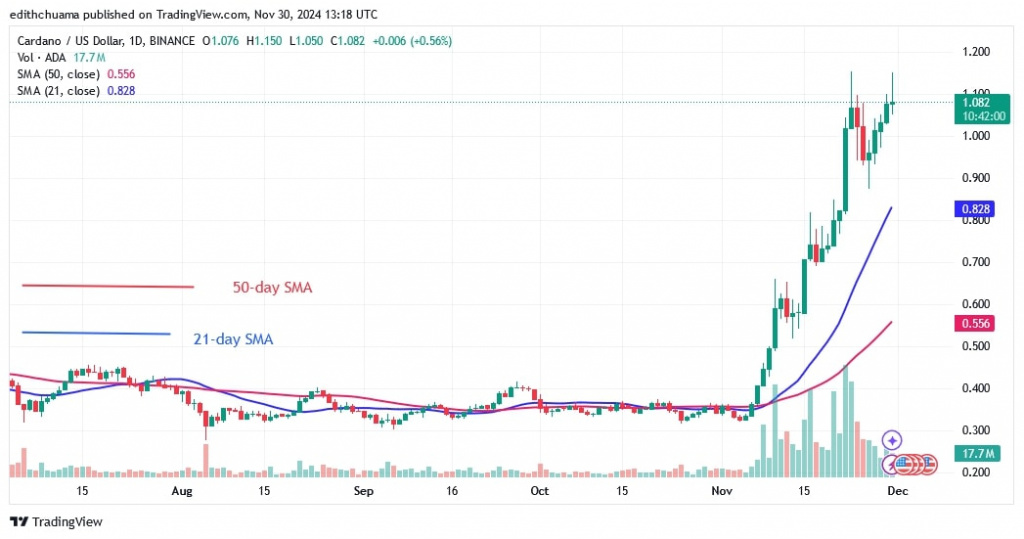
Cardano (ADA) сохранил восходящий тренд и 23 ноября вырос до 1,10 доллара. Ожидается, что Cardano достигнет предыдущих максимумов в 2,47 и 3,00 доллара.

Долгосрочный прогноз цены Cardano: бычий

Однако восходящий тренд достиг барьера в 1,10 доллара. Покупатели предприняли две неудачные попытки удержать цену выше 1,10 доллара, но потерпели неудачу. По данным Coinidol.com, с 23 ноября восходящий тренд цены остановился на уровне 1,10 доллара.

Альткоин торгуется выше 21-дневной SMA, но ниже предыдущего максимума, что указывает на восходящий тренд. ADA может упасть выше 21-дневной поддержки SMA или достичь минимума в 0,80 доллара по сравнению с предыдущим максимумом. С другой стороны, рост продолжится, как только будет преодолен барьер в 1,10 доллара.

На момент написания статьи стоимость Cardano составляет 1,09 доллара.

Анализ индикатора ADA

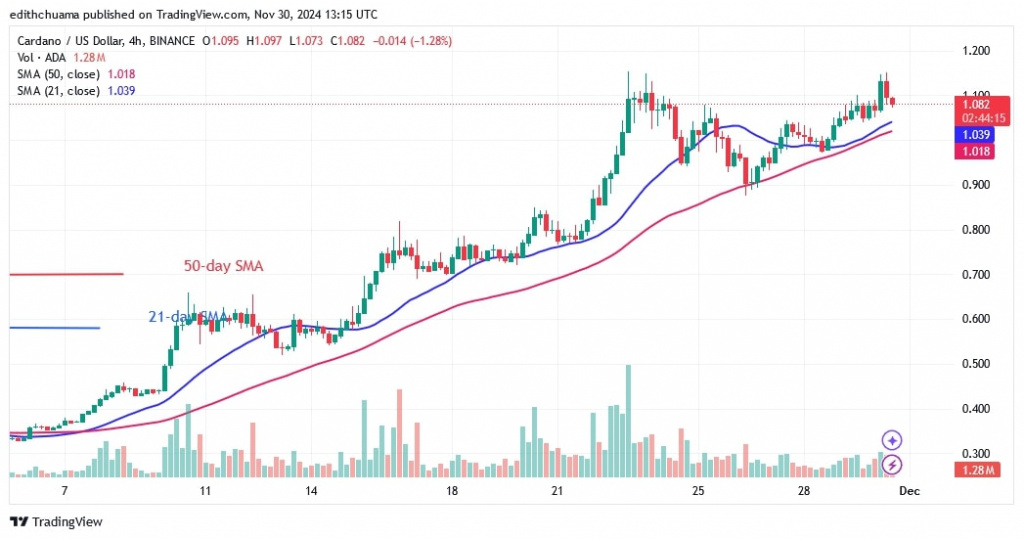
Ценовые бары находятся выше восходящих линий скользящих средних. Два фитиля свечей указывают на уровень сопротивления 1,10 доллара. Фитили этих свечей указывают на значительное давление со стороны продавцов при более высоких ценах. В ценовых движениях преобладают маленькие неопределённые свечи, известные как «доджи».

Технические индикаторы

Ключевые зоны сопротивления: 0,90 доллара, 1,00 доллара и 1,10 доллара

Ключевые зоны поддержки: 0,80 доллара, 0,70 доллара и 0,60 доллара
Каков следующий шаг Cardano?

Кардано находится в восходящем тренде, но остановился на максимуме в 1,10 доллара. Ценовые бары стабилизировались выше линий скользящих средних, но ниже уровня сопротивления в 1,10 доллара. Альткоин оттолкнулся от уровня сопротивления и теперь находится в своём диапазоне.
Trending Cryptos

Related Reads

Opinion: AI Bubble Bursts, Bitcoin and Other Risky Assets Are the First to Be Impacted

BIS Warns AI Investment Boom Could Trigger Market Stress, Impacting Bitcoin First The Bank for International Settlements (BIS) warns that a potential bursting of the "AI bubble" could tighten liquidity and severely impact risk assets like Bitcoin in the near term. Major tech firms are projected to spend over $1 trillion on AI infrastructure in 2025-2026. The BIS cautions that if returns fail to meet expectations, a sudden withdrawal of financing could turn this investment boom into a prolonged bust, creating ripple effects across financial markets. While AI holds long-term economic promise, the current scale and speed of investment, coupled with intense competition and physical bottlenecks (e.g., semiconductors, power grids), mirror historical bubbles. The report highlights that the AI funding web—spanning corporate debt, private credit, and complex vendor agreements—makes systemic risks harder to see. A disappointment in AI adoption could transmit stress through this chain, widening credit spreads and pressuring weaker borrowers. For Bitcoin, the initial reaction to such a market shock would likely be defensive. As liquidity tightens, investors typically sell liquid assets first, and Bitcoin often trades in line with other risk assets during portfolio de-risking. Recent correlations, like Bitcoin's drop following a sharp decline in South Korea's stock market, support this view. However, the longer-term outcome for Bitcoin depends on the policy response. If an AI-driven credit crunch forces central banks to inject liquidity and ease policy eventually, it could reignite Bitcoin's narrative as a hedge against monetary debasement. Yet, traders betting on this outcome may first have to endure significant market volatility and potential price declines.

marsbit8m ago

Opinion: AI Bubble Bursts, Bitcoin and Other Risky Assets Are the First to Be Impacted

marsbit8m ago

South Korea Reaps Riches, America Turns Hostile

The US has filed a collective antitrust lawsuit in California against Samsung, SK Hynix, and US-based Micron, alleging they colluded to create a "RAMpocalypse" by slashing traditional DRAM production and raising prices 700% over four years amid the AI boom. This lawsuit targets the heart of the AI supply chain: High Bandwidth Memory (HBM), critical for Nvidia's GPUs. Currently, SK Hynix (57%), Samsung (22%), and Micron (21%) dominate global HBM production. The case highlights a deeper US concern: in the AI era, South Korea, through its HBM dominance, is capturing an estimated 35% of global AI profits, second only to the US (49%). SK Hynix's operating profit margin recently hit a record 72%. In response to the lawsuit, South Korea announced a massive $800 trillion won investment to build four new chip plants, doubling down on its strategic position. Analysts see the lawsuit not merely as a consumer price issue but as strategic pressure. It aims to support Micron's US manufacturing expansion (subsidized by the CHIPS Act) and secure America's share of AI profits by bringing more HBM production onshore. However, South Korea's rapid execution and massive cash flow from current HBM sales give it a significant speed advantage over US build-out timelines. The conflict underscores a fundamental shift: AI infrastructure like GPUs and HBM is becoming a new form of strategic national resource, akin to oil. While Nvidia and Korean memory giants are interdependent, the struggle over profit distribution and industrial sovereignty in this new landscape is just beginning. This lawsuit may be the first major skirmish in the AI resource wars.

marsbit20m ago

South Korea Reaps Riches, America Turns Hostile

marsbit20m ago

AAVE Rallies 30% in a Week, Is It Back on Track?

Over the past week, the price of AAVE surged from around $70 to nearly $100, a rebound exceeding 30%. This occurred despite Aave's TVL continuing to decline following the Kelp DAO security incident. The price movement was partly driven by market rumors, first reported by CoinDesk, that Kraken was negotiating to acquire a stake in Aave. While Aave founder Stani Kulechov denied the specific terms, he confirmed discussions with multiple parties about purchasing Aave Labs' AAVE tokens. He also revealed ongoing work on Tokenomics 3.0, featuring an automated buyback mechanism, and plans to expand into securities-backed lending. Analysts remain optimistic about Aave's long-term prospects. Standard Chartered gave an extremely bullish $3,500 price target for 2030, citing DeFi revival and RWA tokenization. Grayscale offered a more conservative one-year target of $175. However, competitors like Morpho are gaining traction, with recent reports highlighting its advantages in capital efficiency and customization. Morpho also secured a massive $175 million funding round. Fundamentally, Aave maintains its dominance as the leading DeFi lending protocol. Its TVL is nearly double that of second-place Morpho and rivals the combined total of the next several competitors. Key metrics like active borrowing, total supply, and revenue significantly outpace rivals. While Aave faces challenges from newer, more flexible protocols, its deep liquidity and established position make it a preferred choice for large, yield-seeking users. The article concludes that despite setbacks, Aave's long-tested protocol merits ongoing attention in a market with increasingly scarce quality projects.

Foresight News57m ago

AAVE Rallies 30% in a Week, Is It Back on Track?

Foresight News57m ago

Trading

Spot

Hot Articles

Discussions

Welcome to the HTX Community. Here, you can stay informed about the latest platform developments and gain access to professional market insights. Users' opinions on the price of ADA (ADA) are presented below.

活动图片