NFT зафиксировали еженедельный объем продаж в размере $158 млн, во главе с Ethereum и Bitcoin

cryptonews.ruPublished on 2023-10-25Last updated on 2024-11-25

Невзаимозаменяемые токены (NFT) сохранили солидный еженедельный объем продаж, несмотря на небольшое снижение по сравнению с ростом предыдущей недели.

24 ноября трекер данных NFT CryptoSlam показал, что у цифровых предметов коллекционирования была сильная неделя, зафиксировав объем продаж около 158 млн долларов за предыдущие семь дней. Данные показывают снижение на 12,7% по сравнению с предыдущей неделей, когда объем продаж цифровых предметов коллекционирования составил 181 млн долларов.

Несмотря на замедление, еженедельный объем все еще был значительно выше уровня начала ноября. С 4 по 10 ноября еженедельный объем продаж NFT составил всего 93 млн долларов.

Ethereum лидирует по объему продаж, в то время как Solana лидирует по покупателям

Ethereum сохранил лидерство по еженедельному объему продаж NFT. Сеть зафиксировала продажи в размере 49 миллионов долларов, что на 25,9% меньше, чем на предыдущей неделе. Bitcoin занял второе место с продажами в размере 43 миллионов долларов, что на 29% меньше.
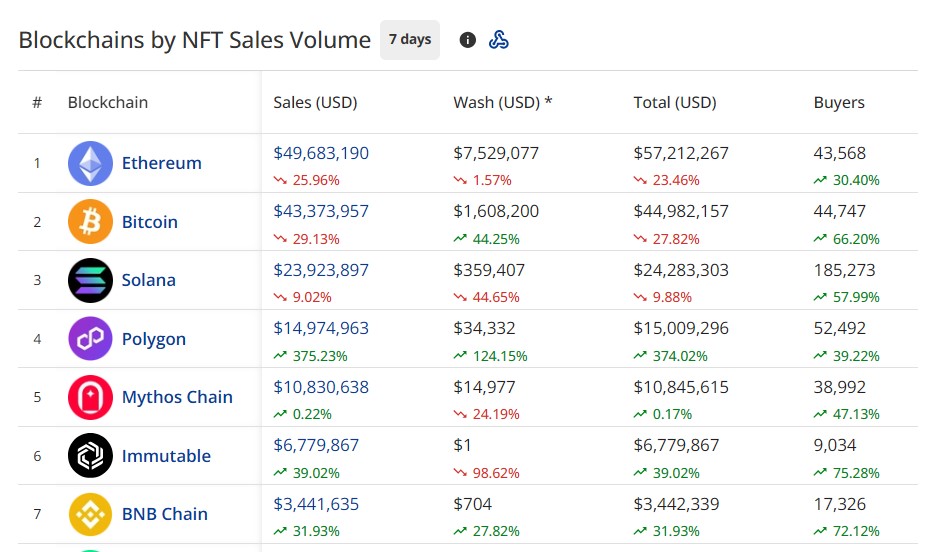

Лидирующие сети по объему продаж NFT за последнюю неделю. Источник: CryptoSlam

Сеть Solana сохранила свой рейтинг на третьем месте по объему продаж цифровых коллекционных предметов. Сеть зафиксировала 23,9 миллиона долларов еженедельных продаж, что на 9% меньше, чем на предыдущей неделе. Между тем, Polygon, Mythos Chain, Immutable и BNB Chain в совокупности зафиксировали объем продаж в размере 35,8 миллиона долларов за неделю.

Solana лидировала среди всех блокчейнов по количеству покупателей NFT. Данные CryptoSlam показали, что у Solana было более 185 000 покупателей NFT за неделю, что на 58% больше, чем 117 000 на предыдущей неделе.

Средняя стоимость транзакции во всех сетях немного снизилась, с 133,08 до 126,17 долларов.

Ежемесячные объемы продаж продолжают расти

NFT на пути к завершению ноября с сильным импульсом.

В октябре объем продаж NFT составил 356 миллионов долларов, что на 18% больше, чем в сентябре.

Текущие еженедельные показатели продаж указывают на устойчивый интерес к NFT, несмотря на колебания рынка. Рост покупательской активности Solana и доминирование Ethereum в объеме продаж подчеркивают различную динамику среди ведущих блокчейнов в сфере цифровых предметов коллекционирования.

Эта положительная траектория следует за сильными показателями октября, которые завершили семимесячную тенденцию к снижению продаж NFT.


Trending Cryptos

Related Reads

The Strategy That Would Never Sell Bitcoin Opened a Permanent Sales Channel

MicroStrategy, a company long known for its "never sell Bitcoin" mantra, announced a "Digital Credit Capital Framework" allowing it to sell up to $1.25 billion worth of Bitcoin. Surprisingly, its stock (MSTR) rose nearly 7% pre-market. This shift, coming just a month after a small, "ad-hoc" sale of 32 BTC for dividends, transitions from a temporary action to a formal, institutional tool. The framework outlines four clear purposes for potential sales: bolstering USD reserves, paying preferred stock dividends/interest, and repurchasing its own preferred and common stock. The key driver for this change is the immense financial pressure from MicroStrategy's complex capital structure, specifically its massive $8.5 billion perpetual preferred stock (STRC). STRC features a variable interest rate that has been reset upward eight times in a year to 12% in an attempt to stabilize its price. However, the stock has fallen over 25% below its face value. Combined with other preferred stocks and convertible notes, MicroStrategy's total annual fixed obligations now stand at $1.76 billion, equating to a daily burn of roughly $4.8 million. While its $2.55 billion in USD reserves and the new $1.25 billion BTC sales framework provide a two-year+ runway, a dangerous feedback loop exists. Falling Bitcoin prices would force the sale of more BTC to meet fixed obligations, potentially creating further sell-side pressure and lowering MSTR's asset valuation multiple. This, in turn, limits its ability to raise cash through stock issuance. The market's positive reaction likely stems from relief; the framework replaces fears of a forced, disorderly sell-off with a structured plan. However, it does not resolve the underlying high-cost capital structure, leaving the company's long-term health heavily dependent on Bitcoin's price performance.

marsbit13m ago

The Strategy That Would Never Sell Bitcoin Opened a Permanent Sales Channel

marsbit13m ago

OpenClaw and Cursor Just Invaded Phones! Agents Are Now in Your Pocket

AI Agents have officially arrived on mobile. In a landmark move, both OpenClaw and Cursor launched native mobile apps on the same day, fundamentally shifting how AI assistants are accessed and controlled. OpenClaw has released full-featured native apps for iOS and Android. Its "local-first" architecture, developed by the OpenClaw Foundation, keeps user data private by running the agent on a user's private Gateway. The mobile app now allows seamless remote control and approval of the agent's actions directly from a smartphone, with access to device capabilities like the camera, GPS, and contacts. Simultaneously, Cursor, the AI-powered coding tool, launched a public beta of its native iOS app. It enables developers to start and manage cloud-based AI coding agents from their phones. These agents can work asynchronously for extended periods—debugging, writing code, and creating pull requests—while developers are away from their computers. The app sends notifications for key decisions, allowing users to review and merge PRs from anywhere. Together, these releases signal a major shift: AI agents are no longer confined to desktop browsers or terminals. They are becoming persistent, autonomous assistants that work independently in the cloud, with humans transitioning from constant operators to mobile supervisors who approve key steps. The era of pocket-sized, on-demand AI is now here.

marsbit26m ago

OpenClaw and Cursor Just Invaded Phones! Agents Are Now in Your Pocket

marsbit26m ago

Trading

Spot

Hot Articles

What is $BITCOIN

DIGITAL GOLD ($BITCOIN): A Comprehensive Analysis Introduction to DIGITAL GOLD ($BITCOIN) DIGITAL GOLD ($BITCOIN) is a blockchain-based project operating on the Solana network, which aims to combine the characteristics of traditional precious metals with the innovation of decentralized technologies. While it shares a name with Bitcoin, often referred to as “digital gold” due to its perception as a store of value, DIGITAL GOLD is a separate token designed to create a unique ecosystem within the Web3 landscape. Its goal is to position itself as a viable alternative digital asset, although specifics regarding its applications and functionalities are still developing. What is DIGITAL GOLD ($BITCOIN)? DIGITAL GOLD ($BITCOIN) is a cryptocurrency token explicitly designed for use on the Solana blockchain. In contrast to Bitcoin, which provides a widely recognized value storage role, this token appears to focus on broader applications and characteristics. Notable aspects include: Blockchain Infrastructure: The token is built on the Solana blockchain, known for its capacity to handle high-speed and low-cost transactions. Supply Dynamics: DIGITAL GOLD has a maximum supply capped at 100 quadrillion tokens (100P $BITCOIN), although details regarding its circulating supply are currently undisclosed. Utility: While precise functionalities are not explicitly outlined, there are indications that the token could be utilized for various applications, potentially involving decentralized applications (dApps) or asset tokenization strategies. Who is the Creator of DIGITAL GOLD ($BITCOIN)? At present, the identity of the creators and development team behind DIGITAL GOLD ($BITCOIN) remains unknown. This situation is typical among many innovative projects within the blockchain space, particularly those aligning with decentralized finance and meme coin phenomena. While such anonymity may foster a community-driven culture, it intensifies concerns about governance and accountability. Who are the Investors of DIGITAL GOLD ($BITCOIN)? The available information indicates that DIGITAL GOLD ($BITCOIN) does not have any known institutional backers or prominent venture capital investments. The project seems to operate on a peer-to-peer model focused on community support and adoption rather than traditional funding routes. Its activity and liquidity are primarily situated on decentralized exchanges (DEXs), such as PumpSwap, rather than established centralized trading platforms, further highlighting its grassroots approach. How DIGITAL GOLD ($BITCOIN) Works The operational mechanics of DIGITAL GOLD ($BITCOIN) can be elaborated on based on its blockchain design and network attributes: Consensus Mechanism: By leveraging Solana’s unique proof-of-history (PoH) combined with a proof-of-stake (PoS) model, the project ensures efficient transaction validation contributing to the network's high performance. Tokenomics: While specific deflationary mechanisms have not been extensively detailed, the vast maximum token supply implies that it may cater to microtransactions or niche use cases that are still to be defined. Interoperability: There exists the potential for integration with Solana’s broader ecosystem, including various decentralized finance (DeFi) platforms. However, the details regarding specific integrations remain unspecified. Timeline of Key Events Here is a timeline that highlights significant milestones concerning DIGITAL GOLD ($BITCOIN): 2023: The initial deployment of the token occurs on the Solana blockchain, marked by its contract address. 2024: DIGITAL GOLD gains visibility as it becomes available for trading on decentralized exchanges like PumpSwap, allowing users to trade it against SOL. 2025: The project witnesses sporadic trading activity and potential interest in community-led engagements, although no noteworthy partnerships or technical advancements have been documented as of yet. Critical Analysis Strengths Scalability: The underlying Solana infrastructure supports high transaction volumes, which could enhance the utility of $BITCOIN in various transaction scenarios. Accessibility: The potential low trading price per token could attract retail investors, facilitating wider participation due to fractional ownership opportunities. Risks Lack of Transparency: The absence of publicly known backers, developers, or an audit process may yield skepticism regarding the project's sustainability and trustworthiness. Market Volatility: The trading activity is heavily reliant on speculative behavior, which can result in significant price volatility and uncertainty for investors. Conclusion DIGITAL GOLD ($BITCOIN) emerges as an intriguing yet ambiguous project within the rapidly evolving Solana ecosystem. While it attempts to leverage the “digital gold” narrative, its departure from Bitcoin's established role as a store of value underscores the need for a clearer differentiation of its intended utility and governance structure. Future acceptance and adoption will likely depend on addressing the current opacity and defining its operational and economic strategies more explicitly. Note: This report encompasses synthesised information available as of October 2023, and developments may have transpired beyond the research period.

520 Total ViewsPublished 2025.05.13Updated 2025.05.13

What is $BITCOIN

Discussions

Welcome to the HTX Community. Here, you can stay informed about the latest platform developments and gain access to professional market insights. Users' opinions on the price of BTC (BTC) are presented below.

活动图片