BTC 直逼 9 万美元,10 万大关触手可及

链捕手Published on 2024-11-12Last updated on 2024-11-12

作者:BitpushNews


特朗普胜选引发的交易热潮持续升温。

周一,比特币一骑绝尘,以超 10% 的惊人涨幅,强势站上 8.9 万美元,最高触及 89,575.96 美元。以太坊上涨 6.4%,超过 3,300 美元,Solana (SOL) 上涨 6.7%,突破 220 美元。投资者热情空前高涨,比推数据显示,自 2021 年 11 月(上一轮牛市高峰)以来,加密货币总市值首次突破 3.1 万亿美元。

美股方面,加密货币概念股当日大涨,嘉楠科技 (CAN.O) 涨 41%,MicroStrategy(MSTR.O) 涨 25%,收盘价创下 340 美元的历史新高,该公司周一宣布加仓 27,200 枚比特币,总持有量达到 279,420 枚,按当前价格计算价值约 245 亿美元。Coinbase(COIN.O) 涨 19%,Robinhood ( HOOD ) 股价上涨逾 7%,五天内涨幅逾 35%。此前彭博社报道称,Robinhood 法律负责人 Dan Gallagher 是特朗普团队考虑领导美 SEC 的候选人之一。

ETF 交易量续创新高

自大选以来,现货加密货币 ETF 的资金流入量接连攀升。

随着比特币首次飙升至 88,000 美元以上,贝莱德现货比特币 ETF 也创下了新的日交易量记录,彭博社数据显示,贝莱德的现货比特币 ETF 日交易量达到 45 亿美元。
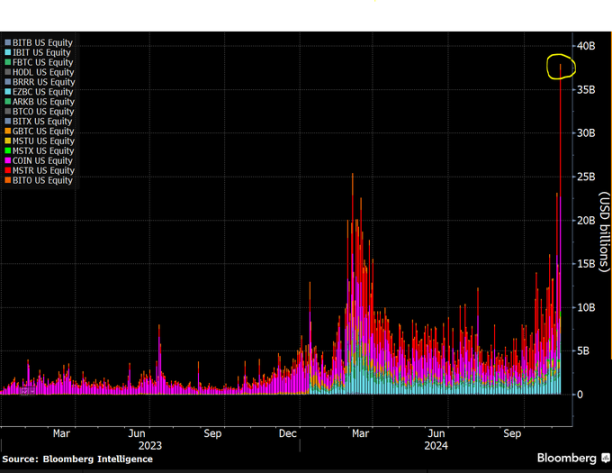
花旗策略师在一份研究报告中强调,加密货币是「少数尚未回撤的特朗普交易」之一。

策略师团队表示:「部分原因在于特朗普政府预期将对加密货币持友好态度,投资者希望这将转化为美国的监管清晰度。具体来说,选举后两天内 BTC 和 ETH ETF 的净流入分别为 20.1 亿美元和 1.32 亿美元。我们继续将 ETF 资金流入视为比特币涨幅的主要驱动力。」

特朗普物色加密友好团队,监管风暴或将平息

SEC 互联网执法办公室前负责人 John Reed Stark 近日爆料称,随着特朗普赢得美国总统大选,SEC 对加密货币的严厉监管或将迎来转机。

Stark 在 Twitter Space 中预测:「未来几年,SEC 不太可能对加密货币行业发起大规模的欺诈诉讼。」这一说法无疑给饱受监管困扰的加密行业注入了一针强心剂。

Stark 认为,随着特朗普的当选,对加密货币的过度监管将成为过去,新任 SEC 主席将会更加友好,他还预测,Gensler 可能会在特朗普就职前主动辞职,以避免被解雇的尴尬局面。

Coinbase 首席执行官 Brian Armstrong 也认为这将是「有史以来最支持加密货币的国会」。

总的来说,随着共和党在控制参议院后即将夺得众议院控制权,加密行业将迎来一个更加友好的监管环境。然而,具体政策走向仍需等待新任 SEC 主席上任后才能最终确定。

Fundstrat 数字资产策略主管 Sean Farrell 周一在 X 帖子中表示:「市场可能对某些人来说似乎存在泡沫,但请理解,我们只是在一夜之间从客观上压迫性的监管制度转变为过度友好的监管制度。图表完全有理由证明 BTC 的阶梯式回报。」

年底前比特币价格可能达到 12.5 万美元

传奇交易员 Peter Brandt 表示,比特币可能在新年夜之前达到 12.5 万美元。

Brandt 在 X 平台指出,比特币在价格上涨时往往会重复其强劲的市场表现模式。他分析了比特币当前突破历史最高点位的走势,并基于贝叶斯概率理论预测其价格可能达到 12.5 万美元。

简单来说,贝叶斯概率 ( 又称贝叶斯定理 ) 是通过现有数据来计算未来事件发生概率的一种方法。对于交易者而言,它可以通过比较过去类似情况下的资产表现,帮助他们设定价格目标,应对不确定的价格波动。

Brandt 基于贝叶斯定理分析了比特币 2024 年第一季度的价格走势,认为其可能会在 2024 年第四季度复制这一模式,并在 2024 年新年夜之前触及 12.5 万美元的高点。

另一位交易员 Titan of Crypto 则预测比特币的看涨三角形目标价为 15.8 万美元。他认为,比特币周线图上金叉的出现是看涨趋势持续的关键因素,并指出 10 万美元是 2024 年第二波牛市的首个目标价。
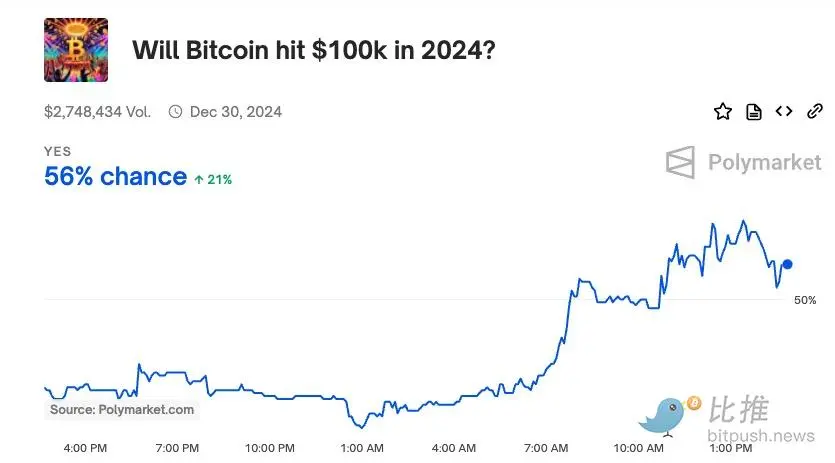
截至发稿时,在成功预测特朗普胜选的 Polymarket 市场上,用户押注「比特币年底突破 10 万美元」的几率升至 56%,按 8.9 万美元的价格来看,目前 BTC 距离 10 万的目标仅差 11%。


Trending Cryptos

Related Reads

Breaking News: Musk Delivers the Most Powerful Grok 4.5, Slashes Price of Top-tier Opus Intelligence Drastically

**Elon Musk Launches Grok 4.5: A Cost-Effective, High-Performance AI Rival** SpaceXAI, in collaboration with Cursor, has released Grok 4.5, its new flagship AI model designed specifically for coding and agentic tasks. Trained on tens of thousands of NVIDIA GB300 GPUs using massive, high-quality data filtered from trillions of Cursor developer interactions, the model emphasizes "per-token intelligence." In benchmark performance, Grok 4.5 is highly competitive. It scores 64.7% on SWE Bench Pro (surpassing GPT-5.5's 58.6% and Opus 4.7's 64.3%), 83.3% on Terminal Bench 2.1 (nearly matching GPT-5.5), and 62.0% on DeepSWE 1.0 (beating Opus 4.8). Overall, it ranks fourth in AAAI official tests and first in the Harvey legal agent benchmark. The model's key advantage is its combination of speed, efficiency, and low cost. It generates responses at 80 tokens per second and, crucially, uses far fewer tokens to complete tasks—4.2 times fewer than Opus 4.8 on SWE Bench Pro. It is priced at $2 per million input tokens and $6 per million output tokens, significantly undercutting competitors. Musk stated it is "roughly equivalent to Opus 4.7, but much faster." Early user tests show Grok 4.5 can generate functional code for applications like 3D solar system simulators and basic games from simple prompts, though some note it still lags behind top models in certain creative tasks. Musk has hinted at a major update next month, leveraging real-world engineering data from his companies, with an even larger 2-trillion parameter version reportedly in development. Grok 4.5 positions itself not as the absolute strongest model, but as a highly efficient and affordable alternative in the top tier.

marsbit2m ago

Breaking News: Musk Delivers the Most Powerful Grok 4.5, Slashes Price of Top-tier Opus Intelligence Drastically

marsbit2m ago

Today, The Hong Kong Exchange Was Once Again Overwhelmed

Hong Kong's stock exchange witnessed an exceptionally busy day on July 9, with a record seven companies conducting initial public offerings (IPOs) simultaneously. The list included major firms such as Luxshare Precision, which launched the largest Hong Kong IPO of the year, and other notable names like Tri-Ring Group and Qiyunshan Food. However, the market reception was sharply divided on the first trading day. While Qiyunshan Food's shares surged over 110%, several other newcomers, including Luxshare Precision, Dingtai High-Tech, and Rigol Technologies, opened below their issue prices, with some falling nearly 20%. This event highlights a broader, bustling IPO scene in Hong Kong for 2024, with 82 Chinese companies listing in the first half alone—more than double the figure from the same period last year. A significant portion of this activity comes from dual "A+H" listings, where mainland China-listed firms seek secondary listings in Hong Kong. These larger companies have accounted for nearly 60% of total fundraising. Despite the high volume, recent trends show a cooling market sentiment for many new listings. Several IPOs in early July, including that of Tongrentang Healthcare, debuted with significant losses, indicating increased investor caution and selectivity. The market narrative is shifting, with capital increasingly concentrating on high-growth sectors like artificial intelligence, robotics, and semiconductors, while traditional manufacturing and consumer goods face greater pressure and volatility. This divergence underscores a market where success is no longer guaranteed by merely listing, but depends heavily on a company's growth prospects and sector appeal.

marsbit6m ago

Today, The Hong Kong Exchange Was Once Again Overwhelmed

marsbit6m ago

Glassnode: Crypto Market Enters Later Stages of Bottoming Phase

Glassnode: Crypto Market Enters Later Stages of Bottom Formation Bitcoin has traded below the true market average and the short-term holder cost basis for five consecutive months, indicating a deep undervaluation. On-chain data reveals a significant shift in selling pressure, with long-term holders now accounting for 43% of all realized losses. Daily realized losses for this group recently peaked at $280 million, the highest level since December 2022. While this large-scale capitulation is a hallmark of bear market bottoms, a sustained decline in this metric is a prerequisite for a sustained recovery. Institutional demand remains weak. US spot Bitcoin ETFs continue to see monthly net outflows, although the pace has moderated from June's peak. Furthermore, average daily ETF trading volumes have contracted by approximately 80% from their October 2025 peak, reflecting subdued institutional participation. Derivatives markets present a mixed picture. Overall positioning has shifted to cautiously bullish, with the put/call ratio dropping to a yearly low. However, the options volatility skew remains elevated, signaling that traders are still paying a premium for downside protection. The spot price also trades below the gamma "max pain" level. In summary, multiple indicators suggest the market is in the later phases of a bottoming process, characterized by long-term holder capitulation and weak institutional inflows. However, key confirmation signals for a durable trend reversal—a sustained drop in long-term holder selling pressure, stabilization of ETF flows, and a price recovery above key cost bases—are still pending.

Foresight News32m ago

Glassnode: Crypto Market Enters Later Stages of Bottoming Phase

Foresight News32m ago

Private Credit in US Dollar

Stablecoins are evolving into a new type of money market fund, channeling crypto deposits into the $2 trillion private credit market. This mirrors the 1970s innovation where money market funds pooled small deposits to buy high-yield government securities, bypassing bank restrictions. Today, platforms like Apollo's ACRED tokenized fund and Figure's on-chain lending system allow stablecoin holders to access institutional private credit strategies with no minimum investment, offering yields of 8-12%. On-chain tokenization enables greater liquidity and DeFi composability (e.g., using tokens as collateral for leveraged positions) compared to traditional, locked-up private credit funds. Consequently, on-chain private credit has grown 15x in a year to $5.87 billion, though it remains a tiny fraction (0.3%) of the global market. However, this model carries significant risks, as illustrated by the failure of Goldfinch. Launched in 2021, it directed crypto deposits to motorcycle loans in Kenya and Nigeria. Critical issues included a lack of local oversight, leading to unauthorized fund transfers and borrower defaults. With $56 million now trapped in non-performing loans, its collapse highlights that while blockchain streamlines capital transfer, the essential 90% of lending—underwriting, monitoring, and recovery—remains a costly, localized challenge. Success requires robust, traditional credit infrastructure, not just on-chain execution.

marsbit53m ago

Private Credit in US Dollar

marsbit53m ago

Trading

Spot

Hot Articles

What is $BITCOIN

DIGITAL GOLD ($BITCOIN): A Comprehensive Analysis Introduction to DIGITAL GOLD ($BITCOIN) DIGITAL GOLD ($BITCOIN) is a blockchain-based project operating on the Solana network, which aims to combine the characteristics of traditional precious metals with the innovation of decentralized technologies. While it shares a name with Bitcoin, often referred to as “digital gold” due to its perception as a store of value, DIGITAL GOLD is a separate token designed to create a unique ecosystem within the Web3 landscape. Its goal is to position itself as a viable alternative digital asset, although specifics regarding its applications and functionalities are still developing. What is DIGITAL GOLD ($BITCOIN)? DIGITAL GOLD ($BITCOIN) is a cryptocurrency token explicitly designed for use on the Solana blockchain. In contrast to Bitcoin, which provides a widely recognized value storage role, this token appears to focus on broader applications and characteristics. Notable aspects include: Blockchain Infrastructure: The token is built on the Solana blockchain, known for its capacity to handle high-speed and low-cost transactions. Supply Dynamics: DIGITAL GOLD has a maximum supply capped at 100 quadrillion tokens (100P $BITCOIN), although details regarding its circulating supply are currently undisclosed. Utility: While precise functionalities are not explicitly outlined, there are indications that the token could be utilized for various applications, potentially involving decentralized applications (dApps) or asset tokenization strategies. Who is the Creator of DIGITAL GOLD ($BITCOIN)? At present, the identity of the creators and development team behind DIGITAL GOLD ($BITCOIN) remains unknown. This situation is typical among many innovative projects within the blockchain space, particularly those aligning with decentralized finance and meme coin phenomena. While such anonymity may foster a community-driven culture, it intensifies concerns about governance and accountability. Who are the Investors of DIGITAL GOLD ($BITCOIN)? The available information indicates that DIGITAL GOLD ($BITCOIN) does not have any known institutional backers or prominent venture capital investments. The project seems to operate on a peer-to-peer model focused on community support and adoption rather than traditional funding routes. Its activity and liquidity are primarily situated on decentralized exchanges (DEXs), such as PumpSwap, rather than established centralized trading platforms, further highlighting its grassroots approach. How DIGITAL GOLD ($BITCOIN) Works The operational mechanics of DIGITAL GOLD ($BITCOIN) can be elaborated on based on its blockchain design and network attributes: Consensus Mechanism: By leveraging Solana’s unique proof-of-history (PoH) combined with a proof-of-stake (PoS) model, the project ensures efficient transaction validation contributing to the network's high performance. Tokenomics: While specific deflationary mechanisms have not been extensively detailed, the vast maximum token supply implies that it may cater to microtransactions or niche use cases that are still to be defined. Interoperability: There exists the potential for integration with Solana’s broader ecosystem, including various decentralized finance (DeFi) platforms. However, the details regarding specific integrations remain unspecified. Timeline of Key Events Here is a timeline that highlights significant milestones concerning DIGITAL GOLD ($BITCOIN): 2023: The initial deployment of the token occurs on the Solana blockchain, marked by its contract address. 2024: DIGITAL GOLD gains visibility as it becomes available for trading on decentralized exchanges like PumpSwap, allowing users to trade it against SOL. 2025: The project witnesses sporadic trading activity and potential interest in community-led engagements, although no noteworthy partnerships or technical advancements have been documented as of yet. Critical Analysis Strengths Scalability: The underlying Solana infrastructure supports high transaction volumes, which could enhance the utility of $BITCOIN in various transaction scenarios. Accessibility: The potential low trading price per token could attract retail investors, facilitating wider participation due to fractional ownership opportunities. Risks Lack of Transparency: The absence of publicly known backers, developers, or an audit process may yield skepticism regarding the project's sustainability and trustworthiness. Market Volatility: The trading activity is heavily reliant on speculative behavior, which can result in significant price volatility and uncertainty for investors. Conclusion DIGITAL GOLD ($BITCOIN) emerges as an intriguing yet ambiguous project within the rapidly evolving Solana ecosystem. While it attempts to leverage the “digital gold” narrative, its departure from Bitcoin's established role as a store of value underscores the need for a clearer differentiation of its intended utility and governance structure. Future acceptance and adoption will likely depend on addressing the current opacity and defining its operational and economic strategies more explicitly. Note: This report encompasses synthesised information available as of October 2023, and developments may have transpired beyond the research period.

683 Total ViewsPublished 2025.05.13Updated 2025.05.13

What is $BITCOIN

Discussions

Welcome to the HTX Community. Here, you can stay informed about the latest platform developments and gain access to professional market insights. Users' opinions on the price of BTC (BTC) are presented below.

活动图片