Брандт говорит, что биткоин повлияет на фондовые рынки в будущем, и определяет критический уровень прорыва BTC

cryptonews.ruPublished on 2022-11-15Last updated on 2024-10-15

Ветеран рынка Питер Брандт определяет важный ценовой уровень, который биткоину необходимо преодолеть, чтобы сломать текущую структуру диапазона.

В последних новостях о биткоине анализ топ-трейдера привлекает внимание к нескольким ценовым точкам и структурам, предполагая, что биткоин приближается к важной зоне. Эта область может определить, пойдет ли цена вверх или поддастся дальнейшей консолидации или снижению.

Биткоин борется

График показывает нисходящий канал, который определял движение биткоина с первого квартала 2024 года. Этот канал удерживал цену в диапазоне, поскольку формировались уровни поддержки и сопротивления.
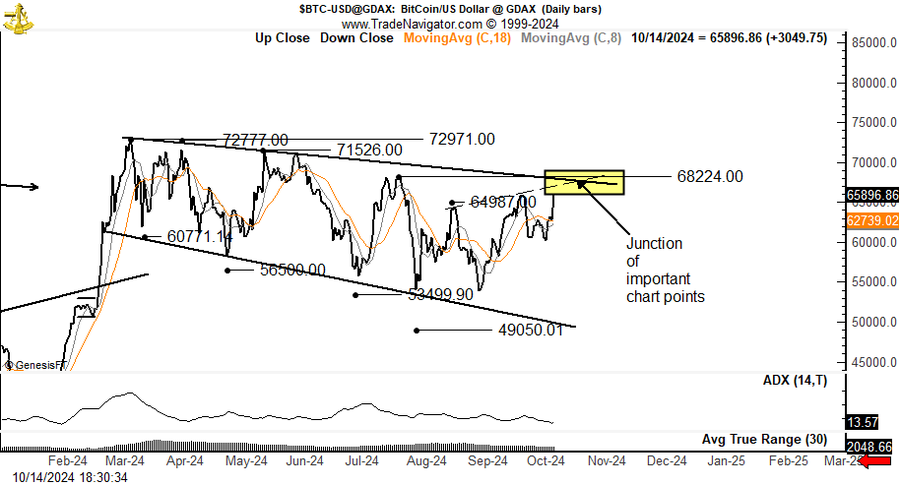
Самый значительный из этих уровней находится около $68 224, который Брандт определяет как «соединение важных точек графика». Движение биткоина через эту зону чрезвычайно важно.

Брандт назвал структуру перевернутым расширяющимся треугольником, а не традиционным медвежьим флагом. Эта треугольная формация может указывать на надвигающийся прорыв, но только если цене удастся пробить сопротивление на уровне $68 224. Пока этого не произойдет, Bitcoin остается уязвимым для большего давления вниз.

Главный криптоактив пытался вырваться на свободу несколько раз, но каждый прорыв не удержался. Это создало медвежий сценарий, в котором давление предложения препятствует устойчивому движению вверх, что приводит к дальнейшему боковому или нисходящему ценовому движению.

Текущие реалии рынка предполагают, что Bitcoin может быть на грани преодоления этого уровня, недавно пробив $66 тыс. на фоне вчерашнего ралли. Однако на момент публикации BTC столкнулся с коррекцией, теперь торгуясь за $65 395. Быкам нужно возобновить импульс, чтобы пробиться выше области $68 тыс.

Для справки, всякий раз, когда происходит такая формация, прорыв может привести к значительному движению. Однако Брандт подчеркнул, что ситуация остается хрупкой, пока рынок не выдержит несколько закрытий выше этого уровня.


Trending Cryptos

Related Reads

Jensen Huang: Prompts are Becoming Obsolete, Loops are the New Paradigm

Jensen Huang, alongside AI leaders like Peter Norvig, Boris Cherny, and Andrew Ng, is advocating for a shift from "prompt engineering" to "loop engineering" as the new paradigm for AI development. Instead of manually crafting individual prompts, the focus is now on designing autonomous loops—systems where AI agents execute tasks, self-validate results, and iterate until completion without constant human oversight. A loop is a management framework that enables agents to operate independently. Key implementations are seen in Claude Code (with features like /loop, /goal, and /schedule) and OpenAI Codex, which employ multiple agents working in parallel within isolated environments. A core principle is the separation of roles: one agent (or model) performs the task, while an independent agent (or a smaller, separate model) validates the output to ensure objectivity. The article outlines a practical roadmap for implementing loops, starting with a "four-condition test" to assess suitability, building a minimal viable loop, and emphasizing critical pitfalls to avoid, such as lacking hard stop conditions or allowing loops to handle tasks requiring human judgment. This evolution is framed as the fourth major shift in AI interaction: from Prompt Engineering (crafting instructions) to Context Engineering (providing background information), then to Harness Engineering (building tool-enabled environments), and finally to Loop Engineering (creating self-sustaining systems). This progression reflects a consistent trend of increasing abstraction, moving human involvement from direct instruction to system design and rule-setting. The concept has academic roots in frameworks like ReAct, which formalized the "reason-act-observe" cycle. While loop engineering promises greater automation, experts caution about managing token costs and warn against outsourcing understanding—AI can assist, but deep problem comprehension remains essential.

marsbit1h ago

Jensen Huang: Prompts are Becoming Obsolete, Loops are the New Paradigm

marsbit1h ago

GPT Designs GPT

OpenAI has unveiled its first custom AI chip, Jalapeño, a move signaling a strategic shift beyond being a mere model company. While many see it as a challenge to NVIDIA, its core aim is to control the entire intelligent production pipeline—from models and chips to data centers and energy. The key driver is the evolving competitive landscape: model advantages are shrinking, while the computational gap in areas like cost-per-token, system throughput, and energy efficiency is becoming the true long-term barrier. Jalapeño is primarily an inference chip, targeting the massive and growing "inference tax"—the daily operational cost of generating tokens for services like ChatGPT and APIs. By designing its own hardware optimized for its specific workloads and future product roadmaps (even using AI to aid the chip design process), OpenAI aims to drastically reduce token generation costs and improve system efficiency. This creates a potential flywheel: better models help design better chips, which lower costs for running next-generation models, supporting more users and products, which in turn provides more data to refine future chips. The strategy mirrors Apple’s integrated approach, building a closed loop where hardware, software, and applications are co-optimized. In the long term, OpenAI is not trying to become the next NVIDIA (a supplier of "shovels" to all AI companies) but to own and operate the entire "mine"—selling the end product of intelligence itself. This move marks OpenAI's ambition to evolve from creating the smartest models to controlling the foundational infrastructure of AI production.

marsbit1h ago

GPT Designs GPT

marsbit1h ago

Trading

Spot
Futures

Hot Articles

What is $BITCOIN

DIGITAL GOLD ($BITCOIN): A Comprehensive Analysis Introduction to DIGITAL GOLD ($BITCOIN) DIGITAL GOLD ($BITCOIN) is a blockchain-based project operating on the Solana network, which aims to combine the characteristics of traditional precious metals with the innovation of decentralized technologies. While it shares a name with Bitcoin, often referred to as “digital gold” due to its perception as a store of value, DIGITAL GOLD is a separate token designed to create a unique ecosystem within the Web3 landscape. Its goal is to position itself as a viable alternative digital asset, although specifics regarding its applications and functionalities are still developing. What is DIGITAL GOLD ($BITCOIN)? DIGITAL GOLD ($BITCOIN) is a cryptocurrency token explicitly designed for use on the Solana blockchain. In contrast to Bitcoin, which provides a widely recognized value storage role, this token appears to focus on broader applications and characteristics. Notable aspects include: Blockchain Infrastructure: The token is built on the Solana blockchain, known for its capacity to handle high-speed and low-cost transactions. Supply Dynamics: DIGITAL GOLD has a maximum supply capped at 100 quadrillion tokens (100P $BITCOIN), although details regarding its circulating supply are currently undisclosed. Utility: While precise functionalities are not explicitly outlined, there are indications that the token could be utilized for various applications, potentially involving decentralized applications (dApps) or asset tokenization strategies. Who is the Creator of DIGITAL GOLD ($BITCOIN)? At present, the identity of the creators and development team behind DIGITAL GOLD ($BITCOIN) remains unknown. This situation is typical among many innovative projects within the blockchain space, particularly those aligning with decentralized finance and meme coin phenomena. While such anonymity may foster a community-driven culture, it intensifies concerns about governance and accountability. Who are the Investors of DIGITAL GOLD ($BITCOIN)? The available information indicates that DIGITAL GOLD ($BITCOIN) does not have any known institutional backers or prominent venture capital investments. The project seems to operate on a peer-to-peer model focused on community support and adoption rather than traditional funding routes. Its activity and liquidity are primarily situated on decentralized exchanges (DEXs), such as PumpSwap, rather than established centralized trading platforms, further highlighting its grassroots approach. How DIGITAL GOLD ($BITCOIN) Works The operational mechanics of DIGITAL GOLD ($BITCOIN) can be elaborated on based on its blockchain design and network attributes: Consensus Mechanism: By leveraging Solana’s unique proof-of-history (PoH) combined with a proof-of-stake (PoS) model, the project ensures efficient transaction validation contributing to the network's high performance. Tokenomics: While specific deflationary mechanisms have not been extensively detailed, the vast maximum token supply implies that it may cater to microtransactions or niche use cases that are still to be defined. Interoperability: There exists the potential for integration with Solana’s broader ecosystem, including various decentralized finance (DeFi) platforms. However, the details regarding specific integrations remain unspecified. Timeline of Key Events Here is a timeline that highlights significant milestones concerning DIGITAL GOLD ($BITCOIN): 2023: The initial deployment of the token occurs on the Solana blockchain, marked by its contract address. 2024: DIGITAL GOLD gains visibility as it becomes available for trading on decentralized exchanges like PumpSwap, allowing users to trade it against SOL. 2025: The project witnesses sporadic trading activity and potential interest in community-led engagements, although no noteworthy partnerships or technical advancements have been documented as of yet. Critical Analysis Strengths Scalability: The underlying Solana infrastructure supports high transaction volumes, which could enhance the utility of $BITCOIN in various transaction scenarios. Accessibility: The potential low trading price per token could attract retail investors, facilitating wider participation due to fractional ownership opportunities. Risks Lack of Transparency: The absence of publicly known backers, developers, or an audit process may yield skepticism regarding the project's sustainability and trustworthiness. Market Volatility: The trading activity is heavily reliant on speculative behavior, which can result in significant price volatility and uncertainty for investors. Conclusion DIGITAL GOLD ($BITCOIN) emerges as an intriguing yet ambiguous project within the rapidly evolving Solana ecosystem. While it attempts to leverage the “digital gold” narrative, its departure from Bitcoin's established role as a store of value underscores the need for a clearer differentiation of its intended utility and governance structure. Future acceptance and adoption will likely depend on addressing the current opacity and defining its operational and economic strategies more explicitly. Note: This report encompasses synthesised information available as of October 2023, and developments may have transpired beyond the research period.

451 Total ViewsPublished 2025.05.13Updated 2025.05.13

What is $BITCOIN

Discussions

Welcome to the HTX Community. Here, you can stay informed about the latest platform developments and gain access to professional market insights. Users' opinions on the price of BTC (BTC) are presented below.

活动图片