Bitcoin Sentiment Remains Neutral As Traders Hesitant To Become Bullish

bitcoinistPublished on 2024-09-23Last updated on 2024-09-23

Abstract

Data shows the Bitcoin trader sentiment has remained neutral recently, suggesting the market is currently not sure about a bullish...

Data shows the Bitcoin trader sentiment has remained neutral recently, suggesting the market is currently not sure about a bullish outcome.

Bitcoin Price Has Taken To Sideways Movement Recently

After showing a strong recovery surge last week, Bitcoin has hit a bit of a pause in the past few days, as the cryptocurrency’s price has been unable to pick a direction.

The below chart shows how the asset’s performance has looked like over the last month:

Bitcoin Price Chart

The price of the coin has seen notable growth over the last few weeks | Source: BTCUSDT on TradingView

Despite the slowdown, Bitcoin is still carrying notable weekly profits of around 8%. The sideways movement, though, does seem to have had an effect on the investor morale.

Fear & Greed Index Is Currently Signaling A Neutral Market

The “Fear & Greed Index” is an indicator devised by Alternative that tells us about the sentiment of the average trader in the Bitcoin and the wider cryptocurrency markets. The index uses the following five factors to determine the sentiment: volatility, trading volume, social media sentiment, market cap dominance, and Google Trends. Once found, the indicator represents it as a score lying between zero and hundred.

When the value of the metric is greater than 53, it means the investors as a whole share a sentiment of greed. Similarly, it being under 47 suggests fear being dominant in the market.

The region in-between these two cutoffs naturally corresponds to the neutral mentality. It would appear that the Bitcoin investor sentiment is currently in this third category, as the Fear & Greed Index has a value of 50.
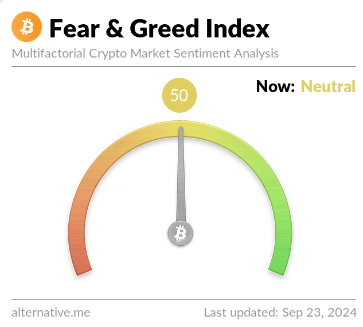
Bitcoin Fear & Greed Index

The latest value of the Fear & Greed Index | Source: Alternative

Just after the recent rally, the indicator had hit a value of 54, suggesting that the investors had started to become slightly bullish on Bitcoin and other cryptocurrencies.

This foray into the greed territory had been the index’s first since late August, but as the latest value of the indicator suggests, this renewed market optimism couldn’t maintain. The reason behind the sentiment degrading into the neutral region is naturally the slowdown of the bullish push in the asset’s price.

Historically, the BTC price has tended to move in the direction opposite to what the crowd is expecting, with the probability of such a contrary move going up the more sure the investors become.

The Fear & Greed Index has two special zones called the extreme fear (below 25) and the extreme greed (above 75) where this likelihood could be assumed to be the strongest.

At present, though, the market sentiment is as far away from either of the zones as it can be, so it’s hard to say where Bitcoin and others might go next. Assuming that the sector is still in a bull market, however, any hesitancy from the investors can be a positive sign, as it suggests there isn’t any hype yet to impede any rallies.

It now remains to be seen how the price of Bitcoin, and hence, the market sentiment, will develop from here on out.

Featured image from Dall-E, Alternative.net, chart from TradingView.com
Keshav Verma

Keshav Verma

Keshav is a Physics graduate who has been employed as a writer with Bitcoinist since June 2021. He is passionate about writing and through the years, he has gained experience working in a variety of niches. Keshav holds an active interest in the cryptocurrency market, with on-chain analysis being an area he particularly likes to research and write about.

Trending Cryptos

Related Reads

Opinion: AI Bubble Bursts, Bitcoin and Other Risky Assets Are the First to Be Impacted

BIS Warns AI Investment Boom Could Trigger Market Stress, Impacting Bitcoin First The Bank for International Settlements (BIS) warns that a potential bursting of the "AI bubble" could tighten liquidity and severely impact risk assets like Bitcoin in the near term. Major tech firms are projected to spend over $1 trillion on AI infrastructure in 2025-2026. The BIS cautions that if returns fail to meet expectations, a sudden withdrawal of financing could turn this investment boom into a prolonged bust, creating ripple effects across financial markets. While AI holds long-term economic promise, the current scale and speed of investment, coupled with intense competition and physical bottlenecks (e.g., semiconductors, power grids), mirror historical bubbles. The report highlights that the AI funding web—spanning corporate debt, private credit, and complex vendor agreements—makes systemic risks harder to see. A disappointment in AI adoption could transmit stress through this chain, widening credit spreads and pressuring weaker borrowers. For Bitcoin, the initial reaction to such a market shock would likely be defensive. As liquidity tightens, investors typically sell liquid assets first, and Bitcoin often trades in line with other risk assets during portfolio de-risking. Recent correlations, like Bitcoin's drop following a sharp decline in South Korea's stock market, support this view. However, the longer-term outcome for Bitcoin depends on the policy response. If an AI-driven credit crunch forces central banks to inject liquidity and ease policy eventually, it could reignite Bitcoin's narrative as a hedge against monetary debasement. Yet, traders betting on this outcome may first have to endure significant market volatility and potential price declines.

marsbit1h ago

Opinion: AI Bubble Bursts, Bitcoin and Other Risky Assets Are the First to Be Impacted

marsbit1h ago

South Korea Reaps Riches, America Turns Hostile

The US has filed a collective antitrust lawsuit in California against Samsung, SK Hynix, and US-based Micron, alleging they colluded to create a "RAMpocalypse" by slashing traditional DRAM production and raising prices 700% over four years amid the AI boom. This lawsuit targets the heart of the AI supply chain: High Bandwidth Memory (HBM), critical for Nvidia's GPUs. Currently, SK Hynix (57%), Samsung (22%), and Micron (21%) dominate global HBM production. The case highlights a deeper US concern: in the AI era, South Korea, through its HBM dominance, is capturing an estimated 35% of global AI profits, second only to the US (49%). SK Hynix's operating profit margin recently hit a record 72%. In response to the lawsuit, South Korea announced a massive $800 trillion won investment to build four new chip plants, doubling down on its strategic position. Analysts see the lawsuit not merely as a consumer price issue but as strategic pressure. It aims to support Micron's US manufacturing expansion (subsidized by the CHIPS Act) and secure America's share of AI profits by bringing more HBM production onshore. However, South Korea's rapid execution and massive cash flow from current HBM sales give it a significant speed advantage over US build-out timelines. The conflict underscores a fundamental shift: AI infrastructure like GPUs and HBM is becoming a new form of strategic national resource, akin to oil. While Nvidia and Korean memory giants are interdependent, the struggle over profit distribution and industrial sovereignty in this new landscape is just beginning. This lawsuit may be the first major skirmish in the AI resource wars.

marsbit1h ago

South Korea Reaps Riches, America Turns Hostile

marsbit1h ago

Trading

Spot

Hot Articles

What is $BITCOIN

DIGITAL GOLD ($BITCOIN): A Comprehensive Analysis Introduction to DIGITAL GOLD ($BITCOIN) DIGITAL GOLD ($BITCOIN) is a blockchain-based project operating on the Solana network, which aims to combine the characteristics of traditional precious metals with the innovation of decentralized technologies. While it shares a name with Bitcoin, often referred to as “digital gold” due to its perception as a store of value, DIGITAL GOLD is a separate token designed to create a unique ecosystem within the Web3 landscape. Its goal is to position itself as a viable alternative digital asset, although specifics regarding its applications and functionalities are still developing. What is DIGITAL GOLD ($BITCOIN)? DIGITAL GOLD ($BITCOIN) is a cryptocurrency token explicitly designed for use on the Solana blockchain. In contrast to Bitcoin, which provides a widely recognized value storage role, this token appears to focus on broader applications and characteristics. Notable aspects include: Blockchain Infrastructure: The token is built on the Solana blockchain, known for its capacity to handle high-speed and low-cost transactions. Supply Dynamics: DIGITAL GOLD has a maximum supply capped at 100 quadrillion tokens (100P $BITCOIN), although details regarding its circulating supply are currently undisclosed. Utility: While precise functionalities are not explicitly outlined, there are indications that the token could be utilized for various applications, potentially involving decentralized applications (dApps) or asset tokenization strategies. Who is the Creator of DIGITAL GOLD ($BITCOIN)? At present, the identity of the creators and development team behind DIGITAL GOLD ($BITCOIN) remains unknown. This situation is typical among many innovative projects within the blockchain space, particularly those aligning with decentralized finance and meme coin phenomena. While such anonymity may foster a community-driven culture, it intensifies concerns about governance and accountability. Who are the Investors of DIGITAL GOLD ($BITCOIN)? The available information indicates that DIGITAL GOLD ($BITCOIN) does not have any known institutional backers or prominent venture capital investments. The project seems to operate on a peer-to-peer model focused on community support and adoption rather than traditional funding routes. Its activity and liquidity are primarily situated on decentralized exchanges (DEXs), such as PumpSwap, rather than established centralized trading platforms, further highlighting its grassroots approach. How DIGITAL GOLD ($BITCOIN) Works The operational mechanics of DIGITAL GOLD ($BITCOIN) can be elaborated on based on its blockchain design and network attributes: Consensus Mechanism: By leveraging Solana’s unique proof-of-history (PoH) combined with a proof-of-stake (PoS) model, the project ensures efficient transaction validation contributing to the network's high performance. Tokenomics: While specific deflationary mechanisms have not been extensively detailed, the vast maximum token supply implies that it may cater to microtransactions or niche use cases that are still to be defined. Interoperability: There exists the potential for integration with Solana’s broader ecosystem, including various decentralized finance (DeFi) platforms. However, the details regarding specific integrations remain unspecified. Timeline of Key Events Here is a timeline that highlights significant milestones concerning DIGITAL GOLD ($BITCOIN): 2023: The initial deployment of the token occurs on the Solana blockchain, marked by its contract address. 2024: DIGITAL GOLD gains visibility as it becomes available for trading on decentralized exchanges like PumpSwap, allowing users to trade it against SOL. 2025: The project witnesses sporadic trading activity and potential interest in community-led engagements, although no noteworthy partnerships or technical advancements have been documented as of yet. Critical Analysis Strengths Scalability: The underlying Solana infrastructure supports high transaction volumes, which could enhance the utility of $BITCOIN in various transaction scenarios. Accessibility: The potential low trading price per token could attract retail investors, facilitating wider participation due to fractional ownership opportunities. Risks Lack of Transparency: The absence of publicly known backers, developers, or an audit process may yield skepticism regarding the project's sustainability and trustworthiness. Market Volatility: The trading activity is heavily reliant on speculative behavior, which can result in significant price volatility and uncertainty for investors. Conclusion DIGITAL GOLD ($BITCOIN) emerges as an intriguing yet ambiguous project within the rapidly evolving Solana ecosystem. While it attempts to leverage the “digital gold” narrative, its departure from Bitcoin's established role as a store of value underscores the need for a clearer differentiation of its intended utility and governance structure. Future acceptance and adoption will likely depend on addressing the current opacity and defining its operational and economic strategies more explicitly. Note: This report encompasses synthesised information available as of October 2023, and developments may have transpired beyond the research period.

522 Total ViewsPublished 2025.05.13Updated 2025.05.13

What is $BITCOIN

Discussions

Welcome to the HTX Community. Here, you can stay informed about the latest platform developments and gain access to professional market insights. Users' opinions on the price of BTC (BTC) are presented below.

活动图片