Ethereum упал до 41-месячного минимума в паре с биткоином

cryptonews.ruPublished on 2023-03-17Last updated on 2024-09-17

Ведущий альткоин подешевел на 24% в этом году, снизившись на 35% по сравнению с пиковым значением 2024 года. Эфир также значительно снизился по отношению к другим криптовалютам – биткоину, Solana, BNB, Tron.

Слабые показатели эфира, скорее всего, связаны с вялой реакцией институциональных инвесторов, которые проявили мало интереса к спотовым Ethereum-ETF. Так, чистый отток из биржевых фондов составил более $581 млн. В настоящее время они владеют активами на сумму $6,62 млрд. Это намного ниже, чем у спотовых биткоин-ETF, в которые уже поступило более $18 млрд.

Эфир также снизился из-за недавних ликвидаций Ethereum Foundation и Виталика Бутерина. Основатель Ethereum продал токенов на $2,2 млн, фонд — 350 000 эфиров.

Инвесторы тоже начали продавать эфир. К примеру, один из крупных держателей перевёл ETH почти на $10 млн за последние сутки. Ещё одной крупной компанией, которая продала свои активы Ethereum, стала компания Jump Trading, один из ведущих игроков в криптоиндустрии. По данным платформы Nansen, её баланс эфира упал с более чем $531 млн в июле до нуля.
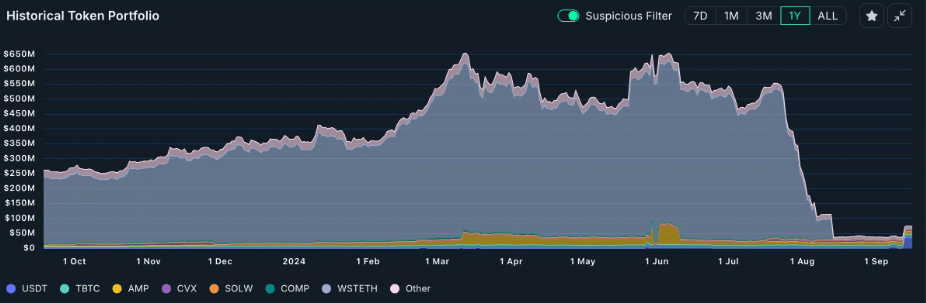
рис 11

Ведущий альткоин также теряет долю рынка из-за сетей второго уровня Base, Arbitrum, Polygon и Blast, которые известны более высокими скоростями и пониженными комиссиями, нежели блокчейн Ethereum.


Trending Cryptos

Related Reads

Why Is No One Buying DeFi Insurance?

"Why DeFi Insurance Remains Unpurchased" explores the paradox of decentralized finance insurance. While DeFi insurance promises automatic, unbiased payouts via smart contracts—eliminating traditional insurers' denial practices—it struggles to attract users. The core issue is economic viability. Premiums are prohibitively high relative to the yields from DeFi protocols. For example, insuring a deposit on Aave or Maple Finance can consume most or even all of the annual yield, leaving returns comparable to or worse than traditional savings. Only the safest protocols, like MakerDAO, offer affordable premiums. Furthermore, the DeFi insurance model is structurally fragile. Unlike traditional insurance where risks are uncorrelated, DeFi risks are highly interconnected (e.g., oracle failures, bridge hacks). A single major exploit can simultaneously threaten multiple protocols, potentially bankrupting the entire insurance pool, which holds only millions against billions in total value locked. The governance model also creates a conflict of interest. In platforms like Nexus Mutual, token holders who vote on claims risk their own capital if payouts are approved, incentivizing denials. Consequently, the market is tiny and shrinking. Nexus Mutual dominates with $81.56 million in assets, but the industry lacks the capacity to cover a catastrophic event like the $292M Kelp DAO hack. Other providers have dwindled or shut down. The article concludes that DeFi insurance faces a "tragedy of the commons": its stability requires widespread adoption, but individual users have no incentive to pay for it, as premiums destroy their yields. Current solutions involve preventative measures like bug bounties and seeking external capital from traditional reinsurance, acknowledging that on-chain capital alone is insufficient to cover on-chain risks.

marsbit3h ago

Why Is No One Buying DeFi Insurance?

marsbit3h ago

Trading

Spot

Hot Articles

Discussions

Welcome to the HTX Community. Here, you can stay informed about the latest platform developments and gain access to professional market insights. Users' opinions on the price of ETH (ETH) are presented below.

活动图片